
As an expert in agricultural technology, I have witnessed the rapid evolution of intelligent agricultural machinery and crop spraying drones, which are revolutionizing modern farming practices. These technologies, when integrated, offer unprecedented automation and intelligence, driving efficiency and sustainability in crop production. However, the synergistic operation of these systems presents challenges such as high technical complexity, maintenance costs, algorithmic bottlenecks, and inadequate monitoring mechanisms. In this article, I explore the principles, issues, and optimization strategies for the collaborative workflow between intelligent agricultural machinery and spraying UAVs, emphasizing the need for innovative solutions to enhance scalability and performance. Through detailed analysis, including tables and mathematical models, I aim to provide insights that can propel agricultural modernization forward.
The integration of intelligent agricultural machinery and crop spraying drones relies on a cohesive system where ground-based equipment handles tasks like plowing, fertilizing, and seeding, while aerial units, such as spraying UAVs, focus on pest monitoring and precise pesticide application. This synergy is enabled by advanced sensors, data transmission protocols, and real-time decision-making algorithms. For instance, a typical crop spraying drone can cover large areas efficiently, but its effectiveness depends on seamless data exchange with ground machinery. To illustrate the data flow, consider the following table summarizing the key modules involved in system integration and data interoperability:
| Module | Function | Example Components |
|---|---|---|
| Data Collection | Gathers real-time data on soil moisture, crop health, and pest incidence | Sensors, IoT devices |
| Data Transmission | Uses wireless communication (e.g., 5G, LoRa) to send data to central systems | Transceivers, cloud gateways |
| Data Processing | Applies big data analytics and cloud computing to clean and analyze information | Algorithms, AI models |
| Data Sharing | Distributes processed data to machinery and drones for adaptive control | APIs, shared databases |
This integrated framework allows for dynamic adjustments based on environmental changes, such as varying soil conditions or pest outbreaks. For example, the efficiency of a spraying UAV can be modeled using a formula that accounts for coverage area and resource utilization: $$ E = \frac{A_c}{T \times R} $$ where \( E \) represents operational efficiency, \( A_c \) is the area covered by the crop spraying drone, \( T \) is the time taken, and \( R \) is the resource consumption (e.g., battery life or pesticide volume). By optimizing these parameters, farmers can achieve higher productivity with reduced waste.
In terms of functional synergy, the collaboration between intelligent agricultural machinery and spraying UAVs involves task allocation, real-time adjustments, and data-driven optimization. For instance, during a typical farming cycle, ground machinery might prepare the soil, while a crop spraying drone performs aerial surveys to detect pest hotspots. The decision-making process can be represented by an optimization function: $$ \min \sum_{i=1}^{n} (C_i + D_i) $$ where \( C_i \) denotes the cost of tasks assigned to machinery, and \( D_i \) represents the cost for the spraying UAV, subject to constraints like time and resource limits. This approach ensures that tasks are distributed efficiently, minimizing overlaps and maximizing output. The following table outlines a sample task allocation scenario in a coordinated operation:
| Task Type | Assigned to Intelligent Machinery | Assigned to Spraying UAV | Synergistic Benefit |
|---|---|---|---|
| Soil Preparation | Yes (e.g., plowing) | No | Ground data shared for aerial follow-up |
| Pest Control | No | Yes (e.g., targeted spraying) | Real-time feedback to adjust ground operations |
| Data Monitoring | Yes (soil sensors) | Yes (aerial imagery) | Integrated datasets for comprehensive analysis |
The operational workflow for synergistic actions typically includes stages like task planning, data acquisition, transmission, analysis, decision optimization, execution, and feedback. For example, in the data analysis phase, machine learning algorithms process inputs from both ground and aerial sources to generate actionable insights. A common formula used in this context is the precision adjustment model for a spraying UAV: $$ P = k \times \frac{S_d}{A_r} $$ where \( P \) is the precision level, \( k \) is a calibration constant, \( S_d \) is the sensor data accuracy, and \( A_r \) is the area resolution. This ensures that the crop spraying drone applies pesticides only where needed, reducing environmental impact and costs.
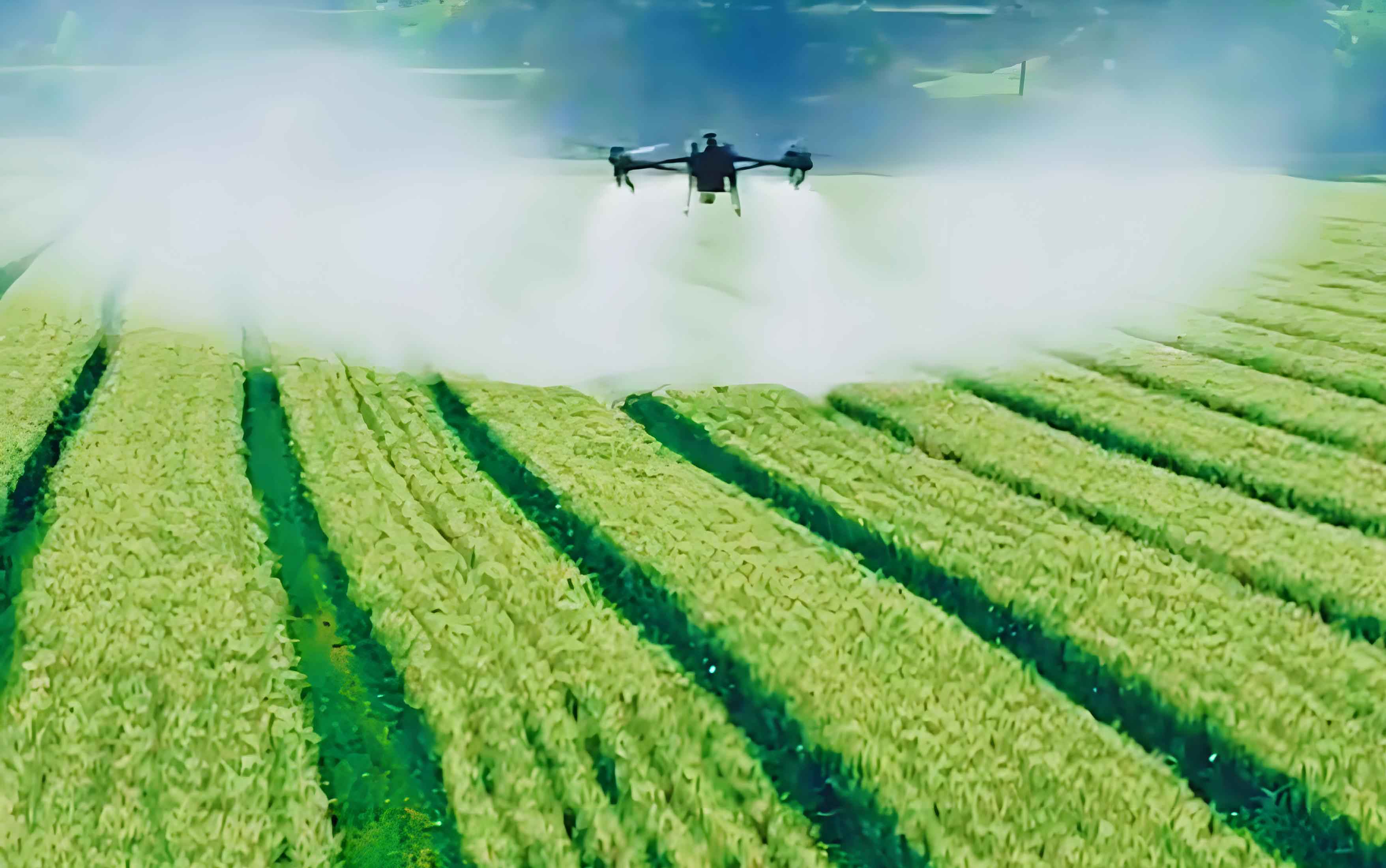
Despite these advancements, the synergistic operation faces significant hurdles. Technical complexity often leads to escalated maintenance costs. For instance, a standard spraying UAV may have an initial investment of around $5,000, with additional expenses for batteries, repairs, and operator training. Over time, the total cost of ownership can be substantial, as shown in the following cost breakdown table based on a hypothetical farm scenario:
| Cost Component | Annual Estimate (USD) | Notes |
|---|---|---|
| Initial Equipment Purchase | 5,000 | For one crop spraying drone |
| Battery Consumption | 1,000 | Based on 10,000 acres coverage |
| Depreciation | 1,000 | Assuming 5-year lifespan |
| Maintenance and Repairs | 500 | Including parts and labor |
| Training and Labor | 2,000 | For skilled operators |
| Total Annual Cost | 9,500 | Can vary with scale and usage |
This cost model can be expressed mathematically as: $$ C_{\text{total}} = C_p + C_b + C_d + C_m + C_l $$ where \( C_{\text{total}} \) is the total annual cost, \( C_p \) is the purchase cost amortized, \( C_b \) is battery expense, \( C_d \) is depreciation, \( C_m \) is maintenance, and \( C_l \) is labor. Such high costs can deter widespread adoption, especially for small-scale farmers.
Algorithmic bottlenecks further impede the efficiency of synergistic operations. Incompatible data standards and slow transmission rates can cause delays in real-time decision-making. For example, if a spraying UAV receives outdated soil data from intelligent machinery, its spraying accuracy may decline, leading to resource waste. To quantify this, consider an efficiency loss formula: $$ L = 1 – \frac{T_a}{T_d} $$ where \( L \) is the loss factor, \( T_a \) is the actual response time, and \( T_d \) is the desired response time. Ideally, \( L \) should be minimized through improved algorithms. Research indicates that enhancing data fusion techniques can reduce this loss by up to 30%, but it requires continuous innovation in AI models.
Moreover, the lack of robust continuous monitoring and feedback mechanisms poses a risk to operational reliability. Without real-time data streams, issues like equipment malfunctions or environmental changes may go unnoticed, resulting in suboptimal outcomes. For instance, a crop spraying drone might miss a pest outbreak if feedback loops are slow, necessitating manual intervention. A proposed solution involves implementing predictive maintenance models, which can be represented as: $$ M(t) = \int_0^t \lambda(\tau) d\tau $$ where \( M(t) \) is the maintenance need over time \( t \), and \( \lambda(\tau) \) is the failure rate function derived from sensor data. By integrating this with cloud-based platforms, farmers can receive alerts and optimize operations proactively.
To address these challenges, I recommend several optimization strategies. First, optimizing device design can lower maintenance costs. This includes developing modular components for easy replacement and promoting shared maintenance platforms among farmers. For example, a cooperative model could pool resources for bulk purchases and repairs, reducing individual burdens. The economic benefit can be calculated as: $$ S = N \times (C_s – C_i) $$ where \( S \) is the total savings, \( N \) is the number of participants, \( C_s \) is the shared cost, and \( C_i \) is the individual cost. Additionally, leasing options for spraying UAVs can make advanced technology more accessible, particularly for resource-limited settings.
Second, fostering industry-academia collaboration is crucial to overcome algorithmic barriers. By partnering with research institutions, farmers can access cutting-edge AI algorithms that enhance task scheduling and data analysis. For instance, adaptive algorithms can improve the coordination between intelligent machinery and crop spraying drones, as shown in this optimization formula for resource allocation: $$ \max \sum_{j=1}^{m} U_j \cdot x_j $$ subject to $$ \sum_{j=1}^{m} c_j x_j \leq B $$ where \( U_j \) is the utility of task \( j \), \( x_j \) is a binary decision variable, \( c_j \) is the cost, and \( B \) is the budget. This maximizes overall efficiency while adhering to constraints, enabling smarter synergies.
Third, building comprehensive operational platforms can streamline monitoring and feedback. These platforms should integrate remote diagnostics, real-time data dashboards, and automated reporting features. For example, a cloud-based system could collect data from multiple spraying UAVs and machinery units, applying machine learning to predict maintenance needs and optimize workflows. The effectiveness of such a platform can be evaluated using a performance metric: $$ P_{\text{sys}} = \alpha \cdot A_{\text{avail}} + \beta \cdot D_{\text{acc}} $$ where \( P_{\text{sys}} \) is the system performance score, \( A_{\text{avail}} \) is equipment availability, \( D_{\text{acc}} \) is data accuracy, and \( \alpha \), \( \beta \) are weighting factors. By regularly updating these platforms, farmers can ensure sustained efficiency and reduce downtime.
In conclusion, the synergistic operation of intelligent agricultural machinery and crop spraying drones holds immense potential for transforming agriculture into a more productive and sustainable sector. However, addressing the issues of high costs, algorithmic limitations, and inadequate monitoring is essential for scaling these technologies. Through design optimizations, collaborative research, and advanced platform integrations, we can unlock greater efficiencies and empower farmers worldwide. As I reflect on my experiences, it is clear that continuous innovation and adaptation will drive the future of smart farming, making technologies like the spraying UAV indispensable tools in the global food system.