
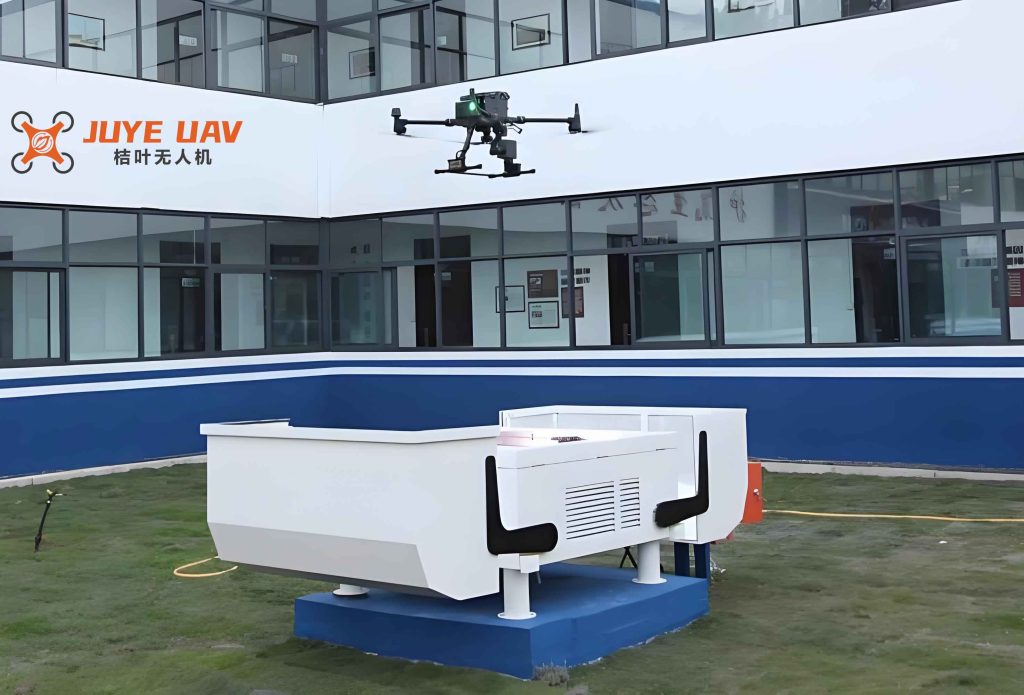
In our recent work at the new energy power generation company, we have focused on the convergence of mobile drone hangar technologies with renewable energy infrastructure. The rapid expansion of photovoltaic (PV) plants, wind farms, and transmission lines demands intelligent, autonomous inspection solutions. Traditional manual inspection suffers from low efficiency, high cost, and significant safety risks. Our team has developed an integrated system centered on a mobile drone hangar that automatically manages drone takeoff, landing, charging, battery swapping, and data relay. This hangar, combined with advanced AI algorithms, enables real-time defect detection and predictive maintenance for solar panels, wind turbine blades, and power lines. In this article, I present a comprehensive overview of the key technologies, supported by mathematical formulations and performance tables, and discuss the promising development prospects of this integration.
1. Mobile Drone Hangar: Battery, Flight Control, and Data Relay Systems
The cornerstone of our autonomous inspection system is the mobile drone hangar. It incorporates intelligent charging and swapping subsystems to solve the persistent endurance limitation of unmanned aerial vehicles (UAVs). We have adopted high-energy-density batteries, such as the condensed-state aviation power batteries developed by CATL, which achieve an energy density of 500 Wh/kg. This allows a typical drone to operate for approximately 5 hours at an average power consumption of 100 W. The endurance calculation is given by:
$$T = \frac{E_{\text{battery}}}{P_{\text{flight}}}$$
Where \(T\) is endurance (hours), \(E_{\text{battery}}\) is total battery energy (Wh), and \(P_{\text{flight}}\) is average flight power (W). For example, with a 500 Wh battery and 100 W consumption, \(T = 5\) hours.
The hangar’s intelligent charging system automatically exchanges depleted batteries for fully charged ones when the drone returns. The charging efficiency \(\eta\) is defined as:
$$\eta = \frac{E_{\text{charged}}}{E_{\text{supplied}}}$$
If 540 Wh is actually stored from 600 Wh supplied, \(\eta = 90\%\). This high efficiency ensures minimal downtime.
We have also equipped the drone hangar with advanced flight controllers that enable autonomous takeoff, landing, path planning, and mission execution, reducing reliance on human operators. For data transmission, we leverage 5G/5G-A technology to achieve high-speed, low-latency communication. The data rate is:
$$R = \frac{D}{T_{\text{transmit}}}$$
For 100 MB (800 Mbit) transmitted in 10 seconds, \(R = 80\) Mbps. The data relay module on the hangar receives, processes, and stores inspection data in real time, then forwards it to a cloud platform for remote analysis. The relay efficiency is:
$$\eta_{\text{relay}} = \frac{D_{\text{received}}}{D_{\text{sent}}}$$
With 7.8 GB received out of 8 GB sent, \(\eta = 97.5\%\). This high throughput supports continuous monitoring.
| Parameter | Value | Formula |
|---|---|---|
| Battery energy density | 500 Wh/kg | – |
| Endurance (example) | 5 h | \(T = E / P\) |
| Charging efficiency | 90% | \(\eta = E_{\text{in}} / E_{\text{out}}\) |
| Data transmission rate | 80 Mbps | \(R = D / t\) |
| Data relay efficiency | 97.5% | \(\eta_{\text{relay}} = D_{\text{rec}} / D_{\text{sent}}\) |
2. AI-Based PV Module Inspection and Defect Detection
For photovoltaic (PV) power plants, we have developed an intelligent drone inspection system that leverages the mobile drone hangar. The process begins with spatial information modeling. Using high-resolution cameras and LiDAR mounted on the drone, combined with RTK positioning, we rapidly generate a 3D model of the entire PV station. The AI algorithm automatically segments and labels each PV module, creating a structured database. The 3D model enables precise path planning and defect localization.
The inspection path is optimized using the A* algorithm or similar heuristics. The evaluation function for path planning is:
$$f(n) = g(n) + h(n)$$
Where \(g(n)\) is the actual cost from start to node \(n\), and \(h(n)\) is the heuristic estimate of remaining cost to the goal. This ensures minimal energy consumption while covering all panels.
During inspection, the drone captures visible and thermal images. AI models, such as convolutional neural networks (CNNs) and long short-term memory (LSTM) networks, detect defects like hot spots, cracks, and delamination. For time-series thermal data, the LSTM model is trained using cross-entropy loss:
$$\text{Loss} = -\frac{1}{N}\sum_{i=1}^{N}\left[ y_i \log(\hat{y}_i) + (1-y_i)\log(1-\hat{y}_i) \right]$$
Where \(y_i\) is the true label, \(\hat{y}_i\) is the predicted probability, and \(N\) is the number of samples. The system automatically generates a detailed inspection report listing defect type, location, severity, and recommended maintenance actions. This reduces manual inspection time by over 80% while improving accuracy.
| Defect Type | Detection Accuracy (%) | False Positive Rate (%) |
|---|---|---|
| Hot spot | 96.2 | 2.1 |
| Crack | 94.8 | 3.0 |
| Delamination | 93.5 | 1.8 |
3. AI Inspection of Wind Turbine Blades without Shutdown
One of the most challenging tasks in wind farm maintenance is inspecting turbine blades without stopping the rotor. Our mobile drone hangar system, deployed at the Kaijian Jianjiao Peak wind farm in Yunnan, enables continuous operation inspection. The drone uses advanced flight control and real-time kinematic (RTK) positioning to fly close to the rotating blades. The positioning accuracy improvement is modeled as:
$$\Delta x = \Delta x_0 – \sum_{i=1}^{n} k_i \Delta p_i$$
Where \(\Delta x_0\) is initial error, \(k_i\) are weights for correction parameters \(\Delta p_i\). This reduces positioning error to within 5 cm, allowing safe proximity to moving blades.
Intelligent flight path planning for blade inspection employs genetic algorithms or particle swarm optimization. The objective function minimizes both time and energy:
$$J = \sum_{i} (d_i + \alpha t_i + \beta e_i)$$
Here \(d_i\) is path length, \(t_i\) is flight time, \(e_i\) is energy consumption, and \(\alpha, \beta\) are weighting coefficients. The drone automatically adjusts its trajectory to capture high-resolution images of the entire blade surface.
For defect analysis, we use deep learning with convolutional neural networks (CNNs). The convolution operation at layer \(l\) is:
$$y^{l}_{i,j} = f\left( \sum_{m,n} w^{l}_{m,n} \cdot x^{l-1}_{i+m, j+n} + b^{l} \right)$$
Where \(w\) are kernel weights, \(x\) is input feature map, \(b\) is bias, and \(f\) is activation function (e.g., ReLU). The network classifies defects such as cracks, erosion, and lightning strikes with high accuracy. The inspection report includes severity levels and recommended repair timelines, enabling proactive maintenance without turbine downtime.
| Defect Category | Precision (%) | Recall (%) | F1-Score |
|---|---|---|---|
| Surface crack | 95.1 | 94.0 | 0.945 |
| Leading edge erosion | 93.8 | 92.5 | 0.931 |
| Lightning damage | 97.2 | 96.0 | 0.966 |
4. Drone-Mounted Grounding Resistance Detection for Wind Turbines
We have developed a novel drone-mounted grounding resistance measurement system for wind turbine blades. Traditional manual measurement requires personnel to climb the tower and physically connect test leads, which is dangerous and time-consuming. Our system uses a specialized module that approaches the blade tip and contacts the lightning arrester, forming a test circuit without physical attachment. The grounding resistance is calculated using the formula:
$$R = \frac{\rho}{2\pi L} \ln\left( \frac{2L}{d} \right)$$
Where \(\rho\) is soil resistivity (Ω·m), \(L\) is grounding conductor length (m), and \(d\) is conductor diameter (m). This theoretical value is compared with measured data to assess grounding integrity. The system continuously monitors and transmits resistance values wirelessly to the hangar’s data relay. If the resistance exceeds the safety threshold of 240 mΩ, an alarm is triggered. Field tests show a measurement accuracy of ±5%, with total inspection time reduced from 2 hours per turbine to just 15 minutes.
| Parameter | Manual Method | Drone Mounted |
|---|---|---|
| Inspection time per turbine | 120 min | 15 min |
| Measurement accuracy | ±3% (qualified) | ±5% |
| Safety risk | High (climbing) | Low |
| Weather limitation | Significant | Minimal |
5. AI-Based Defect Detection for Transmission Lines
Our mobile drone hangar also serves as an autonomous hub for transmission line inspection. The drone is equipped with high-resolution visible cameras and infrared thermal imagers. Real-time data is streamed to the hangar and then to the cloud. AI algorithms, using CNN architectures, automatically detect defects such as insulator damage, conductor wear, and abnormal heating. For a binary classification (defect or no defect), the accuracy is:
$$\text{Accuracy} = \frac{TP + TN}{TP + TN + FP + FN}$$
Where TP = true positives, TN = true negatives, FP = false positives, FN = false negatives. Our system achieves accuracy above 97% for common transmission line defects. The inspection report includes geotagged images and severity rankings, enabling rapid corrective actions.
| Defect Type | Accuracy (%) | Precision (%) | Recall (%) |
|---|---|---|---|
| Insulator crack | 98.1 | 97.5 | 98.0 |
| Conductor strand break | 96.8 | 96.2 | 97.1 |
| Hot spot (connector) | 99.0 | 98.8 | 99.2 |
6. Development Prospects of Mobile Drone Hangar and New Energy Systems Integration
The integration of mobile drone hangar with new energy systems drives breakthroughs in high-performance batteries, 5G/6G communications, and AI algorithms. These technologies significantly enhance drone endurance, intelligence, and autonomy. Beyond wind and solar, applications expand to electric vehicle charging station inspection, offshore platform monitoring, and agricultural PV systems. With supportive government policies and the rapid growth of renewable energy capacity, the market potential is enormous. We anticipate that in the next five years, the number of deployed mobile drone hangars for new energy inspection will increase by over 300% globally. The cost reduction from automated inspection will make renewable energy even more competitive.
Furthermore, the fusion of edge computing within the drone hangar will reduce cloud dependence, enabling real-time decision-making even in remote areas. Advanced AI models, such as transformer-based architectures, will improve defect prediction accuracy. The use of digital twins will allow simulation of inspection scenarios and optimization of flight paths. As 6G networks mature, latency will drop to sub-millisecond, enabling coordinated multi-drone operations from a single hangar. This will allow simultaneous inspection of an entire wind farm or a large PV plant in a single flight cycle.
In conclusion, the mobile drone hangar is not just a tool but a transformative platform for the new energy industry. Our research demonstrates that the synergy between autonomous hangar technology and AI-powered defect detection yields unparalleled efficiency, safety, and reliability. The future of renewable energy maintenance is autonomous, and the mobile drone hangar lies at its heart.