
As a practitioner in the construction industry, I have witnessed firsthand the limitations of traditional surveying and measurement techniques, especially in large-scale projects with complex terrains. The advent of civilian drones, combined with Building Information Modeling (BIM), has revolutionized our approach, offering unprecedented efficiency, accuracy, and cost-effectiveness. In this article, I will elaborate on how we integrate consumer-grade civilian drones for oblique photography with BIM technology, addressing challenges in earthwork quantification, site planning, and real-time monitoring. The focus is on leveraging affordable civilian drones to generate high-precision 3D models, seamlessly fused with BIM data, to streamline construction processes. Throughout this discussion, the term “civilian drones” will be emphasized to highlight their accessibility and transformative potential in modern engineering.
The core of our methodology lies in using civilian drones equipped with standard cameras to perform oblique photography, a technique that captures images from multiple angles—typically one nadir (vertical) and four oblique views. Unlike industrial-grade systems with dedicated multi-camera setups, civilian drones achieve this by flying separate missions for each angle, which remains highly efficient for construction sites due to their limited spatial extent. The resulting georeferenced images are processed into detailed 3D reality models using software like ContextCapture, which employs structure-from-motion algorithms to produce dense point clouds and textured meshes. These models are then integrated with BIM platforms such as Revit, enabling a holistic digital representation of both the natural terrain and built structures. This fusion allows for precise measurements, simulations, and visualizations that were previously unattainable with conventional tools.
To quantify earthwork volumes, such as cut-and-fill operations for foundations, slopes, or backfills, we rely on the geometric accuracy of the drone-derived models. The volume calculation is based on discretizing the area into vertical prisms and summing their volumes. For a given region with a surface defined by a digital elevation model (DEM), the volume \( V \) between two surfaces (e.g., existing ground and design grade) can be computed using the double integral formula:
$$ V = \iint_{A} \left[ z_{\text{design}}(x,y) – z_{\text{existing}}(x,y) \right] \, dx \, dy $$
where \( A \) is the area of interest, \( z_{\text{existing}} \) is the elevation from the drone model, and \( z_{\text{design}} \) is the target elevation from BIM. In practice, we use software like Acute3D Viewer to automate this by sampling points at a specified interval \( \Delta s \), generating a grid of prisms with height \( h_{ij} = z_{\text{design},ij} – z_{\text{existing},ij} \). The total volume is then approximated as:
$$ V \approx \sum_{i=1}^{n} \sum_{j=1}^{m} h_{ij} \cdot (\Delta s)^2 $$
This method ensures high precision, with errors typically below 0.05% when compared to traditional survey data, as validated in our projects. The use of civilian drones makes this process rapid and repeatable, allowing for frequent updates without significant cost.
In terms of equipment, we utilize readily available consumer-grade civilian drones, which drastically reduce upfront investment. The following table summarizes the key materials and devices required for this integration, emphasizing the affordability of civilian drones compared to industrial alternatives:
| Device/Equipment | Specification | Purpose | Cost Estimate (USD) |
|---|---|---|---|
| Civilian Drone (e.g., DJI Phantom Series) | 4K Camera, GPS, 30-min Flight Time | Aerial Image Acquisition | 1,500 – 3,000 |
| Additional Batteries and Charger | High-Capacity Packs | Extended Flight Operations | 300 – 600 |
| Tablet or Mobile Device | iOS/Android with GIS Apps | Flight Control and Data Preview | 500 – 1,000 |
| Processing Workstation | High-End CPU, 32GB RAM, GPU | 3D Model Generation | 2,000 – 5,000 |
| Software Licenses | ContextCapture, BIM Tools | Data Processing and Integration | 2,000 – 4,000 annually |
The total cost for a civilian drone setup is around $6,000 to $13,000, which is approximately 90% lower than industrial drone systems that can exceed $100,000. This affordability democratizes advanced surveying, enabling small to medium-sized firms to adopt this technology. Moreover, civilian drones are easy to deploy, with minimal training required for operators, further enhancing their appeal in fast-paced construction environments.
The workflow for integrating civilian drones and BIM involves several streamlined steps, each crucial for ensuring data accuracy and usability. Below is a detailed breakdown of the process, from planning to application:
- Mission Planning: Using applications like DJI GO or Altizure, we define flight parameters for the civilian drone. Key settings include:
- Flight altitude: Typically 50-100 meters, adjusted for site obstacles and desired ground sampling distance (GSD).
- Overlap rates: Forward overlap ≥75%, side overlap ≥75% to ensure robust photogrammetric reconstruction.
- Camera angles: Nadir (90°) and oblique (45°) shots captured in separate flights.
- Speed and interval: Adjusted to maintain consistent image coverage, often with a 2-second shooting interval.
- Data Acquisition: The civilian drone executes autonomous flights, capturing hundreds of geotagged images. We monitor battery levels and environmental conditions to avoid data gaps.
- Data Processing: Images are imported into ContextCapture, where aerial triangulation and dense matching algorithms generate a 3D reality mesh. This process can take several hours depending on site size and computing power, but outputs a scalable model with centimeter-level accuracy.
- BIM Integration: The reality model is exported as a point cloud or mesh and imported into BIM software (e.g., Revit via 3ds Max or direct plugins). Here, it is aligned with the project’s BIM model, allowing for clash detection, site layout optimization, and progress tracking.
- Analysis and Visualization: Combined models are used for various analyses, such as earthwork volume calculation, slope stability assessment, and 4D scheduling. Tools like Lumion enhance visualization for stakeholder communication.
To illustrate the precision of civilian drone-based models, we conducted validation tests on a construction site. Comparing distances measured in the drone model against traditional total station measurements, the error was consistently below 0.05%. For example, a control distance of 86.939 meters in CAD corresponded to 86.902 meters in the drone model, yielding an error \( E \) calculated as:
$$ E = \frac{|86.939 – 86.902|}{86.939} \times 100\% \approx 0.043\% $$
This high accuracy meets standards such as GB 50026-2007 (Engineering Surveying Code) and GB/T 51212-2016 (Unified Standard for BIM Application), ensuring reliability for engineering decisions.
The benefits of using civilian drones extend beyond cost savings. In earthwork projects, traditional methods like grid surveying or cross-sectioning are labor-intensive and prone to errors in irregular terrains. Our approach reduces field time by up to 70% and improves data frequency. For instance, on a large earthwork site covering 1 km², a single drone survey can be completed in under 2 hours, whereas manual methods might take days. The table below contrasts the two approaches, highlighting the advantages of civilian drones:
| Aspect | Traditional Surveying | Civilian Drone with BIM |
|---|---|---|
| Time per Survey (1 km²) | 3-5 days | 2-4 hours (flight + processing) |
| Labor Required | 4-6 surveyors | 1-2 operators |
| Data Accuracy | ±5-10 cm (dependent on terrain) | ±1-3 cm (consistent) |
| Cost per Survey | $5,000 – $10,000 | $500 – $1,000 (including depreciation) |
| Repeatability | Low, due to manual effort | High, automated missions |
| Safety | Risks in hazardous areas | Minimal, remote operation |
Moreover, the integration with BIM enables dynamic site management. By updating the drone model weekly or monthly, we can track progress against the BIM schedule, detect deviations early, and optimize resource allocation. For example, in a runway construction project, we used civilian drones to monitor fill compaction and material stockpiles, reducing over-excavation by 15% and saving an estimated $200,000 in material costs. The ability to visualize the site in 3D also improves communication with non-technical stakeholders, fostering collaboration and reducing rework.
From a technical perspective, the fusion of GIS (from civilian drones) and BIM data bridges the gap between macro-terrain and micro-building information. This is formalized through coordinate transformation and data interpolation. Let \( M_{\text{GIS}} \) represent the geospatial model from drone data, defined as a set of points \( \{ (x_i, y_i, z_i, t_i) \} \) where \( t_i \) denotes texture attributes. The BIM model \( M_{\text{BIM}} \) consists of parametric objects \( O_j \) with properties like geometry, materials, and schedules. Integration involves a transformation function \( T \) that aligns both models into a unified coordinate system:
$$ M_{\text{integrated}} = T(M_{\text{GIS}}) \cup M_{\text{BIM}} $$
In practice, \( T \) is achieved through control points or cloud-to-cloud registration, with residuals minimized using least-squares optimization. The resulting model supports queries for any point’s elevation, distance, or volume, enabling applications like automated quantity takeoff. For earthwork, the cut-and-fill volume \( V_{\text{net}} \) is computed as:
$$ V_{\text{net}} = V_{\text{cut}} – V_{\text{fill}} = \sum_{k=1}^{N} A_k \cdot \Delta z_k $$
where \( A_k \) is the area of a grid cell and \( \Delta z_k \) is the elevation difference. This formula is implemented in software, allowing for rapid adjustments by modifying the design surface in BIM.
Quality control is paramount, and we adhere to international standards to ensure data integrity. Beyond accuracy validation, we perform checks on image quality, GPS precision, and model completeness. The use of civilian drones requires attention to environmental factors; for instance, wind speeds above 10 m/s may affect image stability, so we plan flights during calm conditions. Additionally, we calibrate cameras periodically to minimize lens distortion, which can introduce errors in photogrammetry. The following equation models the effect of distortion on pixel coordinates \( (u,v) \):
$$ u’ = u + (u – u_0) \left[ k_1 r^2 + k_2 r^4 + k_3 r^6 \right] + p_1 \left[ r^2 + 2(u – u_0)^2 \right] + 2 p_2 (u – u_0)(v – v_0) $$
$$ v’ = v + (v – v_0) \left[ k_1 r^2 + k_2 r^4 + k_3 r^6 \right] + p_2 \left[ r^2 + 2(v – v_0)^2 \right] + 2 p_1 (u – u_0)(v – v_0) $$
where \( (u_0, v_0) \) is the principal point, \( k_i \) are radial distortion coefficients, \( p_i \) are tangential distortion coefficients, and \( r = \sqrt{(u – u_0)^2 + (v – v_0)^2} \). By accounting for these in processing, we enhance model fidelity.
The economic impact of adopting civilian drones is substantial. In a recent airport project, we applied this technology to manage over 2 million cubic meters of earthwork. Compared to traditional surveying, the drone-BIM approach saved approximately $2 per cubic meter in measurement costs, totaling $4 million in direct savings. Indirect benefits included reduced downtime, better inventory management, and improved safety. The table below summarizes the cost-benefit analysis over a one-year period for a mid-sized construction firm:
| Cost Category | Traditional Method (USD) | Civilian Drone + BIM (USD) | Savings (USD) |
|---|---|---|---|
| Equipment Purchase | 20,000 (total stations, etc.) | 10,000 (drone + software) | 10,000 |
| Labor (Annual) | 80,000 (4 surveyors) | 40,000 (2 operators) | 40,000 |
| Survey Operations (per project) | 15,000 (average) | 3,000 (flight and processing) | 12,000 per project |
| Error Reduction (material waste) | 50,000 (estimated losses) | 10,000 (precision gains) | 40,000 |
| Total Annual Savings (for 5 projects) | – | – | 150,000+ |
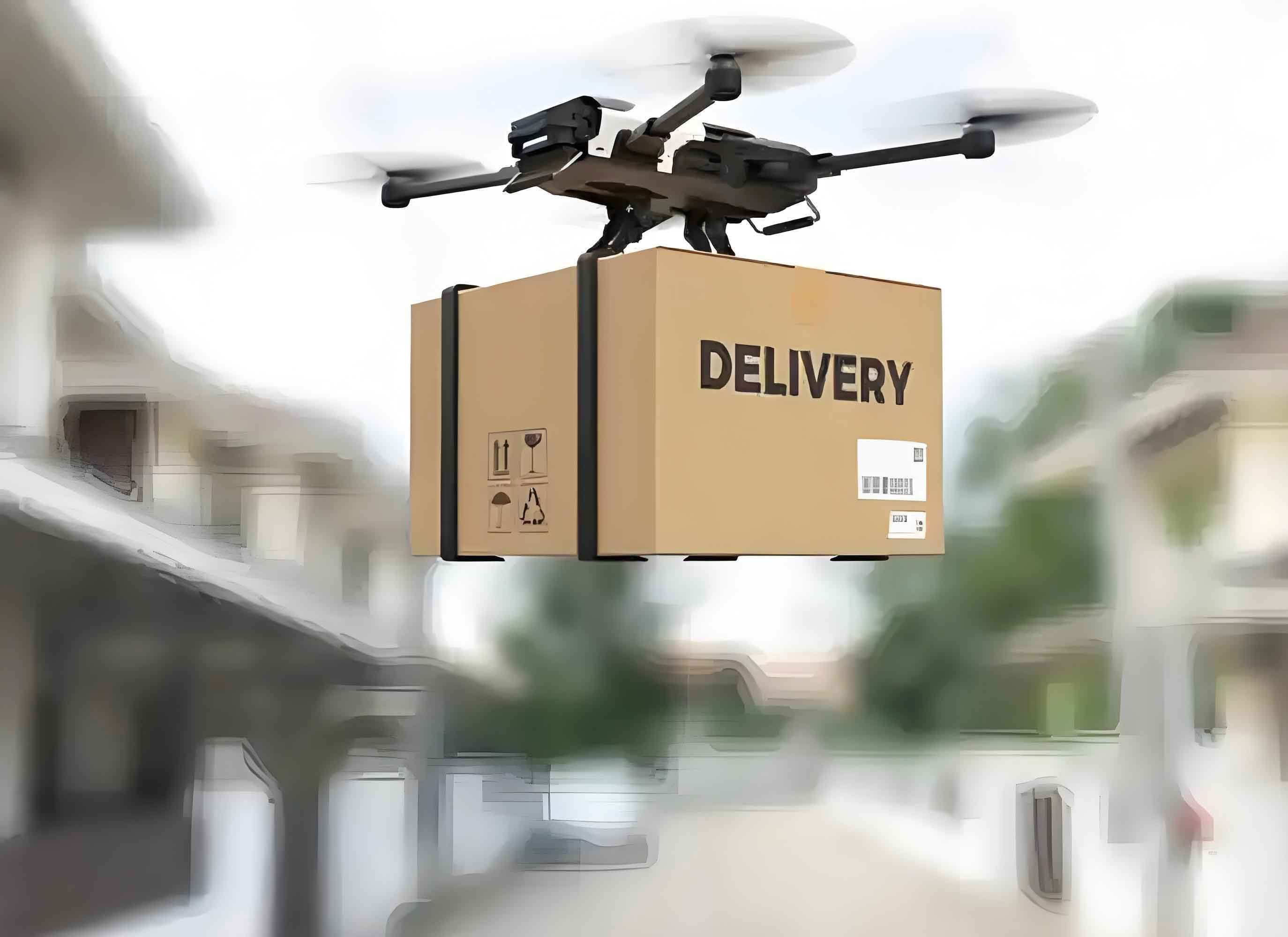
These figures underscore why civilian drones are becoming indispensable in construction. Their versatility extends beyond surveying to inspections, progress reporting, and even autonomous material delivery, as hinted by the image of a delivery drone. However, in this context, we focus on their role as data acquisition tools that synergize with BIM for holistic project management.
Looking ahead, the convergence of civilian drones, BIM, and emerging technologies like AI and IoT promises even greater advancements. For example, machine learning algorithms can automate defect detection from drone imagery, while real-time data streaming can enable live site monitoring. We are exploring the use of civilian drones for thermal imaging to assess concrete curing or energy leaks in buildings, integrating such data directly into BIM for performance analysis. The formula for such integration could involve time-series analysis, where drone data \( D(t) \) at time \( t \) is correlated with BIM parameters \( B(t) \) to predict outcomes:
$$ \frac{dB}{dt} = f(D(t), B(t)) $$
where \( f \) is a function modeling the system dynamics. This approach could revolutionize facility management and smart cities.
In conclusion, the integration of consumer-grade civilian drones with BIM technology represents a paradigm shift in construction surveying and management. By leveraging affordable civilian drones, we achieve high-precision 3D reality models that enhance accuracy, reduce costs, and improve safety. The methods described, supported by formulas and tables, demonstrate tangible benefits in earthwork quantification, site planning, and quality control. As the industry evolves, civilian drones will undoubtedly play a central role in driving digital transformation, making complex projects more manageable and sustainable. I encourage wider adoption of this approach, tailored to project needs, to unlock the full potential of these technologies in built environment.