
As a professional engaged in natural resources and spatial planning, I have witnessed and participated in transformative initiatives aimed at enhancing efficiency, safety, and sustainability. Our work spans various domains, from streamlining administrative processes to deploying advanced technologies for monitoring and protection. In this comprehensive account, I will detail key reforms and programs, with a particular emphasis on the critical role of drone training in modern resource management. The integration of unified surveying, forest fire prevention, drone training, and protected area optimization represents a holistic approach to addressing contemporary challenges.
One of the most significant reforms involves consolidating disparate surveying and mapping services. Previously, construction projects required multiple specialized surveys—for planning verification, cadastral mapping, and property assessment—each conducted by separate entities under different departments. This led to redundancies, prolonged timelines, and higher costs. To address this, we implemented a “unified surveying” model, where a single intermediary service agency handles all necessary geospatial measurements. This approach follows the principle of “one delegation, unified surveying, and shared results,” significantly reducing burdens on enterprises.
The efficiency gains from this reform can be quantified. Let \( T_{old} \) represent the total time previously required for multiple surveys, and \( T_{new} \) the time under the unified model. The improvement rate \( I_t \) is given by:
$$ I_t = \frac{T_{old} – T_{new}}{T_{old}} \times 100\% $$
Based on empirical data, \( I_t \) ranges from 30% to 70%. Similarly, cost savings \( S_c \) are calculated as:
$$ S_c = \frac{C_{old} – C_{new}}{C_{old}} \times 100\% $$
where \( C_{old} \) and \( C_{new} \) are the old and new costs, respectively, with \( S_c \) averaging around 30%. The table below summarizes the impact:
| Metric | Before Reform | After Reform | Improvement |
|---|---|---|---|
| Number of Survey Types | 3-5 separate surveys | 1 integrated survey | Consolidation |
| Time Duration (days) | 20-50 | 10-20 | 30-70% faster |
| Cost (relative units) | 100 | 70 | 30% reduction |
| Stakeholder Interactions | Multiple agencies | Single point of contact | Simplified |
This reform not only accelerates project approvals but also fosters a more open and competitive surveying market. By establishing dedicated entities for integrated surveying, we have enhanced standardization and quality control, aligning with broader goals of administrative streamlining and business environment optimization.
Another critical area is forest fire prevention, especially during high-risk seasons. We adhere to a “prevention first, active suppression” philosophy, building three lines of defense. The first line focuses on education and awareness. We develop targeted campaigns, including localized audio broadcasts and digital content, to instill safety consciousness. The reach \( R \) of these campaigns can be modeled as:
$$ R = N \times p \times f $$
where \( N \) is the population size, \( p \) is the penetration rate of media, and \( f \) is the frequency of messaging. Through initiatives like online quizzes and micro-lessons, we have engaged thousands, significantly raising awareness.
The second line involves stringent control of human-induced ignition sources. We enforce strict regulations on outdoor activities in forested areas, with patrols and checkpoints. The probability of fire occurrence \( P_f \) due to human factors can be expressed as:
$$ P_f = 1 – (1 – p_d)^n $$
where \( p_d \) is the daily probability of a violation and \( n \) is the number of days. By increasing inspections and penalties, we reduce \( p_d \), thereby lowering \( P_f \). Our efforts have resulted in numerous interventions and case resolutions, with a 100% clearance rate for investigated fires.
The third line is preparedness and response. We maintain and train emergency teams, ensuring they are equipped and ready. The response effectiveness \( E_r \) depends on training frequency \( t_f \) and equipment readiness \( e_r \):
$$ E_r = \alpha \cdot \log(t_f + 1) + \beta \cdot e_r $$
where \( \alpha \) and \( \beta \) are coefficients. Regular drills and gear maintenance have enhanced our capacity for early containment, minimizing damage.
The table below outlines the three defense lines:
| Defense Line | Key Actions | Metrics | Outcomes |
|---|---|---|---|
| Education | Broadcasts, online content, community outreach | 5000+ materials distributed, 2700+ quiz participants | Increased public vigilance |
| Control | Patrols, checkpoints, violation查处 | 5760 patrol person-times, 126 violations addressed | Reduced ignition sources |
| Response | Training, equipment upkeep, rapid deployment | 30+ drills, 25 equipment maintenance sessions | Improved suppression capability |
Transitioning to technological advancements, drone training has become a cornerstone of our monitoring and enforcement capabilities. Drones offer rapid, flexible, and comprehensive aerial surveillance, enabling early detection of irregularities such as illegal construction or land use changes. The importance of drone training cannot be overstated; it ensures that operators are proficient in legal, safety, and operational aspects. We have organized comprehensive drone training sessions for staff and technical personnel, covering regulations, flight principles, and maintenance.
During these drone training programs, participants learn about the system components, flight dynamics, and data processing. The competency \( C_d \) of an operator after training can be represented as:
$$ C_d = \int_0^T w(t) \cdot s(t) \, dt $$
where \( T \) is the training duration, \( w(t) \) is the weighting of different skills over time, and \( s(t) \) is the skill acquisition rate. Through hands-on practice, operators master flight maneuvers and software like Terra for photogrammetric modeling, which is vital for creating accurate maps and 3D models.
To visualize the context of such drone training, consider the following image that captures the essence of these educational programs:
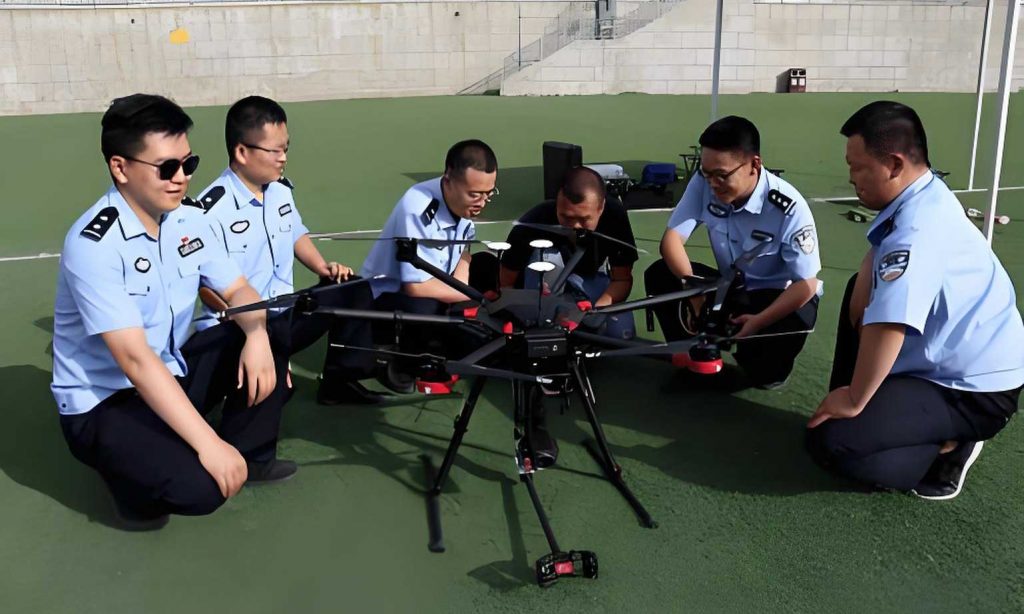
The integration of drone training into our workflow has revolutionized natural resource dynamic monitoring. By enabling frequent and detailed aerial surveys, drones help identify issues at nascent stages, allowing for timely intervention. The effectiveness \( E_d \) of drone-based monitoring is a function of flight coverage \( A \), resolution \( r \), and training level \( L_t \):
$$ E_d = k \cdot \frac{A \cdot r}{L_t^{-1}} $$
where \( k \) is a constant. Higher training levels \( L_t \) (achieved through rigorous drone training) enhance \( E_d \), leading to better resource management.
We have conducted drone training for dozens of personnel, emphasizing safety protocols and operational excellence. The table below summarizes key aspects of our drone training initiatives:
| Training Component | Content Covered | Participants | Outcomes |
|---|---|---|---|
| Theoretical Instruction | Laws, safety, system architecture, flight principles | 53 technicians and staff | Strong foundational knowledge |
| Practical Flight Skills | Takeoff, navigation, landing, emergency procedures | All participants | Proficiency in manual and automated flights |
| Data Processing | Photogrammetry, software usage (e.g., Terra), analysis | Core team members | Ability to generate survey-grade outputs |
| Maintenance | Routine checks, troubleshooting, battery management | All participants | Reduced downtime and increased longevity |
Repeated drone training sessions ensure that skills remain current and adaptive to evolving technologies. We schedule refresher courses and advanced modules, fostering a culture of continuous learning. The cumulative impact of drone training is evident in faster response times, more accurate data collection, and enhanced regulatory compliance.
In parallel, we are pioneering the integration and optimization of protected natural areas. As a pilot region, we aim to create a model for balancing conservation with sustainable development. This involves assessing ecological values, boundary delineation, and management strategies. The optimization process can be formulated as a multi-objective problem:
$$ \max \left( \sum_{i=1}^n E_i \cdot x_i \right), \quad \text{subject to} \quad \sum_{i=1}^n C_i \cdot x_i \leq B $$
where \( E_i \) is the ecological score of area \( i \), \( x_i \) is a decision variable (e.g., inclusion status), \( C_i \) is the cost, and \( B \) is the budget. By leveraging geospatial data—often collected via drones post-drone training—we inform these decisions with precision.
The table below highlights the key steps in protected area integration:
| Phase | Activities | Tools and Methods | Expected Outcomes |
|---|---|---|---|
| Assessment | Inventory of existing areas, biodiversity surveys | GIS, remote sensing, field studies | Comprehensive baseline data |
| Planning | Boundary adjustment, zoning, stakeholder consultation | Modeling algorithms, participatory workshops | Coherent network design |
| Implementation | Legal designation, management plan development | Policy frameworks, monitoring systems | Enhanced protection status |
| Monitoring | Regular audits, impact evaluation | Drones (post-drone training), sensor networks | Adaptive management |
This pilot project not only conserves biodiversity but also supports eco-tourism and local livelihoods, demonstrating that environmental stewardship can go hand-in-hand with economic vitality.
In conclusion, our multifaceted approach—encompassing administrative reforms, proactive fire prevention, extensive drone training, and protected area optimization—reflects a commitment to innovative and efficient natural resource governance. The unified surveying model has cut red tape, while forest fire defenses mitigate risks. Crucially, drone training empowers our teams with cutting-edge skills, enabling better surveillance and data-driven decisions. As we move forward, we will continue to refine these strategies, leveraging technology and collaboration to achieve sustainable outcomes. The journey underscores the transformative power of integration, training, and adaptability in managing the precious resources entrusted to us.