
In recent years, the advancement of unmanned aerial vehicle technology has ushered in a new era for cargo transportation, particularly in challenging terrains such as mountainous regions and remote islands. Among these innovations, the hybrid-electric vertical take-off and landing drone, or VTOL drone, has emerged as a promising solution due to its ability to combine the hover capabilities of rotary-wing systems with the efficient cruise performance of fixed-wing aircraft. However, the operational efficiency of such VTOL drones is often constrained by limited energy storage and the complex interplay between power management and flight paths. To address this, my research focuses on developing an integrated optimization framework that jointly considers energy management strategies and mission path planning for hybrid-electric VTOL drones in cargo delivery tasks. This approach aims to minimize overall mission costs while adhering to various operational constraints, thereby enhancing the viability of VTOL drones in real-world logistics applications.
The core challenge lies in the dual nature of hybrid-electric VTOL drones: they must manage both fuel-based and battery-based power sources across different flight modes, including vertical take-off, transition, and horizontal flight. Each mode imposes distinct power demands, and inefficient energy allocation can lead to excessive fuel consumption or premature battery depletion. Moreover, the path taken during a cargo mission—such as the sequence of delivery points—directly influences the weight distribution and, consequently, the power requirements. Traditional methods often treat energy management and path planning as separate problems, leading to suboptimal solutions. For instance, optimizing solely for the shortest path may ignore the energy implications of heavy payloads or frequent take-offs and landings. Therefore, my work proposes a holistic optimization model that bridges this gap, leveraging dynamic programming for energy control and advanced genetic algorithms for path planning. This integrated methodology ensures that the VTOL drone operates at peak efficiency throughout its mission, reducing costs and extending operational range.
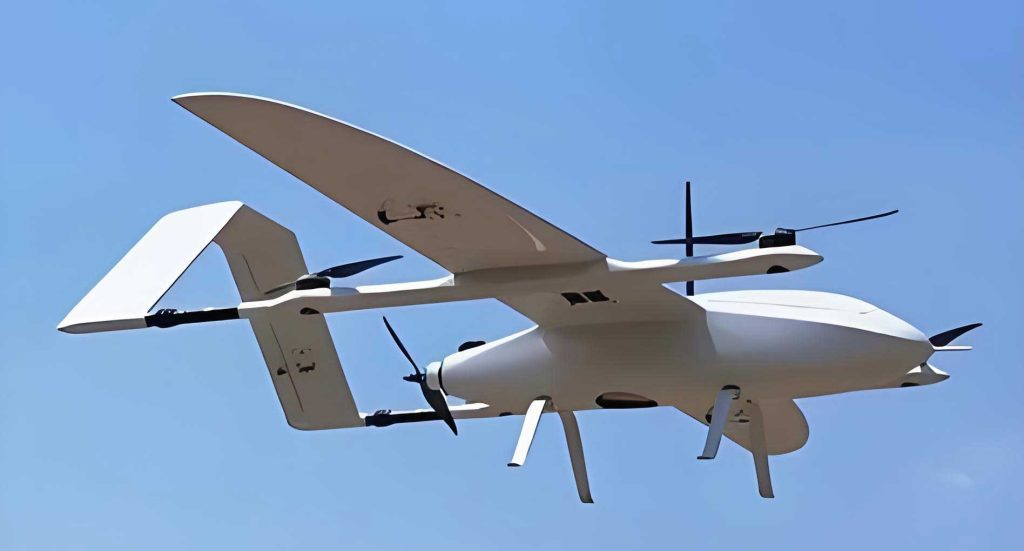
To ground this discussion, I begin by detailing the energy consumption model for a hybrid-electric VTOL drone. The propulsion system of a typical VTOL drone, as considered in my study, employs a series hybrid architecture where an internal combustion engine drives a generator to produce electrical power, which is then distributed to electric motors for propulsion and auxiliary loads. The power demands vary significantly across flight modes. In vertical flight modes, such as hover or ascent, the power required for the rotors can be derived from momentum theory. For example, the absorbed power for a propeller in vertical flight is given by:
$$P_p = \beta T \sqrt{\sqrt{\left( \frac{R_{oc}}{2} \right)^2 + \frac{T}{\rho N_R S_R}} – \frac{R_{oc}}{2}}$$
Here, \(P_p\) is the propeller power, \(\beta\) is a fuel consumption coefficient, \(T\) is the thrust, \(\rho\) is air density, \(R_{oc}\) is the climb rate, \(N_R\) is the number of rotors, and \(S_R\) is the rotor disk area. The thrust \(T\) itself depends on the aircraft weight \(W\), climb rate, and drag coefficients. In horizontal flight modes, such as cruise, the power demand shifts to a fixed-wing model, expressed as:
$$P_p = \frac{v}{\eta_P} \left( \frac{2\kappa \beta^2 W^2}{\rho v^2 S} + \frac{\rho v^2 C_{D0} S}{2} + R_{oc} \cdot \sqrt{\frac{2\beta W \rho S^3 C_{D0} \kappa}{2}} \right)$$
where \(v\) is the velocity, \(\eta_P\) is the propeller efficiency, \(C_{D0}\) is the zero-lift drag coefficient, \(\kappa\) is the induced drag factor, and \(S\) is the wing area. During transition modes, where the VTOL drone shifts between vertical and horizontal flight, the power requirement peaks and is modeled based on trajectory and attitude constraints. For a series hybrid system, the power flow from the engine and battery to the propellers must satisfy a set of power balance equations. Let \(P_{ice}\) be the engine power, \(P_{ge}\) the generator power, \(P_{ed}\) the electric drive power, \(P_b\) the battery power, and \(P_{pl}\) the payload power. The power transfer can be represented as:
$$\begin{bmatrix} P_{ice} \\ P_{ge} \\ P_{ed} \\ P_b \end{bmatrix} = \begin{bmatrix} \eta_{ge}^{-1} & 0 & 0 & 0 \\ 0 & \eta_{pms}^{-1} & 1 & 0 \\ 0 & 0 & \eta_{ed} & 0 \\ 0 & 0 & -u & 1 \end{bmatrix}^{-1} \begin{bmatrix} 0 \\ P_{pl} \\ P_p \\ uP_{pl} \end{bmatrix}$$
In this formulation, \(\eta_{ge}\), \(\eta_{pms}\), and \(\eta_{ed}\) are efficiencies of the generator, power management system, and electric drive, respectively, while \(u\) is the hybrid control parameter dictating the battery’s share of the total load. This parameter is crucial for energy management, as it adjusts in real-time to optimize efficiency across varying flight conditions.
The battery model is another critical component, as the state of charge directly impacts the available energy and peak discharge capability of the VTOL drone. I employ a high-fidelity discharge model based on empirical data from lithium-ion cells. For a single cell, the terminal voltage \(U_c\) during constant power discharge is given by:
$$U_c(t) = \frac{k_1 + k_2 \xi_c(t)}{2} + \sqrt{\left( \frac{k_1 + k_2 \xi_c(t)}{2} \right)^2 – P_c (k_3 \xi_c(t) + k_4)}$$
Here, \(\xi_c\) is the cell state of charge, \(P_c\) is the discharge power, and \(k_1, k_2, k_3, k_4\) are characteristic parameters derived from experimental data. For a battery pack consisting of \(N_S\) cells in series and \(N_L\) in parallel, the overall voltage \(U_b\), current \(i_b\), power \(P_b\), and state of charge \(\xi_b\) scale accordingly:
$$\begin{aligned}
U_b &= N_S U_c \\
i_b &= N_L i_c \\
\xi_b &= \xi_c \\
P_b &= N_L N_S P_c
\end{aligned}$$
This model allows for accurate prediction of battery behavior under dynamic loads, which is essential for ensuring that the VTOL drone maintains safe operating limits throughout its mission.
On the fuel side, the engine’s fuel consumption is modeled using its ideal operating line to maximize efficiency. The fuel mass flow rate \(\dot{m}_{f,s}\) for a scaled engine can be expressed as:
$$\dot{m}_{f,s} = \text{SFC}_s \cdot P_{ice}$$
where \(\text{SFC}_s\) is the specific fuel consumption along the ideal operating line. The total fuel consumption over a mission is the sum across all flight segments, incorporating time steps \(\Delta T_k\):
$$m_f = \sum_{k=1}^{N} \dot{m}_{f,k} \Delta T_k$$
To integrate these models into an energy management strategy, I adopt a dynamic programming approach. This method formulates the control problem as a discrete-time system, where the state variable is the battery state of charge \(\xi_k\) at time step \(k\), and the control variable \(u_k\) is the hybrid control parameter. The objective is to minimize a cost function \(J(\xi_0, u)\) that includes both fuel costs and ground charging costs for the battery. The cost function is defined as:
$$J(\xi_0, u) = L_N(\xi_N) + \sum_{k=0}^{N-1} L_k(\xi_k, u_k)$$
Here, \(L_N(\xi_N)\) represents the charging cost at the end of the mission, calculated as:
$$L_N(\xi_N) = \frac{\mu_{ele} \sum_{k=0}^{N} P_{b,k} \Delta T_k}{\eta_{chg}}$$
where \(\mu_{ele}\) is the electricity price per kWh and \(\eta_{chg}\) is the charging efficiency. The arc cost \(L_k(\xi_k, u_k)\) is the fuel cost incurred during time step \(k\), proportional to the fuel consumed. Dynamic programming solves this by backward induction, determining the optimal control sequence \(u^*\) that minimizes the total cost while respecting state constraints such as battery charge limits and peak power capabilities. This strategy enables the VTOL drone to adapt its power split in real-time, for instance, by charging the battery during low-power segments or discharging it during high-demand phases like transition, thereby reducing overall energy expenditure.
Moving to the path optimization aspect, the cargo mission involves delivering goods from a central hub to multiple delivery points using the hybrid-electric VTOL drone. The goal is to minimize the number of sorties (primary objective) and the total operating cost (secondary objective), subject to constraints on payload capacity, battery state of charge, fuel reserves, and discharge power. Mathematically, this can be framed as a vehicle routing problem with energy considerations. Let \(X(i,j,k)\) be a binary variable indicating whether sortie \(k\) travels from point \(i\) to point \(j\), \(m_{ik}\) be the cargo weight on sortie \(k\) when leaving point \(i\), \(\xi_{ik}\) be the battery state of charge at that moment, \(d_i\) be the delivery demand at point \(i\), and \(c_{ij}\) be the distance between points. The optimization problem is:
$$\min Z_1 = \sum_{i=1}^{M} \sum_{k=1}^{K} X(0,j,k)$$
$$\min Z_2 = \sum_{i=0}^{M} \sum_{j=0}^{M} \sum_{k=1}^{K} X(i,j,k) \cdot J(\xi_{ik}, \xi_{jk}, m_{ik}, c_{ij})$$
subject to constraints such as route continuity, payload limits \(m_{ik} \leq m_L\), fuel limits \(m_f < m_{f,\max}\), and battery limits \(\xi_{\min} < \xi < \xi_{\max}\). To solve this complex problem, I develop a two-tiered approach combining a genetic algorithm for path planning with the dynamic programming solver for energy management. The genetic algorithm encodes delivery sequences as real-number strings, decodes them into sortie paths, and uses crossover and mutation operators to explore the solution space. A key innovation is the secondary utility evaluation system: an initial screening with a shortest-path solver quickly identifies promising candidates, which are then rigorously evaluated with the dynamic programming solver to account for energy constraints. This hybrid method balances computational efficiency with accuracy, ensuring that the final paths are not only short but also energy-feasible for the VTOL drone.
To validate this integrated framework, I conduct two case studies with different scales: one with 10 delivery points and another with 20. The VTOL drone parameters are summarized in the table below, which highlights key specifications influencing energy consumption and performance.
| Parameter | Value |
|---|---|
| Total UAV Mass (kg) | 200 |
| Max Payload Capacity (kg) | 45 |
| Fuel Mass (kg) | 5 |
| Wing Area (m²) | 4.4 |
| Engine Max Power (kW) | 14.7 |
| Generator Efficiency | 0.9 |
| Battery Pack Voltage (V) | 275 |
| Battery Configuration | 75 parallel × 8 series |
| Electricity Price (currency/kWh) | 0.471 |
| Fuel Price (currency/kg) | 7.8345 |
In the first case (10 delivery points), both the shortest-path optimization and the integrated optimization yield three sorties, but the sequence of deliveries differs. The integrated method prioritizes dropping heavier loads earlier to reduce power demands in later flight segments, as guided by the dynamic programming controller. For example, in one sortie, the path is arranged as hub → point 7 → point 3 → point 10 → hub, rather than the reverse, because point 7 has a larger cargo weight. This adjustment lowers the peak power required during transition phases, allowing the battery to enter vertical landing with a lower state of charge (around 30-31%), compared to over 45% in a fully loaded direct flight. The energy management strategy dynamically adjusts the hybrid control parameter \(u\) throughout the mission, as shown in the following profile for a sample sortie:
| Flight Segment | Power Demand (kW) | Battery SOC (%) | Control Parameter \(u\) |
|---|---|---|---|
| Vertical Take-off | 12.5 | 80.0 | 0.3 |
| Cruise to Point 7 | 8.2 | 75.4 | 0.1 |
| Payload Drop at Point 7 | 2.1 | 74.9 | 0.0 |
| Cruise to Point 3 | 7.8 | 70.2 | 0.2 |
| Payload Drop at Point 3 | 1.9 | 69.8 | 0.0 |
| Transition to Landing | 10.5 | 30.7 | 0.6 |
The total operating cost for the integrated optimization is 117.1 currency units, with fuel contributing 111.2 and charging 5.9, whereas the shortest-path approach costs 122.6 currency units. This demonstrates that even with similar mileage, energy-aware sequencing can yield significant savings for the VTOL drone.
The second case (20 delivery points) reveals a more profound impact of energy constraints. The shortest-path solver proposes six sorties, but one of these violates fuel limits when evaluated with dynamic programming. Specifically, a sortie covering points 11, 6, 12, and 13 exceeds the available fuel capacity due to the cumulative power demands in transition and cruise. In contrast, the integrated optimization splits this into three sorties: hub → 11 → 6 → 12 → hub, hub → 13 → 16 → 14 → hub, and hub → 17 → 20 → hub, resulting in seven sorties overall. Although this increases the number of flights, it ensures all constraints are met, with a total cost of 239.1 currency units compared to 256.4 for the infeasible shortest-path plan. The relationship between sortie mileage, fuel use, and cost is non-linear, as illustrated below:
| Sortie Index | Distance (km) | Fuel Used (kg) | Cost (currency) |
|---|---|---|---|
| 1 | 45.2 | 1.2 | 32.5 |
| 2 | 38.7 | 1.0 | 28.1 |
| 3 | 52.1 | 1.4 | 38.9 |
| 4 | 41.5 | 1.1 | 30.7 |
| 5 | 36.8 | 0.9 | 26.3 |
| 6 | 48.3 | 1.3 | 35.8 |
| 7 | 33.4 | 0.8 | 24.2 |
This table underscores that fuel consumption and cost do not scale linearly with distance, as factors like payload weight and take-off frequency play crucial roles. The dynamic programming controller consistently manages the battery state of charge across sorties, ending each mission with a SOC around 23%, indicating robust adaptability to varying task loads. This consistency is vital for the VTOL drone, as it eliminates the need for battery reconfiguration between missions, simplifying operational logistics.
The effectiveness of the integrated optimization stems from its ability to co-adapt energy management and path planning. The dynamic programming strategy optimally schedules power splits, often charging the battery during low-demand cruise phases and depleting it strategically before landing to minimize charging costs. For instance, the control parameter \(u\) might be set high during descent to maximize regenerative braking or low during climb to conserve battery life. These decisions are encoded in the cost function and resolved through the backward induction process, which can be summarized as:
$$Y_k(\xi_k, k) = \min_{u \in U_k} \left[ L_k(\xi_k, u) + Y_{k+1}(f_k(\xi_k, u), k+1) \right]$$
where \(Y_k\) is the cost-to-go from state \(\xi_k\) at time \(k\). Meanwhile, the genetic algorithm evolves path solutions by minimizing sortie count and cost, using operators like crossover correction to eliminate route intersections and reduce travel distance. The synergy between these components ensures that the VTOL drone operates within safe energy margins while achieving logistical efficiency.
In conclusion, my proposed integrated optimization framework for hybrid-electric VTOL drones offers a comprehensive solution to the challenges of cargo transportation in complex environments. By unifying energy management based on dynamic programming with mission path planning via genetic algorithms, it enables significant reductions in operational costs and enhances the practicality of VTOL drone deployments. The case studies confirm that this approach outperforms traditional shortest-path methods, particularly when energy constraints are binding, and it maintains battery health across diverse missions. Future work could extend this model to multi-drone fleets or incorporate real-time weather data, but the current foundation provides a robust tool for advancing the efficiency and sustainability of VTOL drone logistics. As the demand for aerial cargo delivery grows, such holistic optimization will be key to unlocking the full potential of hybrid-electric VTOL drones in global supply chains.