
The rapid advancement of unmanned aerial vehicle (UAV) technology has enabled its widespread adoption across numerous civil sectors, including agriculture, disaster inspection, and surveying. However, the application of UAVs in specialized fields such as law enforcement within complex urban environments remains an area with significant potential for development. For police forces, daily tasks encompass crime prevention, maintaining public order, traffic management, and fire supervision. A police UAV designed for urban management must therefore possess a multifaceted capability profile, balancing demands for endurance, payload versatility, mobility, and operational simplicity. Translating these often competing user needs into a coherent and innovative product design requires a systematic methodology that can handle uncertain information and resolve inherent technical contradictions.
Traditional design approaches often struggle with the “fuzzy front end” of product development, where customer requirements are qualitative and imprecise. Quality Function Deployment (QFD) is a widely recognized tool for linking customer voices to engineering characteristics through its core instrument, the House of Quality (HOQ). However, conventional QFD relies on discrete scoring, which can introduce subjectivity and lacks precision when dealing with small sample sizes and incomplete information—a common scenario in the early design stages for specialized equipment like a police UAV. To address these uncertainties in systems with “small samples and poor information,” Grey System Theory, particularly Grey Relational Analysis (GRA), offers a robust mathematical framework for modeling with limited data. Integrating GRA with QFD forms a Grey-QFD (GQFD) approach, which quantifies relationships and weights more objectively, minimizing human bias.
While GQFD effectively identifies *what* needs to be improved (critical technical characteristics and their importance), it does not provide direct solutions for *how* to achieve these improvements, especially when technical characteristics conflict with one another. This is where the Theory of Inventive Problem Solving (TRIZ) becomes invaluable. TRIZ offers a systematic approach to innovation based on the analysis of global patents, providing tools like the contradiction matrix and separation principles to resolve technical and physical conflicts. The integration of GQFD and TRIZ creates a powerful, end-to-end innovation pipeline: GQFD clarifies design targets and priorities from user needs, and TRIZ provides the principled strategies to overcome the key technical barriers identified.
This article presents an integrated GQFD-TRIZ methodology and demonstrates its application in the conceptual innovation design of a police UAV system for urban management. The process begins by extracting primary user requirements and corresponding engineering characteristics. GRA is then applied to establish their interrelationships and calculate definitive weights, which are populated into an enhanced HOQ. The analysis of this HOQ reveals the ranking of critical technical characteristics and, crucially, the negative correlations (conflicts) between them. These identified conflicts are then translated into the standardized parameters of TRIZ. By applying TRIZ tools—such as the contradiction matrix and inventive principles—concrete design solutions are generated to resolve the conflicts. The outcome is a novel conceptual design for a police UAV system that includes not only the aerial vehicle but also an integrated mobile launch and recovery platform, addressing core challenges in endurance, mobility, and multi-mission capability.
1. The Integrated GQFD-TRIZ Methodology Framework
The proposed integrated innovation model combines Grey Relational Analysis (GRA), Quality Function Deployment (QFD), and TRIZ into a coherent, multi-stage process. The goal is to objectively derive design priorities from vague user needs and systematically solve the ensuing technical contradictions. The step-by-step framework is as follows:
Stage 1: Establishing the Grey Relational Model from Assessments. First, core User Needs (UNs) and Key Technical Characteristics (KTCs) for the product (e.g., a police UAV) are identified through market research, literature review, and expert surveys. A group of experts (e.g., designers, engineers, end-users) then independently evaluates the importance of each UN and KTC, typically on a scale (e.g., 1-9). Let there be \(s\) user needs and \(m\) technical characteristics. The evaluation results form sequences:
User Need (Reference) Sequences: \(X_i = (x_i(1), x_i(2), \dots, x_i(n)), \quad i=1,2,\dots,s\)
Technical Char. (Comparison) Sequences: \(Y_j = (y_j(1), y_j(2), \dots, y_j(n)), \quad j=1,2,\dots,m\)
where \(n\) is the number of experts.
Stage 2: Calculating the Grey Comprehensive Relational Matrix. The relationship between each user need \(X_i\) and each technical characteristic \(Y_j\) is quantified using a generalized grey relational model. This involves calculating both the absolute and relative degrees of relation, then synthesizing them.
First, perform a zeroing transformation on the sequences:
\(X_i^0 = x_i(k) – x_i(1)\), \(Y_j^0 = y_j(k) – y_j(1)\).
The grey absolute relational degree \(\epsilon_{ij}\) is computed as:
$$|X_{si}| = \left| \sum_{k=2}^{n-1} X_i^0(k) + \frac{1}{2} X_i^0(n) \right|, \quad |Y_{sj}| = \left| \sum_{k=2}^{n-1} Y_j^0(k) + \frac{1}{2} Y_j^0(n) \right|$$
$$|X_{si} – Y_{sj}| = \left| \sum_{k=2}^{n-1} (X_i^0(k) – Y_j^0(k)) + \frac{1}{2} (X_i^0(n) – Y_j^0(n)) \right|$$
$$\epsilon_{ij} = \frac{1 + |X_{si}| + |Y_{sj}|}{1 + |X_{si}| + |Y_{sj}| + |X_{si} – Y_{sj}|}$$
Next, for the relative relational degree, sequences are first normalized by their initial values (\(X’_i = X_i / x_i(1)\)), then zeroed again to get \(X’^0_i\), and the same calculation as above yields \(\gamma_{ij}\).
The comprehensive grey relational degree \(\rho_{ij}\), which reflects both absolute and relative relationships, is a weighted sum:
$$\rho_{ij} = \theta \epsilon_{ij} + (1-\theta)\gamma_{ij}$$
where \(\theta\) is typically set to 0.5. All \(\rho_{ij}\) form the comprehensive relational matrix \(\Psi\):
$$\Psi = (\rho_{ij})_{s \times m} = \begin{bmatrix} \rho_{11} & \rho_{12} & \cdots & \rho_{1m} \\ \rho_{21} & \rho_{22} & \cdots & \rho_{2m} \\ \vdots & \vdots & \ddots & \vdots \\ \rho_{s1} & \rho_{s2} & \cdots & \rho_{sm} \end{bmatrix}$$
Stage 3: Determining User Need Weights via Grey Superiority Analysis. The relational matrix \(\Psi\) is used to rank the user needs. For any two user needs \(X_k\) and \(X_i\):
– If \(\rho_{kj} \ge \rho_{ij}\) for all \(j=1,\dots,m\), then \(X_k\) is superior to \(X_i\) (\(X_k > X_i\)).
– If \(\sum_{j=1}^m \rho_{kj} \ge \sum_{j=1}^m \rho_{ij}\), then \(X_k\) is quasi-superior to \(X_i\) (\(X_k \geq X_i\)).
This yields a ranked order \(X_{i1} \circ X_{i2} \circ \dots \circ X_{is}\), where \(\circ \in \{ >, \geq \}\). Absolute weights \(\lambda_i\) are then assigned based on rank. If \(X_{i_l} > X_{i_{l+1}}\), then \(\lambda_{i_l} = n – l + 1\). If \(X_{i_l} \geq X_{i_{l+1}}\), then \(\lambda_{i_l} = n – l + \mu\), where \(\mu\) (often 0.5) denotes the degree of importance.
Stage 4: Constructing the Enhanced House of Quality (HOQ). The calculated user need weights \(\lambda_i\) and the grey relational matrix \(\Psi\) are input into the HOQ. The traditional HOQ calculation is then performed: the importance of each Key Technical Characteristic \(Y_j\) is obtained by summing the product of user need weight and its relational degree with that characteristic across all user needs.
$$\text{Importance of } Y_j = \sum_{i=1}^{s} \lambda_i \cdot \rho_{ij}$$
This provides a clear, quantitatively-derived ranking of which technical characteristics are most critical to address. Furthermore, the “roof” of the HOQ, representing the correlations between different KTCs, highlights negative correlations (trade-offs). These negative correlations pinpoint the precise technical conflicts that must be resolved for successful innovation.
Stage 5: Resolving Conflicts with TRIZ. The negatively correlated KTC pairs from the HOQ roof are identified as the key problem conflicts. Each conflict is analyzed and formulated as either a Technical Contradiction (improving one parameter worsens another) or a Physical Contradiction (opposite requirements on the same parameter).
– For Technical Contradictions, the 39 Standard Engineering Parameters of TRIZ are used to describe the worsening and improving parameters. The TRIZ contradiction matrix is then consulted to suggest relevant Inventive Principles (from the set of 40).
– For Physical Contradructions, the four Separation Principles (in time, space, upon condition, or within system) are applied to identify which inventive principles are most applicable.
Given the list of suggested inventive principles from multiple conflicts, the priority of KTCs from the HOQ is used to filter and select the most pertinent principles. These principles guide the generation of specific, innovative design solutions.
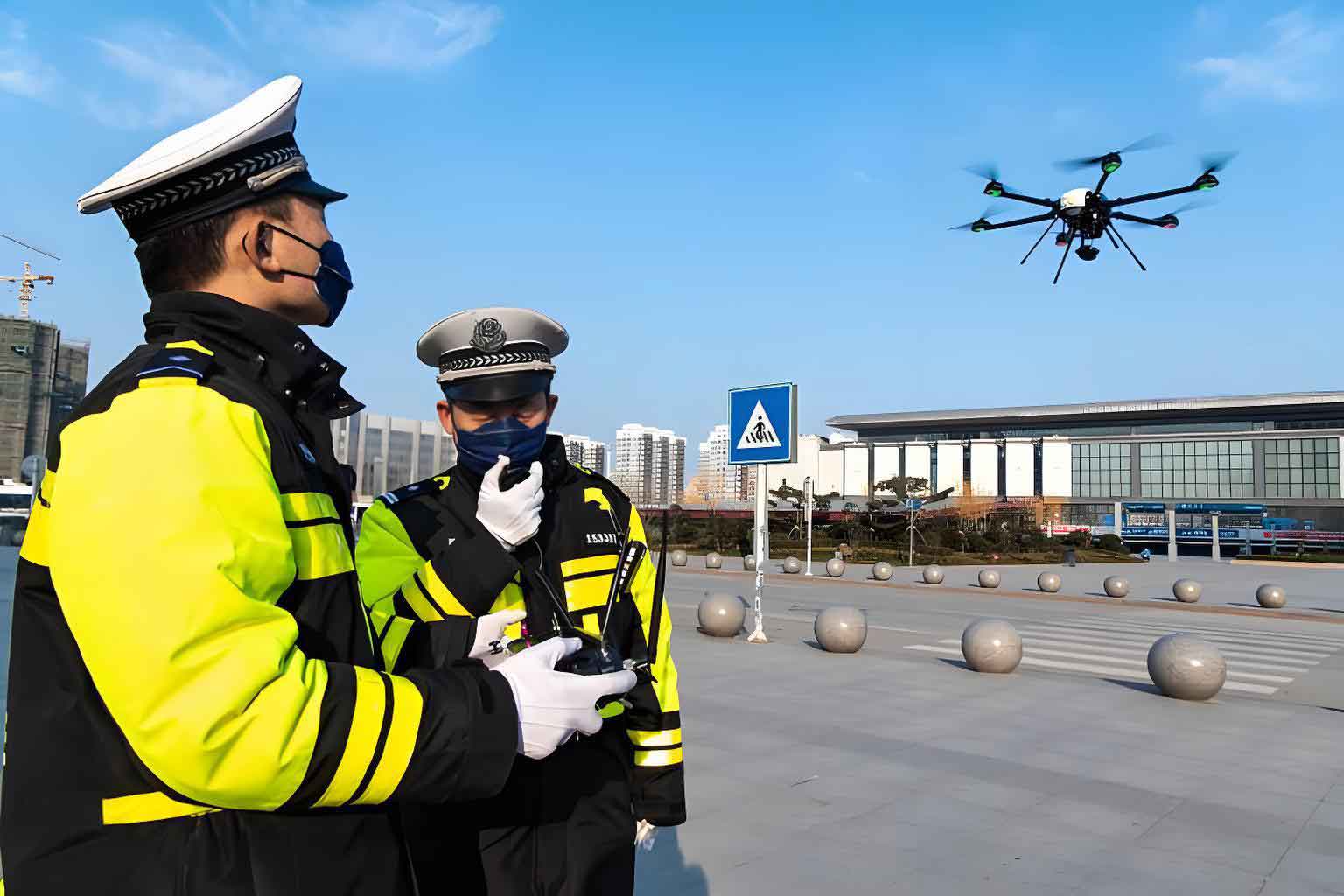
2. Conceptual Innovation Design for a Police UAV System
Applying the integrated GQFD-TRIZ methodology, a conceptual design for an urban police UAV system was developed. The process began with extracting core requirements through expert consultation and analysis of law enforcement scenarios in urban environments.
2.1 Defining Requirements and Technical Characteristics
Six primary User Needs (UNs) and six Key Technical Characteristics (KTCs) were defined for the police UAV:
User Needs (X_i):
X1: Aerial Patrol
X2: Communication & Command
X3: Tracking & Intervention
X4: Fire & Rescue Support
X5: Comprehensive Logistics Support
X6: Reconnaissance & Surveillance
Key Technical Characteristics (Y_j):
Y1: Long Endurance
Y2: High Mobility & Agility
Y3: Multi-purpose Payload Capability
Y4: Advanced Information Acquisition
Y5: Structural Robustness & Stability
Y6: Portability & Ease of Transport
A panel of 20 design professionals and domain experts evaluated the importance of each UN and KTC independently on a 1-9 scale. The aggregated evaluation data is shown in Table 1.
| Expert | User Needs (Rating) | Technical Characteristics (Rating) | ||||||||||
|---|---|---|---|---|---|---|---|---|---|---|---|---|
| No. | X1 | X2 | X3 | X4 | X5 | X6 | Y1 | Y2 | Y3 | Y4 | Y5 | Y6 |
| 1 | 9 | 6 | 6 | 8 | 6 | 5 | 9 | 7 | 7 | 6 | 6 | 6 |
| 2 | 9 | 6 | 6 | 9 | 8 | 9 | 9 | 8 | 8 | 7 | 6 | 6 |
| 3 | 8 | 5 | 6 | 9 | 6 | 7 | 9 | 7 | 8 | 9 | 8 | 7 |
| … | … | … | … | … | … | … | … | … | … | … | … | … |
| 20 | 8 | 6 | 7 | 9 | 6 | 4 | 8 | 7 | 6 | 5 | 5 | 6 |
2.2 GQFD Analysis and HOQ Construction
Using the evaluation data from Table 1, the grey comprehensive relational matrix \(\Psi\) was calculated following the formulas in Stage 2. Grey superiority analysis was then performed to rank the user needs and assign their absolute weights \(\lambda_i\). The results were: \(X_5 \geq X_3 \geq X_4 \geq X_6 \geq X_1 \geq X_2\), with corresponding weights \(\lambda = (1.5, 3.5, 2.5, 0.5, 5.5, 4.5)\).
These weights and the relational matrix \(\Psi\) were used to construct the enhanced HOQ. The calculation of technical characteristic importance (\(\sum \lambda_i \rho_{ij}\)) yielded the definitive ranking for the police UAV design focus, as summarized in Table 2. The correlation matrix in the HOQ “roof” identified key negative relationships between KTCs.
| Key Technical Characteristic (KTC) | Calculated Importance | Priority Rank |
|---|---|---|
| Y2: High Mobility & Agility | Highest Score | 1 |
| Y1: Long Endurance | Very High Score | 2 |
| Y3: Multi-purpose Payload | High Score | 3 |
| Y5: Structural Robustness | Medium-High Score | 4 |
| Y6: Portability | Medium Score | 5 |
| Y4: Information Acquisition | Medium Score | 6 |
The primary negative correlations identified were:
– Endurance (Y1) ↔ Mobility (Y2)
– Multi-purpose Payload (Y3) ↔ Endurance (Y1)
– Mobility (Y2) ↔ Multi-purpose Payload (Y3)
– Endurance (Y1) ↔ Portability (Y6)
2.3 TRIZ Conflict Resolution and Solution Generation
The top-priority conflicts were translated into TRIZ parameters. The conflict between Endurance and Mobility was paramount: increasing endurance typically requires a larger battery, which increases weight and reduces agility. This was formulated as a Technical Contradiction: improving Speed (Parameter #9) is hindered by worsening Weight of Moving Object (Parameter #1). Consulting the TRIZ contradiction matrix suggested Inventive Principles: #2 (Taking Out), #8 (Anti-weight), #13 (The Other Way Round), and #38 (Strong Oxidants).
The conflict between Payload and Endurance (adding payload reduces flight time) was modeled as Duration of Action of Moving Object (#15) vs. Weight of Moving Object (#1), suggesting Principles #19 (Periodic Action), #5 (Merging), #34 (Discarding and Recovering), and #31 (Porous Materials).
The conflict between Endurance and Portability was identified as a Physical Contradiction: the battery must be large for flight (high energy) but small for transport (low volume/weight). Applying the Separation in Time principle pointed to principles such as #15 (Dynamics), #10 (Preliminary Action), and #19 (Periodic Action).
Synthesizing these results and prioritizing based on the KTC importance ranking (Mobility and Endurance being top), three core inventive principles were selected for the police UAV design: #2 (Taking Out), #5 (Merging/Combination), and #15 (Dynamics). Their interpretation and application are detailed in Table 3.
| Inventive Principle | Explanation | Applied Design Solution for Police UAV |
|---|---|---|
| #2: Taking Out | Extract the disturbing part or property from an object, or extract only the necessary part/property. | Separate the primary energy source from the UAV airframe. Design a mobile ground platform that carries spare batteries. The UAV can autonomously dock with the platform to swap its depleted battery for a charged one, significantly extending operational endurance without permanently increasing the UAV’s flight weight. |
| #5: Merging/Combination | Combine in space (merge objects, functions); combine in time (make operations concurrent or sequential). | Design mission-specific payloads (e.g., loudspeaker, spotlight, delivery mechanism, specialized sensors) as modular units. The UAV features a standardized quick-attach interface, allowing different modules to be combined with the airframe as needed for the mission, achieving multi-role capability without a permanently heavy, integrated suite. |
| #15: Dynamics | Make an object or its environment adjustable; divide an object into parts capable of relative movement; make a stationary object movable. | Transform the supporting infrastructure (the battery-swapping platform) into a dynamic system. Integrate the platform with the police vehicle, mounting it on the roof like a specialized carrier. This makes the entire police UAV system mobile, enabling rapid deployment to any incident location, thereby drastically improving operational mobility and response time. |
2.4 Conceptual Design Description
The application of these principles led to a two-part police UAV system concept: 1) a modular multi-rotor UAV, and 2) a vehicular-integrated Launch, Recovery, and Resupply (LRR) Platform.
The UAV Design: The aerial vehicle incorporates a dual-camera gimbal system for comprehensive reconnaissance (addressing UN X6). Its core innovation is a ventral quick-attach interface for mission modules (Principle #5). The airframe is designed for robustness (Y5) but keeps its core weight minimal, as the primary battery is swappable.
The LRR Platform: This platform is the cornerstone of the innovation, directly applying Principles #2 and #15. Mounted on a police vehicle roof, it provides dynamic mobility for the entire system. It features a protective canopy, automated landing guidance (using UWB positioning for precision), and an internal robotic mechanism that swaps the UAV’s battery (Principle #2). The platform houses and charges multiple spare batteries, effectively acting as a mobile energy station. This solves the endurance-portability physical contradiction by separating the “large energy storage” state (in the platform during transport) from the “flight-optimized” state (small battery on the UAV).
The integrated system workflow is: The police UAV is transported securely on the vehicle-mounted LRR platform. Upon arrival, the canopy opens, and the UAV takes off for its mission. When battery is low, it returns to the moving or stationary vehicle, performs an automated precision landing on the platform, and the internal system swaps the battery within seconds. The UAV can then resume flight almost immediately, while the used battery charges in the platform. This cycle enables persistent aerial presence, addressing the top-ranked needs of mobility and endurance.
3. Conclusion
This research presents and validates an integrated product innovation methodology that combines Grey Relational Analysis (GRA), Quality Function Deployment (QFD), and the Theory of Inventive Problem Solving (TRIZ). The GQFD phase effectively handles the uncertainty and subjectivity inherent in the early stages of designing complex products like a police UAV. It transforms qualitative user needs into quantitatively prioritized technical characteristics, objectively identifying the most critical design targets and the conflicts between them. The TRIZ phase then provides a systematic, principle-driven toolkit to resolve these identified conflicts, moving from problem definition to innovative solution generation.
The practical application of this GQFD-TRIZ integration to an urban police UAV system demonstrates its efficacy. The methodology successfully guided the development of a novel concept that moves beyond incremental improvements to the UAV airframe alone. Instead, it fostered a system-level innovation—a dynamically mobile launch/recovery platform with automated battery swapping—that fundamentally addresses the core contradictions of endurance, mobility, and multi-role capability. The resulting concept offers a plausible direction for enhancing the operational effectiveness of law enforcement agencies in complex urban settings.
The proposed framework mitigates the limitations of using any single design theory in isolation. It provides a clear, structured pathway from vague user needs to concrete, principled design solutions. Future work could involve refining the concept with detailed engineering analysis, prototyping, and exploring the integration of other considerations such as secure data links and interoperability with broader public safety command systems. The GQFD-TRIZ methodology thus stands as a valuable model for the structured innovation of complex, requirement-driven technological products.