
As a leading professional manufacturer in the law enforcement technology sector, we proudly introduced the industry’s first fully integrated police drone system at a recent international security exposition. This groundbreaking system embodies the core functionalities of “Reconnaissance, Strike, Management, Control, Rescue, and Communication” within a unified platform. The robust performance of our police drone platforms, the advanced forward-deployable command and control systems, the rich suite of modular functions, and their seamless integration with real-world public security operations garnered significant attention from law enforcement representatives in attendance. This comprehensive police drone ecosystem represents a paradigm shift in tactical response capabilities.
The cornerstone of our offering is the “Three Drones and One Vehicle” suite, complemented by 36 specialized functional modules. This integrated approach is designed to address critical challenges faced by police forces, such as insufficient response efficiency and inadequate protection for officers’ safety. Our police drone system effectively mitigates the limitations of traditional methods, enhancing operational effectiveness, especially in harsh environments.
The “Three Drones and One Vehicle” Suite
This suite comprises three distinct unmanned aerial vehicle (UAV) platforms and a mobile ground command and control vehicle, each engineered for specific tactical roles within the police drone framework.
| Platform Designation | Configuration | Primary Design Purpose | Key Characteristics & Performance Metrics |
|---|---|---|---|
| Drone Platform Alpha | Fixed-Wing | Long-endurance, wide-area reconnaissance | Modular interface design; launch via vehicle-mounted catapult system (assembly-to-takeoff: <5 min); capable of large-area day/night high-altitude reconnaissance over complex terrain (mountains, deserts). Ideal for wide-area searches and fugitive tracking. Coverage area can be modeled as $$ A_{rec} = v \cdot t \cdot w $$ where $A_{rec}$ is area covered, $v$ is velocity, $t$ is flight time, and $w$ is sensor swath width. |
| Drone Platform Beta | Quadcopter | Reconnaissance and precision strike/engagement | High payload capacity (up to 15 kg); compatible with tethering module for sustained stationary surveillance at altitudes up to 200 meters for dozens of hours. The station-keeping endurance $T_{tethered}$ is effectively limited by power supply, not battery: $$ T_{tethered} \approx \frac{E_{supply}}{P_{hover}} $$ where $E_{supply}$ is the continuous ground power and $P_{hover}$ is the power required for hover. |
| Drone Platform Gamma | Hexacopter | Stealthy, mobile reconnaissance and strike | Low acoustic signature; high maneuverability; capable of carrying both reconnaissance and tactical payload modules for rapid deployment in emergency scenarios. Agility can be quantified by a simplified thrust-to-weight ratio: $$ \zeta = \frac{T_{total}}{m \cdot g} $$ where $T_{total}$ is total rotor thrust, $m$ is mass, and $g$ is gravity. |
The Mobile Ground Command and Control Vehicle serves as the operational nerve center. It integrates multiple sophisticated systems: the Flight Control System, Intelligent Catapult Launch System, Real-Time Situational Awareness System, Personnel Tracking Overlay System, Multi-Drone Station Coordination System, Automatic Target Tracking System, Joystick Control Interface, Oblique Photogrammetry Modeling System, and a Dual-Transmission Command Center Linkage System. This vehicle enables remote control and command of up to three police drone platforms simultaneously, along with all 36 modules. The entire system is designed for deep integration with existing police operational architectures, allowing for rapid insertion into current command and warfare systems.
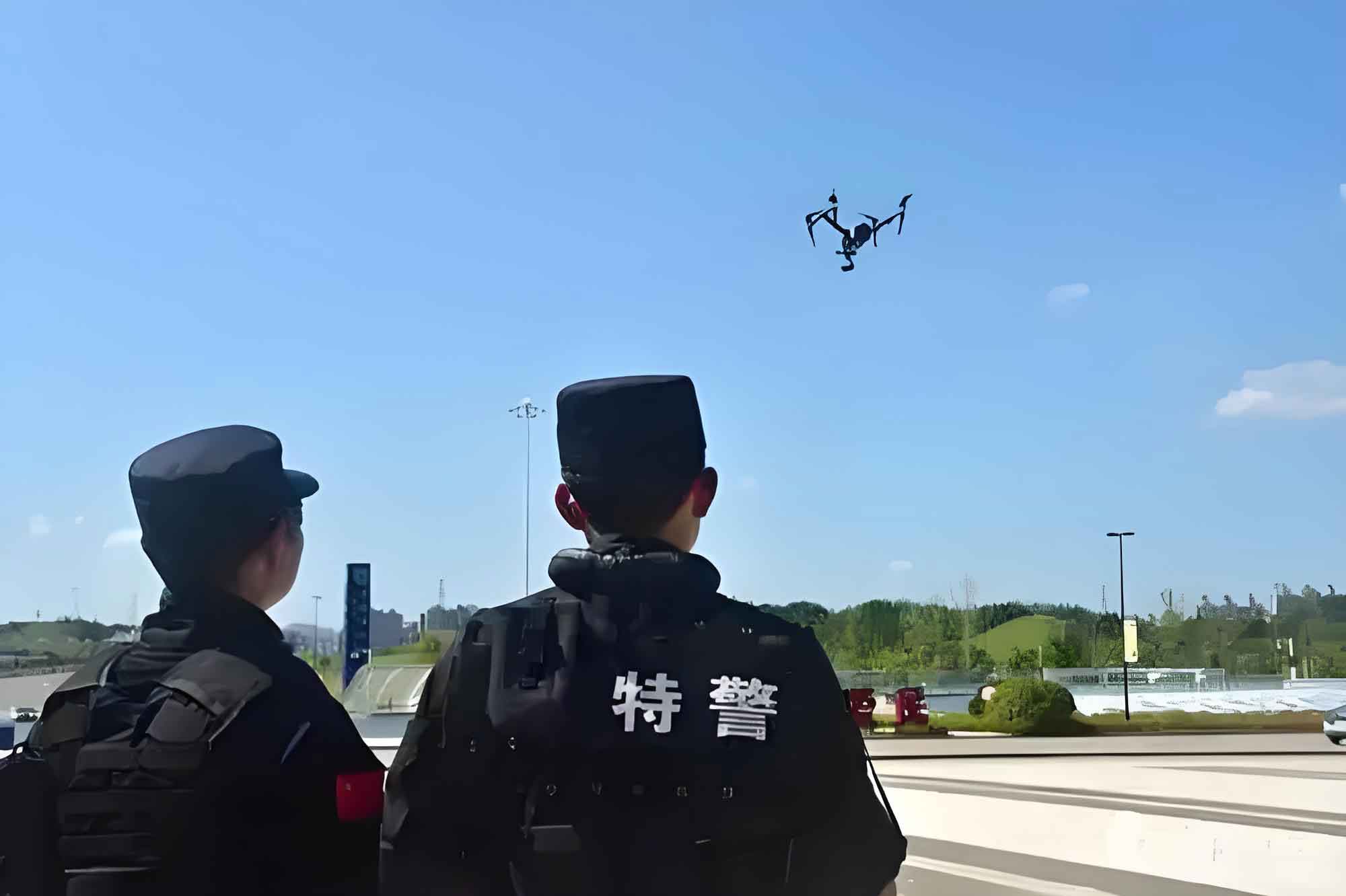
The 36 Functional Modules: A Toolkit for Police Drone Operations
The versatility and power of our police drone system are unlocked through an extensive library of swappable, mission-specific modules. These modules can be rapidly configured and mounted on the appropriate drone platform, allowing a single police drone unit to adapt to myriad situations. The following table categorizes a selection of these key modules.
| Module Category | Module Examples | Primary Function & Description | Operational Metric / Formula |
|---|---|---|---|
| Surveillance & Reconnaissance | Real-Time Video Transmission Module | Provides live, low-latency video feed to command. | Data rate $R$ required: $$ R = f_r \cdot r \cdot b $$ where $f_r$ is frame rate, $r$ is resolution, and $b$ is bit depth. |
| Thermal Imaging Module | Detects heat signatures for night ops/search & rescue. | Detection range influenced by Noise Equivalent Temperature Difference (NETD): $$ \Delta T_{min} \propto \frac{1}{\sqrt{D^* \cdot A_d \cdot \Delta f}} $$ where $D^*$ is detectivity, $A_d$ is detector area, $\Delta f$ is bandwidth. | |
| Reconnaissance & Evidence Collection Module | High-resolution photography/videography for evidence. | Ground Sampling Distance (GSD): $$ GSD = \frac{h \cdot s}{f} $$ where $h$ is altitude, $s$ is sensor pixel size, $f$ is focal length. | |
| Tactical Engagement | Net Launcher Module | Deploys a net to immobilize suspects or small UAVs. | Kinetic energy on impact: $$ KE = \frac{1}{2} m_p v_p^2 $$ where $m_p$ is projectile mass and $v_p$ is velocity. |
| 38mm Non-Lethal Launcher Module | Fires non-lethal rounds (e.g., kinetic, gas). | Trajectory modeling follows parabolic motion: $$ y = x \tan(\theta) – \frac{g x^2}{2 v_0^2 \cos^2(\theta)} $$ | |
| Multi-Purpose Ejector Module | Deploys various payloads (e.g., smoke, supplies). | Payload capacity constrained by drone lift: $$ m_{payload} \leq \frac{T_{max} – m_{drone} \cdot g}{g} $$ | |
| Communication & Control | Communication Relay Module | Extends the range of radio/communication networks. | Extended range $d_{total}$ with a relay: $$ d_{total} \approx d_1 + d_2 $$ where $d_1$ and $d_2$ are line-of-sight segments. |
| 4G/LTE Real-Time Transmission Module | Utilizes cellular networks for robust video/data backhaul. | Throughput depends on signal-to-noise ratio (SNR): $$ C = B \log_2(1 + SNR) $$ (Shannon-Hartley theorem). | |
| Auxiliary & Support | Searchlight Module | Provides powerful illumination for night operations. | Illuminance $E_v$ at distance $d$: $$ E_v \approx \frac{I_v}{d^2} $$ where $I_v$ is luminous intensity. |
| Loudspeaker Module | Enables clear aerial broadcast/negotiation. | Sound pressure level (SPL) decay: $$ SPL(d) = SPL_0 – 20 \log_{10}\left(\frac{d}{d_0}\right) $$ | |
| Tethering Module | Provides continuous power and data link for indefinite hover. | As previously noted, endurance is a function of supplied power. | |
| Specialized Detection | Explosives Detection Module, Narcotics Detection Module | Uses specialized sensors (e.g., spectroscopic) to detect target substances. | Detection probability $P_d$ relates to false alarm rate $P_{fa}$ and signal strength: $$ P_d = f(SNR, P_{fa}) $$ often modeled with Receiver Operating Characteristic (ROC) curves. |
| Rescue | Life Rescue Module | Can deliver life-saving equipment (e.g., flotation devices, AEDs). | Delivery time critical: $$ t_{delivery} = \frac{\sqrt{(x_t – x_0)^2 + (y_t – y_0)^2}}{v_{avg}} $$ where $(x_0, y_0)$ is drone start, $(x_t, y_t)$ is target. |
System Integration and Operational Efficacy
The true strength of this advanced police drone system lies not just in individual components but in their synergistic integration. The command vehicle’s software synthesizes data from all deployed police drones and their modules into a unified operational picture. This fusion enables capabilities like coordinated search patterns, automated tracking of multiple targets, and real-time mission replanning. The efficiency gain from deploying such an integrated police drone system can be quantified. For a traditional ground-based search operation, the time $T_{g}$ to cover an area $A$ with $N_o$ officers searching at an effective sweep rate $r_g$ is approximately: $$ T_{g} \approx \frac{A}{N_o \cdot r_g} $$. In contrast, a police drone equipped with a wide-area sensor can cover the same area in time $T_{d}$: $$ T_{d} \approx \frac{A}{v_d \cdot w_d} + t_{setup} $$ where $v_d$ is drone speed, $w_d$ is sensor swath width, and $t_{setup}$ is deployment time. The relative efficiency improvement $\eta$ is: $$ \eta = \left(1 – \frac{T_{d}}{T_{g}}\right) \times 100\% $$. In practice, $\eta$ often exceeds 70-80% for large-area tasks, not accounting for the enhanced safety for personnel.
The modularity of the system allows for cost-effective scalability. Police departments can start with a core “Three Drones and One Vehicle” setup and acquire modules based on their specific threat landscape and operational needs. The interoperability between modules and platforms is ensured through standardized mechanical, power, and data interfaces, a critical design philosophy for our police drone ecosystem.
Deployment and Impact in Law Enforcement Scenarios
This integrated police drone system has been deployed across multiple regions and has proven instrumental in various high-stakes law enforcement operations. Its applications span a wide spectrum:
- Major Drug Enforcement Campaigns: Police drones have been used for large-scale aerial surveillance in remote terrain to identify illicit crop cultivation and production sites, providing invaluable intelligence for raid planning and post-operation verification.
- Counter-Terrorism and Response to Violent Incidents: In barricade or hostage situations, police drones provide persistent, safe surveillance, thermal imaging of structures, and delivery of communication devices. Their ability to position a camera or other sensor at any vantage point is irreplaceable.
- Search and Rescue (SAR) in Harsh Environments: The endurance of the fixed-wing police drone and the stability of the hexacopter make them ideal for searching mountainous areas, forests, or bodies of water for missing persons, with thermal imaging being particularly effective at night.
- Crowd Monitoring and Management at Large Events: Police drones offer a dynamic aerial platform for monitoring crowd density, flow, and identifying potential disturbances, feeding real-time video to command centers for proactive decision-making.
- Traffic Accident Scene Reconstruction: Using the oblique photogrammetry system, a police drone can quickly capture detailed 3D models of an accident scene, allowing for faster clearance of roads and more accurate investigation.
- Evidence Collection in Complex Crime Scenes: From outdoor shootings to clandestine lab sites, police drones can document the scene comprehensively from the air without contaminating ground evidence.
The adoption of this police drone technology has demonstrably elevated operational outcomes. By providing “eyes in the sky” and, when necessary, a precise “action in the sky,” it reduces the need to expose officers to immediate danger in preliminary stages of an operation. It accelerates intelligence gathering and situational awareness, leading to faster, more informed decisions. The quantitative impact is clear: missions that previously required dozens of officers scouring an area for days can now be scoped accurately by a police drone in a matter of hours. The system has made outstanding contributions to improving police work efficiency and conserving precious human resources.
Technological Foundations and Future Trajectory
The development of this comprehensive police drone system rests on several technological pillars: advanced composite materials for airframe lightness and durability; high-efficiency propulsion systems for extended flight time; miniaturized and robust sensor packages; secure, jam-resistant data links; and intelligent software for autonomous flight, data processing, and system management. The algorithmic heart of the system includes computer vision for object detection and tracking, as well as path planning algorithms that optimize coverage or pursuit. A simplified path cost function for an autonomous search police drone might be: $$ C_{path} = \int_{t_0}^{t_f} \left( \alpha \cdot E(t) + \beta \cdot \frac{1}{I(p(t))} \right) dt $$ where $E(t)$ is energy consumption rate, $I(p(t))$ is an “information gain” metric at point $p(t)$, and $\alpha, \beta$ are weighting factors.
Looking forward, the evolution of police drone systems is poised to integrate more deeply with artificial intelligence and machine learning. Future iterations may feature:
– Predictive Analytics: AI analyzing live drone feeds to predict suspect movement or identify anomalous behavior.
– Swarm Intelligence: Coordinated fleets of police drones operating as a single intelligent entity for vast area searches or complex urban operations, governed by swarm algorithms: $$ \dot{x}_i = f(x_i) + \sum_{j \neq i} g(x_i, x_j) $$ where $x_i$ is the state of drone $i$, and $g$ defines inter-drone interaction.
– Enhanced Autonomy: Beyond line-of-sight (BVLOS) operations regulated by sense-and-avoid systems, allowing a single command vehicle to control police drones over an entire metropolitan area.
– Advanced Non-Lethal Engagement: Development of more sophisticated, precisely targeted non-lethal payloads that can be deployed from police drones with minimal collateral risk.
– Blockchain for Evidence Chain-of-Custody: Using distributed ledger technology to cryptographically seal and log all video and sensor data collected by a police drone the moment it is generated, ensuring its admissibility in court.
The role of the police drone is transitioning from a tactical accessory to a central component of modern policing infrastructure. It is a force multiplier that enhances safety, efficiency, and effectiveness. As a manufacturer at the forefront of this field, our commitment is to continuous innovation, ensuring that our police drone systems not only meet the current demands of law enforcement agencies worldwide but also anticipate the challenges of tomorrow. The integration of robust platforms, intelligent modules, and centralized command will continue to define the standard for professional police drone solutions, making communities safer and supporting the brave men and women in law enforcement.