
The development of low-altitude economy represents a strategic emerging industry globally, with drone technology integrating advanced fields such as autonomous driving, flight control, and artificial intelligence, marking a significant technological revolution. Countries are actively promoting low-altitude economic industries, with drones finding extensive applications in environmental monitoring, aerial logistics, and more. In this context, drone training for graduate students肩负着 the nation’s demand for high-level talent and the critical mission of technological self-innovation. Currently, drone training in some non-aerospace universities lags behind that in renowned aerospace institutions domestically and internationally. We address the issues in existing drone training for graduate students in non-aerospace universities and propose a comprehensive educational reform plan to enhance theoretical knowledge, practical skills, and innovative capabilities, ensuring that graduates meet societal and industrial needs.
Drone training at the graduate level encompasses course learning, project development, and application practice. Through foundational theoretical courses, core technology courses, and application development courses, students build a solid theoretical foundation. By participating in drone-related research projects, they independently develop software and hardware for drone control systems, fostering innovation. Through device debugging and validation, they cultivate practical abilities. However, with the rapid evolution of drone control technologies, current drone training models exhibit several deficiencies, particularly in non-aerospace universities. These include disparities in student quality, outdated curriculum, idealized research scenarios, lack of practical training, and insufficient faculty expertise. We explore these challenges in detail and propose reforms to advance drone training.
In aerospace universities, drone training benefits from strong disciplinary backgrounds, advanced laboratories, and expert faculty. In contrast, non-aerospace universities face shortcomings in student recruitment, curriculum design, research environments, practical training, and faculty development. For drone training to be effective, these gaps must be addressed. We emphasize that drone training must keep pace with technological advancements and industrial demands. Below, we outline the current state and our proposed reforms for drone training in graduate education.
| Aspect | Aerospace Universities | Non-Aerospace Universities |
|---|---|---|
| Student Quality | Strong background in aerospace disciplines | Cross-disciplinary students with weak foundations |
| Curriculum | Comprehensive and up-to-date courses | Outdated and narrowly focused courses |
| Research Scenarios | Specialized labs (e.g., wind tunnels, test fields) | Idealized environments lacking real-world conditions |
| Practical Training | Extensive industry collaborations and hands-on projects | Limited practical exposure and few enterprise ties |
| Faculty Expertise | Experts with deep theoretical and practical knowledge | Faculty from diverse fields with insufficient drone specialization |
To improve drone training, we propose strengthening basic professional education. For students with weak foundations, we establish foundational courses covering fundamental theories and methods in drone technology, flight control principles, and practical applications. We utilize online platforms and university resources to provide supplementary materials, such as video tutorials and textbooks, enabling self-paced learning. By integrating theoretical instruction, case studies, experimental teaching, and project-based learning, we enhance student engagement and knowledge absorption. Personalized training plans are developed for each student, addressing their specific needs in drone training. Psychological counseling and career planning services are offered to help students adjust their mindset and set clear goals. Additionally, we encourage the formation of study groups where students can collaborate, share experiences, and collectively improve their understanding of drone training concepts.
Optimizing the drone training curriculum is crucial. Since drone technology intersects with control science, electronics, mechanical engineering, computer science, and other disciplines, we analyze the specific applications of these fields in drones. For instance, in our institution, we leverage disciplines like control science and engineering to offer research directions in drone navigation and control, focusing on intelligent perception, autonomous decision-making, safety, and multi-drone coordination. We design interdisciplinary courses such as “Drone Flight Control System Design,” “Drone Navigation and Control,” and “Multi-Drone Cooperative Control.” By inviting leading experts and professional teams to teach these courses, we ensure content that integrates multiple disciplines, broadening students’ knowledge and stimulating innovative thinking in drone training.
Faculty teams continuously monitor the latest trends in drone technology, such as advanced obstacle avoidance, anti-interference techniques, multi-drone cooperative control, and environmental perception. These advancements are promptly incorporated into the curriculum. We regularly revise teaching plans and materials to maintain content relevance, ensuring that graduate students are exposed to cutting-edge research in drone training. Furthermore, we add seminars and case analyses tailored to various application domains, such as search and rescue, environmental monitoring, and logistics. Through these cases, students gain insights into the practical applications and technical implementations of drones across industries, enriching their drone training experience.
Autonomous innovation in drone training is fostered through a professional practice model. We form high-level drone research teams composed of experienced faculty to apply for quality research projects. Graduate students engage in these projects, starting by identifying scientific problems from real-world scenarios, such as navigation accuracy, battery endurance, multi-drone coordination, and environmental perception challenges. They conduct field investigations to collect data during drone flights, analyze design flaws in software, hardware, structure, and electrical systems, and determine root causes. Subsequently, students integrate technologies from diverse fields, like artificial intelligence and the Internet of Things, into drone solutions. Through interdisciplinary knowledge fusion, they optimize drone designs to enhance performance and stability. For example, in flight control systems, they explore robust and stable control algorithms; in power systems, they improve battery design for better endurance and load capacity; in environmental perception, they develop higher-precision sensors to elevate drone intelligence. This approach drives autonomous innovation in drone training.
The innovative practice model in drone training is illustrated by the following process: introduce high-level professionals to form multidisciplinary faculty teams; secure research projects as a foundation; integrate technologies across disciplines to cultivate innovative thinking; establish drone laboratories and test fields for experimental validation; and build international academic exchange mechanisms to broaden students’ horizons. In our institution, we have established intelligent robotics and machine vision research labs and drone industry-education integration bases, forming cross-disciplinary teams that implement this model. The innovation cycle can be summarized by the formula for continuous improvement in drone training: $$I = f(R, K, E)$$ where \(I\) represents innovation output, \(R\) denotes research projects, \(K\) symbolizes interdisciplinary knowledge integration, and \(E\) stands for experimental validation. This emphasizes how drone training thrives on project-based learning and practical testing.
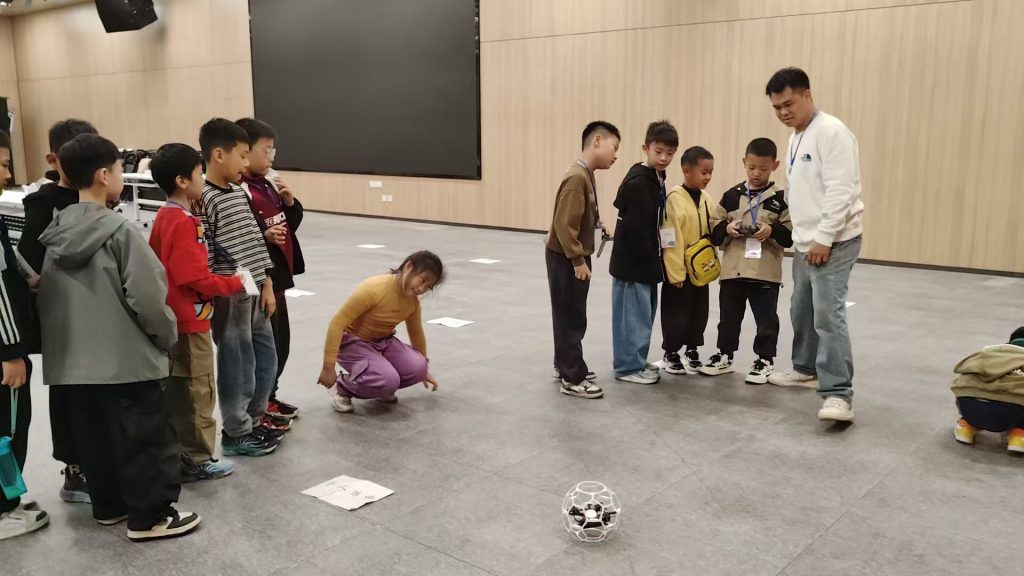
The competition-education and industry-education (赛教-产教) model, combined with experimental base construction, is vital for drone training. Competition-education involves integrating drone industry competitions into academic teaching. By participating in these events, students apply theoretical knowledge to actual flight control, sparking interest and enhancing practical skills and teamwork. This approach promotes learning through competition, reinforcing drone training objectives. Industry-education entails collaboration between universities and enterprises to build joint training bases. By hiring senior engineers from drone companies as adjunct faculty, we bridge the gap between theory and practice. This model leverages the strengths of both academia and industry, accelerating the translation of research into applications and providing students with frontline industry exposure. Such initiatives in drone training ensure that graduates are well-prepared for real-world challenges.
We have established industry-education integration bases in collaboration with local drone industrial parks, offering modern drone training for enrollment and cultivation. Partnerships with leading companies facilitate joint courses focused on low-altitude safety technologies, standard development, and public service platforms. These bases serve as effective platforms for fostering innovation and practical abilities in drone training. To quantify the benefits, consider the effectiveness metric for drone training programs: $$E_{dt} = \alpha \cdot C + \beta \cdot I + \gamma \cdot P$$ where \(E_{dt}\) is the overall effectiveness of drone training, \(C\) represents curriculum quality, \(I\) denotes innovation indicators, \(P\) signifies practical skills, and \(\alpha, \beta, \gamma\) are weighting coefficients reflecting the importance of each component. This formula underscores the multifaceted nature of drone training.
Talent introduction and faculty development are critical for enhancing drone training. We implement policies to attract leading professionals and experts in drone technology, offering competitive salaries, career development opportunities, and research support. These experts improve course design, train faculty teams, and secure high-level research projects, elevating the quality of drone training. Additionally, we invite enterprise engineers as graduate supervisors to strengthen university-industry ties, boosting students’ practical skills and employability. For faculty training, we design personalized plans including theoretical workshops, hands-on drills, and academic exchanges. We support participation in international conferences to keep abreast of trends in drone training. Reward funds are established for teaching and research achievements, motivating faculty engagement. We aim to build a “dual-qualified” faculty team with strong theoretical and practical expertise, essential for effective drone training.
| Reform Area | Specific Measures | Expected Impact on Drone Training |
|---|---|---|
| Basic Education | Foundational courses, online resources, study groups | Strengthens theoretical foundation for cross-disciplinary students |
| Curriculum Optimization | Interdisciplinary courses,前沿技术 integration, case studies | Enhances knowledge breadth and innovation potential |
| Innovation Practice | Research projects, interdisciplinary fusion,实验验证 | Fosters autonomous innovation and problem-solving skills |
| Competition-Industry Model | Drone competitions, enterprise collaborations, training bases | Boosts practical abilities and industry relevance |
| Faculty Development | Talent引进, training programs, incentive mechanisms | Improves teaching quality and research output in drone training |
The university-enterprise feedback mechanism ensures that drone training aligns with societal and industrial needs. Enterprises provide input on talent demands, technological requirements, and market trends. Universities adjust training plans accordingly, fostering a responsive drone training ecosystem. Regular交流 meetings are held to discuss research progress, market needs, and talent cultivation. Joint research centers or laboratories are established to tackle technical challenges collaboratively. Through project-based cooperation, both parties share information on difficulties and市场需求, driving innovation. Information-sharing platforms facilitate the exchange of technology, market, and talent data, supporting effective drone training. This feedback loop promotes the transformation of academic成果 into industrial applications, advancing drone technology and contributing to economic growth. By prioritizing this mechanism, drone training programs can better serve national strategies.
In conclusion, drone training for graduate students in non-aerospace universities requires comprehensive educational reforms to catch up with aerospace institutions. We propose strengthening basic education, updating curricula, fostering innovation through interdisciplinary projects, implementing competition-industry models, building experimental bases, enhancing faculty capabilities, and establishing feedback mechanisms with enterprises. These measures aim to improve theoretical knowledge, practical skills, and innovative capacities in drone training. By continuously深化 reforms, we can cultivate graduates who meet the evolving demands of the low-altitude economy, supporting technological self-reliance and industrial升级. Drone training must evolve dynamically, integrating前沿技术 and real-world applications to produce competent professionals. We believe that through these efforts, drone training will play a pivotal role in advancing the low-altitude economy and national development.
To further illustrate the technical aspects of drone training, consider the mathematical models used in drone control systems. For instance, the dynamics of a quadrotor drone can be described by the following equations of motion, which are often taught in advanced drone training courses: $$ \begin{aligned} m \ddot{x} &= (\cos\phi \sin\theta \cos\psi + \sin\phi \sin\psi) U_1 \\ m \ddot{y} &= (\cos\phi \sin\theta \sin\psi – \sin\phi \cos\psi) U_1 \\ m \ddot{z} &= (\cos\phi \cos\theta) U_1 – mg \\ I_x \ddot{\phi} &= \dot{\theta} \dot{\psi} (I_y – I_z) + U_2 \\ I_y \ddot{\theta} &= \dot{\phi} \dot{\psi} (I_z – I_x) + U_3 \\ I_z \ddot{\psi} &= \dot{\phi} \dot{\theta} (I_x – I_y) + U_4 \end{aligned} $$ where \(m\) is the mass, \(x, y, z\) are positional coordinates, \(\phi, \theta, \psi\) are roll, pitch, and yaw angles, \(I_x, I_y, I_z\) are moments of inertia, \(U_1\) is the total thrust, and \(U_2, U_3, U_4\) are control torques. These equations form the basis for designing flight controllers in drone training, emphasizing the importance of theoretical rigor.
Moreover, in drone training for navigation and perception, algorithms such as simultaneous localization and mapping (SLAM) are crucial. The SLAM problem can be formulated as estimating the posterior probability: $$ p(x_{1:t}, m | z_{1:t}, u_{1:t}) $$ where \(x_{1:t}\) represents the drone’s trajectory, \(m\) is the map, \(z_{1:t}\) are sensor observations, and \(u_{1:t}\) are control inputs. Through hands-on projects, students implement these algorithms, reinforcing their understanding in drone training. Additionally, optimization techniques like gradient descent are used to minimize error functions in drone control: $$ \min_{u} \sum_{t} \| y_t – \hat{y}_t \|^2 $$ where \(y_t\) is the desired output and \(\hat{y}_t\) is the predicted output based on control input \(u\). Such mathematical tools are integral to advanced drone training programs.
The integration of artificial intelligence in drone training is another key area. Machine learning models, such as deep neural networks, are employed for tasks like object detection and autonomous decision-making. The loss function for training these models can be expressed as: $$ L(\theta) = \frac{1}{N} \sum_{i=1}^{N} \ell(f(x_i; \theta), y_i) $$ where \(\theta\) are network parameters, \(f\) is the model, \(x_i\) are input data (e.g., images from drone cameras), \(y_i\) are labels, and \(\ell\) is a loss function. By incorporating such内容 into courses, drone training keeps pace with technological advancements. We also emphasize ethical considerations and safety protocols in drone training, ensuring that graduates adhere to regulations and best practices.
In terms of assessment, we propose a balanced evaluation system for drone training programs. The performance of students can be measured using a composite score: $$ S = w_1 T + w_2 P + w_3 I $$ where \(S\) is the overall score, \(T\) denotes theoretical exam results, \(P\) represents practical project outcomes, \(I\) indicates innovation contributions (e.g., patents or publications), and \(w_1, w_2, w_3\) are weights reflecting the priorities of drone training. This approach encourages holistic development in drone training. Furthermore, regular feedback from industry partners helps refine these metrics, aligning drone training with employer expectations.
Looking ahead, the future of drone training will involve更多 interdisciplinary collaborations and global partnerships. We advocate for international exchange programs where students can study at leading institutions abroad, gaining exposure to diverse approaches in drone training. Virtual仿真 platforms can supplement physical实验, providing scalable and cost-effective training tools. For example, drone training simulators allow students to practice flight maneuvers in various scenarios without risking hardware. The effectiveness of such simulators can be modeled as: $$ E_{sim} = \int_{0}^{T} F(s(t), a(t)) dt $$ where \(E_{sim}\) is the training effectiveness, \(s(t)\) is the simulated state, \(a(t)\) is the student’s action, and \(F\) is a performance function. By leveraging technology, drone training can become more accessible and efficient.
In summary, our proposed reforms for drone training encompass multiple dimensions: curricular updates, practical enhancements, innovation fostering, and stakeholder engagement. We stress that drone training must be dynamic, adapting to rapid technological changes. Through continuous improvement, non-aerospace universities can elevate their drone training programs to produce graduates who drive innovation in the low-altitude economy. The success of drone training hinges on collaboration among academia, industry, and government, creating an ecosystem that supports lifelong learning and technological advancement. We remain committed to advancing drone training for the benefit of society and the economy.