
In recent years, the rapid advancement of unmanned aerial vehicle (UAV) technology has revolutionized various sectors, particularly in firefighting and emergency response. As a researcher focused on leveraging technology for public safety, I have developed a novel fire UAV system that integrates visible light and infrared thermal imaging cameras to improve fire detection and rescue operations. This design addresses the limitations of current fire UAVs, which often rely on单一 cameras and lack robust image fusion techniques, hindering their effectiveness in complex environments, especially at night. My approach combines hardware innovation with sophisticated computer vision algorithms to create a system that is not only reliable but also enhances situational awareness for firefighters. Throughout this article, I will detail the design, implementation, and benefits of this fire UAV, emphasizing how it can transform firefighting strategies.
The core motivation behind this fire UAV design stems from the critical need for accurate and timely fire scene assessment. Traditional methods often put firefighters at risk when entering hazardous areas, and existing UAVs may fail to provide comprehensive data due to limited sensor capabilities. By integrating both visible light and infrared thermal imaging, my fire UAV can operate effectively day and night, detecting fire points with high precision through image fusion. This system is designed to be user-friendly, with a simple structure that facilitates easy deployment in various scenarios, from urban fires to forest blazes. The following sections will explore the hardware components, software algorithms, and practical applications of this fire UAV, demonstrating its potential to save lives and property.
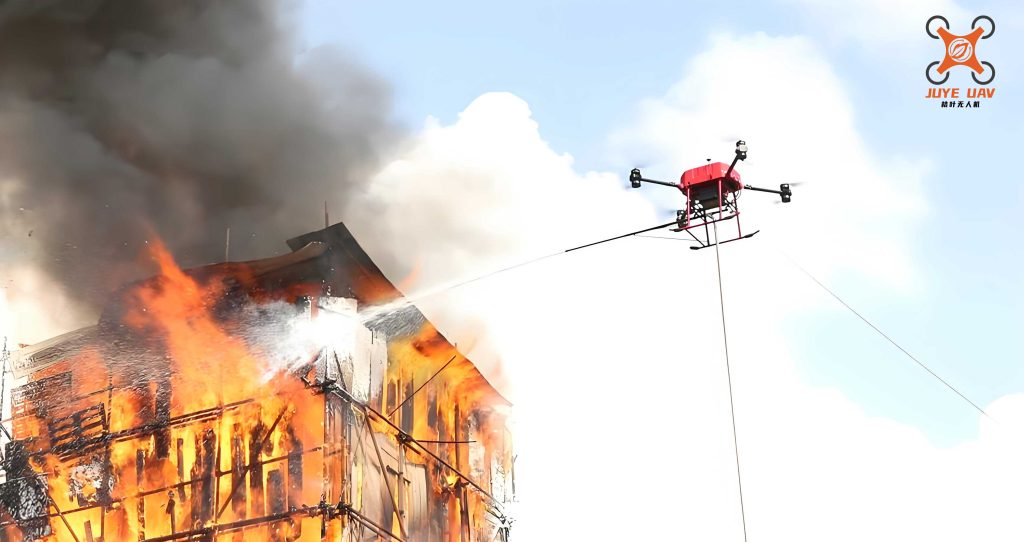
To build an effective fire UAV, the hardware selection is paramount. My design incorporates several key components that work in harmony to ensure optimal performance. The UAV platform itself must be robust and reliable, capable of carrying the necessary payload while maintaining stable flight in adverse conditions. I chose a platform equipped with GPS navigation, a PX4 flight controller, and multiple sensors including a three-axis gyroscope, accelerometer, and digital compass. This allows for precise navigation and control, essential for maneuvering in fire-affected areas. Additionally, the fire UAV features fail-safe functions such as low-battery return and loss-of-signal return, which are critical for safety during missions. The platform’s specifications are summarized in the table below to provide a clear overview of its capabilities.
| Component | Specification | Purpose in Fire UAV | |
|---|---|---|---|
| UAV Platform | GPS-enabled, PX4 flight controller, IP63 waterproof rating | Ensures reliable navigation and durability in smoky or rainy conditions | |
| Endurance | ≥30 minutes with full payload | Allows extended operation for thorough fire scene assessment | |
| Flight Altitude | Up to 1 km | Enables wide-area surveillance from a safe distance | |
| Operational Radius | 5 km | Facilitates coverage of large fire zones without manual intervention | |
| Speed | ≥12 m/s | Quick response to dynamic fire situations | |
| Camera Gimbal | Three-axis electric gimbal with angle feedback | Stabilizes cameras and allows remote adjustment for targeting fire points | |
| Visible Light Camera | AR0144 sensor, 1280×720 resolution, global shutter | Captures high-quality daytime images for scene context | |
| Infrared Thermal Camera | FLIR Lepton module, 160×120 resolution | Detects heat signatures for fire identification in low-light or smoky environments | |
| Onboard Computer | Intel NUC mini-PC | Processes image data in real-time for immediate fire detection | |
| Wireless Transmission | Enhanced long-range video link | Streams live footage to firefighters for remote decision-making | |
| Remote Controller | Range up to 6 km | Provides manual control and system monitoring during operations |
The integration of a three-axis camera gimbal is crucial for this fire UAV, as it ensures that the cameras remain steady despite UAV movements. This gimbal can be adjusted remotely via the controller, allowing firefighters to pan, tilt, and roll the cameras to focus on specific areas of interest. Equipped with onboard gyroscopes and accelerometers, the gimbal provides real-time angle data to the flight controller and onboard computer, enabling accurate coordinate mapping. The visible light and infrared thermal cameras are mounted co-axially and aligned in the same direction, ensuring that both capture images from identical perspectives. This alignment is vital for subsequent image fusion processes, which I will discuss in detail later. The Intel NUC mini-PC serves as the brain of the fire UAV, handling image processing tasks and running the fire detection algorithms without relying on external servers, thus reducing latency and improving reliability.
In designing the fire UAV, I prioritized modularity and scalability. For instance, the camera module can be upgraded with higher-resolution sensors as technology advances, while the UAV platform can be adapted for different payloads, such as additional sensors or灭火 equipment. The use of open-source flight controllers like PX4 allows for customization and integration with various software tools. Moreover, the fire UAV’s waterproof rating of IP63 ensures it can operate in light rain or dusty conditions, common in fire scenarios. This robustness makes the fire UAV suitable for diverse environments, from industrial complexes to wilderness areas. By combining these hardware elements, I have created a versatile fire UAV that can be deployed quickly by firefighting teams, enhancing their ability to assess and respond to emergencies.
Moving to the software aspect, the fire detection algorithm is the heart of this fire UAV system. It processes images from both cameras to identify fire points accurately. The algorithm begins by capturing simultaneous video feeds at 30 frames per second from the visible light and infrared thermal cameras. These feeds are transmitted to the onboard computer, where they undergo preprocessing steps such as calibration and distortion correction using camera intrinsic matrices. For the visible light images, I apply color-based criteria to detect potential fire regions. Specifically, I use RGB and HSI color models to identify flames and smoke. The constraints for flame detection are as follows: rule 1 requires that the red component (R) is greater than or equal to the green component (G), which in turn is greater than or equal to the blue component (B); rule 2 sets a threshold for the red component, R ≥ R_T; and rule 3 involves saturation, S ≥ ((255 – R) * S_T / R_T). Here, R_T and S_T are thresholds determined empirically through adjustable sliders in the software interface. Pixels meeting these criteria are marked as fire candidates, and morphological operations are applied to connect regions and reduce noise.
For the infrared thermal images, the fire UAV leverages temperature data embedded in each pixel. Since fire points typically exhibit temperatures between 600°C and 1200°C, far above ambient temperatures of 0°C to 50°C, I set a threshold of 101°C to segment potential fire areas. The algorithm converts the infrared image to HSV color space and extracts regions with orange or red hues, which correspond to high temperatures. These regions of interest (ROIs) are then subjected to edge detection using the Canny algorithm. To enhance accuracy, I incorporate fire-specific features such as circularity, area change rate, correlation between frames, edge jitter, and flicker frequency (8–12 Hz). These features help distinguish true fire points from false positives like hot machinery or human bodies. The process is summarized in the flowchart below, which outlines the steps from image acquisition to fire confirmation.
The image fusion technique is a key innovation in this fire UAV design. After detecting fire points in both image types, I fuse them to provide a comprehensive view for firefighters. Due to the resolution disparity—visible light images at 1280×720 and infrared images at 160×120—I first resize both images to 1280×720 using the OpenCV resize() function. This normalization ensures pixel-level alignment. From the infrared image, I extract the ROI vertices coordinates, denoted as (x_1, y_1), (x_2, y_2), (x_3, y_3), and (x_4, y_4), and overlay a red rectangle with a width of 16 pixels onto the visible light image. Similarly, the edges of the fire region from the infrared image are mapped onto the visible light image as black lines with 8-pixel width. For the fusion of interior regions, I employ a Laplacian pyramid algorithm. This involves creating Gaussian pyramids for both the infrared ROI and the corresponding visible light region, followed by building 4-layer Laplacian pyramids. A mask is generated to blend the images, typically with left half as 255 and right half as 0 for symmetrical fusion. The fusion process can be expressed mathematically as follows: let L_IR and L_VL represent the Laplacian pyramids of the infrared and visible light images, respectively, and G_mask be the Gaussian pyramid of the mask. The fused pyramid L_fused is computed as:
$$ L_{\text{fused}} = G_{\text{mask}} \cdot L_{IR} + (1 – G_{\text{mask}}) \cdot L_{VL} $$
Then, the final fused image I_fused is reconstructed by recursively upsampling and adding the layers of L_fused. This results in a single image that combines the thermal highlights from the infrared data with the contextual details from the visible light, making it easier for firefighters to locate fire points accurately.
Beyond image fusion, the fire UAV calculates the three-dimensional coordinates of fire points in real-time. This is essential for precise targeting and navigation. Using the visual data, I compute the relative height and yaw angle between the UAV and the fire point. The transformation from image coordinates to the UAV’s coordinate system involves the following equations. Let (x_{ft}, y_{ft}) be the fire point coordinates in the image plane, ĥ be the estimated relative height from the UAV to the fire point, and C^n_b be the rotation matrix from the body frame to the navigation frame. The 3D position (x_d, y_d, z_d) in the UAV coordinate system is given by:
$$ \begin{bmatrix} x_d \\ y_d \end{bmatrix} = \begin{bmatrix} x_v \\ y_v \end{bmatrix} + \frac{ĥ}{(0,0,1) C^n_b \begin{bmatrix} x_{ft} \\ y_{ft} \\ 1 \end{bmatrix}} \times \begin{bmatrix} 1 & 0 & 0 \\ 0 & 1 & 0 \end{bmatrix} C^n_b \begin{bmatrix} x_{ft} \\ y_{ft} \\ 1 \end{bmatrix} $$
$$ z_d = ĥ + z_v $$
where (x_v, y_v, z_v) are the UAV’s own coordinates. This calculation leverages data from the gimbal angles and GPS to ensure accuracy. Once the local coordinates are determined, they are converted to global world coordinates using the UAV’s GPS readings, providing latitude and longitude for the fire point. This information is displayed on the remote controller and logged for post-mission analysis. The ability to pinpoint fire locations in 3D space significantly enhances the fire UAV’s utility in planning rescue operations and directing灭火 resources.
The software implementation of this fire UAV is designed for efficiency and ease of use. I developed a flowchart that outlines the entire process from image capture to coordinate output. The system runs on the onboard computer using OpenCV and custom C++ code, optimized for real-time performance. Firefighters interact with the system via the remote controller, which displays live feeds, fire alerts, and coordinate data. The interface includes sliders for adjusting detection thresholds, allowing customization based on environmental conditions. Additionally, the fire UAV supports autonomous flight modes, such as waypoint navigation, which can be pre-programmed for routine inspections of high-risk areas. This automation reduces the cognitive load on operators, enabling them to focus on decision-making. The integration of machine learning techniques could further improve fire detection accuracy in future iterations, but for now, the rule-based approach ensures reliability and transparency.
In practical applications, this fire UAV offers numerous advantages over traditional methods. For urban firefighting, it can navigate through dense smoke to identify trapped individuals using thermal imaging, while providing aerial views of building layouts. In forest fires, the fire UAV can cover vast areas quickly, detecting hotspots that are invisible to the naked eye. The image fusion capability is particularly valuable in complex scenarios where both visual context and thermal data are needed, such as in industrial facilities with multiple heat sources. Moreover, the fire UAV can be equipped with additional payloads, like loudspeakers for communication or droppers for delivering emergency supplies. This versatility makes it a multi-tool for rescue teams, extending beyond mere reconnaissance to active intervention.
To illustrate the system’s performance, consider the following table comparing key metrics of my fire UAV with conventional UAVs used in firefighting. This highlights the improvements brought by image fusion and enhanced hardware.
| Aspect | Conventional Fire UAV | My Fire UAV Design |
|---|---|---|
| Camera System | Single visible light or infrared camera | Dual visible light and infrared cameras with co-axial alignment |
| Night Operation | Limited or impossible without infrared | Fully operational via infrared thermal imaging |
| Image Fusion | Rarely implemented; manual comparison needed | Real-time fusion using Laplacian pyramid algorithm |
| Fire Detection Accuracy | Moderate, prone to false positives | High, due to multi-criteria validation and feature analysis |
| 3D Coordination | Often lacking or imprecise | Accurate calculation using visual and sensor data |
| User Interface | Basic video feed | Interactive display with alerts and coordinate overlays |
| Durability | Standard waterproofing | IP63 rating for harsh conditions |
| Cost-Effectiveness | Lower upfront cost but limited functionality | Higher initial investment but reduced operational risks |
The benefits of this fire UAV extend to logistical and strategic aspects of firefighting. By providing real-time data, it enables commanders to make informed decisions about resource allocation and evacuation routes. For example, during a large-scale fire, the fire UAV can map the spread of flames and identify safe zones for firefighters. This proactive approach minimizes casualties and property damage. Additionally, the fire UAV can be deployed for preventive monitoring in high-risk areas, such as chemical plants or wildland-urban interfaces, where early detection is crucial. The ability to store mission data allows for post-event analysis, helping improve future response plans. In essence, this fire UAV acts as a force multiplier, enhancing the capabilities of firefighting teams without exposing them to unnecessary danger.
Looking ahead, I envision further enhancements to this fire UAV system. Integrating artificial intelligence for adaptive threshold adjustment could improve detection in varying climates, such as deserts or rainforests. Adding swarm technology would allow multiple fire UAVs to collaborate, covering larger areas simultaneously. Moreover, advancements in battery technology could extend flight times, making the fire UAV even more effective for prolonged missions. The modular design ensures that these upgrades can be incorporated seamlessly, keeping the system at the forefront of firefighting technology. As drones become more prevalent in public safety, my fire UAV design sets a benchmark for combining hardware robustness with intelligent software, ultimately contributing to safer communities.
In conclusion, the fire UAV I have developed represents a significant step forward in firefighting technology. By fusing visible light and infrared thermal images, it provides a comprehensive view of fire scenes, enabling accurate detection and localization of hazards. The hardware components are carefully selected for reliability and performance, while the software algorithms ensure real-time processing and user-friendly operation. This fire UAV is not just a tool for surveillance but a complete system that enhances decision-making and operational efficiency. As I continue to refine this design, I am confident that it will play a vital role in saving lives and protecting property, demonstrating the transformative potential of UAVs in emergency response. The journey from concept to implementation has reinforced my belief in leveraging technology for public good, and I look forward to seeing this fire UAV deployed in real-world scenarios.