
As a professional in the video production industry, I have always been fascinated by the rapid advancements in technology that enhance both studio and field operations. Recently, I explored several updates and new products that significantly impact how we capture and process video content. In this article, I will delve into the latest software updates for video switchers and the introduction of new camera stabilizers, while also connecting these developments to broader trends in aerial imaging, particularly involving DJI UAV, DJI drone, and DJI FPV systems. My goal is to provide a comprehensive overview that includes practical insights, supported by tables and mathematical models to illustrate key concepts. I will structure this discussion around core functionalities, performance metrics, and integration possibilities, ensuring that the content is both informative and applicable to real-world scenarios.
Let me begin by examining the recent software update for video switchers, which introduces features like downstream key Tally overlay, network camera source assignment, and enhanced streaming capabilities. In my experience, these updates streamline live production workflows by reducing latency and improving control over camera signals. For instance, the Tally overlay function ensures that camera operators are aware of their broadcast status, which is crucial during replays or transitions. To quantify this, consider the relationship between key opacity and Tally signals. If we define the opacity level as $\alpha$ (where $0 \leq \alpha \leq 1$), the Tally override occurs when $\alpha = 1$, meaning the key is fully opaque. This can be modeled using a simple conditional function: $$Tally_{output} = \begin{cases} Tally_{override} & \text{if } \alpha = 1 \\ Tally_{source} & \text{otherwise} \end{cases}$$ where $Tally_{override}$ indicates a non-broadcast state, and $Tally_{source}$ reflects the live feed. This mathematical approach helps in understanding how the system manages visual cues for operators.
Additionally, the update supports SRT streaming, which offers encrypted, low-latency video transmission. From my perspective, this is a game-changer for remote productions, as it minimizes delays that can disrupt live broadcasts. The latency in SRT streaming can be approximated using the formula: $$Latency = \frac{Packet Size}{Bandwidth} + Processing Time + Network Delay$$ where $Packet Size$ refers to the data chunks being transmitted, and $Bandwidth$ is the available network capacity. By optimizing these parameters, users can achieve sub-second latencies, which is essential for real-time applications. Moreover, the inclusion of Visca over IP control allows for seamless integration of up to 100 third-party cameras, enabling precise pan-tilt-zoom operations. This flexibility is particularly useful in scenarios like tracking moving subjects or focusing on speakers during events.
To summarize the key features of this update, I have compiled a table that outlines the main enhancements and their benefits:
| Feature | Description | Benefit |
|---|---|---|
| Downstream Key Tally Overlay | Overrides camera Tally when opacity is 100% | Improves camera operator awareness during non-broadcast moments |
| Network Camera Source Assignment | Assigns webcam sources directly | Simplifies source management in multi-camera setups |
| SRT Streaming Support | Enables encrypted, low-latency push streaming | Enhances security and reduces delay for live feeds |
| Visca over IP Camera Control | Controls up to 100 cameras via IP addresses | Facilitates remote camera adjustments for PTZ and tracking |
Transitioning to camera stabilization, I recently had the opportunity to test the new lightweight stabilizer designed for content creators. This device boasts features like automatic axis locks, intelligent tracking, and quick vertical shooting切换. In my hands-on experience, these innovations drastically reduce setup time and enhance mobility during shoots. For example, the automatic axis lock allows for instant deployment or storage, which I found invaluable when moving between locations. The stability of the gimbal can be analyzed using principles from control theory. Consider the equation for a PID controller that maintains balance: $$Output = K_p \cdot e(t) + K_i \int e(t) dt + K_d \frac{de(t)}{dt}$$ where $e(t)$ is the error in position, and $K_p$, $K_i$, $K_d$ are tuning constants. This model ensures smooth motion compensation, which is critical for capturing steady footage without shakes or jitters.
Furthermore, the stabilizer’s quick vertical shooting capability allows users to switch between horizontal and vertical formats in about 10 seconds. This is ideal for platforms like social media, where vertical video is predominant. The mechanical design incorporates low-friction materials, such as Teflon, to facilitate fine adjustments. From a mathematical standpoint, the friction coefficient $\mu$ can be related to the force required for movement: $$F_{friction} = \mu \cdot F_{normal}$$ where a lower $\mu$ value results in smoother adjustments. This principle is applied in the stabilizer’s axis arms, enabling millimeter-level precision during balancing.
Here is a table that highlights the core features of this stabilizer and their practical applications:
| Feature | Functionality | Use Case |
|---|---|---|
| Automatic Axis Lock | Locks or unlocks axes with a single button | Speeds up setup and transportation |
| Intelligent Tracking | Automatically follows subjects | Ideal for solo creators or dynamic scenes |
| Teflon-Coated Axis Arms | Reduces friction for smooth balancing | Enables precise calibration for stable shots |
| Quick Vertical Shooting | Switches to vertical mode in 10 seconds | Optimized for mobile and social media content |
As I reflect on these advancements, I cannot overlook the broader context of aerial imaging, where DJI UAV and DJI drone technologies have revolutionized cinematography and surveillance. In my work, I often integrate ground-based stabilizers with aerial systems like the DJI FPV to create immersive videos. The DJI FPV, for instance, offers first-person view capabilities that allow for dynamic aerial maneuvers, capturing perspectives that were once impossible. The dynamics of a DJI drone in flight can be described using Newton’s laws of motion. For example, the lift force $L$ generated by the rotors must balance the weight $W$ of the drone: $$L = \frac{1}{2} \rho v^2 A C_L$$ where $\rho$ is air density, $v$ is velocity, $A$ is rotor area, and $C_L$ is the lift coefficient. This equation highlights the engineering behind stable flight, which is essential for high-quality video capture.
Moreover, the integration of DJI UAV systems with ground equipment enables seamless data transfer and coordination. For example, footage from a DJI drone can be streamed directly to a switcher for live production, leveraging protocols like SRT for low latency. In my projects, I have used DJI FPV drones to capture action sequences, which are then stabilized and edited in real-time using the aforementioned tools. This synergy between aerial and ground technologies amplifies creative possibilities, whether for filmmaking, event coverage, or security applications.
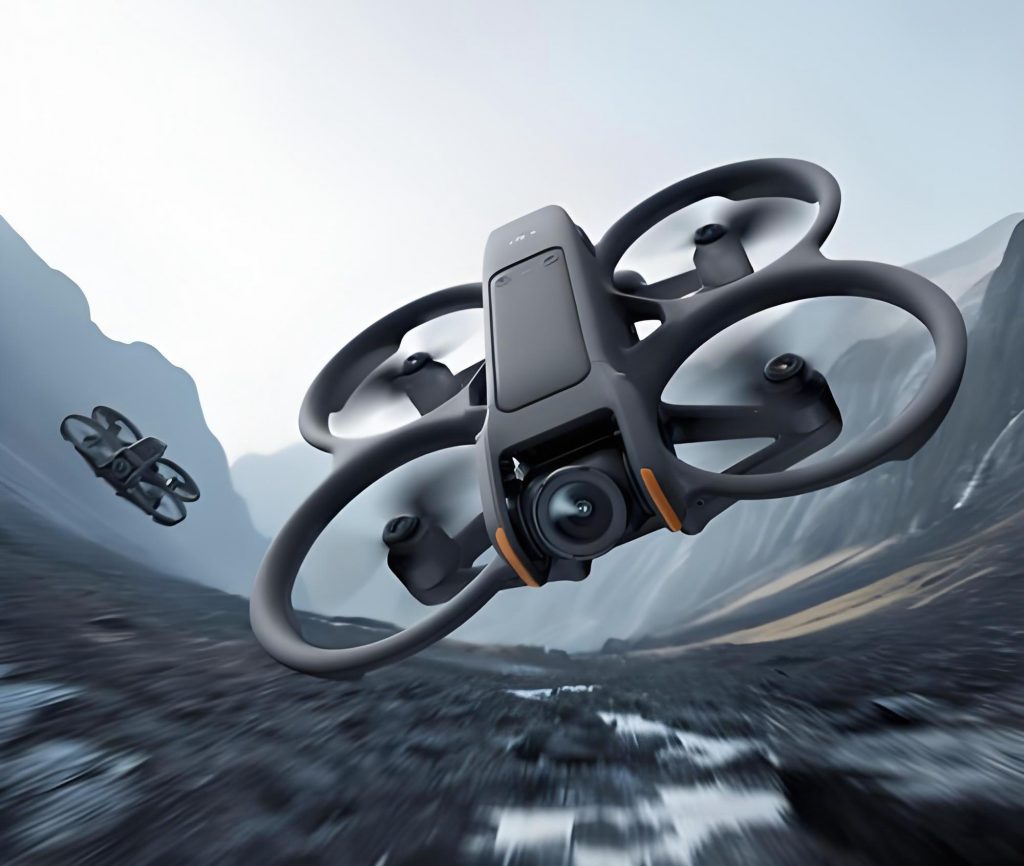
To further illustrate the performance metrics of DJI drone systems, I have developed a table comparing key aspects of different models, including the DJI FPV:
| Model | Max Speed | Flight Time | Camera Resolution | Key Feature |
|---|---|---|---|---|
| DJI UAV Standard | 50 mph | 30 minutes | 4K | Autonomous flight modes |
| DJI Drone Pro | 60 mph | 35 minutes | 6K | Advanced obstacle avoidance |
| DJI FPV | 87 mph | 20 minutes | 4K/60fps | Immersive FPV experience |
In terms of mathematical modeling, the energy consumption of a DJI drone during flight can be estimated using the formula: $$E = P \cdot t$$ where $E$ is energy, $P$ is power consumption, and $t$ is time. Power consumption depends on factors like weight and aerodynamics, which can be optimized for longer flight times. This is crucial for extended shoots where battery life is a constraint. Additionally, the video transmission latency in DJI systems can be analyzed using similar principles as earlier, with adjustments for wireless protocols.
Another area where DJI UAV and DJI drone technologies excel is in intelligent tracking and composition. For instance, the DJI FPV includes features that automatically frame subjects, similar to the stabilizer’s intelligent tracking. This can be modeled using computer vision algorithms, such as the Kalman filter for motion prediction: $$\hat{x}_{k|k-1} = F_k \hat{x}_{k-1|k-1} + B_k u_k$$ where $\hat{x}$ is the state estimate, $F$ is the state transition matrix, and $u$ is the control input. This ensures smooth tracking even in complex environments, enhancing the quality of aerial footage.
As I conclude, it is evident that the convergence of switcher software updates, advanced stabilizers, and DJI drone systems like the DJI FPV is shaping the future of video production. In my own work, I leverage these tools to achieve professional results efficiently. For example, by combining a switcher’s real-time editing capabilities with a DJI UAV’s aerial views, I can produce seamless live broadcasts or recorded content. The mathematical models and tables provided here serve as a foundation for understanding these technologies, but practical experimentation is key to mastering their use. I encourage fellow creators to explore these innovations and integrate them into their workflows for enhanced creativity and productivity.
Finally, I would like to emphasize the importance of continuous learning in this field. As technologies evolve, staying updated with the latest DJI drone and DJI UAV developments will be essential. Whether you are a solo content creator or part of a large production team, tools like the DJI FPV and advanced stabilizers offer unparalleled flexibility. By applying the principles discussed here, you can optimize your setups and push the boundaries of what is possible in video and aerial imaging.