
As a public safety professional deeply involved in modernizing emergency response, I have witnessed firsthand the escalating challenges associated with water-related incidents. From urban flooding and river rescues to maritime law enforcement, the demands on our first responders are immense and often fraught with peril. The traditional paradigm of water rescue, heavily reliant on the physical prowess and courage of individual rescuers, is increasingly strained by factors such as climate change-induced extreme weather, stretched police resources, and the critical importance of the “golden minutes” following a drowning incident. In this context, the integration of unmanned aerial vehicles (UAVs), or drones, represents not merely a technological upgrade but a fundamental shift toward a safer, faster, and more efficient operational model. This article explores the application of police drones in water rescue from a practitioner’s perspective, analyzing current practices, technological integrations, and the pivotal role of systematic drone training in realizing this potential.
The fundamental challenge in water rescue is time. Research indicates that irreversible brain damage can begin after approximately five minutes of submersion. This creates an unforgiving timeline for any rescue operation, traditionally segmented into distinct phases: notification, mobilization, transit to the victim, and execution of the rescue. We can model the total response time, $T_{\text{total}}$, as:
$$T_{\text{total}} = T_{\text{notification}} + T_{\text{mobilization}} + T_{\text{transit}} + T_{\text{execution}}$$
In conventional responses, $T_{\text{transit}}$ for a rescue boat or swimmer can be prohibitively long, especially over large or cluttered water surfaces. Furthermore, $T_{\text{execution}}$ carries a high risk factor for the rescuer. The primary objective of integrating drones is to dramatically reduce $T_{\text{transit}}$ and de-risk $T_{\text{execution}}$ by providing immediate remote assistance.
The technological core of a modern rescue drone system extends far beyond basic flight. It is an integrated platform comprising several key subsystems, as outlined in the table below:
| Subsystem | Key Components | Rescue Function |
|---|---|---|
| Flight Platform | Airframe, Propulsion, Flight Controller, GPS | High-speed, stable transit to coordinates; precise hovering. |
| Sensory Payload | High-zoom RGB Camera, Thermal Imaging Camera, Loudspeaker | Victim identification (day/night), situation assessment, verbal guidance. |
| Delivery Payload | Programmable Release Mechanism, Rescue Pods (e.g., auto-inflating lifebuoys) | Precise aerial delivery of flotation devices to the victim. |
| Data Link | High-bandwidth Video Downlink, Command Uplink | Real-time situational awareness for the command center; remote piloting. |
The operational workflow for a drone-assisted rescue can be visualized as a closed-loop system, where information and action flow rapidly between the scene and the commander. The process typically initiates with an emergency call. A drone, potentially pre-positioned at a strategic “nest” or rapidly deployed from a patrol vehicle, is launched. Its first role is reconnaissance. Using its cameras, it surveys the area, locates the victim, and assesses hazards (currents, debris, etc.). This live feed is crucial for informed decision-making. Concurrently, the drone can use its loudspeaker to provide calming instructions to the victim, a psychological intervention that can prevent panic and conserve energy.
The most critical intervention is the delivery of emergency flotation. Drones can carry specialized pods that activate upon water contact. The dynamics of deploying such a device from a hovering drone are important. We can consider the simplified motion of a dropped rescue pod. Neglecting air resistance for initial approximation, the time $t$ it takes to hit the water from a hover height $h$ is given by:
$$t = \sqrt{\frac{2h}{g}}$$
where $g$ is the acceleration due to gravity. For a typical operational height of 20 meters, $t \approx 2.02$ seconds. The horizontal drift $d$ due to wind or drone movement is $d = v_{w} \cdot t$, where $v_w$ is the relative horizontal wind speed. Advanced drone training focuses on compensating for these factors to achieve pinpoint accuracy, ensuring the life-saving device lands within arm’s reach of the victim.
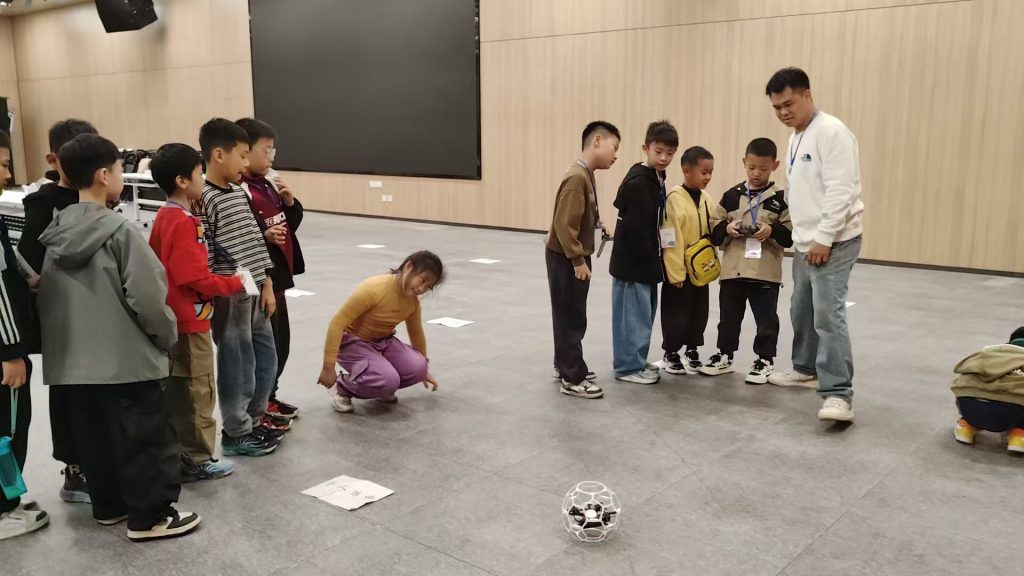
This image underscores a non-negotiable element of success: comprehensive and recurrent drone training. The technology is only as effective as its operator. Effective drone training programs must be multidimensional, moving far beyond basic flight controls.
An effective drone training curriculum must be holistic and rigorous. It should progress from foundational knowledge to advanced tactical applications, as detailed in the following framework:
| Training Module | Core Objectives | Key Performance Indicators |
|---|---|---|
| Regulatory & Safety | Understand national & local UAV regulations, airspace restrictions, emergency procedures. | Pass certification exams; demonstrate safe pre-flight checklists and contingency responses. |
| Basic & Advanced Piloting | Master manual flight in various conditions, precise hovering, navigation in GNSS-denied environments. | Execute complex flight patterns; maintain stable hover in crosswinds; perform simulated precision drops. |
| Sensor & Payload Operation | Proficient use of optical/thermal cameras for search patterns; mastery of payload release systems. | Quickly locate a mock victim in cluttered thermal imagery; achieve >90% accuracy in buoy deployment drills. |
| Tactical Water Rescue Drills | Integrate drone into standard rescue protocols; practice coordination with boat and dive teams. | Reduce total simulated rescue time by >40% compared to non-drone methods; demonstrate clear communication protocols. |
| Data Management & Reporting | Handle video footage as evidence; compile operational reports from flight logs and sensor data. | Produce a concise, court-admissible situational report from a recorded mission simulation. |
The real-world application extends beyond simple victim retrieval. Consider a scenario where an individual is stranded on a vehicle roof in a flash flood. The water velocity and debris make boat approaches lethal. A drone can first deliver a life jacket and a communication radio. Using its thermal sensor, it can monitor the victim’s core temperature, providing critical data to medics. It can then deploy a lightweight, high-strength tether to the victim, which boat teams downstream can use to guide a rescue craft safely along a drone-identified path. This concept of the drone as a “force multiplier” and “risk absorber” is central to its value proposition. The effectiveness $E$ of a drone in such a complex rescue can be thought of as a function of its capabilities:
$$E_{\text{drone}} = f(C_{\text{speed}}, C_{\text{sensor}}, C_{\text{payload}}, C_{\text{comms}}, S_{\text{training}})$$
where $C$ terms represent capacities for speed, sensing, payload delivery, and communication, and $S_{\text{training}}$ is the operator’s skill level, a direct output of drone training. It is clear that without high $S_{\text{training}}$, the maximum potential of the hardware cannot be realized.
Despite the clear advantages, integration is not without challenges. Battery life limits operational endurance; high winds and heavy precipitation can ground flights; and electromagnetic interference can disrupt control links. Furthermore, the initial investment in equipment and, more importantly, in sustained drone training programs can be a barrier for some departments. The future lies in addressing these limitations. We are moving towards hybrid drones with longer endurance, AI-assisted object detection that can automatically highlight potential victims in sensor feeds, and swarm technology where multiple drones cooperate—one for illumination, one for delivery, and one for communication relay.
In conclusion, the adoption of police drones for water rescue is a transformative development in public safety. It transitions response from a purely reactive, high-risk physical endeavor to a technology-mediated, intelligence-driven operation. The drone serves as an aerial first responder, delivering eyes, a voice, and life-saving equipment in minutes where it previously took much longer. However, this transformation is critically dependent on human expertise. Investment in continuous, scenario-based drone training is the essential catalyst that transforms a purchased asset into a reliable life-saving partner. As we refine the technology, standardize the protocols, and deepen the drone training, we move closer to a future where the dangers of water rescue are significantly mitigated, protecting both the public and the brave personnel sworn to serve them.