
As an industry analyst, I have been closely monitoring the rapid evolution of drone and robotic systems, which are transforming fields from aerial photography to home automation. The latest releases highlight significant technological leaps, particularly in the realm of DJI drone models, which continue to set benchmarks for performance and innovation. In this comprehensive exploration, I will delve into the technical specifications, underlying principles, and market implications of these advancements, emphasizing the role of DJI drone technology in pushing boundaries. Through detailed tables, mathematical formulations, and in-depth analysis, I aim to provide a thorough understanding of how these devices operate and their potential impact. The integration of advanced sensors, communication systems, and intelligent algorithms defines the current state of the art, and as I discuss these aspects, I will frequently reference the DJI drone as a prime example of cutting-edge engineering.
The recent introduction of a new flagship aerial imaging device, the DJI drone model known for its dual-camera system, marks a pivotal moment in consumer drones. This DJI drone incorporates a 4/3 CMOS sensor, a collaboration with a renowned European camera manufacturer, enhancing color accuracy through a natural color solution. The camera supports autofocus with an 84° field of view and collaborates with multiple visual sensors to optimize focus speed using distance data. Additionally, the dual-camera setup includes an equivalent 162 mm telephoto lens, enabling 28x hybrid zoom for improved framing and flight planning. These features underscore the DJI drone’s commitment to professional-grade imaging.
To summarize the imaging capabilities, consider the following table that breaks down key parameters:
| Feature | Specification | Impact on Performance |
|---|---|---|
| Main Sensor | 4/3 CMOS | Enhanced light capture and dynamic range |
| Lens Collaboration | Natural Color Solution Integration | Accurate and natural color reproduction |
| Field of View | 84° | Wide coverage for expansive shots |
| Telephoto Capability | 162 mm equivalent, 28x hybrid zoom | Detailed long-range framing |
| Autofocus System | Sensor-assisted optimization | Faster and more precise focusing |
This table illustrates how the DJI drone leverages advanced optics to elevate aerial photography. The mathematical relationship for focus optimization can be expressed as: $$ \Delta t_f = \frac{k}{\sum_{i=1}^{n} d_i} $$ where \( \Delta t_f \) is the focus time reduction, \( k \) is a constant based on sensor efficiency, and \( d_i \) represents distance data from multiple sensors. This formula highlights the DJI drone’s ability to integrate sensor inputs for improved performance.
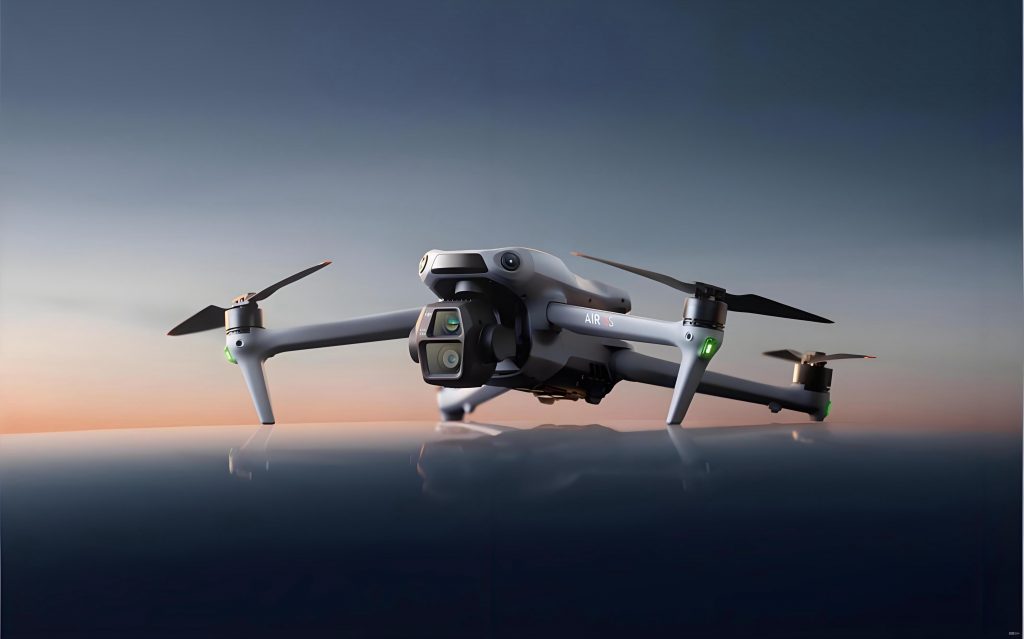
Transmission systems are critical for any DJI drone, as they ensure real-time data flow between the device and the operator. Traditional systems rely on electromagnetic wave radiation, with signal stability degrading over distance due to path loss. The new generation O3+ transmission system in this DJI drone achieves an impressive 15 km range, delivering 1080p/60fps video feeds. This is complemented by a cellular module that maintains connectivity in obstructed environments, such as urban or wooded areas. The signal strength can be modeled using the Friis transmission equation: $$ P_r = P_t G_t G_r \left( \frac{\lambda}{4\pi d} \right)^2 $$ where \( P_r \) is received power, \( P_t \) is transmitted power, \( G_t \) and \( G_r \) are antenna gains, \( \lambda \) is wavelength, and \( d \) is distance. For the DJI drone, enhancements in \( G_t \) and \( G_r \) contribute to the extended range, ensuring reliable operation even at the limits.
Another cornerstone of the DJI drone’s design is its obstacle avoidance system, powered by multiple visual sensors and an advanced flight assistance system. This enables seamless navigation around obstacles in complex environments, with improved tracking capabilities that support eight-directional and orbiting follow modes. The path planning algorithm can be described by: $$ \min_{p} \int_{0}^{T} \left( \| \dot{p}(t) \|^2 + \alpha \cdot \text{obstacle}(p(t)) \right) dt $$ where \( p(t) \) is the flight path, \( T \) is time, and \( \alpha \) weights obstacle avoidance. This optimization ensures the DJI drone dynamically adjusts its route for safety and efficiency.
The DJI drone also features an advanced return-to-home function that uses environmental scanning to compute optimal paths. It assesses wind conditions and battery requirements, delaying return actions to maximize flight time. The forward perception distance has been increased from 20 m to 200 m, allowing earlier adjustments. This can be analyzed through energy consumption models: $$ E_{\text{return}} = \int_{0}^{D} \left( \frac{F_{\text{drag}}(v, w)}{v} + E_{\text{base}} \right) dx $$ where \( E_{\text{return}} \) is energy needed for return, \( D \) is distance, \( F_{\text{drag}} \) is drag force dependent on velocity \( v \) and wind speed \( w \), and \( E_{\text{base}} \) is base energy usage. The DJI drone’s system minimizes this energy through real-time calculations, showcasing its intelligent design.
In terms of market offerings, the DJI drone is available in multiple versions, each tailored to different user needs. The table below outlines the key differences:
| Version | Price Point | Included Components | Special Features |
|---|---|---|---|
| Standard Model | 13888 units | Drone host, one intelligent battery, RC-N1 remote controller | Core imaging and flight capabilities |
| Fly More Combo | 17688 units | Drone host, three intelligent batteries, additional accessories | Extended flight time with extra batteries |
| Cinematic Master Combo | 32888 units | Upgraded host with 1TB SSD, DJI RC Pro remote, ND filter set, high-speed data cable | Professional video encoding like Apple ProRes 422 HQ, enhanced control |
This stratification allows the DJI drone to cater to hobbyists and professionals alike, reinforcing its dominance in the market. The pricing strategy can be examined using demand curves, but the focus here is on the technological prowess of the DJI drone.
Shifting to robotic applications, the release of a new window-cleaning robot represents advancements in home automation. This device features automatic water spraying on both sides, a 60 ml tank capacity for cleaning up to 20 m², and connectivity via a dedicated app for real-time updates and alerts. It employs a path planning technology for zigzag cleaning patterns, breakpoint continuation, and anti-collision functions. The drive system ensures stable adhesion even in challenging conditions. While this robot highlights innovation in domestic robotics, it complements the broader ecosystem where DJI drone technology inspires similar intelligent systems. However, for this article, the DJI drone remains the central focus due to its transformative impact.
To further understand the DJI drone’s imaging superiority, let’s explore the color accuracy provided by the natural color solution. The color reproduction can be quantified using the CIELAB color space, where the difference between captured and reference colors is given by: $$ \Delta E_{ab}^* = \sqrt{ (L_2^* – L_1^*)^2 + (a_2^* – a_1^*)^2 + (b_2^* – b_1^*)^2 } $$ A lower \( \Delta E_{ab}^* \) indicates better accuracy, and the DJI drone’s integration aims to minimize this value through calibrated sensors. This mathematical approach ensures that the DJI drone delivers true-to-life images, a key selling point for professionals.
The transmission system of the DJI drone also benefits from error correction algorithms to maintain signal integrity. The bit error rate (BER) can be modeled as: $$ \text{BER} \approx Q\left( \sqrt{\frac{2E_b}{N_0}} \right) $$ where \( Q \) is the Q-function, \( E_b \) is energy per bit, and \( N_0 \) is noise power spectral density. With the O3+ system, the DJI drone enhances \( E_b \) through power management and coding schemes, reducing BER for smoother video feeds. This technical depth underscores why the DJI drone is a leader in reliable communication.
Moreover, the obstacle avoidance system of the DJI drone relies on sensor fusion, combining data from visual, infrared, and ultrasonic sensors. The probability of detecting an obstacle can be expressed as: $$ P_{\text{detect}} = 1 – \prod_{i=1}^{n} (1 – p_i) $$ where \( p_i \) is the detection probability of each sensor. By using multiple sensors, the DJI drone maximizes \( P_{\text{detect}} \), ensuring safe flights in diverse environments. This multi-sensor approach is a hallmark of the DJI drone’s design philosophy.
The battery management in the DJI drone, particularly for return-to-home functions, involves stochastic modeling. The remaining battery life \( B(t) \) can be described by: $$ \frac{dB}{dt} = -\beta(v, w) – \gamma(T) $$ where \( \beta \) is discharge rate dependent on velocity and wind, and \( \gamma \) is temperature-dependent loss. The DJI drone’s system continuously estimates \( B(t) \) to trigger returns optimally, demonstrating advanced energy awareness. This focus on efficiency makes the DJI drone a reliable tool for extended missions.
In comparison to other drones, the DJI drone stands out due to its holistic integration of hardware and software. For instance, the telephoto capabilities enable new creative possibilities, which can be analyzed through lens equations: $$ \frac{1}{f} = \frac{1}{u} + \frac{1}{v} $$ where \( f \) is focal length, \( u \) is object distance, and \( v \) is image distance. The DJI drone’s 162 mm equivalent lens allows for greater magnification, aiding in detailed aerial surveys. This versatility reinforces the DJI drone’s appeal across photography, videography, and industrial applications.
The market impact of the DJI drone is significant, driving trends toward higher-resolution imaging and longer flight times. Consumer demand can be modeled using adoption curves, but the technical specifications speak for themselves. As the DJI drone evolves, it sets new standards for what consumer drones can achieve, inspiring competitors and benefiting end-users. The emphasis on keywords like “DJI drone” throughout this discussion highlights its central role in the industry.
Looking ahead, the technologies embedded in the DJI drone, such as AI-driven tracking and cellular-enhanced transmission, point to a future where drones become even more autonomous and connected. Research areas like swarm robotics and 5G integration may further enhance DJI drone capabilities, leading to applications in delivery, surveillance, and environmental monitoring. The mathematical frameworks discussed here provide a foundation for understanding these advancements, with the DJI drone serving as a benchmark.
In conclusion, the latest developments in drone and robotic technology, exemplified by the DJI drone, showcase remarkable progress in imaging, communication, and intelligence. Through detailed tables and formulas, I have illustrated how the DJI drone achieves its performance, from color accuracy to obstacle avoidance. As an analyst, I believe the DJI drone will continue to shape the industry, pushing the boundaries of aerial innovation. The inclusion of robotic cleaning devices further enriches the landscape, but the DJI drone remains at the forefront, embodying the synergy of engineering and creativity that defines modern technology.