
In modern precision agriculture, the use of unmanned aerial vehicles (UAVs), specifically agricultural drones, has revolutionized crop management practices. These agricultural drones enable efficient spraying of pesticides, fertilizers, and other agents, reducing labor costs and environmental impact. A critical aspect of spray efficacy is the downwash airflow generated by the rotors, which influences droplet deposition and distribution on crops. The structural design of an agricultural drone, particularly the inclination angle of its arms, can significantly alter this airflow field. In this study, I investigate how varying the inner tilt angle of the arms affects the downwash airflow of a six-rotor agricultural drone. Through computational fluid dynamics (CFD) simulations and experimental validation, I analyze the flow characteristics to provide insights for optimizing agricultural drone design.
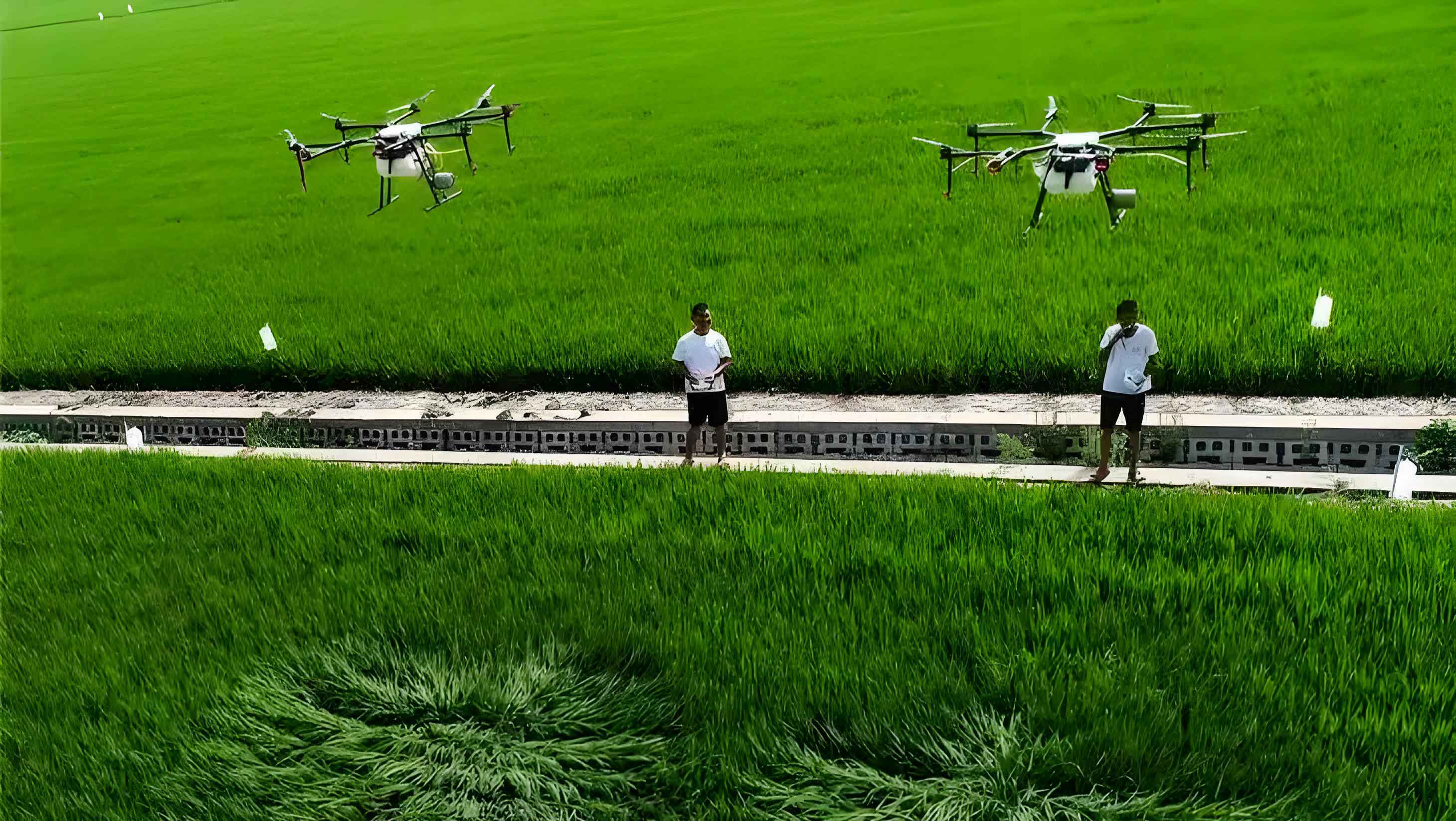
The downwash airflow from an agricultural drone is a complex phenomenon involving turbulent mixing and pressure gradients. When the drone hovers, the rotors induce a high-velocity air stream that impacts the ground and spreads laterally. This flow can enhance droplet penetration into the crop canopy, but non-uniformities may lead to uneven coverage. The arm inclination angle, defined as the inward tilt of the arms from the vertical, is hypothesized to modify the flow direction and stability. For agricultural drones, even minor design changes can have substantial effects on operational performance. Therefore, understanding the relationship between arm geometry and airflow is essential for improving the efficiency of agricultural drones in field applications.
Previous studies have focused on rotor configurations and flight dynamics, but limited research exists on arm inclination. In this work, I employ a combination of numerical simulation and physical experimentation. The CFD models are built using ANSYS Fluent, solving the Reynolds-averaged Navier-Stokes (RANS) equations with the RNG k-ε turbulence model. I simulate five different arm inner tilt angles: 0°, 2°, 4°, 6°, and 8°. The governing equations for fluid flow are expressed as follows:
Continuity equation:
$$\frac{\partial \rho}{\partial t} + \nabla \cdot (\rho \mathbf{u}) = 0$$
where $\rho$ is the air density and $\mathbf{u}$ is the velocity vector.
Momentum equation:
$$\frac{\partial (\rho \mathbf{u})}{\partial t} + \nabla \cdot (\rho \mathbf{u} \mathbf{u}) = -\nabla p + \nabla \cdot \mathbf{\tau} + \mathbf{f}$$
with $p$ as pressure, $\mathbf{\tau}$ as the stress tensor, and $\mathbf{f}$ representing body forces such as gravity.
The RNG k-ε model equations for turbulent kinetic energy $k$ and dissipation rate $\varepsilon$ are:
$$\frac{\partial (\rho k)}{\partial t} + \frac{\partial (\rho k u_i)}{\partial x_i} = \frac{\partial}{\partial x_j} \left( \alpha_k \mu_{\text{eff}} \frac{\partial k}{\partial x_j} \right) + G_k – \rho \varepsilon$$
$$\frac{\partial (\rho \varepsilon)}{\partial t} + \frac{\partial (\rho \varepsilon u_i)}{\partial x_i} = \frac{\partial}{\partial x_j} \left( \alpha_\varepsilon \mu_{\text{eff}} \frac{\partial \varepsilon}{\partial x_j} \right) + C_{1\varepsilon} \frac{\varepsilon}{k} G_k – C_{2\varepsilon} \rho \frac{\varepsilon^2}{k}$$
where $\mu_{\text{eff}}$ is the effective viscosity, $G_k$ represents generation of turbulence kinetic energy, and $\alpha_k$, $\alpha_\varepsilon$, $C_{1\varepsilon}$, $C_{2\varepsilon}$ are model constants. These equations are solved for the agricultural drone geometry to capture the downwash behavior.
The computational domain is a cylindrical volume enclosing the agricultural drone, with a diameter of 10 m and height of 5 m to allow full development of the flow. The drone model has a rotor diameter of 0.3 m and arm length of 0.5 m. Mesh independence is ensured by refining the grid until solution changes are negligible. Boundary conditions include a velocity inlet at the rotor surfaces and pressure outlet at the domain boundaries. The simulations run for 5 seconds of physical time to reach steady-state flow. Table 1 summarizes the CFD model parameters for the agricultural drone.
| Parameter | Value |
|---|---|
| Number of Rotors | 6 |
| Rotor Diameter | 0.3 m |
| Arm Length | 0.5 m |
| Inner Tilt Angles | 0°, 2°, 4°, 6°, 8° |
| Domain Size | Diameter 10 m, Height 5 m |
| Turbulence Model | RNG k-ε |
| Simulation Time | 5 s |
| Mesh Cells | Approximately 3 million |
For experimental validation, I develop a wireless wind speed acquisition system using micro-anemometers. The system measures the vertical component of downwash velocity at various points below the agricultural drone. Measurement points are arranged in a grid from 0.2 m to 2.3 m above ground, covering regions directly under rotors and between them. The system’s error is less than 0.3 m/s, and consistency is verified through repeated trials. The agricultural drone is mounted on a stationary frame to maintain hover conditions during testing. Table 2 lists the experimental setup details.
| Component | Specification |
|---|---|
| Wind Speed Sensors | Micro-anemometers, range 0-20 m/s |
| Data Acquisition | Wireless system, sampling at 100 Hz |
| Measurement Heights | 0.2 m, 0.5 m, 0.8 m, 1.1 m, 1.4 m, 1.7 m, 2.0 m, 2.3 m |
| Drone Frame | Fixed mount, rotor speed controlled at 3000 RPM |
| Environmental Conditions | Indoor, still air, temperature 20°C |
The simulation results reveal that the downwash airflow from the agricultural drone reaches a stable spread on the ground at around 3 seconds, regardless of arm inclination. This indicates that arm tilt does not cause significant temporal differences in flow development. However, spatial variations are pronounced. For a 0° tilt angle, the downwash contracts inward toward the drone’s central axis after forming below the rotors. As the inclination increases, this contraction diminishes. At 8°, the flow is nearly vertical with minimal lateral movement. This behavior can be quantified by analyzing velocity profiles along vertical lines. The vertical velocity $v_z$ at a height $z$ below a rotor can be approximated by an exponential decay model:
$$v_z = v_0 e^{-k z}$$
where $v_0$ is the velocity just below the rotor and $k$ is a decay constant that depends on arm angle.
I extract velocity data from simulations at key locations: directly under a rotor (center), in the “inflow region” between rotors where air is drawn upward, and in the “outflow region” where air is expelled downward. Table 3 compares the maximum vertical velocities at 1 m below the rotor plane for different arm angles.
| Arm Inner Tilt Angle | Velocity at Center (m/s) | Velocity in Inflow Region (m/s) | Velocity in Outflow Region (m/s) |
|---|---|---|---|
| 0° | 8.5 | 6.2 | 4.1 |
| 2° | 8.3 | 6.0 | 4.0 |
| 4° | 8.0 | 5.8 | 3.8 |
| 6° | 7.6 | 5.5 | 3.5 |
| 8° | 7.2 | 5.2 | 3.2 |
The data show a linear decrease in velocity with increasing tilt angle. The decay amplitude, defined as the difference between maximum and minimum velocities along the vertical, also increases. For instance, from 0° to 8°, the decay amplitude grows by about 1 m/s. This implies that agricultural drones with higher arm inclination may produce a more diffused but slower downwash, which could affect droplet settling. The inflow region consistently exhibits higher velocities than the outflow region, highlighting inherent asymmetries in the airflow of agricultural drones.
To further analyze the flow structure, I compute the vorticity magnitude $\omega$, which indicates rotational motion in the downwash. The vorticity is derived from the velocity field:
$$\omega = \nabla \times \mathbf{u}$$
Higher vorticity values are observed near rotor tips and in the shear layers between adjacent flows. For agricultural drones, vorticity can promote mixing and droplet dispersion. The total kinetic energy $E_k$ in the downwash region is estimated by integrating over the volume:
$$E_k = \int \frac{1}{2} \rho |\mathbf{u}|^2 dV$$
This energy decreases with arm angle, suggesting that inclined arms may reduce the overall impact force on crops, potentially benefiting delicate plants.
The experimental measurements align well with simulation predictions. At heights from 1.1 m to 2.3 m below the agricultural drone, the average relative error between experimental and simulated velocities is within 10%. Near the ground (0.2 m to 0.8 m), errors are within 20%, likely due to ground effect complexities. Table 4 presents a comparison for the 4° arm angle case at selected points.
| Height Above Ground (m) | Experimental Velocity (m/s) | Simulated Velocity (m/s) | Relative Error (%) |
|---|---|---|---|
| 2.3 | 7.8 | 8.1 | 3.8 |
| 1.7 | 6.5 | 6.7 | 3.1 |
| 1.1 | 5.2 | 5.4 | 3.8 |
| 0.8 | 4.0 | 4.5 | 12.5 |
| 0.5 | 3.2 | 3.8 | 18.8 |
| 0.2 | 2.5 | 3.1 | 24.0 |
The wireless acquisition system proves effective for field measurements of agricultural drone downwash. Its low error and consistency make it suitable for optimizing spray operations. Discrepancies near the ground are acceptable given the turbulent nature of the flow. Overall, the validation confirms that CFD models can reliably predict airflow patterns for agricultural drones with varying arm designs.
Discussion of these results centers on the implications for agricultural drone performance. The reduction in flow contraction with increased arm inclination means that droplets may be distributed over a wider area, potentially improving coverage uniformity. However, the lower velocities could reduce droplet penetration into dense canopies. Therefore, selecting an optimal arm angle requires balancing these factors. For instance, an agricultural drone used for broadacre spraying might benefit from a 4-6° tilt to achieve moderate spread and velocity. In contrast, a drone targeting orchard trees might prefer 0-2° for focused downwash. The aerodynamic interactions between rotors also change with arm angle. The inward tilt may reduce interference, enhancing stability—a critical factor for agricultural drones operating in windy conditions.
Moreover, the energy efficiency of the agricultural drone is influenced by downwash characteristics. The power required to maintain hover, $P$, can be related to the thrust $T$ and induced velocity $v_i$ through momentum theory:
$$P = T v_i$$
where $v_i$ depends on the airflow geometry. My simulations suggest that inclined arms alter $v_i$, possibly affecting battery life. Future work could incorporate power consumption metrics into the analysis.
To generalize the findings, I propose a dimensionless parameter, the inclination number $I_n$, combining arm angle $\theta$, rotor radius $R$, and drone mass $m$:
$$I_n = \frac{\theta R^2}{m g}$$
where $g$ is gravity. This number might correlate with downwash uniformity metrics, aiding in scalable design rules for agricultural drones.
In conclusion, this study demonstrates that arm inner tilt angle significantly affects the downwash airflow of a multi-rotor agricultural drone. Through detailed CFD simulations and experimental validation, I show that increasing the angle from 0° to 8° reduces flow contraction and decreases velocity decay amplitudes. The airflow patterns have direct consequences for spray deposition and operational stability. The results provide a foundation for optimizing the structural design of agricultural drones to enhance spraying efficacy. Future research should explore dynamic flight conditions, different rotor numbers, and coupling with spray dispersion models. As agricultural drones become more prevalent, such aerodynamic insights will be invaluable for advancing precision agriculture technologies.
In summary, the integration of numerical and experimental methods offers a robust approach to studying agricultural drone aerodynamics. The wireless wind speed acquisition system developed here can be deployed in real field scenarios to further refine models. By continuing to investigate parameters like arm inclination, we can design agricultural drones that are not only efficient but also environmentally sustainable, ensuring optimal crop protection and yield improvement.