
In modern agriculture, the adoption of advanced technologies such as agricultural UAVs (unmanned aerial vehicles) has revolutionized crop management practices. As a researcher focused on precision farming, I have conducted a comprehensive study to evaluate the effects of agricultural UAV fertilization on wheat growth characteristics, yield, and quality. This investigation aims to address the limitations of traditional fertilization methods, which often lead to environmental pollution and low nutrient use efficiency. By leveraging agricultural UAVs, we can achieve precise and efficient fertilizer application, thereby enhancing wheat productivity and sustainability. In this article, I will present our experimental findings, using tables and formulas to summarize key data, and emphasize the pivotal role of agricultural UAVs in optimizing wheat cultivation.
Wheat is a staple crop critical for global food security, and its production heavily depends on effective fertilization strategies. Conventional fertilization techniques, such as manual spreading, are prone to uneven distribution, over-application, and high labor costs. In contrast, agricultural UAVs offer a promising solution by enabling variable-rate fertilization based on real-time field monitoring. These devices can capture multispectral imagery to assess crop health, allowing for targeted interventions. Our study specifically examines how agricultural UAV fertilization influences wheat growth stages, biomass accumulation, yield components, and quality parameters. Through rigorous field trials in a representative wheat-growing region, we compared agricultural UAVs with other mechanized methods to determine the optimal approach for maximizing wheat benefits.
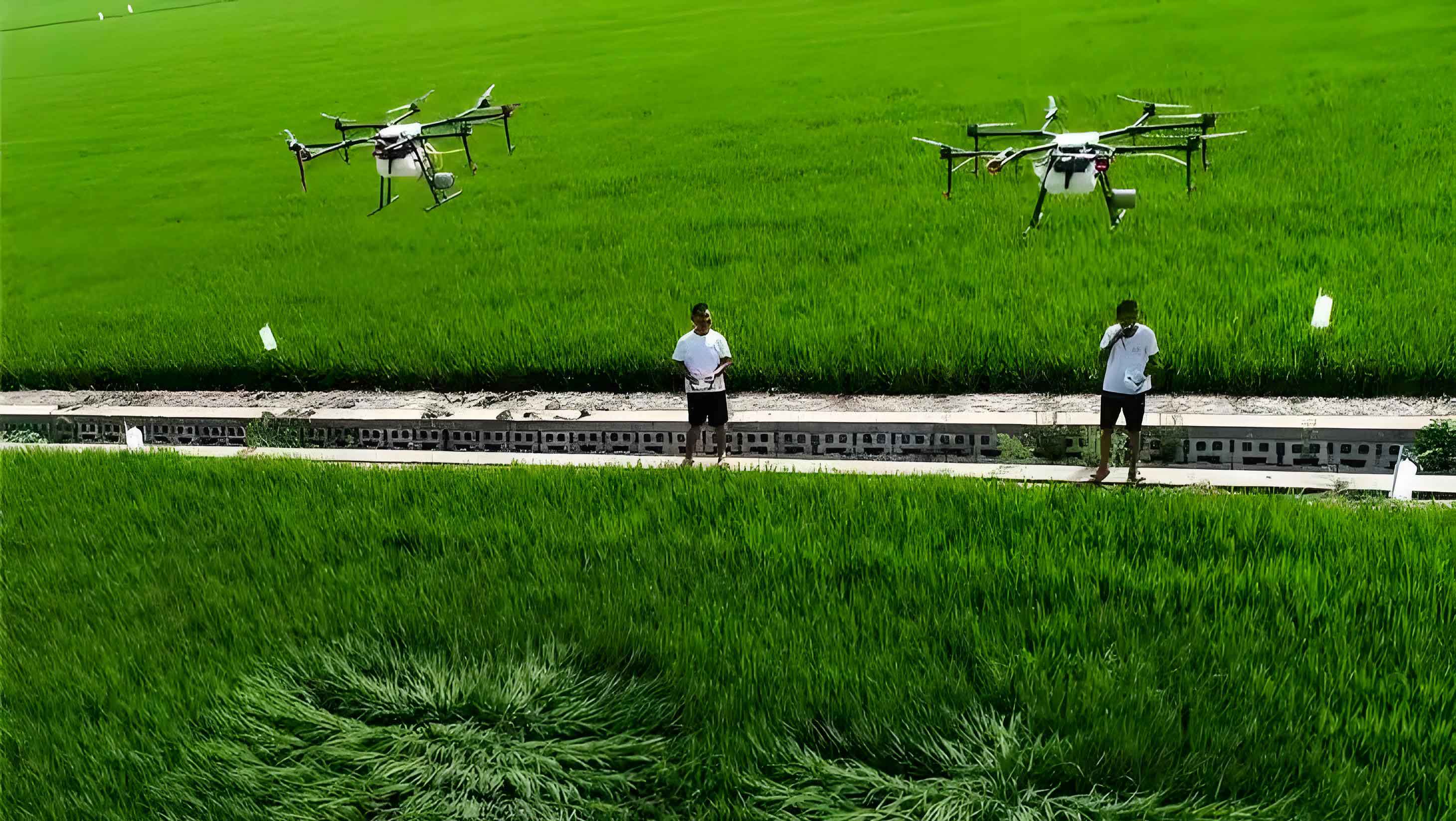
The experiment was conducted in a wheat cultivation base located in a temperate monsoon climate zone, characterized by flat terrain and fertile soil. We selected the wheat variety ‘Luomai 4’ for its adaptability and high yield potential. Fertilizers included a nitrogen-phosphorus-potassium compound fertilizer and an amino acid-based foliar spray. The study employed a randomized block design with four treatments: manual fertilization as the control (CK), a manned spray-fertilizer integrated machine (T1), a fully automatic four-wheel unmanned driving plant protection machine (T2), and an agricultural UAV (T3). Each treatment was replicated four times across plots of 120 m². Sowing was done mechanically with a seeding rate of 150 kg/ha, and basal fertilizer was applied during land preparation. Additional foliar fertilization was administered at the jointing and filling stages using the specified dosages. Throughout the growth cycle, we monitored wheat performance to assess the impact of different fertilization methods.
To quantify the effects, we measured several key indicators. Plant height was recorded at multiple growth stages—regreening, jointing, heading, and filling—using a sampling method. Biomass was determined at maturity by separating above-ground and below-ground parts, drying them to constant weight, and calculating dry matter mass. Yield components, including effective panicle number, grains per panicle, and thousand-grain weight, were evaluated from sampled areas, with overall yield measured by harvesting entire plots. Quality parameters such as protein content, bulk density, and wet gluten content were analyzed using near-infrared spectroscopy, manual washing, and steam methods, respectively. All data were processed using statistical software to ensure reliability, with analysis of variance applied to identify significant differences.
The results revealed distinct advantages of agricultural UAV fertilization across all measured aspects. In terms of plant height, the agricultural UAV treatment (T3) consistently outperformed other methods. As summarized in Table 1, at regreening, jointing, heading, and filling stages, plant heights under T3 were 18.00 cm, 37.19 cm, 74.25 cm, and 82.01 cm, respectively. These values represent increases of 10.84%, 30.67%, 14.83%, and 13.09% compared to the control (CK). This enhancement can be attributed to the precision of agricultural UAVs in delivering fertilizers uniformly and timely, based on multispectral data that guide application rates. The ability of agricultural UAVs to operate under various weather conditions ensures that fertilization is not delayed, promoting consistent growth. In contrast, traditional methods often lead to uneven distribution, which can stunt plant development.
| Fertilization Method | Regreening (cm) | Jointing (cm) | Heading (cm) | Filling (cm) |
|---|---|---|---|---|
| CK (Manual) | 16.24 ± 0.10 | 28.46 ± 1.27 | 64.66 ± 4.76 | 72.52 ± 4.70 |
| T1 (Manned Machine) | 17.56 ± 0.20 | 33.50 ± 3.40 | 70.24 ± 5.03 | 77.66 ± 8.50 |
| T2 (Unmanned Machine) | 17.47 ± 0.55 | 34.74 ± 2.78 | 71.99 ± 6.54 | 78.99 ± 4.38 |
| T3 (Agricultural UAV) | 18.00 ± 0.27 | 37.19 ± 2.20 | 74.25 ± 5.42 | 82.01 ± 5.15 |
Biomass accumulation is a critical factor influencing yield, and our data show that agricultural UAV fertilization significantly boosted dry matter production. As presented in Table 2, above-ground dry matter mass, below-ground dry matter mass, and total dry matter mass were highest under T3, reaching 30.17 g, 10.79 g, and 40.96 g, respectively. These correspond to increases of 23.55%, 79.83%, and 49.38% over the control. The superior performance of agricultural UAVs can be modeled using a biomass growth equation that accounts for fertilizer use efficiency. For instance, we can express the relationship between biomass (B) and fertilization efficiency (E) as: $$B = B_0 + k \cdot E$$ where \(B_0\) is the baseline biomass without fertilization, \(k\) is a growth coefficient, and \(E\) represents the efficiency of the fertilization method. Agricultural UAVs maximize \(E\) through precise application, reducing waste and enhancing nutrient uptake. This aligns with studies indicating that agricultural UAVs can improve fertilizer utilization by over 30 times compared to manual methods, as they enable variable-rate technology tailored to field heterogeneity.
| Fertilization Method | Above-Ground Dry Matter (g) | Below-Ground Dry Matter (g) | Total Dry Matter (g) |
|---|---|---|---|
| CK (Manual) | 24.42 ± 2.20 | 6.00 ± 2.10 | 27.42 ± 2.21 |
| T1 (Manned Machine) | 27.80 ± 0.40 | 9.55 ± 3.40 | 35.35 ± 4.20 |
| T2 (Unmanned Machine) | 28.10 ± 0.62 | 9.10 ± 3.99 | 37.20 ± 3.80 |
| T3 (Agricultural UAV) | 30.17 ± 0.48 | 10.79 ± 2.21 | 40.96 ± 4.21 |
Yield and its components further underscore the benefits of agricultural UAV fertilization. As detailed in Table 3, effective panicle number, grains per panicle, thousand-grain weight, and yield were all highest under T3. Specifically, effective panicle number reached 594.28 × 10⁴ panicles/ha, a 15.11% increase over CK; grains per panicle were 35.74, up by 31.93%; thousand-grain weight was 52.06 g, rising by 12.13%; and yield achieved 7,706.00 kg/ha, a significant 24.08% boost. These improvements can be attributed to the synchronized growth promoted by agricultural UAVs, which ensure optimal nutrient supply at critical stages. To quantify yield enhancement, we can use a yield prediction formula: $$Y = P \times G \times W \times \eta$$ where \(Y\) is yield, \(P\) is panicle number, \(G\) is grains per panicle, \(W\) is thousand-grain weight, and \(\eta\) is a correction factor for environmental conditions. Agricultural UAVs elevate \(P\), \(G\), and \(W\) by mitigating nutrient deficiencies and stress, thereby maximizing \(\eta\). The precision of agricultural UAVs allows for real-time adjustments based on crop monitoring, a feature lacking in traditional methods that often lead to suboptimal fertilization timing and rates.
| Fertilization Method | Effective Panicle Number (×10⁴ panicles/ha) | Grains per Panicle | Thousand-Grain Weight (g) | Yield (kg/ha) |
|---|---|---|---|---|
| CK (Manual) | 516.29 ± 4.06 | 27.09 ± 2.12 | 46.43 ± 3.48 | 6,210.66 ± 70.56 |
| T1 (Manned Machine) | 549.31 ± 3.04 | 29.89 ± 2.47 | 48.70 ± 6.19 | 7,105.46 ± 62.34 |
| T2 (Unmanned Machine) | 565.16 ± 6.91 | 31.97 ± 1.48 | 49.62 ± 5.26 | 7,043.32 ± 49.30 |
| T3 (Agricultural UAV) | 594.28 ± 3.25 | 35.74 ± 3.54 | 52.06 ± 3.29 | 7,706.00 ± 65.20 |
Quality parameters also demonstrated the superiority of agricultural UAV fertilization. As shown in Table 4, protein content, bulk density, and wet gluten content were highest under T3. Protein content reached 14.88%, a 20.29% increase over CK; bulk density was 810.12 g/L, up by 17.72%; and wet gluten content was 24.18%, though statistical differences were not significant, it still represented a 20.90% improvement. These enhancements are crucial for wheat market value and nutritional profile. The consistency offered by agricultural UAVs in fertilizer application ensures balanced nutrient delivery, which promotes the synthesis of proteins and other quality-related compounds. We can model quality improvement using a linear regression: $$Q = \alpha + \beta \cdot F$$ where \(Q\) is a quality metric (e.g., protein content), \(\alpha\) is the intercept, \(\beta\) is the slope representing fertilization impact, and \(F\) is the fertilization efficiency. Agricultural UAVs increase \(F\) by providing precise dosages, thus elevating \(Q\). This aligns with prior research highlighting that variable-rate fertilization via agricultural UAVs can optimize crop quality while reducing input costs.
| Fertilization Method | Protein Content (%) | Bulk Density (g/L) | Wet Gluten Content (%) |
|---|---|---|---|
| CK (Manual) | 12.37 ± 0.18 | 688.17 ± 4.28 | 20.00 ± 1.28 |
| T1 (Manned Machine) | 13.48 ± 0.26 | 742.23 ± 2.61 | 22.07 ± 1.14 |
| T2 (Unmanned Machine) | 13.89 ± 0.27 | 775.56 ± 5.20 | 22.28 ± 2.03 |
| T3 (Agricultural UAV) | 14.88 ± 1.01 | 810.12 ± 4.20 | 24.18 ± 1.29 |
In discussing these results, it is evident that agricultural UAV fertilization outperforms both traditional manual methods and other mechanized approaches. The key advantage lies in the precision and adaptability of agricultural UAVs. By utilizing multispectral imaging, agricultural UAVs can assess crop vigor and tailor fertilization accordingly, ensuring that nutrients are applied where and when needed. This reduces waste and environmental impact, addressing common issues like nutrient runoff and soil degradation. Moreover, agricultural UAVs can operate in diverse weather conditions and on uneven terrain, making them more versatile than manned machines or ground-based equipment. Our findings corroborate existing literature that emphasizes the efficiency gains from agricultural UAVs, such as enhanced fertilizer use efficiency and improved crop monitoring capabilities. For instance, studies have shown that agricultural UAVs can achieve fertilizer utilization rates over 30 times higher than manual methods, thanks to their ability to perform variable-rate applications based on real-time data.
From a theoretical perspective, the success of agricultural UAVs can be explained through optimization models. Consider a cost-benefit analysis where the objective is to maximize yield while minimizing input costs. Let \(C\) represent total cost, including fertilizer and operational expenses, and \(R\) represent revenue from yield. The net benefit \(N\) is given by: $$N = R – C = p \cdot Y – (c_f \cdot F + c_o)$$ where \(p\) is the price of wheat, \(Y\) is yield, \(c_f\) is fertilizer cost per unit, \(F\) is fertilizer amount, and \(c_o\) is other costs. Agricultural UAVs optimize \(F\) through precise application, reducing \(c_f \cdot F\) while increasing \(Y\), thereby maximizing \(N\). Additionally, the environmental benefit \(E_b\) can be quantified as: $$E_b = \gamma \cdot (F_{traditional} – F_{UAV})$$ where \(\gamma\) is an environmental impact factor, and \(F_{traditional}\) and \(F_{UAV}\) are fertilizer amounts under traditional and UAV methods, respectively. Since agricultural UAVs use less fertilizer for the same or better outcomes, \(E_b\) is positive, contributing to sustainable agriculture.
The integration of agricultural UAVs into wheat farming systems also aligns with broader trends in digital agriculture. These devices facilitate data-driven decision-making, allowing farmers to monitor crop health, detect pests, and assess soil conditions remotely. In our study, the agricultural UAV employed was equipped with a multispectral camera that provided high-resolution imagery for growth analysis. This capability enabled us to adjust fertilization strategies dynamically, ensuring that wheat plants received optimal nutrition throughout their lifecycle. Compared to manned machines or fully automatic ground vehicles, agricultural UAVs offer greater flexibility and lower operational risks, as they can cover large areas quickly without soil compaction. Furthermore, the scalability of agricultural UAVs makes them suitable for both smallholder and large-scale farms, promoting inclusive technological adoption.
However, challenges remain in the widespread implementation of agricultural UAVs. These include initial investment costs, regulatory hurdles, and the need for technical training. Despite these barriers, the long-term benefits—such as increased yield, improved quality, and reduced environmental footprint—justify the adoption. Our research demonstrates that agricultural UAV fertilization can enhance wheat growth characteristics by promoting taller plants, greater biomass, and higher yield components. The quality improvements further add value to the harvest, making wheat more competitive in markets. As precision agriculture evolves, we anticipate that agricultural UAVs will become even more sophisticated, with advancements in artificial intelligence and machine learning enabling autonomous decision-making for fertilization and other agronomic practices.
In conclusion, our study confirms that agricultural UAV fertilization is the optimal method for wheat cultivation. It significantly improves plant height, biomass accumulation, yield, and quality parameters compared to manual fertilization and other mechanized methods. The precision and efficiency of agricultural UAVs ensure timely and uniform fertilizer application, leading to balanced growth and enhanced productivity. We recommend that farmers and agricultural stakeholders consider integrating agricultural UAVs into their fertilization protocols to maximize wheat benefits. Future research should explore the long-term effects of agricultural UAV fertilization on soil health and ecosystem sustainability, as well as its applicability to other crops. By embracing agricultural UAV technology, we can advance towards a more productive and sustainable agricultural future, where resources are used judiciously and crop yields are optimized for global food security.
To further elaborate, let us consider some additional formulas that summarize the relationships observed. The growth response to fertilization can be modeled using a quadratic function: $$Y = a + b \cdot F + c \cdot F^2$$ where \(Y\) is yield, \(F\) is fertilizer input, and \(a\), \(b\), \(c\) are coefficients. Agricultural UAVs help identify the optimal \(F\) that maximizes \(Y\) without causing diminishing returns. Similarly, for quality enhancement, we can use a logarithmic model: $$Q = \ln(\delta \cdot F + 1)$$ where \(Q\) is quality metric, \(\delta\) is a sensitivity parameter, and \(F\) is fertilization efficiency. Agricultural UAVs increase \(F\), thereby boosting \(Q\) in a sustainable manner. These mathematical representations underscore the scientific basis for adopting agricultural UAVs in modern farming.
In summary, the evidence from our experiment strongly supports the superiority of agricultural UAV fertilization. From increased plant height and biomass to higher yield and better quality, the benefits are multifaceted. As we continue to refine agricultural UAV technologies, their role in precision agriculture will only expand, offering new opportunities for efficient and eco-friendly crop management. I encourage further investigations into the integration of agricultural UAVs with other smart farming tools, such as IoT sensors and blockchain for traceability, to create holistic agricultural systems. Through continued innovation and adoption, agricultural UAVs will undoubtedly play a pivotal role in shaping the future of wheat production and global agriculture at large.