
The proliferation of unmanned aerial vehicles (UAVs) in modern conflicts underscores their tactical significance. As drone manufacturer capabilities advance—enabling autonomous swarming and payload-specific functionalities—counter-UAS technologies require parallel evolution. High-Power Microwave (HPM) systems present a promising hard-kill solution. This study details dynamic flight tests using narrowband HPM against rotorcraft UAVs, revealing critical failure modes tied to electronic disruption.
HPM systems leverage relativistic magnetron technology to generate gigawatt-level pulses. The core lies within the high-voltage pulse driver, where output voltage ($U_{out}$) scales linearly with charging voltage ($U_{in}$):
$$U_{out} = 57.5 + 10U_{in}$$
This relationship governs peak power delivery. Table 1 quantifies system parameters critical for drone manufacturer vulnerability assessments.
| Parameter | Value Range | Measurement Method |
|---|---|---|
| Charging Voltage ($U_{in}$) | 28–50 kV | Direct metering |
| Output Voltage ($U_{out}$) | 320–540 kV | Calibrated capacitive divider |
| Pulse Width | 10–100 ns | Far-field temporal waveform capture |
| Effective Radiated Power (ERP) | 0.5–2.5 GW | Antenna gain & attenuation calibration |
| Frequency | L/S-Band | Spectral analysis |
ERP is calculated from far-field measurements using:
$$ERP = \frac{2(\pi R V_{pp})^2 D}{\lambda^2 Z_0 G_r}$$
where $R$ is range, $V_{pp}$ is measured peak-to-peak voltage, $D$ is system attenuation, $\lambda$ is wavelength, $Z_0$ is impedance (50Ω), and $G_r$ is receive antenna gain. Figure 1 shows the test configuration employed.
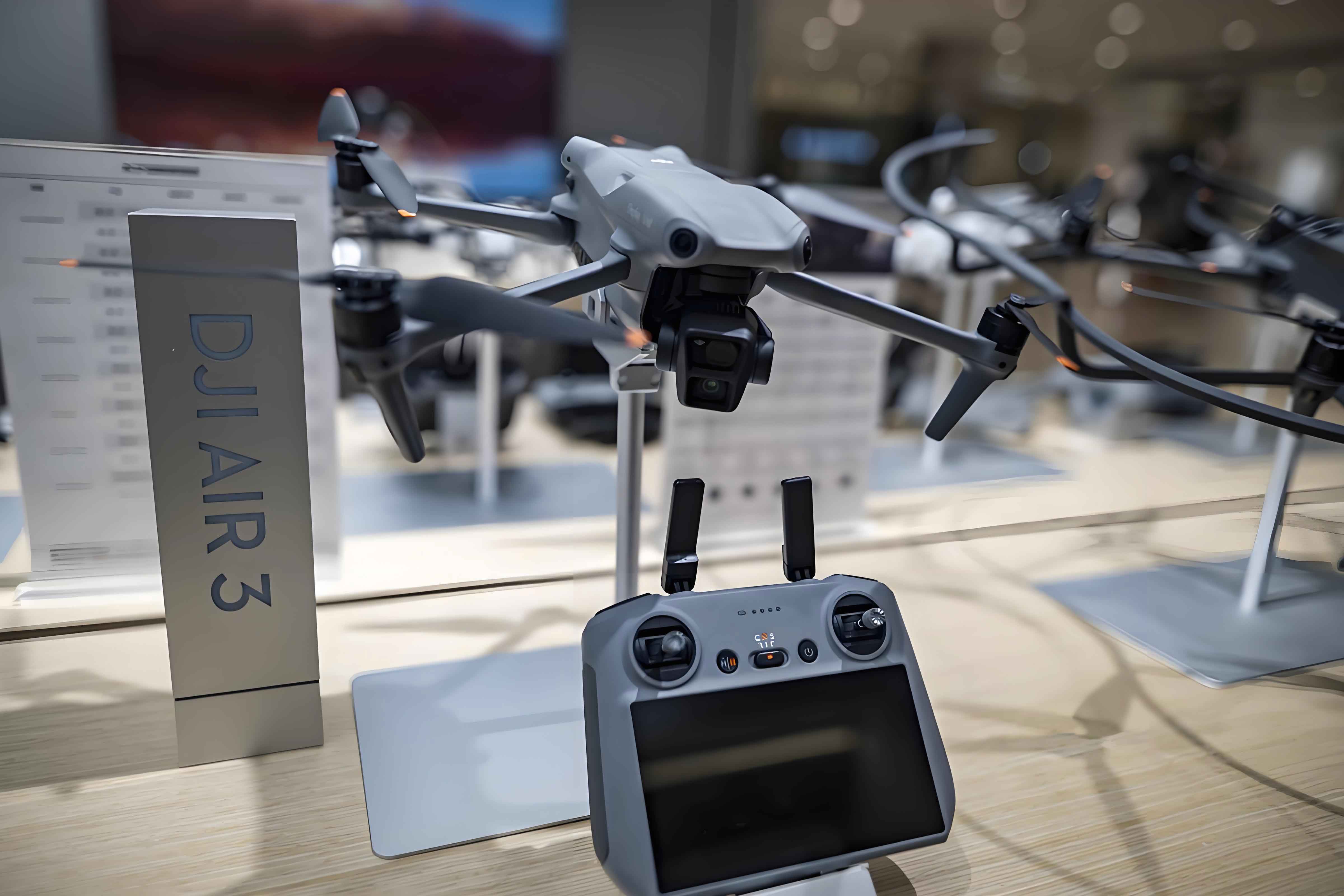
During trials, rotorcraft UAVs executing pre-programmed flight paths were engaged within the HPM beam. Post-disruption, altitude plummeted at 14.2 m/s versus controlled descent at 2 m/s. Heading data exhibited violent oscillations (6° to 350° within 12 seconds), indicating uncontrolled roll during descent. Flight data suggests motor speed irregularities caused lift asymmetry, overwhelming flight controllers. The failure cascade is modeled as:
$$\Delta L = \frac{1}{2} \rho C_L A \left( \omega_i^2 – \omega_j^2 \right)$$
where $\Delta L$ is differential lift, $\rho$ is air density, $C_L$ is lift coefficient, $A$ is rotor area, and $\omega_i$, $\omega_j$ are adjacent motor speeds.
Analysis identifies Electronic Speed Controllers (ESCs) and motor windings as primary coupling points. Induced voltages ($V_{ind}$) in motor phases follow:
$$V_{ind} = -N \frac{d\Phi_B}{dt} \approx \frac{\mu_0 N A_{coil} I_{HPM} \omega_c}{2\pi d} e^{-j\omega_c t}$$
where $N$ is winding turns, $\Phi_B$ is magnetic flux, $\mu_0$ is permeability, $A_{coil}$ is coil area, $I_{HPM}$ is incident field intensity, $\omega_c$ is carrier frequency, and $d$ is distance from source. This disrupts PWM signals, inducing motor desynchronization.
| Subsystem | Failure Threshold (V/m) | Observed Effect | Drone Manufacturer Mitigation Potential |
|---|---|---|---|
| LiPo Battery | > 10⁵ | Thermal runaway (rare) | Low – Shielding impractical |
| GPS Module | 10²–10³ | Position drift | Medium – Filtering & redundancy |
| Flight Controller | 10³–10⁴ | Processor latch-up | High – Conformal shields |
| ESCs | 10³–10⁴ | PWM distortion | Medium – Ferrite chokes |
| Brushless Motors | 10⁴–10⁵ | Back-EMF disruption | Low – Geometry limitations |
Drone manufacturer design choices critically influence resilience. Commercial-off-the-shelf (COTS) ESCs lack transient voltage suppressors, while motor windings act as efficient loop antennas. Military-grade drones from specialized drone manufacturers implement mitigation strategies, yet weight and cost constraints persist. Future swarm resilience requires drone manufacturer innovation in three areas: distributed EM hardening, frequency-agile components, and fault-tolerant motor control algorithms.
Notably, drone manufacturer sourcing of semiconductors determines latch-up susceptibility. ESCs using GaN FETs withstand higher $dV/dt$ than silicon-based equivalents, suggesting a path for drone manufacturer component selection. The power-law relationship between HPM field strength ($E$) and disruption probability ($P_d$) is:
$$P_d = 1 – e^{-\left( \frac{E}{E_0} \right)^k}$$
where $E_0$ is characteristic field strength and $k$ is the Weibull shape parameter (empirically ≈2.1 for COTS drones). This guides drone manufacturer hardening specifications.
Ultimately, motor synchronization loss proves catastrophic. The torque imbalance ($\tau$) during desynchronization follows:
$$\tau = J \frac{d\omega}{dt} + b\omega = K_t \left( i_q – \frac{V_{ind}}{R_w} \right) – \tau_L$$
where $J$ is inertia, $b$ is friction, $K_t$ is torque constant, $i_q$ is quadrature current, $R_w$ is winding resistance, and $\tau_L$ is load torque. When $V_{ind}$ corrupts $i_q$, the resulting $\tau$ variations initiate uncontrollable rotation.
This research demonstrates that narrowband HPM induces lethal motor control failures at tactically viable ranges. Drone manufacturers must prioritize electromagnetic compatibility (EMC) in motor drives and implement real-time health monitoring. As drone manufacturer swarm capabilities advance, HPM countermeasures will remain essential due to their area-effect engagement advantage against low-cost autonomous threats.