
Pier deflection poses significant safety hazards for bridges, causing eccentric loading that accelerates structural degradation. Traditional inspection methods require extensive manpower with limited coverage and accuracy. This study presents a novel approach using camera drones for efficient high-pier deflection detection.
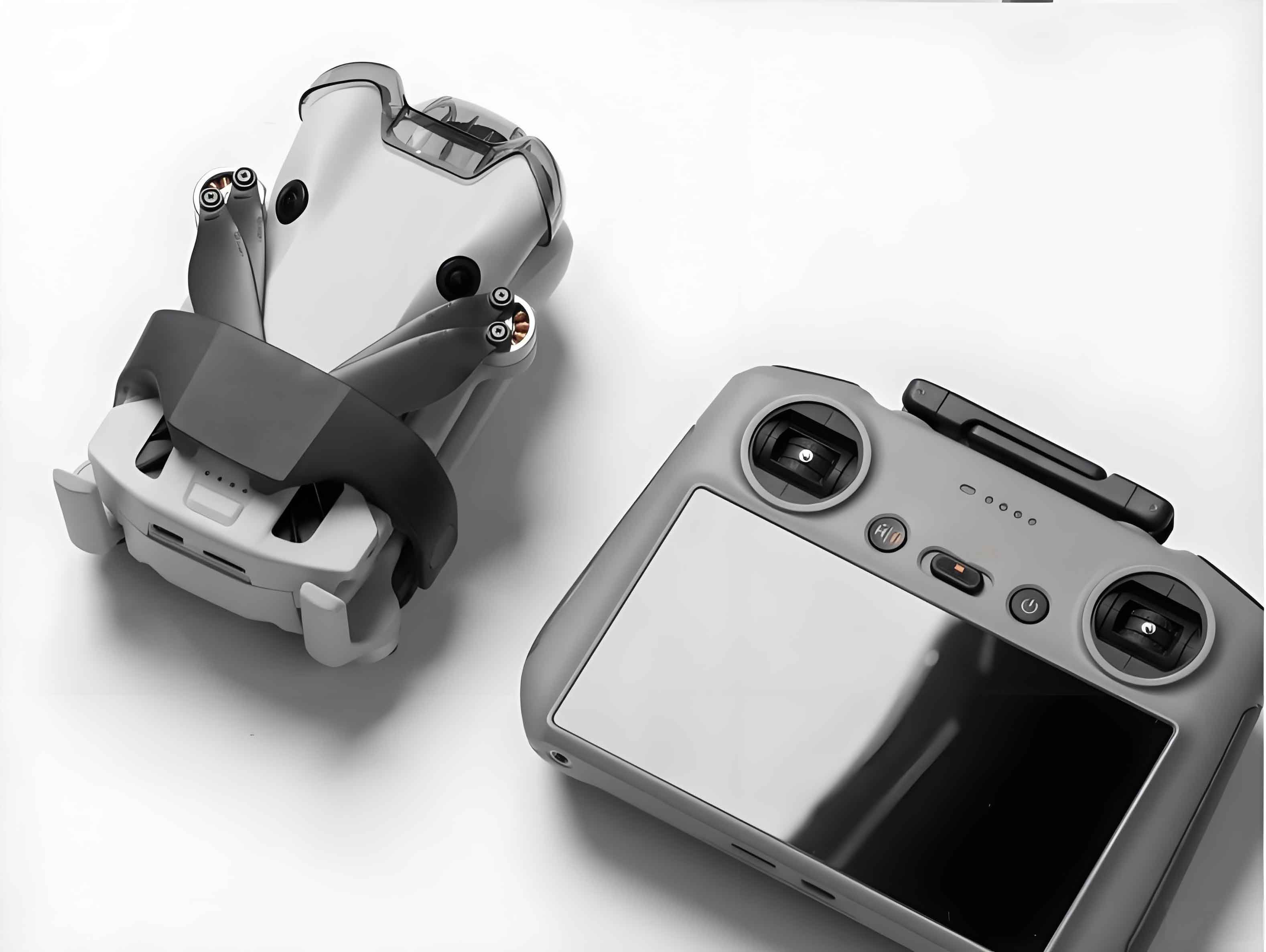
Camera UAVs offer exceptional maneuverability with vertical climb capabilities exceeding 100m, stable hovering in wind speeds up to 12m/s, and precise GPS positioning. Their compact size enables operation in confined spaces where traditional equipment fails. Modern camera drones provide real-time telemetry including:
| Parameter | Specification | Detection Advantage |
|---|---|---|
| Altitude Accuracy | ±0.5m | Consistent imaging distance |
| Tilt Resolution | 0.01° | Precise angular correction |
| Wind Resistance | Level 4 | Stable image capture |
The methodology employs camera UAVs in vertical flight paths along pier faces. At constant height intervals (typically 1m), the camera drone captures images processed through these stages:
1. Image Rectification
Correct lens tilt using drone telemetry. For tilt angle $\theta$, each image rotates by transformation matrix:
$$ R = \begin{bmatrix} \cos\theta & -\sin\theta \\ \sin\theta & \cos\theta \end{bmatrix} $$
This ensures horizontal alignment critical for measurement accuracy.
2. Coordinate System Establishment
Define the origin at the pier base midpoint. Subsequent images share the y-axis with $x$-coordinates offset by flight height $h_i$:
$$ \text{Image}_i : (x, y + h_i) \quad \text{where} \quad h_i = i \cdot \Delta h $$
3. Axis Extraction
Process images through binarization and edge detection. For each row $y_k$, pier boundaries satisfy:
$$ I(x,y_k) =
\begin{cases}
1 & \text{(pier)} \\
0 & \text{(background)}
\end{cases} $$
The central axis coordinates derive from boundary averaging:
$$ x_c = \frac{1}{2} \left[ \min\{x | I(x,y_k)=1\} + \max\{x | I(x,y_k)=1\} \right] $$
$$ (x_c, y_k) = \text{axis point} $$
4. Central Axis Fitting
Pier deflection follows elastic deformation principles. Under bending moment $M$, the central axis equation is quadratic:
$$ y = ax^2 + bx + c $$
where parameters relate to material properties:
$$ a = -\frac{\mu M}{2EI}, \quad b = \frac{Mh}{EI} $$
with $E$ = Young’s modulus, $I$ = moment of inertia, $\mu$ = Poisson’s ratio.
| Image No. | $a$ ($\times10^{-5}$) | $b$ ($\times10^{-3}$) |
|---|---|---|
| 1 | -1.041 | 3.843 |
| 2 | -1.009 | 3.844 |
| 3 | -1.016 | 3.841 |
| … | … | … |
| 15 | -1.018 | 3.849 |
| Mean | -1.013 | 3.845 |
5. Deflection Calculation
The deflection angle $\alpha$ at pier base ($x=0$) is:
$$ \frac{dy}{dx} = 2ax + b \quad \xrightarrow{x=0} \quad \tan\alpha = b $$
$$ \alpha = \tan^{-1}(b) $$
For $b=3.845\times10^{-3}$, $\alpha = 0.22^\circ$.
Accuracy Validation
Simulated 5° deflection tests confirmed method precision:
| Actual Angle | Measured Angle | Error |
|---|---|---|
| 5.00° | 4.72° | 5.6% |
The minimal error demonstrates camera UAV effectiveness for infrastructure monitoring.
Operational Workflow
Field implementation involves:
1. Position camera drone perpendicular to pier face (2m optimal)
2. Execute automated vertical flight with image capture
3. Process images through MATLAB algorithm
4. Generate deflection report within 15 minutes
Advantages Over Traditional Methods
| Metric | Camera UAV | Manual Inspection |
|---|---|---|
| Time per pier | 20 min | 4 hours |
| Accessibility | All surfaces | Limited zones |
| Data precision | ±0.1° | ±0.5° |
This camera drone-based method revolutionizes infrastructure monitoring, enabling rapid, accurate deflection assessment without scaffolding or traffic disruption. Future developments in camera UAV stabilization and AI processing promise sub-millimeter precision for next-generation structural health monitoring.