
The proliferation of unmanned aerial vehicles (UAVs) has ushered in a new era of convenience, transforming sectors from logistics and infrastructure inspection to cinematography and emergency response. However, this rapid adoption concurrently introduces significant security and privacy threats in dense urban landscapes. Malicious actors can exploit drones for espionage, contraband delivery, disruption of critical infrastructure, or even acts of terror. Consequently, the development and deployment of effective anti-drone systems have become a critical imperative for urban safety and airspace sovereignty. The challenge is uniquely complex in cities: we must secure the sky without harming the very fabric of urban life—its people, its constant electromagnetic heartbeat, and its daily operations. This document outlines a vision for the future of urban anti-drone technology, analyzing current limitations and proposing integrated solutions powered by advancements in telecommunications and artificial intelligence.
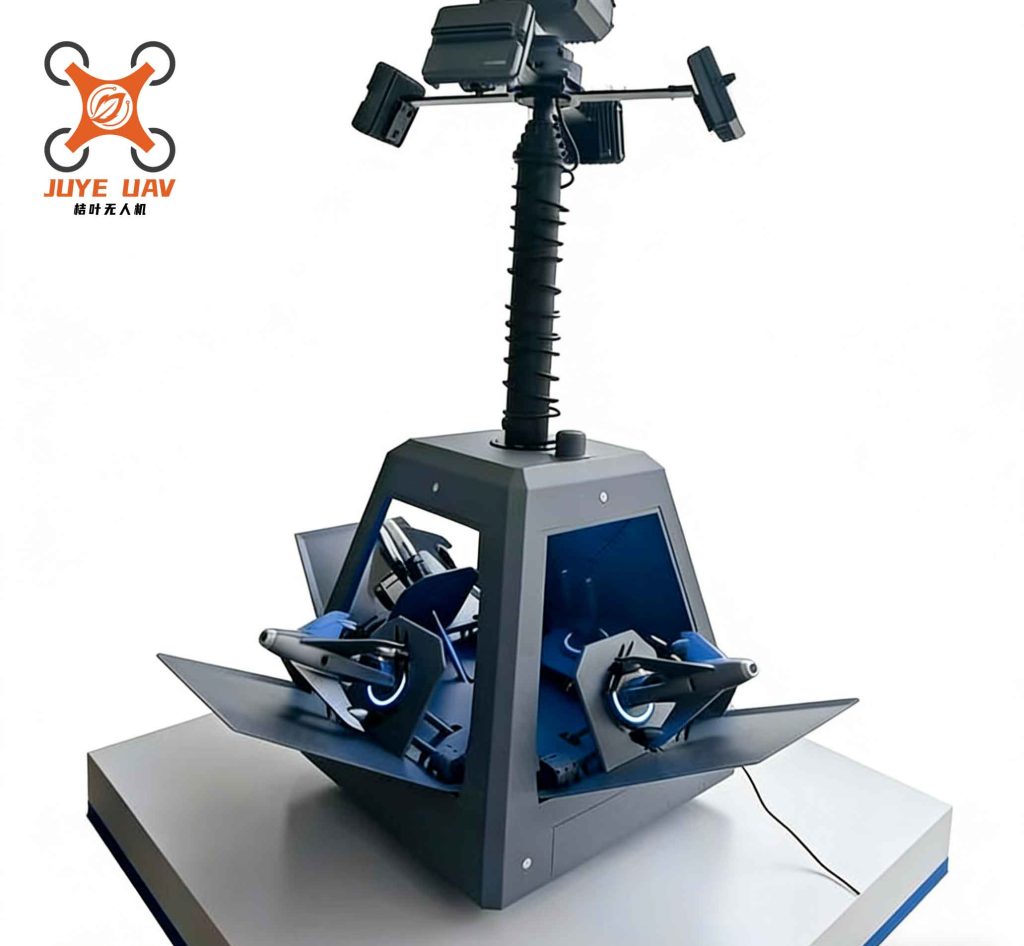
The Current Landscape of anti-drone Technologies
Present-day anti-drone systems are typically bifurcated into detection and mitigation segments, often deployed as standalone or loosely integrated solutions.
Detection Modalities
Detection is the first and crucial layer of defense. No single sensor is perfect; each has strengths compromised by urban constraints.
| Technology | Principle | Strengths | Urban Limitations |
|---|---|---|---|
| Radar | Active emission and reception of radio waves to determine range, velocity, and angle. | All-weather, long-range, good for tracking. | Line-of-sight blocked by buildings; high false alarms from clutter (birds, debris); active emission may cause interference. |
| Electro-Optical/Infrared (EO/IR) | Passive imaging using visible or infrared cameras. | Provides positive visual identification, high accuracy in clear conditions. | Severely degraded by weather (fog, rain, smoke), darkness (for EO); limited field of view requires cueing. |
| Radio Frequency (RF) Sensing | Passive detection and analysis of communication signals between drone and controller. | Passive (non-emitting), provides target identification (via RF fingerprinting), can locate source. | Drowns in dense urban RF noise (Wi-Fi, Bluetooth, 4G/5G); ineffective against pre-programmed or 4G/5G-controlled drones. |
| Acoustic Sensing | Detection of unique acoustic signatures from rotor blades and motors. | Passive, omnidirectional, works in visual obscurants. | Very short range; ineffective in noisy urban environments; high false positive rate. |
Modern systems often employ sensor fusion, combining data from multiple detectors (e.g., radar cueing an EO/IR camera) to improve reliability. The location of a drone using multiple RF sensors often relies on Time Difference of Arrival (TDOA) algorithms. If multiple sensors at known locations $(x_i, y_i, z_i)$ receive a signal at times $t_i$, the time differences define hyperbolic surfaces on which the emitter $(x, y, z)$ must lie. For sensors 1 and 2:
$$c \cdot (t_2 – t_1) = \sqrt{(x-x_2)^2+(y-y_2)^2+(z-z_2)^2} – \sqrt{(x-x_1)^2+(y-y_1)^2+(z-z_1)^2}$$
where $c$ is the speed of light. Solving this set of equations for multiple sensor pairs yields the drone’s position.
Mitigation Techniques
Once detected and deemed a threat, a drone must be neutralized. Mitigation strategies fall into “soft-kill” (electronic) and “hard-kill” (physical) categories.
| Category | Technique | Mechanism | Urban Suitability |
|---|---|---|---|
| Soft-Kill | Radio Jamming | Overwhelms command & control (C2) and/or GNSS (GPS) links with noise. | Low. Causes widespread collateral interference to legitimate communications and navigation; illegal in many areas. |
| Spoofing | Transmits forged GNSS or C2 signals to take control or divert the drone. | Moderate. More precise than jamming but still poses GNSS denial risks; complex to execute against encrypted links. | |
| Cyber Takeover | Exploits software vulnerabilities to hijack the drone’s systems. | High (theoretically). Non-kinetic, precise. However, it is highly specific to drone model/software and not yet reliable for real-time defense. | |
| Hard-Kill | Kinetic Intercept | Uses nets, projectiles, or interceptor drones for physical capture/destruction. | Very Low. Falling debris poses extreme public safety hazard in cities. |
| High-Energy Laser (HEL) | Focuses laser energy to burn through critical components. | Low. Line-of-sight only; atmospheric attenuation (fog, rain); significant safety concerns for eyesight and causing fires. | |
| High-Power Microwave (HPM) | Emits powerful microwaves to fry electronic circuits. | Very Low. Indiscriminate area effect would disable all electronics in a wide cone, a catastrophic scenario in a city. |
The conclusion is stark: most existing anti-drone mitigation tools are fundamentally unsuited for dense urban environments due to safety and collateral damage concerns.
Core Challenges for Urban anti-drone Operations
The urban canyon presents a multifaceted problem set for traditional anti-drone architectures:
1. Physical Occlusion: Buildings create a labyrinth that blocks line-of-sight for radar, EO/IR, and directed energy weapons. A drone flying below roof level becomes virtually invisible and untargetable to ground-based systems.
2. Electromagnetic Congestion: The urban RF spectrum is saturated. Distinguishing a drone’s control signal from countless Wi-Fi, cellular, and IoT emissions is like finding a specific voice in a roaring stadium. This renders passive RF detection unreliable.
3. Strict Operational Constraints: The primary mandate is “do no harm.” Any solution that risks physical injury, property damage, or widespread disruption of essential communications (cellular, GPS, emergency bands) is non-viable. The regulatory and safety burden is immense.
4. Evolving Drone Threats: Drones are becoming smarter and more resilient. They are incorporating 4G/5G for beyond-visual-line-of-sight (BVLOS) control, making RF detection based on traditional ISM bands obsolete. Advanced drones use vision-based navigation and inertial systems, rendering GNSS spoofing ineffective. Swarm technology further complicates the threat picture.
A Vision for the Future: Pervasive, Intelligent, and Non-Disruptive anti-drone Systems
Overcoming these challenges requires a paradigm shift from isolated, high-power systems to a distributed, intelligent, and adaptive urban anti-drone ecosystem. This vision leverages the city’s existing infrastructure and the latest breakthroughs in telecommunications and AI.
1. Ubiquitous Detection: Turning the City into a Sensor
The key to solving occlusion is density. Instead of few, expensive dedicated sensors, we must create a dense, low-cost detection mesh.
a) 5G/6G Integrated Sensing and Communication (ISAC): The most promising path is to co-opt the pervasive mobile network. Future 5G-Advanced and 6G base stations are being designed with native radar-like sensing capabilities. They can use their communication signals to detect and track objects—a concept known as ISAC. Every cell tower becomes a potential anti-drone sensor. The mathematical formulation involves analyzing the perturbation of the communication channel. The received signal $y(t)$ can be modeled as:
$$y(t) = \alpha s(t-\tau) e^{j2\pi f_d t} + w(t)$$
where $s(t)$ is the transmitted 5G signal, $\alpha$ is attenuation, $\tau$ is delay (for range), $f_d$ is Doppler shift (for velocity), and $w(t)$ is noise. By processing the channel state information (CSI) from multiple base stations, drones can be localized without any dedicated radar emission. This provides seamless, cell-level coverage throughout the urban fabric.
b) Intelligent Reflecting Surface (IRS)-Assisted Sensing: IRS are planar arrays of low-cost, reconfigurable metamaterial elements that can dynamically shape how radio waves are reflected. Strategically placed on building facades, they can solve the “last-meter” occlusion problem. If a drone is hidden from a sensing node (like a 5G base station), an IRS can be electronically tuned to create an alternative reflection path, effectively “bending” the sensing signal around the corner to illuminate the target. This can be optimized by solving:
$$\max_{\mathbf{\Phi}} \quad P_r(drone)$$
$$\text{subject to} \quad \mathbf{\Phi} = \text{diag}(e^{j\theta_1}, …, e^{j\theta_N})$$
where $\mathbf{\Phi}$ is the IRS reflection matrix with controllable phase shifts $\theta_n$, and $P_r$ is the power reflected towards the hidden drone.
c) Distributed Camera Network with Edge AI: Millions of security and traffic cameras already blanket cities. Upgrading them with lightweight AI chips enables a distributed visual detection grid. Using convolutional neural networks (CNNs) trained on drone imagery, these cameras can autonomously detect and classify drones, forwarding alerts to a central system. This leverages existing infrastructure for low-altitude, visual-line-of-sight coverage, complementing the RF-based sensing layer.
d) Advanced RF Signal Separation: To tackle RF congestion, advanced signal processing is required. Blind source separation techniques, like Independent Component Analysis (ICA), can be employed. Assuming $m$ received mixed signals $\mathbf{x}(t)$ from $n$ sources (drones, WiFi, etc.):
$$\mathbf{x}(t) = \mathbf{A}\mathbf{s}(t)$$
where $\mathbf{A}$ is an unknown mixing matrix and $\mathbf{s}(t)$ are the independent source signals. ICA algorithms estimate an unmixing matrix $\mathbf{W}$ to recover the sources: $\mathbf{\hat{s}}(t) = \mathbf{W}\mathbf{x}(t)$. This allows for the isolation of a drone’s RF signature even in a crowded spectrum.
2. Precise, Contained, and Adaptive Mitigation
Mitigation must be as surgical as the detection mesh is pervasive.
a) Autonomous Counter-UAV Swarms: The most elegant solution is to fight drones with drones. Small, agile counter-UAVs can be deployed from rooftops or mobile units. They are the ideal mitigation tool for cities: they can pursue a threat drone in 3D space, avoiding buildings, and employ contained effects. These effects include:
- Precision Net Capture: Firing a net to entangle the target’s rotors.
- Close-Proximity Jamming: Flying alongside the target and emitting a very low-power, focused jamming signal that only affects the target drone, minimizing collateral impact.
- Physical Nudging: Safely herding the drone to a designated containment area.
b) Generative AI for Smart Electronic Warfare: The future of electronic mitigation lies in intelligence, not power. Generative Adversarial Networks (GANs) can revolutionize electronic attack. A GAN framework can be trained for anti-drone spoofing: a Generator ($G$) creates sophisticated spoofing signals, while a Discriminator ($D$) tries to distinguish them from real drone C2 signals. They are trained simultaneously in a minimax game:
$$\min_G \max_D V(D, G) = \mathbb{E}_{x \sim p_{data}(x)}[\log D(x)] + \mathbb{E}_{z \sim p_z(z)}[\log(1 – D(G(z)))]$$
where $x$ is real signal data and $z$ is noise. Once trained, $G$ can generate adaptive, waveform-agile spoofing signals that are highly likely to deceive a specific class of drone, enabling clean takeover or diversion without blanket jamming.
c) Directed, Manageable RF Effects: For scenarios requiring immediate signal denial, new antenna technologies like phased arrays and multiple-input multiple-output (MIMO) systems can create extremely focused, steerable nulls directed solely at the threat drone. This “RF scalpel” approach minimizes the energy spilled into the surrounding environment. The beamforming weights $\mathbf{w}$ can be calculated to maximize power towards the drone’s angle $\theta_d$ while placing nulls in directions of sensitive infrastructure $\theta_i$:
$$\begin{aligned}
\max_{\mathbf{w}} \quad & \mathbf{w}^H \mathbf{a}(\theta_d) \mathbf{a}^H(\theta_d) \mathbf{w} \\
\text{s.t.} \quad & \mathbf{w}^H \mathbf{a}(\theta_i) = 0, \quad \forall i \\
& \|\mathbf{w}\|^2 = 1
\end{aligned}$$
where $\mathbf{a}(\theta)$ is the array steering vector.
The Integrated Urban anti-drone Architecture
The future system is a unified cognitive network. Data flows from the pervasive sensor fabric (5G ISAC, IRS-enhanced nodes, AI cameras) to a central or distributed AI “brain.” This brain performs real-time sensor fusion, threat assessment, and trajectory prediction. It then commands the most appropriate, localized mitigation asset—dispatching a counter-swarm, activating a precise RF null from a nearby node, or initiating a AI-generated cyber/spoofing attack. All actions are logged, and the system continuously learns from outcomes. Regulatory “geofences” and safety rules are hard-coded into its decision-making core to prevent any action that could endanger the public.
In conclusion, the future of urban anti-drone defense lies not in powerful, standalone systems but in a deeply integrated, intelligent network that turns the city’s own infrastructure into its shield. By leveraging 5G/6G ISAC, Intelligent Reflecting Surfaces, distributed AI vision, and autonomous countermeasures guided by generative AI, we can envision a system that provides seamless, safe, and persistent protection of the low-altitude urban sky. This ecosystem will enable the safe integration of commercial and recreational drones while robustly defending against malicious use, ensuring that the air above our cities remains a secure domain for innovation and daily life.