
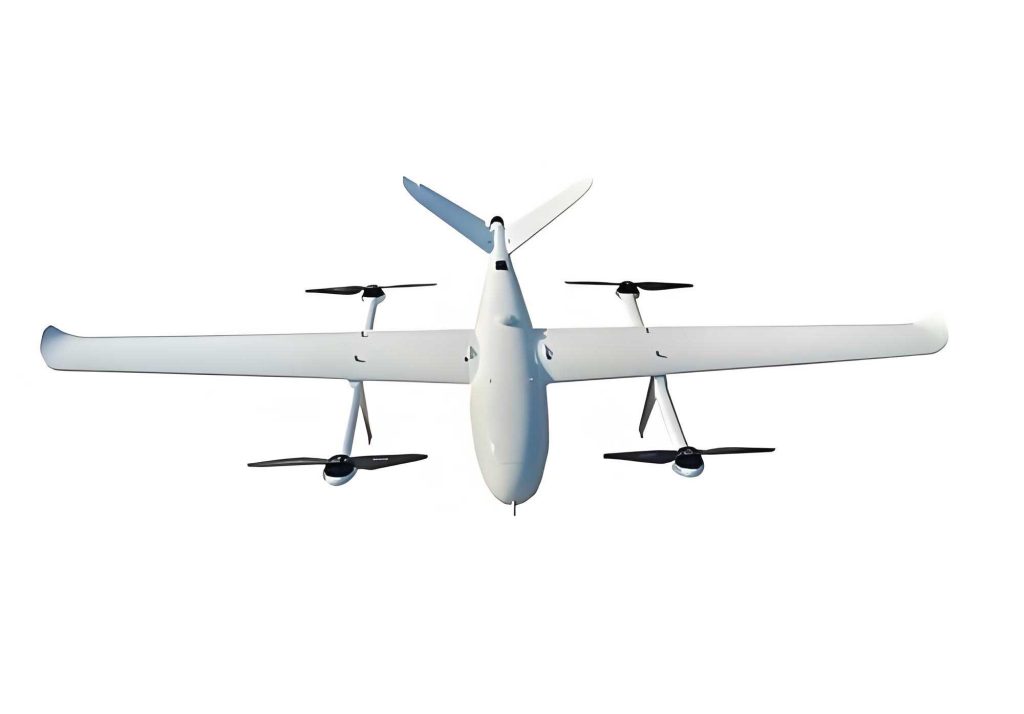
The design of high-performance control systems for Vertical Take-Off and Landing (VTOL) Unmanned Aerial Vehicles (UAVs) presents significant challenges due to their inherent nonlinear dynamics, strong coupling between axes, and sensitivity to external disturbances and model uncertainties. This is particularly critical during the VTOL phase, where precise attitude stabilization is paramount for safe operation. In this work, we address the attitude control problem for a quad tilt-rotor (QTR) VTOL UAV operating in hover and low-speed vertical flight modes. We propose a robust control strategy that synergistically integrates fractional calculus theory, sliding mode variable structure control, a novel reaching law, and a super-twisting second-order sliding mode disturbance observer to achieve accurate and resilient attitude tracking in the presence of composite disturbances.
The dynamic model of the VTOL UAV during vertical flight is characterized by coupled rotational motions. Under the assumptions of small Euler angles typical for hover and low-speed regimes, the attitude dynamics can be derived. Considering model inaccuracies and external disturbances, the rotational dynamics for roll ($\phi$), pitch ($\theta$), and yaw ($\psi$) are expressed as:
$$ \ddot{\phi} = f_1(\mathbf{x}, t) + g_1 u_1 + T_{d1} $$
$$ \ddot{\theta} = f_2(\mathbf{x}, t) + g_2 u_2 + T_{d2} $$
$$ \ddot{\psi} = f_3(\mathbf{x}, t) + g_3 u_3 + T_{d3} $$
where $\mathbf{x} = [\phi, \dot{\phi}, \theta, \dot{\theta}, \psi, \dot{\psi}]^T$ is the state vector, $f_k$ encapsulate the known nonlinear and cross-coupling terms, $g_k$ are control gains, $u_k$ are the control inputs (differential thrusts and nacelle tilts), and $T_{dk}$ represent the composite disturbances for each channel. These disturbances lump together unmodeled dynamics $\Delta f_k$, parametric uncertainties $\Delta g_k$, and external disturbances $d_k$: $T_{dk} = \Delta f_k(\mathbf{x}, t) + \Delta g_k u_k + d_k$. The control objective is to design $u_k$ such that the attitude angles $\phi, \theta, \psi$ accurately track desired reference commands $\phi_d, \theta_d, \psi_d$ despite the influence of $T_{dk}$.
Sliding Mode Control (SMC) is a powerful technique for controlling nonlinear systems with uncertainties due to its inherent invariance properties once the system state reaches a predetermined sliding surface. However, conventional integer-order SMC can suffer from chattering and may not fully exploit the system’s dynamic memory. To enhance performance, we incorporate fractional calculus. The Caputo definition of a fractional-order derivative/integral of order $\alpha$ for a function $f(t)$ is employed:
$$ _{t_0}D^{\alpha}_t f(t) = \frac{1}{\Gamma(m-\alpha)} \int_{t_0}^{t} \frac{f^{(m)}(\tau)}{(t-\tau)^{\alpha-m+1}} d\tau, \quad m-1 < \alpha < m $$
where $\Gamma(\cdot)$ is the Gamma function. The fractional operator’s hereditary property, where the weighting kernel $\frac{1}{(t-\tau)^{\alpha-m+1}}$ decays over time, allows for a more nuanced and memory-dependent control action compared to its integer-order counterpart, potentially leading to smoother transient responses.
We define a Fractional-Order Proportional-Integral-Derivative (FOPID) sliding surface $s_k$ for each attitude channel $k=1,2,3$:
$$ s_k = \lambda_{k1} e_{(2k-1)} + \dot{e}_{(2k-1)} + \lambda_{k2} D^{\eta_1} e_{(2k-1)} + \lambda_{k3} D^{-\eta_2} e_{(2k-1)} $$
where $e_{(2k-1)} = x_{(2k-1)} – x_{d(2k-1)}$ is the tracking error (e.g., $\phi – \phi_d$), $\dot{e}$ is its derivative, $D^{\eta_1}$ is a fractional differentiator of order $\eta_1 \in (0,1)$, $D^{-\eta_2}$ is a fractional integrator of order $\eta_2 \in (0,1)$, and $\lambda_{k1}, \lambda_{k2}, \lambda_{k3}$ are positive tuning gains. This surface generalizes the traditional PID sliding surface by incorporating fractional-order terms, offering additional degrees of freedom for shaping the system’s convergence behavior on the sliding manifold.
The convergence of the system state to the sliding surface $s_k=0$ is governed by the reaching law. Traditional laws like the constant rate or exponential reaching law often involve a trade-off between convergence speed and chattering. To achieve fast convergence while maintaining a smooth control signal, we propose a novel fast reaching law with second-order sliding mode characteristics:
$$ \dot{s}_k = -\epsilon_{k1} \left( \frac{1}{1+|s_k|} \right)^{\alpha} \text{sign}(s_k) – \epsilon_{k2} |s_k|^{\alpha} s_k $$
where $\epsilon_{k1}, \epsilon_{k2} > 0$ and $\alpha \in (0,1)$. When $|s_k|$ is large, the term $-\epsilon_{k2} |s_k|^{\alpha} s_k$ dominates, providing rapid convergence. As $|s_k|$ becomes small, the term $-\epsilon_{k1} ( \frac{1}{1+|s_k|} )^{\alpha} \text{sign}(s_k)$ dominates, ensuring a smooth approach to the sliding surface and reducing chattering. It can be proven that this law guarantees finite-time convergence of both $s_k$ and $\dot{s}_k$ to zero.
To robustly counteract the composite disturbances $T_{dk}$, a Super-Twisting (ST) second-order sliding mode observer is designed for each channel. The ST algorithm provides finite-time convergence of the estimation error without the need for direct differentiation of the output, and it smoothens the discontinuous sign function through integration. The observer structure is:
$$ \dot{\hat{x}}_{(2k)} = f_k(\mathbf{x}, t) + g_k u_k + \hat{T}_{dk} $$
$$ \hat{T}_{dk} = \beta_{k1} |z_k|^{1/2} \text{sign}(z_k) + \beta_{k2} \int_0^t \text{sign}(z_k(\tau)) d\tau $$
where $z_k = x_{(2k)} – \hat{x}_{(2k)}$ is the observation error, and $\hat{T}_{dk}$ is the estimated disturbance. For a disturbance with a bounded rate of change $|\dot{T}_{dk}| \leq C_k$, choosing gains $\beta_{k1} \geq 1.5\sqrt{C_k}$ and $\beta_{k2} \geq 1.1 C_k$ ensures that $\hat{T}_{dk}$ converges to the true $T_{dk}$ in finite time. This continuous estimate is then used for feedforward compensation.
Synthesizing the fractional-order sliding surface, the novel reaching law, and the disturbance observer, the complete control law for the VTOL UAV is derived:
$$ u_k = -g_k^{-1} \left[ \lambda_{k1} \dot{e}_{(2k-1)} + \lambda_{k2} D^{1+\eta_1} e_{(2k-1)} + \lambda_{k3} D^{1-\eta_2} e_{(2k-1)} + f_k(\mathbf{x}, t) – \ddot{x}_{d(2k-1)} + \hat{T}_{dk} + \epsilon_{k1} \left( \frac{1}{1+|s_k|} \right)^{\alpha} \text{sign}(s_k) + \epsilon_{k2} |s_k|^{\alpha} s_k \right] $$
This control law consists of several components: a feedback linearization term based on the nominal model ($f_k, g_k$), a reference feedforward term ($\ddot{x}_d$), a fractional-order error feedback term, a disturbance compensation term ($\hat{T}_{dk}$), and the reaching law terms that drive the system onto the sliding surface. The stability of the closed-loop system is analyzed using Lyapunov theory. Defining a Lyapunov function candidate $V_k = \frac{1}{2} s_k^2$ and differentiating it along the trajectories of the system under the proposed control law and with the disturbance estimation error ($\tilde{T}_{dk} = T_{dk} – \hat{T}_{dk}$) converging to zero in finite time, one can show that $\dot{V}_k \leq 0$, guaranteeing the finite-time reachability of the sliding surface $s_k=0$. Once on the surface, the fractional-order dynamics ensure asymptotic convergence of the tracking error to zero.
The performance of the proposed Fractional-Order Sliding Mode with Observer-based Disturbance compensation (FOSMOD) strategy is validated through numerical simulation of the VTOL UAV model and compared against two benchmarks: a traditional Integer-Order Sliding Mode Control (SMC) with a standard exponential reaching law, and a Dynamic Inverse PID (DIPID) controller. The simulation scenario involves commanding a simultaneous step change in roll ($2^\circ$), pitch ($2^\circ$), and yaw ($3^\circ$) from a hover condition. The system is subjected to significant model parameter uncertainties (8% variation in moments of inertia) and time-varying external disturbance torques.
| Performance Metric | FOSMOD (Proposed) | Traditional SMC | Dynamic Inverse PID |
|---|---|---|---|
| Settling Time (s) | Fastest (~2.5s) | Moderate (~3.5s) | Very Slow/Divergent |
| Steady-State Error | Negligible (~0) | Small | Large, Non-zero |
| Overshoot (%) | None | Minor | Significant |
| Control Signal Chattering | Very Low | Moderate | N/A (Smooth) |
| Robustness to Disturbances | Excellent | Good | Poor |
The Super-Twisting observer demonstrates excellent performance in estimating the composite disturbances. The estimation error converges to near zero rapidly after a brief initial transient, providing an accurate and continuous feedforward compensation signal. This is a key factor in the superior disturbance rejection capability of both the FOSMOD and traditional SMC strategies that utilize the observer.
The attitude tracking responses clearly show the advantages of the proposed method. The FOSMOD controller achieves the most precise tracking with the fastest convergence and no overshoot. The traditional SMC controller also tracks the commands effectively but with slightly slower convergence and minimal overshoot. In contrast, the DIPID controller fails to provide satisfactory tracking; it exhibits large steady-state errors and significant oscillations, demonstrating its inability to handle the strong nonlinear coupling and time-varying disturbances inherent to the VTOL UAV dynamics without explicit robust compensation mechanisms.
The control effort, or torque commands, generated by the FOSMOD controller are notably smooth. This is a direct result of the novel reaching law’s second-order sliding property ($s_k=\dot{s}_k=0$) and the continuous disturbance compensation from the ST observer. This smoothness is highly desirable in practical VTOL UAV applications as it reduces actuator wear and fuel/power consumption, and minimizes the excitation of unmodeled high-frequency dynamics.
In conclusion, this work presents a comprehensive and robust solution for the challenging problem of attitude control for VTOL UAVs. The proposed FOSMOD control framework successfully addresses critical issues: it leverages the memory property of fractional calculus for refined dynamic response, incorporates a novel fast reaching law for rapid and chattering-suppressed convergence, and employs a high-order sliding mode observer for accurate, real-time estimation and compensation of composite disturbances. The simulation results confirm that this integrated approach significantly outperforms both traditional integer-order sliding mode control and linearization-based PID control in terms of tracking accuracy, convergence speed, and robustness, making it a highly suitable candidate for enhancing the stability and performance of VTOL UAV systems in demanding operational environments. The methodology is general and can be adapted to other classes of multi-rotor or hybrid UAVs with complex dynamics.