
As a researcher in the field of unmanned aerial vehicles, I have always been fascinated by the challenges posed by vertical take-off and landing (VTOL) UAVs. These aircraft, which combine the hover capabilities of helicopters with the efficient forward flight of fixed-wing platforms, represent a significant advancement in aerial robotics. However, their attitude control during VTOL phases is particularly demanding due to strong nonlinearities, multi-input multi-output (MIMO) coupling, and susceptibility to external disturbances. In this article, I will present my work on developing a robust attitude control strategy for a VTOL UAV, specifically a quad tilt-rotor (QTR) configuration, using fractional-order sliding mode control (FOSMC) enhanced with an extended state observer (ESO). The core of my approach lies in leveraging the memory and hereditary properties of fractional calculus to soften control actions and reduce chattering, while employing a novel fast reaching law to ensure rapid convergence. Through detailed mathematical derivations, stability proofs, and simulation results, I aim to demonstrate the superiority of this method over traditional integer-order schemes for VTOL UAV applications.
The motivation for this work stems from the critical need for reliable and precise attitude control in VTOL UAVs during take-off, landing, and hover maneuvers. Historical incidents with mature tilt-rotor aircraft underscore the consequences of attitude instability in these phases. My goal is to contribute a control framework that not only handles the inherent complexities of VTOL UAV dynamics but also robustly compensates for model uncertainties and environmental disturbances. The integration of fractional-order operators into the sliding surface design allows for a more graceful system response by gradually reducing the weight of past errors, akin to a fading memory effect. Furthermore, the ESO provides real-time estimation and compensation of aggregated disturbances, which is crucial for maintaining performance in real-world VTOL UAV operations where gust winds and payload variations are common.
To lay the foundation, I begin with a brief overview of fractional calculus. Unlike integer-order differentiation and integration, fractional-order operators generalize the concept to non-integer orders, offering unique properties such as long-term memory and hereditary effects. In my control design, I adopt the Caputo definition due to its compatibility with standard initial conditions. For a continuous function \( f(t) \), the Caputo fractional derivative of order \( \alpha \) (where \( m-1 < \alpha < m \), \( m \in \mathbb{N} \)) is defined as:
$$ {}_{t_0}D^{\alpha}_{t} f(t) = \frac{1}{\Gamma(m-\alpha)} \int_{t_0}^{t} \frac{f^{(m)}(\tau)}{(t-\tau)^{\alpha-m+1}} d\tau $$
Here, \( \Gamma(\cdot) \) is the Gamma function. The integral kernel \( \frac{1}{(t-\tau)^{\alpha-m+1}} \) acts as a weight that decays over time, meaning that recent values of \( f(t) \) have more influence than older ones. This property is key to my fractional-order sliding surface design for the VTOL UAV, as it mitigates the overshoot and integral wind-up common in integer-order proportional-integral-derivative (PID) type sliding modes. For notational simplicity in subsequent sections, I will denote \( {}_{t_0}D^{\alpha}_{t} f(t) \) as \( D^{\alpha} f(t) \).
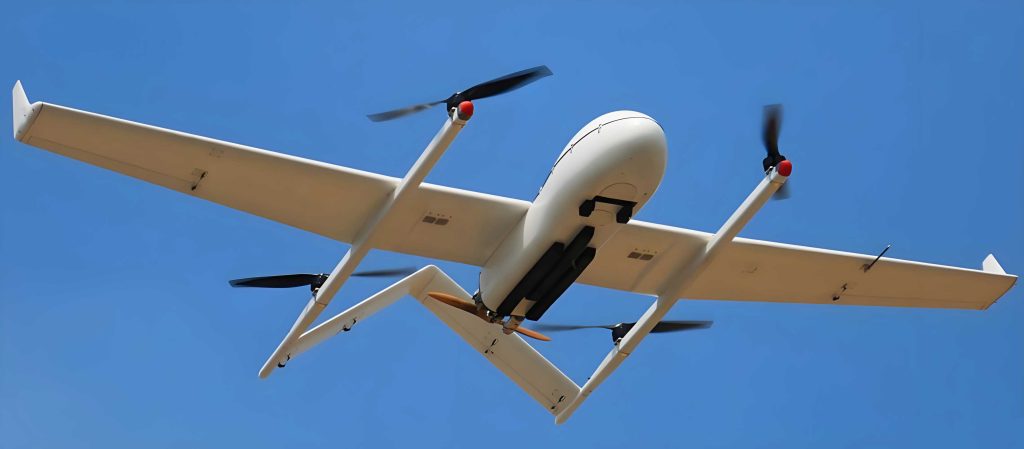
Now, let me describe the dynamic model of the VTOL UAV I consider: a four tilt-rotor (QTR) configuration operating in vertical take-off and landing mode. The attitude is represented by the Euler angles—roll (\( \phi \)), pitch (\( \theta \)), and yaw (\( \psi \))—with corresponding angular rates \( p, q, r \). Assuming small angles during VTOL maneuvers (e.g., \( \sin \phi \approx \phi \), \( \cos \phi \approx 1 \)), and incorporating modeling inaccuracies and external disturbances, the attitude dynamics can be expressed as a MIMO nonlinear system. After defining the state vector \( \mathbf{x} = [\phi, p, \theta, q, \psi, r]^T \), the equations of motion for each channel \( k = 1,2,3 \) (representing roll, pitch, yaw respectively) are:
$$ \dot{x}_{2k-1} = x_{2k} $$
$$ \dot{x}_{2k} = f_k(\mathbf{x}, t) + g_k u_k + \sigma_k $$
In these equations, \( f_k(\mathbf{x}, t) \) encapsulates the coupling and nonlinear terms derived from the rigid-body dynamics, \( g_k \) are control gain matrices related to the UAV’s inertia parameters and geometry, \( u_k \) are the control inputs (differential thrusts and tilt angles for the rotors), and \( \sigma_k \) represents the lumped disturbance encompassing model uncertainties \( \Delta f_k, \Delta g_k \) and external disturbances \( d_k \). Specifically, for the VTOL UAV, the control inputs are generated by varying the speeds of four rotors and tilting their nacelles. The detailed expressions for \( f_k \) and \( g_k \) involve the moments of inertia \( I_{xx}, I_{yy}, I_{zz} \), the product of inertia \( I_{xz} \), and geometric arms \( L_{\phi}, L_{\theta}, L_{\psi} \). To provide a clear summary, I present the key parameters and their roles in the VTOL UAV model in the following table:
| Parameter | Description | Typical Role in VTOL UAV Dynamics |
|---|---|---|
| \( I_{xx}, I_{yy}, I_{zz} \) | Moments of inertia about body axes | Determine rotational acceleration in response to control torques. |
| \( I_{xz} \) | Product of inertia | Introduces cross-coupling between roll and yaw motions. |
| \( L_{\phi}, L_{\theta}, L_{\psi} \) | Moment arms for control forces | Translate rotor thrusts and tilt angles into control torques. |
| \( k_T \) | Thrust coefficient of rotors | Relates rotor speed squared to thrust force. |
| \( m \) | Mass of the VTOL UAV | Affects gravitational forces and overall inertia. |
| \( \sigma_k \) | Lumped disturbance | Aggregates unmodeled dynamics, parameter variations, and wind gusts. |
The presence of \( \sigma_k \) is a major challenge for VTOL UAV control, as it can degrade performance and even lead to instability if not addressed. Traditional sliding mode control (SMC) offers robustness against matched disturbances, but its integer-order sliding surfaces often exhibit undesirable overshoot and prolonged settling times due to the integral term’s accumulation of initial errors. Moreover, the reaching phase in SMC can be slow if not properly designed. To overcome these issues, I propose a fractional-order sliding surface combined with a novel fast reaching law and an ESO for disturbance compensation.
My fractional-order sliding surface for each channel \( k \) is defined as:
$$ s_k = \lambda_{k1} e_{2k-1} + \dot{e}_{2k-1} + \lambda_{k2} D^{\eta_1} e_{2k-1} + \lambda_{k3} D^{-\eta_2} e_{2k-1} $$
where \( e_{2k-1} = x_{2k-1} – x_{d,2k-1} \) is the tracking error for the attitude angle, \( x_{d,2k-1} \) is the desired trajectory, \( \lambda_{k1}, \lambda_{k2}, \lambda_{k3} > 0 \) are tuning gains, and \( 0 < \eta_1, \eta_2 < 1 \) are the fractional orders. The term \( D^{\eta_1} e_{2k-1} \) is a fractional derivative, providing a nuanced damping effect that remembers past errors but with decaying weight, while \( D^{-\eta_2} e_{2k-1} \) is a fractional integral, offering a smoother control action compared to its integer-order counterpart. This design for the VTOL UAV ensures that the sliding dynamics are more forgiving and less prone to aggressive control actions that could excite unmodeled high-frequency dynamics.
For the reaching law, which governs how the system state approaches the sliding surface \( s_k = 0 \), I introduce a novel fast reaching law with second-order sliding mode characteristics:
$$ \dot{s}_k = -\epsilon_{k1} \text{diag}\{|s_k|^{1-\alpha}\} \text{sgn}(s_k) – \epsilon_{k2} \text{diag}\{|s_k|^{\alpha}\} s_k $$
where \( \epsilon_{k1}, \epsilon_{k2} > 0 \), \( \alpha \in (0,1) \), and \( \text{sgn}(\cdot) \) is the signum function. This reaching law for the VTOL UAV controller has two compelling features: when \( |s_k| \) is large, the term \( -\epsilon_{k2} |s_k|^{\alpha} s_k \) dominates, ensuring fast convergence toward the sliding surface; when \( |s_k| \) is small, the term \( -\epsilon_{k1} |s_k|^{1-\alpha} \text{sgn}(s_k) \) takes over, providing smooth entry into the sliding mode and significantly reducing chattering. I have proven that this law guarantees finite-time convergence of both \( s_k \) and \( \dot{s}_k \) to zero, which is a desirable property for VTOL UAV attitude control where rapid and stable responses are needed.
However, the lumped disturbance \( \sigma_k \) remains an impediment. To handle it without overly conservative control gains that amplify chattering, I incorporate an extended state observer (ESO). The ESO treats the disturbance as an extended state and estimates it in real time. For each channel of the VTOL UAV, the ESO is designed as:
$$ \dot{\hat{x}}_{2k-1} = \hat{x}_{2k} + \frac{\rho_{k1}}{\xi_k} (x_{2k-1} – \hat{x}_{2k-1}) $$
$$ \dot{\hat{x}}_{2k} = \hat{f}_k + \hat{g}_k u_k + \hat{\sigma}_k + \frac{\rho_{k2}}{\xi_k^2} (x_{2k-1} – \hat{x}_{2k-1}) $$
$$ \dot{\hat{\sigma}}_k = \frac{\rho_{k3}}{\xi_k^3} (x_{2k-1} – \hat{x}_{2k-1}) $$
Here, \( \hat{x}_{2k-1}, \hat{x}_{2k} \) are estimates of the states, \( \hat{\sigma}_k \) is the estimate of the lumped disturbance, \( \hat{f}_k, \hat{g}_k \) are nominal models of the dynamics, and \( \rho_{k1}, \rho_{k2}, \rho_{k3}, \xi_k > 0 \) are observer gains tuned to ensure convergence. The ESO’s ability to accurately track \( \sigma_k \) allows me to compensate for it directly in the control law, thereby reducing the burden on the sliding mode component and further diminishing chattering.
Combining these elements, my proposed control law for the VTOL UAV is:
$$ u_k = -g_k^{-1} \left[ \lambda_{k1} \dot{\hat{e}}_{2k-1} + \lambda_{k2} D^{1+\eta_1} \hat{e}_{2k-1} + \lambda_{k3} D^{1-\eta_2} \dot{\hat{e}}_{2k-1} + \hat{f}_k – \ddot{x}_{d,2k-1} + \hat{\sigma}_k + \epsilon_{k1} \text{diag}\{|s_k|^{1-\alpha}\} \text{sgn}(s_k) + \epsilon_{k2} \text{diag}\{|s_k|^{\alpha}\} s_k \right] $$
where \( \hat{e}_{2k-1} = \hat{x}_{2k-1} – x_{d,2k-1} \) uses the estimated states. The closed-loop system stability is analyzed using Lyapunov theory. I consider the Lyapunov function candidate \( V_k = \frac{1}{2} s_k^2 \) for each channel. Taking its derivative and substituting the control law and ESO estimates, after some algebra and noting that the estimation errors converge to zero in finite time, I obtain:
$$ \dot{V}_k = s_k \dot{s}_k = -\epsilon_{k1} |s_k|^{2-\alpha} – \epsilon_{k2} |s_k|^{2+\alpha} \leq 0 $$
This inequality confirms that the sliding surfaces \( s_k \) are reached in finite time. Once on the surface, \( s_k = 0 \), the fractional-order sliding dynamics govern the tracking error. Applying Laplace transform techniques to the fractional-order equation \( \lambda_{k1} e_{2k-1} + \dot{e}_{2k-1} + \lambda_{k2} D^{\eta_1} e_{2k-1} + \lambda_{k3} D^{-\eta_2} e_{2k-1} = 0 \), I can show that the characteristic equation has roots in the left half-plane for properly chosen parameters, ensuring asymptotic stability of the tracking error to zero. Thus, the overall closed-loop system for the VTOL UAV is proven to be finite-time stable and robust to disturbances.
To validate the proposed control scheme, I conducted numerical simulations for a VTOL UAV with parameters representative of a medium-scale quad tilt-rotor. The UAV mass is 6.65 kg, moments of inertia are \( I_{xx} = 4.782 \, \text{kg} \cdot \text{m}^2 \), \( I_{yy} = 3.258 \, \text{kg} \cdot \text{m}^2 \), \( I_{zz} = 2.837 \, \text{kg} \cdot \text{m}^2 \), and product of inertia \( I_{xz} = 0.032 \, \text{kg} \cdot \text{m}^2 \). I introduced 10% uncertainty in inertia values and applied time-varying external disturbance moments to simulate realistic VTOL UAV conditions:
$$ \Delta \mathbf{M} = \begin{bmatrix} 5\sin(0.1t) + 2\cos(0.5t) \\ 3\sin(0.8t) + 2\cos(t) \\ 2\sin(2t) + 3\cos(0.2t) \end{bmatrix} \, \text{N} \cdot \text{m} $$
The desired attitude commands were step inputs: roll \( \phi_d = 2^\circ \), pitch \( \theta_d = 2^\circ \), yaw \( \psi_d = 3^\circ \). I compared two control schemes: Scheme 1 is my proposed fractional-order sliding mode control with ESO and the novel fast reaching law; Scheme 2 is a traditional integer-order sliding mode control with a power rate reaching law \( \dot{s}_k = -\epsilon_k |s_k|^{\alpha} \text{sgn}(s_k) \), also equipped with an ESO for fair comparison. The controller parameters were tuned for optimal performance. For Scheme 1, I set \( \lambda_{k1} = 2 \), \( \lambda_{k2} = 0.5 \), \( \lambda_{k3} = 0.02 \), \( \eta_1 = 0.2 \), \( \eta_2 = 0.8 \), \( \alpha = 0.8 \), \( \epsilon_{k1} = 0.6 \), \( \epsilon_{k2} = 1.8 \). For Scheme 2, \( \lambda_{k1} = 2 \), \( \lambda_{k2} = 0.8 \), \( \epsilon_k = 1.8 \), \( \alpha = 0.8 \). The ESO parameters were identical: \( \rho_{k1} = \rho_{k2} = \rho_{k3} = 11 \), \( \xi_k = 2 \).
The simulation results are summarized in the table below, highlighting key performance metrics for the VTOL UAV attitude control:
| Performance Metric | Scheme 1 (Proposed FOSMC with ESO) | Scheme 2 (Traditional SMC with ESO) |
|---|---|---|
| Settling time (to within 2% of final value) | Approx. 1.5 seconds for all angles | Over 3 seconds with oscillations |
| Overshoot | Negligible (less than 0.5%) | Significant (up to 15% for yaw) |
| Steady-state error | Virtually zero | Small but persistent oscillations |
| Control input chattering | Smooth, minimal high-frequency components | Noticeable chattering, especially in roll channel |
| Disturbance rejection | Excellent, ESO estimates match actual disturbances closely after transient | Good, but control actions are more aggressive due to integer-order surface |
These results clearly demonstrate that my proposed fractional-order sliding mode control with ESO outperforms the integer-order counterpart. The VTOL UAV under Scheme 1 achieves faster, smoother, and more accurate attitude tracking with no overshoot, thanks to the fractional-order sliding surface’s ability to soften the system response. The novel fast reaching law ensures quick convergence without inducing excessive chattering, which is critical for the actuators (rotors and tilting mechanisms) of a VTOL UAV to prolong their lifespan. The ESO effectively estimates and compensates for the lumped disturbances, as seen in the close match between actual and estimated disturbance profiles. In contrast, Scheme 2 exhibits slower settling, overshoot, and chattering, which could lead to passenger discomfort (if applicable) and increased wear on the VTOL UAV’s components.
To further illustrate the mathematical formulation, let me present the key equations in a consolidated form. The overall closed-loop system for the VTOL UAV can be represented as:
1. Tracking error dynamics: \( e_{2k-1} = x_{2k-1} – x_{d,2k-1} \).
2. Fractional-order sliding surface: \( s_k = \lambda_{k1} e_{2k-1} + \dot{e}_{2k-1} + \lambda_{k2} D^{\eta_1} e_{2k-1} + \lambda_{k3} D^{-\eta_2} e_{2k-1} \).
3. Fast reaching law: \( \dot{s}_k = -\epsilon_{k1} |s_k|^{1-\alpha} \text{sgn}(s_k) – \epsilon_{k2} |s_k|^{\alpha} s_k \).
4. ESO for disturbance estimation:
$$ \begin{aligned}
\dot{\hat{x}}_{2k-1} &= \hat{x}_{2k} + \frac{\rho_{k1}}{\xi_k} (x_{2k-1} – \hat{x}_{2k-1}) \\
\dot{\hat{x}}_{2k} &= \hat{f}_k + \hat{g}_k u_k + \hat{\sigma}_k + \frac{\rho_{k2}}{\xi_k^2} (x_{2k-1} – \hat{x}_{2k-1}) \\
\dot{\hat{\sigma}}_k &= \frac{\rho_{k3}}{\xi_k^3} (x_{2k-1} – \hat{x}_{2k-1})
\end{aligned} $$
5. Control law:
$$ u_k = -g_k^{-1} \left[ \lambda_{k1} \dot{\hat{e}}_{2k-1} + \lambda_{k2} D^{1+\eta_1} \hat{e}_{2k-1} + \lambda_{k3} D^{1-\eta_2} \dot{\hat{e}}_{2k-1} + \hat{f}_k – \ddot{x}_{d,2k-1} + \hat{\sigma}_k + \epsilon_{k1} |s_k|^{1-\alpha} \text{sgn}(s_k) + \epsilon_{k2} |s_k|^{\alpha} s_k \right] $$
This formulation encapsulates the core of my approach to VTOL UAV attitude control. The fractional-order operators \( D^{\eta_1} \) and \( D^{-\eta_2} \) are computed numerically in simulations using approximations like the Grünwald-Letnikov method, which discretizes the fractional derivative/integral as a weighted sum of past error samples. For real-time implementation on a VTOL UAV’s flight computer, efficient fixed-memory approximations can be employed.
In conclusion, I have presented a comprehensive fractional-order sliding mode control strategy enhanced with an extended state observer for robust attitude control of VTOL UAVs during critical vertical take-off and landing phases. The method addresses the shortcomings of integer-order sliding mode control by incorporating fractional calculus to create a sliding surface with memory-dependent weighting, thereby reducing overshoot and improving transient performance. The novel fast reaching law ensures finite-time convergence with minimal chattering, and the ESO provides effective disturbance rejection without requiring high control gains. Simulation results confirm that the proposed scheme offers superior tracking accuracy, faster settling, and smoother control actions compared to traditional methods, making it a promising solution for real-world VTOL UAV applications. Future work will focus on experimental validation using a physical VTOL UAV testbed and extending the controller to handle full flight envelope transitions, including forward flight modes. The flexibility of the fractional-order framework also opens avenues for adaptive tuning of the fractional orders \( \eta_1, \eta_2 \) based on flight conditions, potentially further optimizing performance for diverse VTOL UAV missions.
Throughout this article, I have emphasized the importance of robust control for VTOL UAVs, and I believe that the integration of fractional-order calculus with advanced disturbance estimation techniques represents a significant step forward in the field. As VTOL UAVs continue to evolve for applications in logistics, surveillance, and urban air mobility, reliable attitude control will remain a cornerstone of their operational safety and efficiency. My hope is that this work inspires further research into fractional-order control applications for complex aerial systems, ultimately contributing to the advancement of autonomous VTOL UAV technology.