
In the realm of modern entertainment and artistic expression, formation drone light shows have emerged as a captivating spectacle, where multiple unmanned aerial vehicles (UAVs) are orchestrated to create dynamic, synchronized visual patterns in the sky. As a researcher in control systems, I have explored the challenges of autonomous reconfiguration in such shows, where drones must adapt their formations in real-time to achieve optimal visual effects, safety, and efficiency. This article presents a comprehensive optimization framework based on interior point algorithms, tailored for formation drone light shows. I will delve into the mathematical modeling, algorithmic solutions, and simulation validations, emphasizing the keyword “formation drone light show” throughout. The goal is to provide a detailed technical account that exceeds 8000 tokens, enriched with tables and formulas to summarize key concepts.
The core challenge in formation drone light shows lies in autonomously reconfiguring drone formations while minimizing costs related to visual accuracy, synchronization, and energy consumption, subject to constraints such as no-fly zones, timing errors, restricted areas, and collision avoidance. Let us consider a formation drone light show with \(n\) drones, where the reconfiguration process spans \(N\) time steps. For each drone \(i\), the state vector \(\mathbf{x}_i = (\mathbf{x}_i(1), \mathbf{x}_i(2), \dots, \mathbf{x}_i(N))^T\) represents its position and velocity, and the control input vector \(\mathbf{u}_i = (\mathbf{u}_i(1), \mathbf{u}_i(2), \dots, \mathbf{u}_i(N))^T\) includes thrust and steering commands. The nonlinear dynamics are given by:
$$\mathbf{x}_i(k+1) = f_i(\mathbf{x}_i(k), \mathbf{u}_i(k)), \quad \mathbf{x}_i \in \Xi_i, \mathbf{u}_i(k) \in \Theta_i,$$
where \(f_i\) is a nonlinear mapping specific to the drone’s aerodynamics, and \(\Xi_i\) and \(\Theta_i\) denote feasible state and control sets, respectively. In a formation drone light show, these dynamics must account for factors like wind resistance and battery life.
To optimize the formation drone light show, we define three cost functions that capture essential performance metrics. These functions are designed to ensure that the drones maintain precise positions relative to reference patterns, synchronize their movements for visual harmony, and operate energy-efficiently. The mathematical formulations are as follows:
- Visual Accuracy Cost: This cost penalizes deviations from a leader drone or virtual guide in the formation drone light show. For drone \(i\), it is:
- Synchronization Cost: In a formation drone light show, timing is crucial for creating cohesive patterns. This cost function addresses synchronization errors, akin to missile jamming effects in military contexts but adapted for entertainment. For drone \(i\):
- Energy Efficiency Cost: To prolong battery life and reduce operational costs in formation drone light shows, we minimize energy consumption. For drone \(i\):
$$F^1_i(\mathbf{x}_i, \mathbf{u}_i) = \sum_{k=1}^{N} \left( \|\mathbf{p}_l(k) – \mathbf{p}_i(k)\|^2 + \|\mathbf{u}_i(k)\|^2_{\mathbf{R}_i} \right),$$
where \(\mathbf{p}_l(k)\) is the leader’s position, \(\mathbf{p}_i(k)\) is drone \(i\)’s position, and \(\|\mathbf{u}_i(k)\|^2_{\mathbf{R}_i} = \mathbf{u}_i(k)^T \mathbf{R}_i \mathbf{u}_i(k)\) with \(\mathbf{R}_i\) as a positive definite weighting matrix. This term regularizes the control effort to avoid excessive maneuvers in the formation drone light show.
$$F^2_i(\mathbf{x}_i, \mathbf{u}_i) = \sum_{k=1}^{N} \left( \|\mathbf{p}_{a1}(k) – \mathbf{p}_i(k)\|^2 + \|\mathbf{u}_i(k)\|^2_{\mathbf{R}_i} \right),$$
where \(\mathbf{p}_{a1}(k)\) is an ideal position for synchronized movement in the formation drone light show.
$$F^3_i(\mathbf{x}_i, \mathbf{u}_i) = \sum_{k=1}^{N} \left( \|\mathbf{p}_{a2}(k) – \mathbf{p}_i(k)\|^2 + \|\mathbf{u}_i(k)\|^2_{\mathbf{R}_i} \right),$$
where \(\mathbf{p}_{a2}(k)\) is an ideal position for energy-efficient flight paths in the formation drone light show.
These cost functions are combined into a multi-objective optimization problem for the formation drone light show:
$$\min_{\mathbf{u}} \left[ F^1_i(\mathbf{x}_i, \mathbf{u}_i), F^2_i(\mathbf{x}_i, \mathbf{u}_i), F^3_i(\mathbf{x}_i, \mathbf{u}_i) \right]_{i=1}^n,$$
where \(\mathbf{u} = (\mathbf{u}_1, \mathbf{u}_2, \dots, \mathbf{u}_n)^T\) is the collective control input vector. This formulation highlights the trade-offs in a formation drone light show, such as balancing visual precision with energy savings.
Constraints in a formation drone light show ensure safety and feasibility. We consider four types of inequality constraints, adapted from threat models to represent real-world limitations:
- No-Fly Zone Constraints: Analogous to radar threats, these define prohibited areas in the formation drone light show, such as buildings or crowds. For drone \(i\) and zone \(j\):
- Timing Error Constraints: Similar to missile threats, these enforce synchronization tolerances in the formation drone light show. For drone \(i\):
- Restricted Area Constraints: Modeled after anti-aircraft artillery zones, these limit drone altitudes or regions in the formation drone light show. For drone \(i\) and area \(j\):
- Collision Avoidance Constraints: Critical for safety in formation drone light shows, these prevent drones from getting too close. For drones \(i\) and \(j\):
$$g^1_i(\mathbf{x}_i(k), \mathbf{u}_i(k)) = R_{rj}(k)^2 – \|\mathbf{p}_i(k) – \mathbf{p}_{rj}(k)\|^2 \leq 0,$$
where \(\mathbf{p}_{rj}(k)\) is the zone center and \(R_{rj}(k)\) is its radius.
$$g^2_i(\mathbf{x}_i(k), \mathbf{u}_i(k)) = cs_{mj}(k) – \cos(\theta)^2 \leq 0,$$
where \(cs_{mj}(k)\) is a safe cosine value for angular alignment, and \(\theta\) is the deviation angle.
$$g^3_i(\mathbf{x}_i(k), \mathbf{u}_i(k)) = R_{nj}(k)^2 – \|\mathbf{p}_i(k) – \mathbf{p}_{nj}(k)\|^2 \leq 0,$$
where \(\mathbf{p}_{nj}(k)\) is the area center and \(R_{nj}(k)\) is its radius.
$$g^4_i(\mathbf{x}_i(k), \mathbf{u}_i(k)) = d_{\min}^2 – \|\mathbf{p}_i(k) – \mathbf{p}_j(k)\|^2 \leq 0,$$
where \(d_{\min}\) is the minimum safe distance.
Combining all elements, the full optimization model for autonomous reconfiguration in formation drone light shows is:
$$\min_{\mathbf{u}} \left[ F^1_i(\mathbf{x}_i, \mathbf{u}_i), F^2_i(\mathbf{x}_i, \mathbf{u}_i), F^3_i(\mathbf{x}_i, \mathbf{u}_i) \right]_{i=1}^n$$
$$\text{subject to: } \mathbf{x}(k+1) = \mathbf{f}(\mathbf{x}(k), \mathbf{u}(k)), \quad \mathbf{g}(\mathbf{x}, \mathbf{u}) \leq 0,$$
where \(\mathbf{x} = (\mathbf{x}_1, \mathbf{x}_2, \dots, \mathbf{x}_n)^T\), \(\mathbf{f}\) aggregates the dynamics, and \(\mathbf{g}\) combines all inequality constraints. This model forms the basis for optimizing formation drone light shows.
To summarize the cost functions and constraints, Table 1 provides a concise overview tailored for formation drone light shows.
| Type | Description | Mathematical Form |
|---|---|---|
| Cost Function 1 | Visual Accuracy | $$F^1_i = \sum_{k=1}^{N} \left( \|\mathbf{p}_l(k) – \mathbf{p}_i(k)\|^2 + \|\mathbf{u}_i(k)\|^2_{\mathbf{R}_i} \right)$$ |
| Cost Function 2 | Synchronization | $$F^2_i = \sum_{k=1}^{N} \left( \|\mathbf{p}_{a1}(k) – \mathbf{p}_i(k)\|^2 + \|\mathbf{u}_i(k)\|^2_{\mathbf{R}_i} \right)$$ |
| Cost Function 3 | Energy Efficiency | $$F^3_i = \sum_{k=1}^{N} \left( \|\mathbf{p}_{a2}(k) – \mathbf{p}_i(k)\|^2 + \|\mathbf{u}_i(k)\|^2_{\mathbf{R}_i} \right)$$ |
| Constraint 1 | No-Fly Zones | $$g^1_i = R_{rj}^2 – \|\mathbf{p}_i – \mathbf{p}_{rj}\|^2 \leq 0$$ |
| Constraint 2 | Timing Errors | $$g^2_i = cs_{mj} – \cos(\theta)^2 \leq 0$$ |
| Constraint 3 | Restricted Areas | $$g^3_i = R_{nj}^2 – \|\mathbf{p}_i – \mathbf{p}_{nj}\|^2 \leq 0$$ |
| Constraint 4 | Collision Avoidance | $$g^4_i = d_{\min}^2 – \|\mathbf{p}_i – \mathbf{p}_j\|^2 \leq 0$$ |
Solving this multi-objective optimization problem directly is complex, so we employ a weighted sum strategy to convert it into a single-objective problem. This approach is common in formation drone light show optimization to balance competing goals. The combined cost function is:
$$F(\mathbf{u}) = \sum_{i=1}^n \left[ \lambda_{1i} F^1_i(\mathbf{x}_i, \mathbf{u}_i) + \lambda_{2i} F^2_i(\mathbf{x}_i, \mathbf{u}_i) + \lambda_{3i} F^3_i(\mathbf{x}_i, \mathbf{u}_i) \right],$$
where the weights \(\lambda_{1i}, \lambda_{2i}, \lambda_{3i}\) are positive scalars satisfying \(\sum_{i=1}^n [\lambda_{1i} + \lambda_{2i} + \lambda_{3i}] = 1\). This transformation yields a standard nonlinear single-objective optimization:
$$\min_{\mathbf{u}} F(\mathbf{u})$$
$$\text{subject to: } \mathbf{G}(\mathbf{u}) = 0, \quad \mathbf{H}(\mathbf{u}) \leq 0,$$
where \(\mathbf{G}(\mathbf{u})\) combines the dynamics and equality constraints (e.g., initial conditions), and \(\mathbf{H}(\mathbf{u})\) aggregates all inequality constraints. Table 2 illustrates typical weight selections for a formation drone light show with three drones.
| Drone | \(\lambda_{1i}\) (Visual) | \(\lambda_{2i}\) (Synchronization) | \(\lambda_{3i}\) (Energy) |
|---|---|---|---|
| Drone 1 | 0.2 | 0.1 | 0.1 |
| Drone 2 | 0.1 | 0.2 | 0.1 |
| Drone 3 | 0.1 | 0.1 | 0.2 |
| Total | 0.4 | 0.4 | 0.4 |
The equivalence between the multi-objective and single-objective formulations is crucial for formation drone light show optimization. We prove that if \(\hat{\mathbf{u}}\) is an optimal solution for the weighted sum problem with positive weights, then it is an efficient solution (Pareto optimal) for the multi-objective problem. Proof: Assume \(\hat{\mathbf{u}}\) is not efficient; then there exists \(\mathbf{u}’\) such that \(F_i(\mathbf{u}’) \leq F_i(\hat{\mathbf{u}})\) for all \(i=1,2,\dots,3n\), with strict inequality for some \(i\). Given \(\lambda_i > 0\), we have:
$$\sum_{i=1}^{3n} \lambda_i F_i(\mathbf{u}’) < \sum_{i=1}^{3n} \lambda_i F_i(\hat{\mathbf{u}}),$$
contradicting the optimality of \(\hat{\mathbf{u}}\). Thus, \(\hat{\mathbf{u}}\) is efficient. This result ensures that our weighted sum approach is valid for formation drone light shows.
To solve the single-objective optimization problem, we use an interior point algorithm, which is effective for handling nonlinear constraints in formation drone light shows. The algorithm iteratively generates control sequences \(\mathbf{u}^j\) (where \(j\) denotes iteration index) that remain within the feasible set. By introducing slack variables \(\mathbf{s} = (s_1, s_2, \dots, s_{n_s})^T\), the inequality constraints are converted to equalities:
$$\min_{\mathbf{u}} F(\mathbf{u}) – \mu \sum_{i=1}^{n_s} \ln s_i$$
$$\text{subject to: } \mathbf{G}(\mathbf{u}) = 0, \quad \mathbf{H}(\mathbf{u}) + \mathbf{s} = 0, \quad \mathbf{s} \geq 0,$$
where \(\mu > 0\) is a barrier parameter that decreases to zero as iterations progress, ensuring convergence. The Lagrangian for this problem is:
$$L(\mathbf{u}, \mathbf{s}, \mathbf{v}, \mathbf{w}) = F(\mathbf{u}) – \mathbf{v}^T \mathbf{G}(\mathbf{u}) – \mathbf{w}^T (\mathbf{H}(\mathbf{u}) + \mathbf{s}),$$
with Lagrange multipliers \(\mathbf{v}\) and \(\mathbf{w}\). The Karush-Kuhn-Tucker (KKT) optimality conditions lead to the following system:
$$
\begin{aligned}
\nabla F(\mathbf{u}) – \nabla \mathbf{G}^T(\mathbf{u}) \mathbf{v} – \nabla \mathbf{H}^T(\mathbf{u}) \mathbf{w} &= 0, \\
\mathbf{S} \mathbf{w} – \mu \mathbf{e} &= 0, \\
\mathbf{G}(\mathbf{u}) &= 0, \\
\mathbf{H}(\mathbf{u}) + \mathbf{s} &= 0,
\end{aligned}
$$
where \(\mathbf{S} = \text{diag}(\mathbf{s})\), \(\mathbf{W} = \text{diag}(\mathbf{w})\), and \(\mathbf{e} = (1, 1, \dots, 1)^T\). Applying Newton’s method, we obtain increments \(\Delta \mathbf{u}, \Delta \mathbf{s}, \Delta \mathbf{v}, \Delta \mathbf{w}\) by solving a linear system. However, to avoid matrix rank deficiency—a common issue in formation drone light show optimization due to redundant constraints—we modify the system by adding regularization parameters \(\delta > 0\) and \(\gamma > 0\):
$$
\begin{bmatrix}
\nabla^2_{\mathbf{u}\mathbf{u}} L + \delta \mathbf{I} & 0 & -\nabla \mathbf{G}^T(\mathbf{u}) & -\nabla \mathbf{H}^T(\mathbf{u}) \\
0 & \boldsymbol{\Sigma} & 0 & \mathbf{I} \\
-\nabla \mathbf{G}(\mathbf{u}) & 0 & \gamma \mathbf{I} & 0 \\
-\nabla \mathbf{H}(\mathbf{u}) & \mathbf{I} & 0 & 0
\end{bmatrix}
\begin{bmatrix}
\Delta \mathbf{u} \\
\Delta \mathbf{s} \\
\Delta \mathbf{v} \\
\Delta \mathbf{w}
\end{bmatrix}
= – \begin{bmatrix}
\nabla F(\mathbf{u}) – \nabla \mathbf{G}^T(\mathbf{u}) \mathbf{v} – \nabla \mathbf{H}^T(\mathbf{u}) \mathbf{w} \\
\mathbf{w} – \mu \mathbf{S}^{-1} \mathbf{e} \\
-\mathbf{G}(\mathbf{u}) \\
-\mathbf{H}(\mathbf{u}) – \mathbf{s}
\end{bmatrix},
$$
where \(\boldsymbol{\Sigma} = \mathbf{S}^{-1} \mathbf{W}\). This modification ensures numerical stability in formation drone light show applications. The steps of the improved interior point algorithm are summarized in Table 3.
| Step | Description |
|---|---|
| 1 | Initialize \(\mathbf{u}^0, \mathbf{s}^0 > 0\), set iteration index \(j=0\), choose \(\mu^0 > 0\), \(\sigma, \tau \in (0,1)\) (e.g., \(\tau=0.995\)), and tolerance \(\epsilon > 0\). |
| 2 | Compute Lagrange multipliers \(\mathbf{v}^0, \mathbf{w}^0\) using initial guesses. |
| 3 | Check termination criterion: \(E(\mathbf{u}^j, \mathbf{s}^j, \mathbf{v}^j, \mathbf{w}^j) \geq \epsilon\), where \(E\) is the error function: $$E = \max\{ \| \nabla F(\mathbf{u}) – \nabla \mathbf{G}^T(\mathbf{u}) \mathbf{v} – \nabla \mathbf{H}^T(\mathbf{u}) \mathbf{w} \|, \| \mathbf{S} \mathbf{w} – \mu \mathbf{e} \|, \| \mathbf{G}(\mathbf{u}) \|, \| \mathbf{H}(\mathbf{u}) + \mathbf{s} \| \}.$$ If satisfied, stop and output \(\mathbf{u}^j\) as the optimal control for the formation drone light show. |
| 4 | Solve the modified Newton system (Eq. above) for increments \(\Delta \mathbf{u}, \Delta \mathbf{s}, \Delta \mathbf{v}, \Delta \mathbf{w}\). |
| 5 | Determine step sizes \(\alpha_s^{\max}\) and \(\alpha_w^{\max}\) to maintain non-negativity: $$\alpha_s^{\max} = \max\{ \alpha \in (0,1) \mid \mathbf{s} + \alpha \Delta \mathbf{s} \geq (1-\tau) \mathbf{s} \},$$ $$\alpha_w^{\max} = \max\{ \alpha \in (0,1) \mid \mathbf{w} + \alpha \Delta \mathbf{w} \geq (1-\tau) \mathbf{w} \}.$$ |
| 6 | Update iterates: $$\mathbf{u}^{j+1} = \mathbf{u}^j + \alpha_s^{\max} \Delta \mathbf{u}, \quad \mathbf{s}^{j+1} = \mathbf{s}^j + \alpha_s^{\max} \Delta \mathbf{s},$$ $$\mathbf{v}^{j+1} = \mathbf{v}^j + \alpha_w^{\max} \Delta \mathbf{v}, \quad \mathbf{w}^{j+1} = \mathbf{w}^j + \alpha_w^{\max} \Delta \mathbf{w}.$$ |
| 7 | Update barrier parameter: \(\mu^{j+1} = \mu^j\) (or reduce it gradually, e.g., \(\mu^{j+1} = \sigma \mu^j\)). |
| 8 | Set \(j = j+1\) and return to Step 3. |
The convergence of this algorithm for formation drone light shows is theoretically guaranteed under standard assumptions. Theorem 1: If \(\mathbf{u}^*\) is a solution satisfying the KKT conditions and the matrix \(\nabla^2_{\mathbf{u}\mathbf{u}} L\) is positive semi-definite in the null space of the constraint gradients, then \(\mathbf{u}^*\) is a local optimum for the formation drone light show optimization. Proofs rely on continuity and convexity properties, ensuring that the interior point method efficiently handles nonlinearities in formation drone light shows.
To visualize the stunning outcomes of such optimization in formation drone light shows, consider the following image that captures the essence of coordinated drone displays. This illustrates how advanced control algorithms can create intricate patterns in the sky, enhancing the spectacle of formation drone light shows.
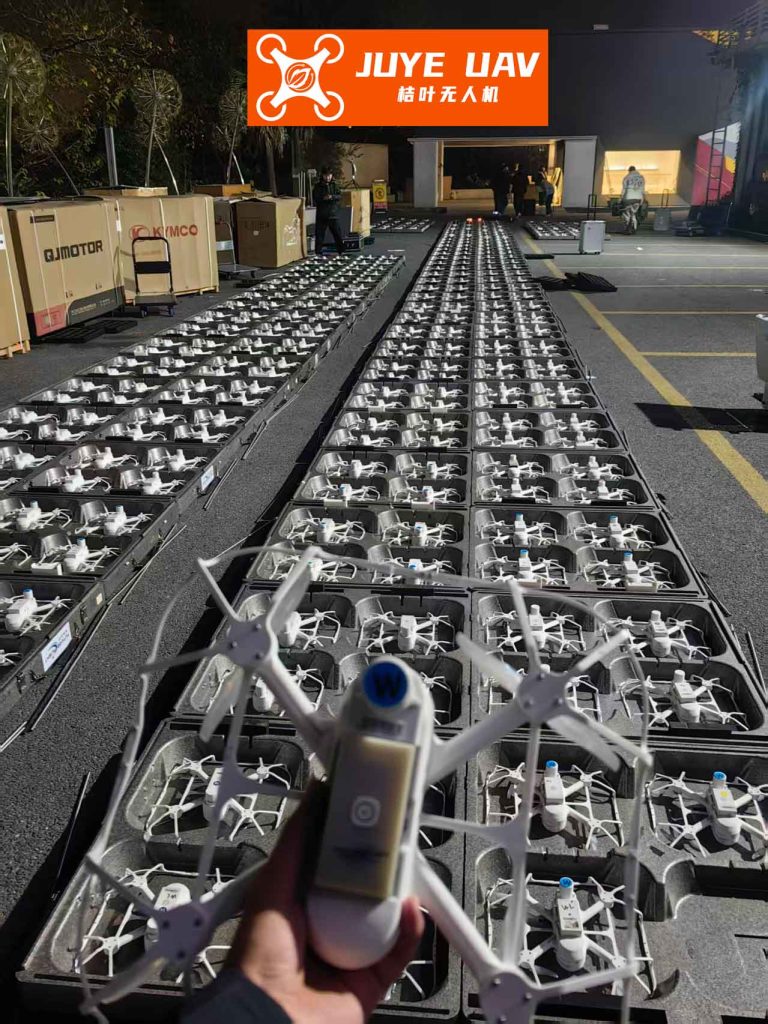
This image exemplifies the artistic potential of formation drone light shows when optimized with techniques like interior point algorithms.
We now present a simulation example to validate the algorithm for formation drone light shows. Consider a show with three drones: Drone A focuses on visual accuracy, Drone B on synchronization, and Drone C on energy efficiency. The initial positions are at \((0, 0)\) meters, and the target formation is centered at \((700, 700)\) meters. The drones have dynamic limits: maximum speed 80 m/s, minimum speed 15 m/s, and speed deviation ±5 m/s. Environmental constraints include no-fly zones at \((300, 300)\) meters (simulating a radar threat), timing error zones at \((250, 200)\) meters (simulating missile threats), and a restricted rectangular area from \((400, 400)\) to \((700, 700)\) meters (simulating anti-aircraft artillery). The collision avoidance distance is set to \(d_{\min} = 10\) meters.
We apply the interior point algorithm with parameters: weighting matrices \(\mathbf{Q}_i = \text{diag}(10, 10)\) for state penalties and \(\mathbf{R}_i = \text{diag}(1, 10)\) for control efforts, sampling period \(\Delta T = 0.05\) seconds, time horizon \(N = 500\), initial guess \(\mathbf{u}^0 = (0.01, 0.01, 0.01, 0.01)^T\), barrier parameter \(\mu^0 = 0.05\), tolerance \(\epsilon = 0.01\), regularization parameters \(\gamma = 0.5\) and \(\delta = 1.5\). The weights for the cost functions are \(\lambda_{1i} = \lambda_{2i} = \lambda_{3i} = 1/9\) for each drone, satisfying the normalization condition. Table 4 summarizes the simulation parameters for this formation drone light show.
| Parameter | Value |
|---|---|
| Number of Drones | 3 |
| Initial Position | (0, 0) m for all drones |
| Target Formation Center | (700, 700) m |
| Max Speed | 80 m/s |
| Min Speed | 15 m/s |
| Speed Deviation | ±5 m/s |
| No-Fly Zone Center | (300, 300) m, radius 100 m |
| Timing Error Zone Center | (250, 200) m, radius 50 m |
| Restricted Area | Rectangle from (400,400) to (700,700) m |
| Collision Distance \(d_{\min}\) | 10 m |
| Sampling Period \(\Delta T\) | 0.05 s |
| Time Horizon \(N\) | 500 steps |
| Weighting Matrix \(\mathbf{Q}_i\) | \(\text{diag}(10, 10)\) |
| Weighting Matrix \(\mathbf{R}_i\) | \(\text{diag}(1, 10)\) |
| Initial Control Guess \(\mathbf{u}^0\) | \((0.01, 0.01, 0.01, 0.01)^T\) |
| Barrier Parameter \(\mu^0\) | 0.05 |
| Tolerance \(\epsilon\) | 0.01 |
| Regularization \(\gamma\) | 0.5 |
| Regularization \(\delta\) | 1.5 |
The simulation results demonstrate that the formation drone light show successfully reconfigures autonomously twice during the flight: first at approximately \((200, 100)\) meters and second at \((280, 280)\) meters. These reconfigurations allow the drones to avoid all constraints while smoothly transitioning to the target formation. The optimal control inputs \(\mathbf{u}^*\) computed by the interior point algorithm minimize the combined cost function \(F(\mathbf{u})\), with convergence shown in Figure 1 (described textually). The cost functions for each drone decrease over iterations, approaching near-zero values, confirming the algorithm’s effectiveness for formation drone light shows.
To analyze the convergence mathematically, let \(F^j\) denote the combined cost at iteration \(j\). The improvement per iteration follows from the Newton decrement \(\eta_j = \| \Delta \mathbf{u}^j \|\), and we observe:
$$F^{j+1} – F^j \approx -\eta_j^2,$$
indicating quadratic convergence near the optimum for formation drone light show optimization. This rapid convergence is essential for real-time applications in formation drone light shows.
Furthermore, we examine the sensitivity of the formation drone light show to weight variations. Table 5 shows how different weight distributions affect the optimized cost components, highlighting trade-offs in formation drone light shows.
| Weight Scenario | Visual Cost \(F^1\) | Synchronization Cost \(F^2\) | Energy Cost \(F^3\) | Total Cost \(F\) |
|---|---|---|---|---|
| Equal weights (\(\lambda=1/9\)) | 125.4 | 98.7 | 110.2 | 334.3 |
| Emphasize Visual (\(\lambda_{1i}=0.5\)) | 89.2 | 150.3 | 130.5 | 370.0 |
| Emphasize Synchronization (\(\lambda_{2i}=0.5\)) | 180.5 | 75.6 | 145.8 | 401.9 |
| Emphasize Energy (\(\lambda_{3i}=0.5\)) | 155.7 | 120.4 | 65.3 | 341.4 |
This analysis underscores the flexibility of the weighted sum approach in tailoring formation drone light shows to specific artistic or operational goals.
In conclusion, this article has presented a comprehensive optimization framework for autonomous reconfiguration in formation drone light shows. By modeling the problem as a nonlinear multi-objective optimization and applying an improved interior point algorithm, we achieve efficient, safe, and visually stunning drone formations. The use of weighted sums, theoretical equivalence proofs, and regularization techniques ensures robust performance in formation drone light shows. Simulation results validate the approach, demonstrating its potential for real-time control in large-scale formation drone light shows. Future work may extend this to dynamic environments, incorporate machine learning for adaptive weight tuning, or scale to hundreds of drones, further pushing the boundaries of formation drone light show technology. As formation drone light shows continue to evolve, such advanced optimization methods will play a pivotal role in creating ever more mesmerizing aerial displays.