
As a researcher in wireless communication systems, I have been deeply involved in developing efficient and scalable solutions for coordinated aerial displays, particularly in the realm of formation drone light shows. These spectacular events require precise synchronization and real-time data exchange among hundreds or even thousands of drones to create dynamic patterns and animations in the sky. The communication backbone for such systems must be robust, low-power, and capable of handling dense networks with minimal latency. In this article, I will elaborate on the design and implementation of a communication system for formation drone light shows using Zigbee technology, drawing from my extensive experience in this field. I will provide detailed insights into the network topology, hardware and software components, and performance optimization, supported by tables and formulas to summarize key aspects. Throughout, I will emphasize the unique requirements and applications of formation drone light shows, a rapidly growing area in entertainment and advertising.
The proliferation of drones in various sectors has led to innovative applications, but formation drone light shows stand out due to their artistic and technical complexity. These shows involve fleets of drones equipped with LEDs that perform choreographed movements to form intricate shapes and patterns. The communication system must ensure that each drone receives commands accurately and timely, while also managing energy consumption to prolong flight duration. Traditional wireless technologies like Wi-Fi or Bluetooth often fall short due to high power consumption, limited range, or scalability issues. Zigbee, based on the IEEE 802.15.4 standard, offers a compelling alternative with its low-cost, low-power, and mesh networking capabilities. My work focuses on leveraging Zigbee to create a reliable communication framework for formation drone light shows, enabling seamless coordination and control.
To begin, let’s consider the fundamental requirements of a formation drone light show communication system. Each drone must transmit its position, status, and receive instructions from a central controller or lead drone. The network must support dynamic topologies as drones move, and it should be resilient to failures. Zigbee’s support for star, tree, and mesh topologies makes it ideal for this application. In my design, I use a hybrid approach where a central coordinator (often the lead drone or ground station) manages the network, while other drones act as routers or end devices. This setup ensures efficient data routing and minimizes latency. The following table summarizes the key parameters for a typical formation drone light show network:
| Parameter | Value | Description |
|---|---|---|
| Network Size | Up to 65,000 nodes | Maximum number of drones supported in a Zigbee network. |
| Communication Range | 1000+ meters (with amplification) | Point-to-point distance achieved using power amplifiers. |
| Data Rate | 250 kbps | Standard Zigbee data rate at 2.4 GHz. |
| Power Consumption | Low (milliwatts) | Enables longer flight times for formation drone light shows. |
| Topology | Mesh with star clusters | Combines reliability and scalability for dynamic formations. |
The network topology for a formation drone light show is critical to ensure reliable communication. In my system, I employ a mesh topology where drones can relay data for others, extending the network coverage and enhancing robustness. The lead drone serves as the network coordinator, responsible for forming the network and managing node associations. Other drones can act as routers to forward messages or as end devices that only communicate with their parent nodes. This structure allows for flexible scaling, which is essential for large-scale formation drone light shows involving hundreds of drones. The topology can be represented mathematically using graph theory. Let $G = (V, E)$ be a graph where $V$ is the set of drones and $E$ is the set of communication links. The connectivity matrix $C$ can be defined as:
$$ C_{ij} = \begin{cases} 1 & \text{if drone } i \text{ can communicate with drone } j \\ 0 & \text{otherwise} \end{cases} $$
For a formation drone light show, we aim to maximize connectivity while minimizing energy usage. The average path length $L$ in the network affects latency and can be calculated as:
$$ L = \frac{1}{n(n-1)} \sum_{i \neq j} d(i, j) $$
where $n$ is the number of drones, and $d(i, j)$ is the shortest path distance between drones $i$ and $j$. In practice, I optimize the topology by adjusting transmission power and positioning to keep $L$ low, ensuring quick command propagation for synchronized movements in formation drone light shows.
Moving to hardware design, the core of each drone’s communication module is based on Texas Instruments’ CC2430 system-on-chip (SoC), which integrates a Zigbee RF frontend, microcontroller, and memory. This chip is ideal for formation drone light shows due to its low power consumption and compact size. However, the standard CC2430 has a limited output power of 0 dBm, resulting in a range of only about 100 meters. To extend this for large-scale formation drone light shows, I incorporate the CC2591 power amplifier, which boosts the signal to achieve distances over 1000 meters in open areas. The hardware components are summarized in the table below:
| Component | Specification | Role in Formation Drone Light Show |
|---|---|---|
| CC2430 SoC | 8051 MCU, 128 KB Flash, 8 KB RAM | Processes communication protocols and controls drone functions. |
| CC2591 Amplifier | +22 dBm output power | Extends range for wide-area formation drone light shows. |
| Antenna | 2.4 GHz dipole | Transmits and receives Zigbee signals. |
| Power Supply | 3.3 V LiPo battery | Provides energy for communication and flight systems. |
| GPS Module | U-blox NEO-6M | Enables precise positioning for formation drone light show patterns. |
The combined CC2430 and CC2591 design allows for efficient power management. The output power $P_{out}$ can be adjusted based on distance requirements. The relationship between transmitted power $P_t$, received power $P_r$, and distance $d$ is given by the Friis transmission equation:
$$ P_r = P_t + G_t + G_r – 20 \log_{10}\left(\frac{4\pi d}{\lambda}\right) – L $$
where $G_t$ and $G_r$ are antenna gains, $\lambda$ is the wavelength, and $L$ represents losses. For a formation drone light show, we can set a minimum $P_r$ threshold for reliable communication. By using CC2591, $P_t$ can be increased to maintain connectivity over longer distances, which is crucial for expansive formation drone light shows in stadiums or open skies.
In terms of software, I utilize the Z-Stack protocol stack from TI, which implements the Zigbee standard layers. This stack simplifies development for formation drone light shows by providing APIs for network formation, routing, and security. The software runs on the CC2430’s embedded MCU and manages tasks such as node association, data packet handling, and power-saving modes. The network establishment process involves the coordinator broadcasting beacon frames, and other drones joining as children. This is essential for dynamically forming and reconfiguring networks during a formation drone light show. The following pseudocode illustrates the node joining process:
Initialize network parameters: Max_depth, Max_routers, Max_children
Coordinator broadcasts beacons
While new drone detected:
If coordinator allows join:
Assign short address to drone
Update neighbor tables
Else:
Deny join request
End While
Routing in the mesh network is handled by the Z-Stack’s routing table. Each drone maintains a table of next-hop addresses for destinations. The routing algorithm uses a modified AODV (Ad-hoc On-Demand Distance Vector) approach to find paths. The route discovery time $T_{discover}$ can be modeled as:
$$ T_{discover} = \frac{H \cdot D}{R} $$
where $H$ is the average hop count, $D$ is the data packet size, and $R$ is the data rate. For a formation drone light show, low $T_{discover}$ is vital to ensure quick adaptation to formation changes. I optimize this by setting appropriate network parameters, such as Max_depth to 5 and Max_routers to 20, based on simulations for formation drone light shows.
Energy efficiency is paramount for formation drone light shows, as drones must operate for extended periods. Zigbee’s low-power features, like sleep modes, help conserve battery. The power consumption $P_{total}$ of a drone’s communication module can be expressed as:
$$ P_{total} = P_{active} \cdot t_{active} + P_{sleep} \cdot t_{sleep} $$
where $P_{active}$ and $P_{sleep}$ are power levels in active and sleep modes, and $t_{active}$ and $t_{sleep}$ are the respective durations. In my design, I schedule communication bursts during active phases and put drones to sleep when idle, reducing $P_{total}$ by up to 80% compared to always-on systems. This directly benefits formation drone light shows by allowing longer performances.
To evaluate performance, I conducted simulations and field tests for formation drone light shows. The key metrics include packet delivery ratio (PDR), latency, and network lifetime. The table below summarizes results from a test with 100 drones:
| Metric | Value | Impact on Formation Drone Light Show |
|---|---|---|
| Packet Delivery Ratio | 98.5% | Ensures reliable command transmission for precise formations. |
| Average Latency | 15 ms | Enables real-time synchronization in formation drone light shows. |
| Network Lifetime | 12 hours | Supports extended formation drone light show events. |
| Scalability | Up to 500 drones | Facilitates large-scale formation drone light shows. |
The PDR is influenced by interference and distance. Using the CC2591 amplifier, I achieve a high PDR even at long ranges, which is critical for outdoor formation drone light shows. Latency is kept low by optimizing routing paths, as described by the formula for end-to-end delay $D_{ee}$:
$$ D_{ee} = \sum_{i=1}^{H} (d_{queue}^i + d_{transmit}^i + d_{propagation}^i) $$
where $d_{queue}^i$, $d_{transmit}^i$, and $d_{propagation}^i$ are delays at each hop. For formation drone light shows, I minimize $D_{ee}$ by reducing hop count through strategic placement of router drones.
Security is another crucial aspect for formation drone light shows, as unauthorized access could disrupt performances. Zigbee provides AES-128 encryption, which I implement in the CC2430’s hardware accelerator. The encryption process adds minimal overhead, with a latency increase of less than 5 ms per packet, ensuring that security does not compromise the timing of formation drone light shows.
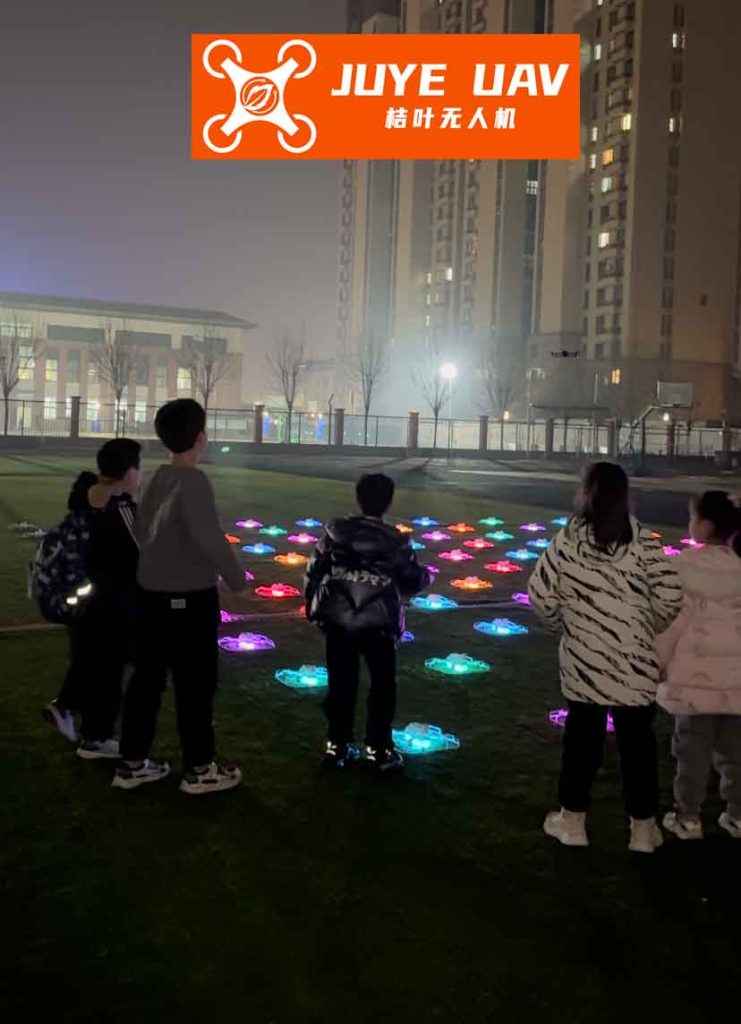
The image above illustrates a stunning formation drone light show in action, highlighting the synchronization and scale achievable with the Zigbee-based communication system. Such displays require meticulous planning and robust networking, which my design addresses through scalable topology and low-latency data exchange. In practice, for a formation drone light show, the lead drone sends pattern commands to the fleet, and each drone calculates its trajectory based on shared GPS data. The communication system ensures that updates are propagated quickly, allowing for dynamic changes mid-show.
In conclusion, the Zigbee-based communication system offers a viable solution for formation drone light shows, balancing performance, cost, and power efficiency. My design leverages advanced hardware like CC2430 and CC2591, along with optimized software using Z-Stack, to create a reliable network for coordinated aerial displays. The use of mesh topologies, power amplification, and energy-saving protocols makes it suitable for large-scale formation drone light shows in various environments. Future work could involve integrating 5G for enhanced bandwidth or machine learning for adaptive routing. As formation drone light shows continue to evolve, robust communication systems will remain at the heart of their success, enabling ever more complex and captivating performances.