
As a researcher focused on modern defense technologies, I have observed the rapid evolution of drone swarm warfare, which poses a significant threat to global security. The concept of anti-drone operations has become paramount, necessitating a thorough examination of foreign strategies and systems. In this article, I will delve into the development, current state, and future trends of anti-drone swarm warfare, emphasizing the integration of detection, hard-kill, and soft-kill methods. The keyword “anti-drone” will be central to our discussion, as it encapsulates the multifaceted approach required to counter these intelligent systems. I aim to provide a comprehensive overview, utilizing tables and formulas to summarize key points, and I will insert a relevant image to illustrate the practical aspects of anti-drone systems. My analysis is based on extensive study of foreign research, particularly from the United States, Russia, and other nations leading in this field.
The advent of drone swarms—large groups of small, coordinated unmanned aerial vehicles (UAVs)—has revolutionized warfare, offering cost-effective, adaptable, and resilient capabilities. These swarms, inspired by biological collective intelligence, can perform tasks such as surveillance, electronic warfare, and targeted strikes with minimal human intervention. The first recorded use of drone swarms in combat occurred in 2018 when Syrian forces attacked a Russian military base, highlighting the urgent need for robust anti-drone measures. Since then, incidents in Yemen and Nagorno-Karabakh have further demonstrated the实战化 potential of drone swarms, driving nations to invest heavily in anti-drone technologies. The global anti-drone market is projected to reach nearly $1.2 billion by 2023, reflecting the growing emphasis on countering this threat. In my view, understanding foreign approaches to anti-drone swarm warfare is crucial for developing effective defenses. This article will explore detection and tracking, hard-kill and soft-kill手段, and future directions, all from a first-person perspective as I synthesize existing research.
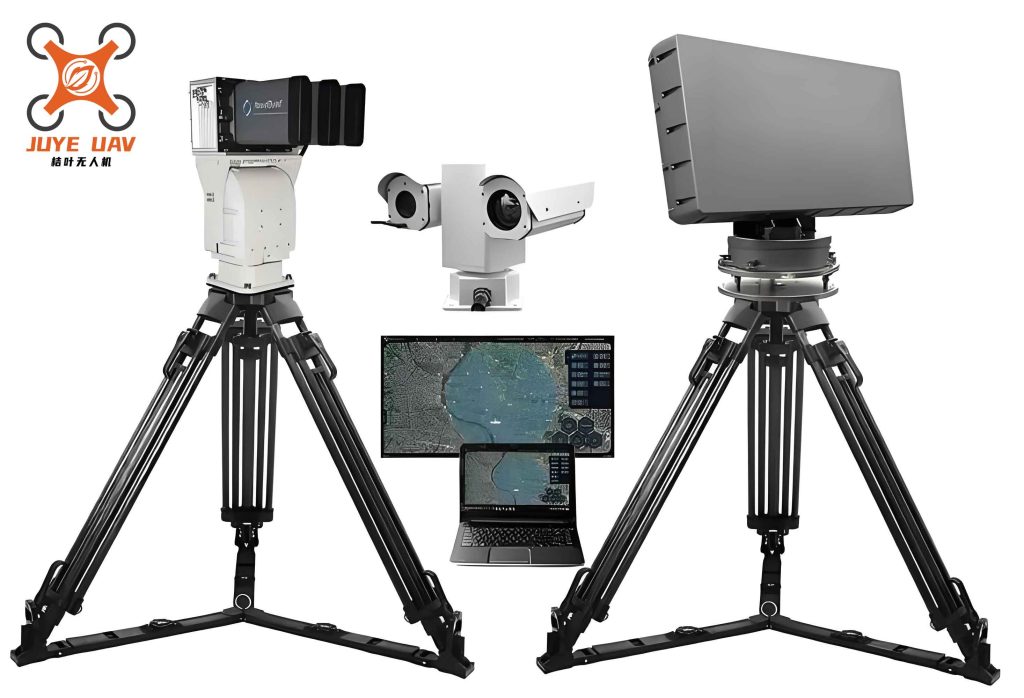
Detection and tracking form the foundational layer of any anti-drone system. Without accurate and timely identification of drone swarms, subsequent countermeasures are ineffective. Foreign nations have developed a range of technologies to address this challenge, often combining multiple sensors to enhance reliability. For instance, Russia’s “Pantsir” air defense system integrates radar and electro-optical systems for multi-target tracking, while the United States employs advanced radar networks like the “Giraffe” AMB, which uses wide-beam transmission and narrow-beam reception for rapid, precise detection. In my analysis, I find that these systems rely on mathematical models to optimize performance. For example, the probability of detecting a drone swarm can be expressed using a Poisson distribution model: $$P_d = 1 – e^{-\lambda \cdot A}$$ where \(P_d\) is the detection probability, \(\lambda\) is the sensor detection rate per unit area, and \(A\) is the coverage area. This formula highlights the importance of sensor density and range in anti-drone operations. Additionally, artificial intelligence is increasingly used for target classification; Russian systems like those from Kabbasi Laboratories employ neural networks to quickly identify and categorize drone swarms, enabling faster response. Below is a table summarizing key detection technologies and their characteristics in anti-drone applications.
| Technology | Country | Range | Advantages | Limitations |
|---|---|---|---|---|
| Radar (e.g., Giraffe AMB) | Sweden | Up to 100 km | Wide coverage, high precision | Susceptible to clutter and stealth |
| Electro-Optical/Infrared | Russia, USA | 5-25 km | Good for visual identification, works in low light | Weather-dependent, limited range |
| Radio Frequency (RF) Sensing | USA, Israel | 10-30 km | Detects communication signals, passive operation | May not work with autonomous drones |
| Acoustic Sensors | Various | 1-5 km | Low cost, effective in urban areas | Short range, noise interference |
| AI-Based Systems | Russia, USA | Varies | Fast classification, adapts to new threats | Requires large datasets, complex integration |
Hard-kill手段 involve physically destroying or disabling drone swarms through kinetic or energy-based means. Foreign research has focused on three main categories: conventional weapons, directed energy weapons, and armed counter-drones. Each offers unique advantages in anti-drone operations, and I believe their synergy is key to effective defense. Conventional weapons, such as missiles and guns, have been adapted for anti-drone use. For example, the U.S. Army’s BLADE system combines precision targeting with fire control, while Russia’s “Tor” and “Pantsir” systems can engage multiple drones simultaneously. However, the cost asymmetry between expensive missiles and cheap drones is a concern, leading to developments in low-cost munitions. The kill probability for a conventional weapon can be modeled as: $$P_k = \frac{1}{1 + \left(\frac{R}{R_0}\right)^n}$$ where \(P_k\) is the kill probability, \(R\) is the engagement range, \(R_0\) is a reference range, and \(n\) is a coefficient dependent on weapon type. This formula underscores the need for close-range engagements in anti-drone scenarios.
Directed energy weapons, particularly lasers and high-power microwaves, represent a paradigm shift in anti-drone warfare due to their speed, precision, and low cost per shot. I have studied how the U.S. and Russia are leading in this area. The U.S. DE M-SHORAD system uses a 50 kW laser to engage drones, with a theoretical engagement time modeled by: $$t_e = \frac{E_{req}}{P_{laser}}$$ where \(t_e\) is the engagement time, \(E_{req}\) is the energy required to disable a drone, and \(P_{laser}\) is the laser power. High-power microwave weapons, like the U.S. THOR system, offer area effects, making them ideal for swarm suppression. Their effectiveness can be expressed as: $$E_{microwave} = P_{avg} \cdot t \cdot \frac{G}{4\pi r^2}$$ where \(E_{microwave}\) is the energy density at the target, \(P_{avg}\) is the average power, \(t\) is the exposure time, \(G\) is the antenna gain, and \(r\) is the distance. Below is a table comparing hard-kill anti-drone systems.
| System Type | Example | Country | Effective Range | Key Features |
|---|---|---|---|---|
| Conventional Missile | Tor-M2DT | Russia | 1-12 km | High accuracy, multi-target engagement |
| Gun Systems | Pantsir-S1 | Russia | 0.2-20 km | Rapid fire, cost-effective for close range |
| Laser Weapon | DE M-SHORAD | USA | Up to 5 km | Precision strike, low cost per shot |
| High-Power Microwave | THOR | USA | Up to 10 km | Area effect, simultaneous multi-drone kill |
| Armed Counter-Drone | Coyote Block 2 | USA | Varies | Autonomous engagement, swarm vs. swarm |
Armed counter-drones, or “drone hunters,” represent an emerging anti-drone approach where UAVs are used to neutralize hostile swarms. I find this method particularly intriguing because it leverages the same technology as the threat. The U.S. Coyote drone, for instance, can be equipped with kinetic or explosive payloads for suicide attacks, while Russia’s “Lancet” drone serves as a loitering munition. The effectiveness of such systems can be analyzed using swarm engagement models, such as: $$N_{survive} = N_0 \cdot e^{-k \cdot t}$$ where \(N_{survive}\) is the number of surviving enemy drones, \(N_0\) is the initial number, \(k\) is the engagement rate, and \(t\) is time. This highlights the dynamic nature of anti-drone battles involving counter-swarms.
Soft-kill手段 aim to disrupt or deceive drone swarms without physical destruction, primarily through electronic warfare and cyber measures. As an anti-drone researcher, I consider these methods essential for minimizing collateral damage and handling autonomous systems. Electronic jamming involves emitting radio frequency signals to interfere with drone communications, GPS, or control links. For example, the Russian REX-1 portable jammer can disable drones within 2 km, while the U.S. DroneDefender uses directional RF beams. The jamming effectiveness can be quantified by the signal-to-interference ratio: $$SIR = \frac{P_{signal}}{P_{jamming} + N}$$ where \(SIR\) is the signal-to-interference ratio, \(P_{signal}\) is the signal power, \(P_{jamming}\) is the jamming power, and \(N\) is the noise power. A low SIR disrupts drone operations, forcing them to land or return. Deception and control techniques, such as GPS spoofing or hijacking, are more sophisticated. Israel’s EnforceAir system, for instance, can take over enemy drones by injecting false coordinates, modeled as: $$\hat{x} = x_{true} + \delta$$ where \(\hat{x}\) is the spoofed position, \(x_{true}\) is the true position, and \(\delta\) is the deception offset. Below is a table summarizing soft-kill anti-drone technologies.
| Technology | Example | Country | Range | Mechanism |
|---|---|---|---|---|
| RF Jamming | REX-1 Electromagnetic Gun | Russia | 2 km | Disrupts control and GPS signals |
| GPS Spoofing | EnforceAir | Israel | 10-30 km | Injects false navigation data |
| Cyber Takeover | UAVX System | USA | Varies | Hijacks communication links |
| Electro-Optical Deception | Camouflage Nets | Various | Visual range | Hides assets from drone sensors |
| Network Attacks | AI-Based Intrusion | USA, Russia | Global | Targets swarm coordination algorithms |
Looking ahead, I foresee several trends shaping the future of anti-drone swarm warfare. First, seamless and comprehensive detection networks will become critical, integrating ground, air, sea, and space-based sensors for 360-degree coverage. AI will play a pivotal role in decision-making, with algorithms like: $$\max_{a} \mathbb{E} \left[ \sum_{t} R_t(s_t, a_t) \right]$$ where \(a\) represents anti-drone actions, \(R_t\) is the reward at time \(t\), and \(s_t\) is the state of the drone swarm. This optimization will enable real-time resource allocation in anti-drone operations. Second, the synergy between conventional and new weapons will enhance, with layered defenses combining missiles, lasers, and microwaves. For instance, a cost-benefit analysis for anti-drone systems can be expressed as: $$C_{total} = \sum_i (C_{deploy,i} + C_{engage,i} \cdot N_i)$$ where \(C_{total}\) is the total cost, \(C_{deploy,i}\) is the deployment cost for system \(i\), \(C_{engage,i}\) is the engagement cost per drone, and \(N_i\) is the number of drones engaged. This formula emphasizes the need for low-cost solutions in anti-drone warfare.
Third, multi-domain intelligent systems will dominate, requiring standardized protocols for interoperability. As an anti-drone advocate, I stress that international standards for data sharing and system integration are urgent to prevent fragmentation. Finally, continuous innovation in anti-drone technologies, such as quantum radar or autonomous swarms of counter-drones, will redefine the battlefield. The evolution of anti-drone measures must keep pace with drone swarm advancements, ensuring a balanced defense posture.
In conclusion, my analysis of foreign anti-drone swarm warfare reveals a dynamic landscape where detection, hard-kill, and soft-kill methods converge to address a growing threat. The keyword “anti-drone” encapsulates a holistic approach, from radar tracking to laser engagement and electronic jamming. I have presented tables and formulas to summarize key aspects, illustrating the technical depth required. As drone swarms become more intelligent and ubiquitous, the importance of robust anti-drone strategies cannot be overstated. Future success will depend on integrated systems, AI-driven decisions, and international cooperation. Through this first-person perspective, I hope to contribute to the ongoing discourse on anti-drone defense, emphasizing innovation and adaptability in the face of emerging challenges.