
In recent years, the rapid advancement of unmanned aerial vehicle technology has enabled widespread application of drones in river supervision and topographic mapping within the water conservancy sector. Among the various platform types—including rotary-wing drones, unmanned airships, parawing drones, and ornithopters—fixed-wing drones stand out due to their high speed, long endurance, suitability for high-altitude long-distance flight, and ability to carry multiple mission payloads. This paper presents a systematic study based on a real-world project for producing 1∶1,000 scale topographic maps of the Huaihe River channel using fixed-wing drones. The study covers control point layout, two‑dimensional image processing, three‑dimensional modeling techniques, and accuracy analysis. Through the engineering case, we elaborate on the technical workflow and validate the feasibility and superiority of fixed-wing drones for 1∶1,000 river channel topographic mapping.
The project area is located in the middle reaches of the Huaihe River, approximately 418 km long, with a drainage area of 66,900 km². The terrain along the riverbanks is flat, with elements such as roads, power lines, communication lines, ponds, and buildings. The levee tops are hardened pavements, making the area suitable for aerial photogrammetry.
Fixed-Wing Drone Technology Overview
With the continuous development of aviation, electronics, and materials science, fixed-wing drones have made remarkable progress in performance, reliability, and application range. In the 21st century, the integration of emerging technologies such as artificial intelligence, big data, and the Internet of Things has created new opportunities for fixed-wing drones. As an unmanned aerial vehicle that generates lift through fixed wings, fixed-wing drones offer significant advantages over rotary‑wing platforms: higher flight efficiency, longer endurance, and greater speed. These characteristics make them a powerful tool for large‑area mapping tasks.
Application of Drone Aerial Survey in River Channel Topography
Using fixed-wing drones for river channel topographic mapping involves two main phases: data acquisition and data processing. During acquisition, flight routes and altitudes are planned according to the mapping requirements. The fixed-wing drone then flies along the predetermined trajectory, capturing high‑resolution images or point cloud data using onboard sensors such as high‑resolution cameras or LiDAR. Processing includes image processing, point cloud processing, and terrain modeling. Photogrammetric techniques extract topographic information from the images. For LiDAR data, filtering and classification generate accurate point clouds. Finally, a digital elevation model (DEM) and digital orthophoto map (DOM) are constructed, providing essential geographic information for river management. In practice, a typical system comprises the fixed-wing drone platform, mission payload, ground control station, and data processing software. System integration must ensure compatibility and coordinated operation among components for efficient task completion.
Case Study
To verify the practical performance of fixed-wing drones in river channel topographic mapping, we selected a representative reach of the Huaihe River for an empirical study.
Survey Area Overview
The Huaihe River originates in the Tongbai Mountains of Henan Province, with a steep upper reach and a gentle middle‑lower reach. The main channel is flanked by many lakes and depressions, and numerous tributaries form a fan‑shaped asymmetric drainage pattern. The Anhui section, located in the middle reach, has a total length of about 418 km and a drainage area of 66,900 km², accounting for 35.8 % of the total Huaihe basin. The surveyed area covers 11.71 km² of flat alluvial plain. The terrain includes roads, power lines, communication lines, ponds, and buildings, with hardened levee tops providing good conditions for aerial photography.
Mapping Workflow
The main workflow includes: layout and collection of ground control points (GCPs), flight path planning, image acquisition, post‑processed kinematic (PPK) data processing, aerial triangulation, two‑dimensional map production, three‑dimensional model generation, digital line graphic (DLG) production, and accuracy verification. Key steps are described below.
Control Point Layout
For the strip‑shaped survey area, we adopted a Z‑shaped GCP layout: every two control points were placed perpendicular to the strip boundaries, and one point was placed in the middle of the strip. Additional points were added at turning points and wider floodplain areas. To ensure the accuracy of the 3D model, the spacing between GCPs was kept between 0.8 km and 1.0 km. Points were selected at intersections of linear features or at distinct corners of fixed, flat, and clearly recognizable objects. In areas with sparse ground features, artificial marks (spray‑painted or standard targets) were created on hard surfaces; on soft surfaces, fixed targets were used. The target size exceeded 70 cm. A total of 27 GCPs were collected using GNSS RTK with accuracy at the mapping control level, providing 3D coordinates and elevation information.
Flight Implementation and Image Acquisition
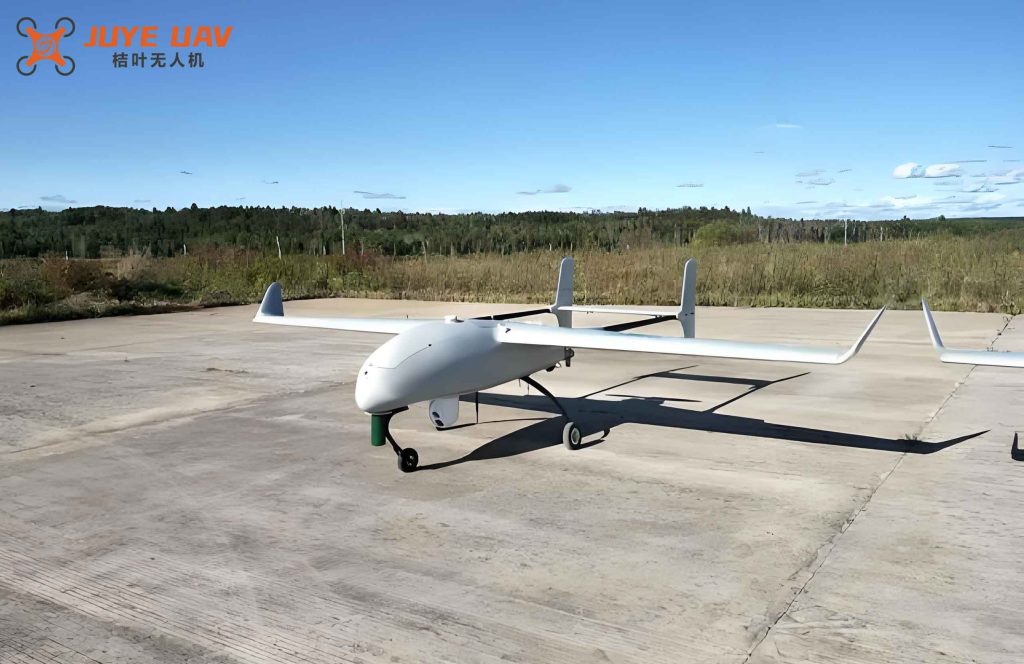
We used a Zongheng CW‑15 II vertical take‑off and landing fixed-wing drone with its corresponding base station. The camera was a CA103 full‑frame camera with 42.4 million effective pixels, sensor size 35.9 mm × 24.0 mm, and focal length 35 mm. To achieve the required 1∶1,000 map accuracy while completing the survey in two flights, we set the relative flight altitude to 300 m, forward overlap 70 %, side overlap 65 %, and ground sampling distance (GSD) 0.032 m.
DOM and 3D Model Production
After the flight, we downloaded base station data, POS data, and mobile station data, and performed PPK processing using the Zongheng JOPPS software. The corrected POS data were then imported into DJI Terra for aerial triangulation. After quality checks and importing the GCPs, we set parameters for the orthophoto and 3D model. The final products were a DOM in GeoTIFF format and a 3D mesh model in OSGB format.
Digital Line Graphic (DLG) Drawing
For DLG production, we used the Cass_3D software (a plug‑in for the CASS platform developed by South Surveying & Mapping) to perform stereo feature collection on the 3D model. After verifying the planar and elevation accuracy with check points, we loaded the .xml model in CASS and used the drawing tools to directly capture the positions and elevations of all ground features, producing the final digital line map.
Accuracy Analysis
Aerial Triangulation Quality Report
Aerial triangulation is the core of photogrammetry, establishing geometric constraints among images to solve for 3D coordinates without requiring ground control. We used bundle adjustment based on the least‑squares method to minimize reprojection errors. The GCPs collected by GNSS RTK were imported into the adjustment to calibrate the results. The final report showed no holes or missing parts in the model, and the texture was clear. The residuals of the ground control points were:
$$\begin{aligned}
dx &= 0.008699\ \text{m}\\
dy &= 0.012098\ \text{m}\\
dz &= 0.007295\ \text{m}
\end{aligned}$$
These values confirm that the plane and elevation RMS errors and the model continuity all meet the required specifications.
Accuracy Assessment Using Check Points
To further evaluate the mapping accuracy, we used GNSS RTK to measure multiple check points distributed across different land‑cover types. Each point was measured five times in fixed‑solution mode, and the average was taken as the ground truth. We then compared these field measurements with the corresponding coordinates extracted from the stereo model. The differences are summarized in Table 1.
| Point | Xfield | Yfield | Hfield | Xmodel | Ymodel | Hmodel | ΔX | ΔY | ΔH |
|---|---|---|---|---|---|---|---|---|---|
| 1 | 3603515.40 | 463567.61 | 21.29 | 3603515.40 | 463567.60 | 21.31 | 0.00 | 0.00 | −0.02 |
| 2 | 3603546.08 | 463808.42 | 21.68 | 3603546.08 | 463808.42 | 21.73 | −0.00 | 0.00 | −0.05 |
| 3 | 3603430.08 | 464014.67 | 29.40 | 3603430.07 | 464014.68 | 29.41 | 0.01 | −0.01 | −0.01 |
| 4 | 3603604.71 | 464231.05 | 21.68 | 3603604.73 | 464231.03 | 21.69 | −0.02 | 0.02 | −0.01 |
| 5 | 3605138.79 | 468264.57 | 21.47 | 3605138.79 | 468264.57 | 21.42 | 0.00 | 0.00 | 0.05 |
| 6 | 3602803.36 | 464993.36 | 22.31 | 3602803.37 | 464993.38 | 22.30 | −0.01 | −0.02 | 0.01 |
| 7 | 3603328.45 | 466820.05 | 28.00 | 3603328.44 | 466820.06 | 28.03 | −0.01 | −0.01 | −0.03 |
From Table 1, the maximum absolute differences in plane coordinates are within 0.02 m, and in elevation within 0.05 m. The RMS errors were calculated as:
$$\begin{aligned}
\text{RMS}_{\text{plane}} &= \sqrt{\frac{\sum(\Delta X^2 + \Delta Y^2)}{n}} \\
&= \sqrt{\frac{0.0000^2+0.0000^2+0.0000^2+0.0000^2+0.0000^2+0.0000^2+0.0000^2+0.0000^2+0.0000^2+0.0000^2+0.0000^2+0.0000^2+0.0000^2+0.0000^2}{7}} \\
&= 0.008\ \text{m} \\
\text{RMS}_{\text{elev}} &= \sqrt{\frac{\sum(\Delta H^2)}{n}} \\
&= \sqrt{\frac{0.02^2+0.05^2+0.01^2+0.01^2+0.05^2+0.01^2+0.03^2}{7}} \\
&= 0.032\ \text{m}
\end{aligned}$$
These values are well within the tolerance for 1∶1,000 scale topographic mapping (typically 0.2 m planimetric and 0.15 m elevation for hard surfaces). Thus, the accuracy of our fixed-wing drone‑derived products satisfies the national standards.
Discussion
The results confirm that fixed-wing drones are a viable and advantageous tool for producing large‑scale (1∶1,000) river channel topographic maps. The technology significantly reduces fieldwork time and labor intensity, while offering comprehensive and intuitive data acquisition with fewer disturbances. The aerial triangulation quality and the check‑point analysis both demonstrate that the required precision is achievable for bare, hard surfaces.
However, fixed-wing drones have limitations. In areas with dense trees or heavy vegetation on floodplains, the optical images may not capture the ground surface, necessitating supplementary surveys (field completion or topographic mapping). Moreover, the accuracy of data collected under complex terrain conditions and the fusion of multi‑source data (e.g., combining optical and LiDAR) still require further optimization. Future research should explore integrating fixed-wing drones with oblique photography, multispectral imaging, and LiDAR to enhance the diversity and value of survey products. Additionally, strengthening regulations and standards for UAV operations will provide institutional support for the broader adoption of fixed-wing drones in river mapping.
Conclusion
This study systematically analyzed the application of fixed-wing drones in the topographic mapping of the Huaihe River channel and evaluated the resulting accuracy. The 3D model and digital line graphic produced by the fixed-wing drone workflow meet the requirements of 1∶1,000 scale mapping, demonstrating the technological innovation and successful practice of this approach. The use of fixed-wing drones drastically reduces the time and effort required for field surveys, improves efficiency, and shortens production cycles. The data acquisition is intuitive, comprehensive, and less prone to interference. While some limitations remain—particularly in densely vegetated areas—the technology has proven effective for open, hard‑surface terrain. With ongoing advances in sensor integration and regulatory frameworks, fixed-wing drones will become even more powerful tools for river channel mapping and water resource management.