
As a professional deeply involved in modern firefighting and rescue operations, I have observed firsthand the escalating challenges faced by emergency services. The expansion of rescue mandates, coupled with complex disaster scenarios such as earthquakes, large-scale fires, and the proliferation of high-rise and underground structures, places immense pressure on response teams. The critical need for immediate, accurate situational awareness at disaster sites has never been more pronounced. In this context, Unmanned Aerial Vehicles (UAVs), specifically fire UAVs, have emerged as a transformative technology. These fire UAVs are increasingly favored by firefighters and rescue personnel. However, their adoption is not without pitfalls and misconceptions. Based on practical experience, this discussion aims to explore the configuration and application of fire UAVs, hoping to provide valuable insights for fire and rescue departments considering their procurement and deployment.
The integration of fire UAVs into emergency response represents a paradigm shift. Their ability to access hazardous or inaccessible areas provides a crucial advantage. Yet, simply purchasing a fire UAV without a comprehensive strategy for training, maintenance, and operational integration often leads to underutilization or accidents. The fire UAV must be seen not just as a tool, but as a system requiring dedicated expertise. This article will delve into the classification of fire UAVs, their multifaceted applications, prevalent issues, and key considerations for successful deployment, all while emphasizing the central role of the specialized fire UAV.
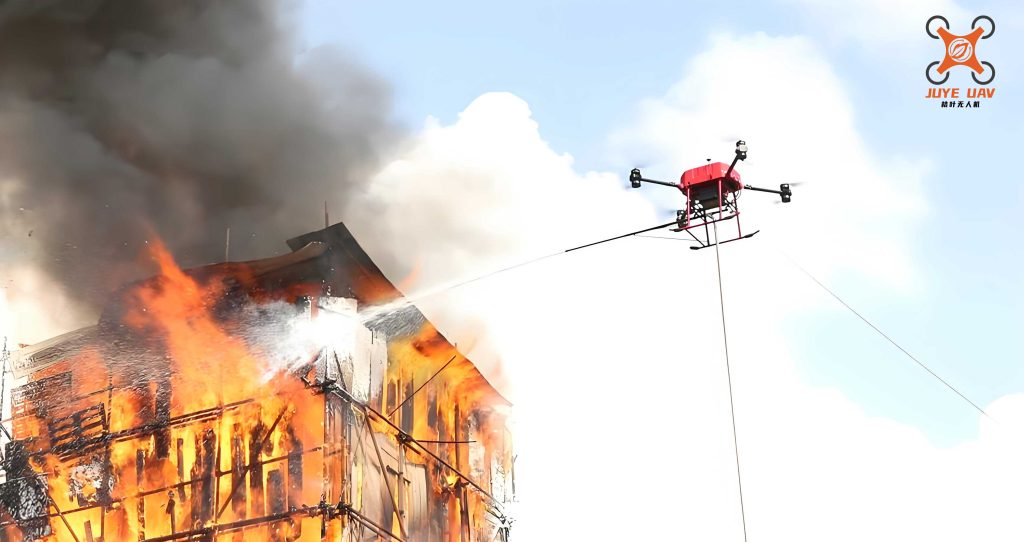
The very term “fire UAV” signifies a UAV tailored for fire and rescue missions. Its value proposition can be summarized by a fundamental operational efficiency formula. If we define mission effectiveness $E_m$ as a function of situational awareness $A_s$, response speed $S_r$, and operational safety $S_o$, the introduction of a fire UAV positively impacts each variable:
$$E_m = k \cdot A_s^{\alpha} \cdot S_r^{\beta} \cdot S_o^{\gamma}$$
where $k$ is a system constant, and $\alpha$, $\beta$, $\gamma$ are positive exponents. The fire UAV enhances $A_s$ through aerial reconnaissance, increases $S_r$ by rapidly covering large areas, and improves $S_o$ by keeping personnel at a distance from immediate dangers.
Categorization of Fire UAVs
Selecting the appropriate fire UAV requires understanding its taxonomy. Fire UAVs can be classified along several dimensions, each affecting performance parameters crucial for rescue work.
| Classification Axis | Categories | Key Characteristics & Relevance to Firefighting |
|---|---|---|
| Domain of Use | Military UAVs | Highest performance (speed, altitude, range); advanced payloads; often cost-prohibitive for civilian use. |
| Civilian/Public Service UAVs (Fire UAVs fall here) | Balance of performance, cost, and ease of use; optimized for tasks like mapping, monitoring, and delivery; the primary market for fire departments. | |
| Power System | Electric Fire UAVs | Simpler maintenance, lower cost, easier piloting, low vibration (good for imaging). Limited by battery energy density. Flight time $T_{flight}$ can be approximated by: $$T_{flight} = \frac{C_{batt} \cdot V_{batt} \cdot \eta}{P_{avg}}$$ where $C_{batt}$ is battery capacity (Ah), $V_{batt}$ is voltage, $\eta$ is efficiency, and $P_{avg}$ is average power draw. This limits endurance. |
| Fuel-powered (Gasoline/Hybrid) Fire UAVs | Superior endurance and wind resistance. Higher cost, complex operation, greater vibration. Endurance is less bound by an energy-density equation like the electric version, but follows: $$T_{flight} \approx \frac{V_{fuel} \cdot \rho_{fuel} \cdot H_{fuel}}{SFC \cdot P_{eng}}$$ where $V_{fuel}$ is fuel volume, $\rho_{fuel}$ is density, $H_{fuel}$ is heating value, $SFC$ is specific fuel consumption, and $P_{eng}$ is engine power. | |
| Platform Configuration | Fixed-Wing Fire UAVs | Long range and endurance, high speed. Require runway or launcher for takeoff/landing. Ideal for large-area survey (e.g., forest fire perimeter mapping). |
| Multi-Rotor Fire UAVs (Most common in firefighting) | Vertical Take-Off and Landing (VTOL), excellent hover stability, maneuverability in tight spaces. Trade-off is lower endurance. The thrust $T$ required for a quadcopter is: $$T = \frac{W}{n \cdot \cos(\phi)}$$ where $W$ is total weight, $n$ is number of rotors (e.g., 4), and $\phi$ is rotor tilt angle. | |
| Unmanned Helicopters | VTOL, good endurance and speed, can handle heavier payloads. More mechanically complex and expensive than multi-rotors. |
For most fire department applications, the multi-rotor electric fire UAV offers the best balance of operational flexibility, ease of use, and cost, despite endurance limitations. The choice, however, must be mission-specific. A department covering vast wildland areas might complement its fleet with a fixed-wing or fuel-powered fire UAV for extended operations.
Applications of Fire UAVs in Fire and Rescue Operations
The utility of a fire UAV extends far beyond simple aerial photography. It serves as a versatile platform that can be equipped with various payloads to address multiple phases of emergency response.
| Application Domain | Specific Tasks | Typical Payloads | Operational Impact |
|---|---|---|---|
| Disaster Reconnaissance & Situational Awareness | Initial assessment of fire spread, structural integrity, hazardous material leaks, flood extent, earthquake damage, search for survivors in rubble. | High-resolution RGB cameras, thermal imaging cameras (for heat signatures through smoke), gas detectors, 4G/5G or satellite live-video transmitters. | Provides real-time, overhead perspective unreachable by ground teams. Reduces risk to personnel. Enables data-driven command decisions. The field of view (FOV) and ground sampling distance (GSD) are critical parameters: $$GSD = \frac{H \cdot s}{f}$$ where $H$ is flight altitude, $s$ is sensor pixel size, and $f$ is focal length. |
| Assisted Rescue & Direct Intervention | Communicating with trapped victims, delivering emergency supplies, deploying life-saving equipment, detecting vital signs. | Loudspeakers, payload release mechanisms, life jackets, ropes, medical kits, automated external defibrillators (AEDs), biometric sensors. | Extends the reach of rescuers. A fire UAV can deliver a payload $m_p$ to coordinates $(x_t, y_t)$ with an accuracy $\sigma$. The required hovering time $t_h$ for communication or precision dropping can be a limiting factor for battery-powered fire UAVs. |
| Mapping & 3D Modeling | Creating accurate maps of disaster zones, 3D models of collapsed structures or chemical plumes, volumetric calculations of landslide debris or fire damage. | Nadir and oblique (tilt) cameras, LiDAR scanners, multispectral sensors. | Enables precise planning and post-disaster analysis. Using Structure from Motion (SfM) photogrammetry, a 3D point cloud is generated from overlapping images. The number of images $N$ needed for a model of area $A$ with overlap $o$ is: $$N \approx \frac{A}{(GSD \cdot (1-o))^2}$$ |
| Monitoring & Surveillance | Tracking the progression of a wildfire, monitoring hot spots after a fire is contained, overseeing large crowds or perimeters during an incident. | Zoom cameras, thermal cameras, automated tracking software. | Provides persistent intelligence over long durations (especially with automated charging stations). Enhances resource allocation efficiency. |
The integration of these applications creates a powerful operational loop. For instance, a fire UAV first conducts thermal reconnaissance of a building fire, identifying the hottest zones and potential victims. Subsequently, it could guide a water drop from an aerial ladder or even deliver a respirator to a trapped individual before ground teams make entry. This multi-role capability is what makes the modern fire UAV indispensable.
Consider the mathematical modeling of a search pattern. For a fire UAV searching an area $A_{search}$ for survivors, using a sensor with sweep width $W$, the probability of detection $P_d$ after time $t$ at speed $v$ is modeled by:
$$P_d = 1 – \exp\left(-\frac{W \cdot v \cdot t}{A_{search}}\right)$$
This shows how a fire UAV, with its higher $v$ compared to ground searchers and ability to maintain a consistent $W$, can significantly accelerate search operations.
Prevalent Challenges in Fire UAV Deployment
Despite the clear benefits, the path to effective fire UAV integration is fraught with technical, operational, and human-factor challenges. Recognizing these pitfalls is the first step toward mitigating them.
| Challenge Category | Specific Issues | Consequences & Risks |
|---|---|---|
| Technological Maturity | 1. Inadequate autonomous obstacle avoidance in complex, dynamic environments (e.g., dense smoke, tangled rubble). 2. Vulnerability to GPS signal loss or spoofing, leading to instability or loss of control. 3. Limited payload capacity and flight endurance, especially for electric multi-rotor fire UAVs. |
High crash rates, loss of expensive equipment, failure during critical missions. A fire UAV without robust sense-and-avoid is a liability. |
| Operational Safety | 1. Pilot error due to inadequate training or stress. 2. Mechanical or electronic failure mid-flight. 3. Hazard to ground personnel and assets from falling debris or spinning propellers ($\text{Kinetic Energy} = \frac{1}{2} m v^2$). 4. Interference with manned aviation (helicopters, air ambulances). |
Serious injury, property damage, legal liability, and disruption of overall rescue efforts. A crashed fire UAV can become a new hazard on scene. |
| Conceptual & Training Deficits | 1. Misconception that a short vendor training qualifies an operator for complex missions. 2. Treating the fire UAV as a standalone gadget rather than part of an integrated command system. 3. Lack of standardized procedures for fire UAV deployment in various incident types. |
Underutilization of capability, operators afraid to fly in challenging conditions, poor data integration into decision-making loops. |
| Regulatory & Logistical Hurdles | 1. Navigating complex airspace regulations, especially in urban environments or near airports. 2. Securing and maintaining frequency spectrum for command and video links. 3. Managing battery logistics, charging in field conditions, and data storage/processing. |
Delayed deployment, restricted operational zones, communication blackouts, and mission abort due to logistical failures. |
The risk of a crash can be modeled as a probability function $P_{crash}$ dependent on technology reliability $R_t$, operator skill $S_o$, and environmental severity $E_e$:
$$P_{crash} = 1 – (R_t \cdot S_o \cdot (1 – E_e))$$
This highlights that even with a reliable fire UAV ($R_t \approx 1$), low operator skill or a severe environment can drastically increase risk.
Strategic Considerations for Effective Fire UAV Implementation
To harness the full potential of fire UAVs while mitigating risks, fire departments must adopt a strategic, systems-level approach. Based on lessons learned, I propose the following critical considerations.
1. Rigorous Procurement Based on Mission Needs: Procurement must be driven by operational requirements, not vendor hype. A detailed needs analysis should be conducted. This involves creating a specification matrix. For example, a department might define minimum requirements for a reconnaissance fire UAV:
- Endurance: $T_{min} \ge 45$ minutes
- Wind Resistance: $V_{wind} \ge 12$ m/s
- Payload Capacity: $m_{payload} \ge 1.5$ kg (to carry thermal/zoom camera)
- Data Link Range: $R_{link} \ge 7$ km
- Mandatory Features: Dual GNSS (GPS+GLONASS/Galileo), 360-degree obstacle sensing, IP54 rating.
Evaluating bids against such a matrix, conducting live fly-off trials, and verifying performance through contractual Service Level Agreements (SLAs) are essential. The total cost of ownership (TCO), not just purchase price, must be calculated:
$$TCO = C_{acq} + \sum_{t=1}^{L} (C_{main,t} + C_{bat,t} + C_{train,t} + C_{soft,t})$$
where $C_{acq}$ is acquisition cost, $L$ is lifespan in years, and other terms are annual costs for maintenance, batteries, training, and software.
2. Comprehensive and Continuous Training & Certification: Operating a fire UAV is a professional skill. The “weekend pilot” model is unacceptable for emergency response. Training must encompass:
– Theoretical Knowledge: Aerodynamics, regulations, meteorology, airspace, electronics.
– Practical Flight Skills: Manual recovery from failures, flight in GNSS-denied environments, precision maneuvering.
– Mission-Specific Tactics: Coordinating with ground teams, data acquisition protocols for mapping, interpreting thermal imagery.
Operators should obtain recognized certifications (e.g., FAA Part 107 in the US, or equivalent national credentials) and undergo regular proficiency checks. The skill decay over time without practice can be significant. A simple model for skill retention $S(t)$ after training with initial skill level $S_0$ and decay constant $\lambda$ is:
$$S(t) = S_0 \cdot e^{-\lambda t}$$
This underscores the need for recurrent training to maintain $\lambda$ at a low value.
3. Adopting a Service-Based or Hybrid Procurement Model: For many departments, especially those with limited in-house expertise or sporadic need for advanced capabilities, purchasing “flight services” can be superior to purchasing assets. This could mean:
– Full-Service Contract: A vendor provides the fire UAV, the certified pilot, data processing, and maintenance for a subscription fee or per-mission cost.
– Hybrid Model: The department owns basic fire UAVs for routine tasks but contracts specialized services (e.g., LiDAR mapping, long-endurance monitoring) as needed.
This model transfers the risks of technology obsolescence, pilot training, and maintenance to the service provider, ensuring access to top-tier capability when required. The decision can be framed as a cost-benefit analysis comparing the Net Present Value (NPV) of ownership versus service contracting over time $T$:
$$NPV_{own} = -C_{acq} + \sum_{t=1}^{T} \frac{B_t – C_{op,t}}{(1+r)^t}$$
$$NPV_{service} = \sum_{t=1}^{T} \frac{B_t – C_{serv,t}}{(1+r)^t}$$
where $B_t$ is benefit (hard to quantify but related to mission success), $C_{op}$ is operational cost of ownership, $C_{serv}$ is service fee, and $r$ is discount rate.
4. Developing Robust Standard Operating Procedures (SOPs): The fire UAV must be seamlessly integrated into the Incident Command System (ICS). This requires clear SOPs covering:
– Pre-flight checklists (including airspace authorization, weather assessment).
– Launch/Recovery zones (LZ) management and safety protocols.
– Communication protocols between the fire UAV pilot and the Incident Commander.
– Data management workflows (how video is streamed, stored, analyzed, and disseminated).
A standardized response matrix linking incident type (e.g., Structure Fire, HAZMAT, Search and Rescue) to recommended fire UAV configuration, payload, and flight pattern should be developed and regularly drilled.
5. Fostering a Culture of Data Utilization: The fire UAV is a data collection node. The real value is extracted from this data. Departments must invest in or partner for data analytics capabilities. This includes software for real-time video analytics (e.g., automatic fire front detection), rapid photogrammetric processing, and integration of UAV-derived data with other GIS and building information systems. The information yield $I_y$ from a fire UAV sortie is a function of sensor quality $Q_s$, data processing capability $C_p$, and analyst skill $S_a$:
$$I_y = \mu \cdot \ln(1 + Q_s \cdot C_p \cdot S_a)$$
This shows diminishing returns without corresponding investment in $C_p$ and $S_a$.
The Future Trajectory and Conclusion
The evolution of fire UAV technology is rapid. We are seeing trends toward:
– Increased Autonomy: Swarm fire UAVs that can collaboratively map large areas or perform distributed sensing.
– Advanced Payloads: Miniaturized chemical “sniffers,” radar for seeing through walls, and integration with AI for real-time object and anomaly detection.
– Hybrid VTOL Platforms: Vehicles that combine the vertical takeoff of a multi-rotor with the efficient forward flight of a fixed-wing, dramatically extending range and endurance.
– Enhanced Connectivity: Integration with 5G networks and satellite constellations for ubiquitous command and control, even in remote areas.
The operational equation for future fire departments will increasingly include the fire UAV as a standard variable. Its cost-effectiveness in saving lives and protecting property is becoming irrefutable. However, this potential will only be realized if adoption is thoughtful, strategic, and centered on building lasting institutional competency rather than acquiring flashy hardware.
In conclusion, the fire UAV has cemented its role as a force multiplier in modern firefighting and rescue. It provides unparalleled eyes in the sky, a robotic first responder, and a mobile data hub. The challenges of technology, safety, and training are significant but manageable through careful planning, investment in human capital, and a focus on integrated systems. As we move forward, the continuous refinement of fire UAV capabilities and their operational doctrines will undoubtedly see them play an even more central and decisive role in safeguarding communities and responders alike. The journey from a novel gadget to an essential tool is complete; the fire UAV is now a cornerstone of effective 21st-century emergency response.