
As a firefighting professional witnessing the rapid evolution of technology, I have observed a transformative shift in our operational capabilities with the integration of Unmanned Aerial Vehicles (UAVs). The maturation of wireless remote control systems has profoundly expanded the application scope of drones. To enhance fire service effectiveness and strengthen our force’s capabilities, UAVs have become indispensable assets in firefighting and rescue domains. These fire UAVs conduct reconnaissance and surveillance of fire scenes and rescue progress, significantly boosting operational efficiency and ensuring responder safety. This article explores the application of wireless remote-controlled fire UAVs, detailing their functions, advantages, specific use cases, and the technical demands they must meet to excel in harsh environments.
The core of a modern fire UAV system lies in its integration of automatic control, communication, and computer technologies. The wireless remote control, often utilizing code-division command systems where different pulse codes represent different control instructions, provides flexibility, though signal range and obstructions remain considerations. These drones are built on advanced flight control platforms equipped with video transmission and ground support systems, enabling real-time aerial monitoring—a capability that solves critical gaps in traditional ground-based observation, especially during emergencies.
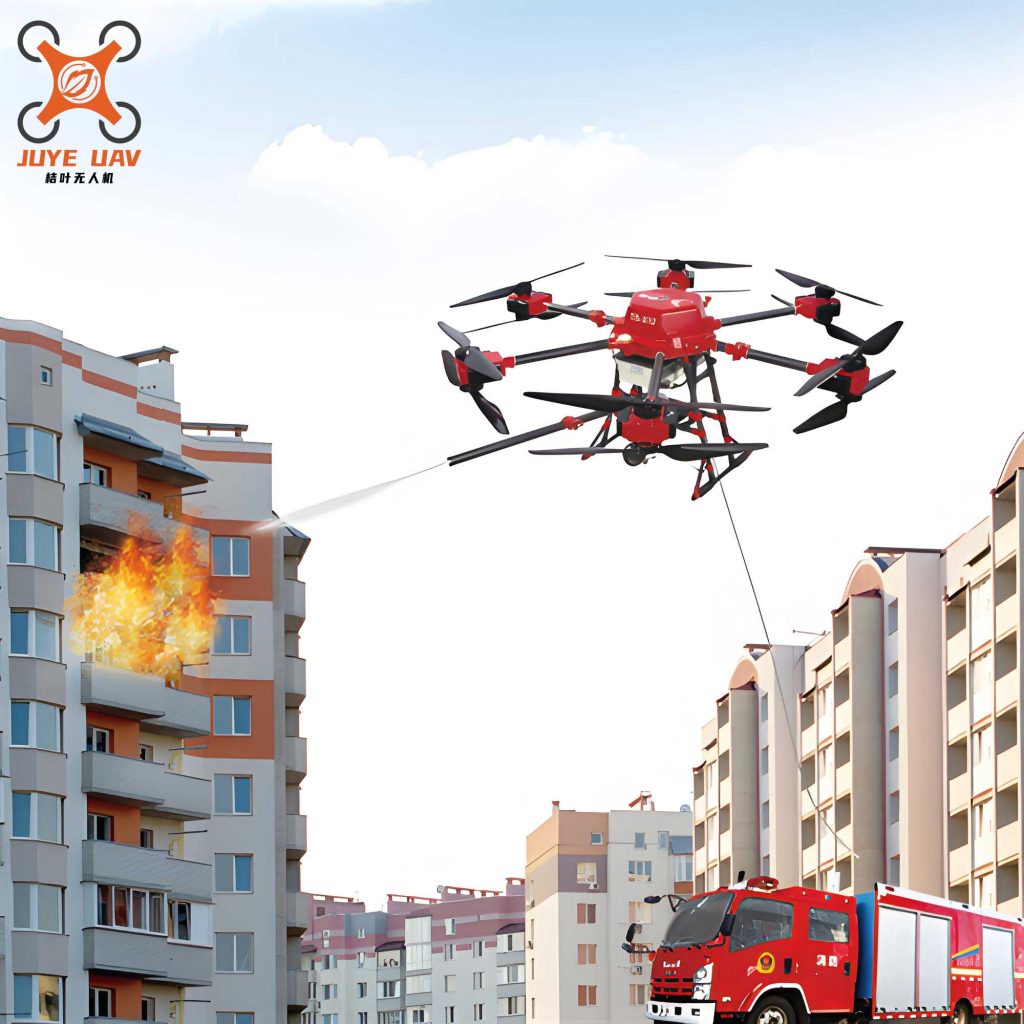
The defining characteristics of effective fire UAVs are their agility, adaptability, and superior vantage point. Their compact and lightweight design allows for rapid deployment, even when ground access is blocked. They exhibit high maneuverability with small turning radii, and their environmental resilience permits operation in diverse and challenging conditions. Perhaps most crucially, they provide an expansive, unobstructed field of view. Using broadband and datalink technology for beyond-visual-line-of-sight (BVLOS) control, a fire UAV can capture high-resolution imagery and video from various angles and altitudes. This capability is enhanced with thermal and night-vision sensors, delivering comprehensive situational awareness regardless of time or smoke obstruction.
The operational advantages of deploying a fire UAV in fire and rescue scenarios are substantial and multi-faceted.
- Reconnaissance in Hazardous Environments: Fire UAVs can safely enter areas deemed too risky for personnel, such as sites with imminent explosion risk or toxic gas release. Equipped with micro gas detectors, they can measure concentrations of combustibles or toxins (e.g., CO, H₂S, VOCs), mapping dispersion patterns to inform safe approach routes and tactical decisions, thereby reducing盲目性和无效性 (blindness and inefficacy) in the initial response phase.
- Aerial Supervision and Dynamic Monitoring: They provide persistent oversight of the entire incident. For high-rise or complex structural fires, fire UAVs can identify hidden fire pockets and track the real-time progression of fire spread. This live feed, integrated into command and control systems, allows for large-capacity archival and remote access, enabling commanders to adjust strategies dynamically to contain the fire’s reach.
- Search and Rescue Support: In large-area disasters like wildfires or collapsed structures, fire UAVs equipped with thermal cameras can quickly scan for heat signatures of missing persons, dramatically accelerating the search process and guiding rescue teams precisely to victims.
To reliably deliver these advantages, fire UAVs must meet stringent technical requirements born from the extreme conditions of firegrounds.
| Requirement | Description | Performance Metric / Consideration |
|---|---|---|
| Enhanced Reliability | Ability to withstand harsh operational environments. |
|
| Operational Performance | Parameters defining mission capability. |
|
| Signal Stability | Robustness of command and data links. |
|
| Integration & Compatibility | Ability to carry payloads and interface with systems. |
|
The effectiveness of a fire UAV program hinges not just on technology but on strategic deployment models. A tiered allocation system ensures appropriate resources are available at different command levels.
| Tier | Platform Type | Primary Role | Typical Specifications |
|---|---|---|---|
| Battalion / Company Level | Portable, multi-rotor electric UAV | Immediate scene assessment, short-range reconnaissance. Deploys with first-response units. | Weight: < 7 kg; Endurance: 25-40 min; Range: 5-10 km; Payload: Basic EO/IR camera, possible speaker. |
| District / Brigade Level | Larger multi-rotor or hybrid VTOL UAV | Extended scene monitoring, mid-range operations, payload delivery (e.g., comms relay). Supports complex incidents. | Weight: 10-25 kg; Endurance: 60-90 min; Range: 15-30 km; Payload: Advanced sensors, modular options for delivery. |
| Regional / Command Level | Fixed-wing or heavy-lift multi-rotor UAV | Large-area surveillance (e.g., wildfires), long-endurance monitoring, heavy payload transport. | Weight: > 25 kg; Endurance: 2+ hours (fixed-wing: 6+ hrs); Range: 50+ km; Payload: Multiple sensors, larger extinguishing agents, specialized equipment. |
The practical application of fire UAVs translates these capabilities into life-saving actions across the incident timeline. We can quantify the scouting efficiency $E_{scout}$ of a fire UAV compared to a ground team as a function of area covered $A$, time $t$, and risk factor $R$ (where $R=1$ for maximum risk to personnel):
$$E_{scout} = \frac{A_{UAV}(t)}{R_{UAV}} \quad \text{vs} \quad E_{scout} = \frac{A_{ground}(t)}{R_{ground}}$$
Typically, $\frac{A_{UAV}(t)}{A_{ground}(t)} > 1$ and $R_{UAV} << R_{ground}$, resulting in a dramatically higher efficiency for the fire UAV in the initial phases.
Beyond scouting, fire UAVs are force multipliers in active response. Integrated loudspeakers or mesh communication nodes can relay commands or establish emergency networks in communication-dead zones. For direct fire attack, the future lies in integrated suppression systems. The potential extinguishing effect $F_{ext}$ of a fire UAV carrying a payload can be modeled by considering the agent’s effectiveness $k$, the delivery accuracy $\alpha$ (a function of UAV stability and targeting), and the payload mass $m_{agent}$:
$$F_{ext} = k \cdot \alpha(v_{wind}, \text{stability}) \cdot m_{agent}$$
This showcases the promise of fire UAVs equipped with:
- Precision Liquid/Agent Delivery: Targeting Class A or B fires in inaccessible spots (e.g., high-floor windows).
- Compact Fire Suppression Grenades: Remotely deploying grenades that disperse extinguishing agent upon impact or detonation.
- Non-Traditional Methods: Experimental systems using acoustic waves to displace oxygen near the flame, a method suitable for small, confined fires, represented by a different agent constant $k_{acoustic}$.
However, the path to ubiquitous fire UAV integration is not without challenges. Regulatory airspace integration, pilot training standards, data management, and cost are persistent hurdles. The total cost of ownership $C_{total}$ must be justified by the operational benefit $B_{ops}$, which includes reduced risk to life, improved outcomes, and potential property saved:
$$ \text{Return on Investment} = \frac{B_{ops}(UAV) – B_{ops}(traditional)}{C_{total}(UAV)} $$
Where $C_{total}$ includes acquisition, training, maintenance, and licensing. The trend is clearly toward positive returns as technology advances and costs decrease.
| Phase | Application | UAV Function | Key Payload / Capability |
|---|---|---|---|
| Pre-Incident | Risk Assessment & Inspection | Aerial inspection of structures, hazardous sites, and large events. | High-resolution zoom camera, thermal camera for hot spot detection. |
| Initial Response | Situational Awareness | Rapid aerial overview, identification of fire location, extent, and hazards. | EO/IR camera, gas sensor, live video downlink. |
| Active Response | Operations Support | Monitoring fire spread, searching for victims, guiding evacuations, delivering light supplies. | Thermal camera, loudspeaker, strobe light, drop mechanism. |
| Active Response | Direct Fire Attack | Targeted application of extinguishing agents to suppress or contain fire. | Integrated liquid/foam system, fire suppression grenade launcher. |
| Post-Incident | Investigation & Documentation | Capturing aerial imagery for damage assessment, forensic analysis, and after-action review. | Photogrammetry software, high-resolution mapping camera. |
In conclusion, the integration of wireless remote-controlled fire UAVs is not merely an addition of new equipment; it represents a fundamental shift in firefighting doctrine and capability. From providing unparalleled situational awareness in toxic environments to actively participating in suppression and rescue, the fire UAV has cemented its role as a critical tool. As technology continues to advance—increasing endurance, payload capacity, and autonomy—the strategic and tactical applications of fire UAVs will only deepen. For fire departments worldwide, the strategic adoption and skilled integration of these systems is paramount to enhancing operational effectiveness, protecting communities, and, most importantly, safeguarding the lives of both the public and fire service personnel. The future of firefighting is intelligent, data-driven, and, undoubtedly, aerial.