
In my years of experience in fire safety and emergency response, I have observed a paradigm shift in how we approach high-rise building fires. The limitations of traditional firefighting equipment, constrained by height and complex environments, have prompted the integration of advanced technologies. Among these, fire UAVs (Unmanned Aerial Vehicles) have emerged as a transformative tool. Their agility, precision, and efficiency offer unprecedented capabilities in scenarios where every second counts. This article, from my first-hand perspective, delves into the application, challenges, and future directions of fire UAVs in high-rise firefighting. I will analyze technical hurdles, propose enhancements using formulas and tables, and outline management strategies, all while emphasizing the critical keyword: fire UAV. The potential of fire UAVs is immense, but realizing it requires continuous optimization and a holistic approach.
The inherent challenges of high-rise fires—rapid vertical spread, difficult access, and complex internal layouts—make traditional ground-based operations often insufficient. Here, fire UAVs provide a unique aerial platform. They can swiftly ascend to great heights, conduct reconnaissance through smoke, and even deliver extinguishing agents. However, their deployment is not without obstacles. I have identified several core issues that currently hinder the optimal performance of fire UAVs in these demanding environments.
Technical and Operational Challenges for Fire UAVs
From a technical standpoint, the most pressing limitation I consistently encounter is the endurance and payload capacity of fire UAVs. The flight time, primarily governed by battery energy density, is often inadequate for prolonged rescue missions. A fire UAV might be forced to return for recharging just as it is providing crucial thermal imaging data, disrupting the operational continuum. The payload restriction further complicates matters; most fire UAVs cannot carry substantial quantities of fire suppressants or heavy-duty equipment, limiting their direct firefighting role to very localized interventions.
We can model the effective operational window, \( T_{op} \), of a fire UAV considering its energy constraints:
$$ T_{op} = \frac{E_{batt} \cdot \eta_{sys}}{P_{hover} + P_{payload} + P_{aux}} $$
Where \( E_{batt} \) is the battery energy, \( \eta_{sys} \) is the system efficiency, \( P_{hover} \) is the power for basic hovering, \( P_{payload} \) is the additional power required for carrying payload (like灭火剂), and \( P_{aux} \) is for auxiliary systems (sensors, communication). Currently, low \( E_{batt} \) and high \( P_{payload} \) drastically reduce \( T_{op} \).
| Constraint | Typical Current Limit | Impact on Fire UAV Mission |
|---|---|---|
| Flight Endurance | 20-40 minutes | Frequent interruptions, missed critical data points. |
| Payload Capacity | 5-15 kg | Limited灭火剂 load, inability to carry large tools. |
| Signal Range/Stability | 1-3 km (LOS) | Loss of control in dense, tall structures. |
| Environmental Tolerance | Winds < 10 m/s, Temp < 40°C | Grounding in adverse fireground conditions. |
Another significant challenge is the adaptability of fire UAVs to the complex application scenarios. High-rise buildings create unpredictable micro-environments. Internal air currents from ventilation shafts and the stack effect can violently destabilize a fire UAV. Narrow corridors, collapsed structures, and intense thermal updrafts form navigational nightmares. Furthermore, the operational environment itself—extreme heat, dense particulate smoke, and potential electromagnetic interference from the building—degrades sensor performance and communication links. I have seen fire UAVs struggle with sensor occlusion in thick smoke, rendering their visual cameras useless and putting immense pressure on thermal systems.
Finally, the synergy between fire UAVs and the broader rescue ecosystem is often underdeveloped. In a coordinated attack, data from a fire UAV must seamlessly inform the actions of ground crews, aerial ladders, and interior teams. However, without standardized protocols and integrated communication platforms, there is a lag—or worse, a misinterpretation—in translating aerial intelligence into ground action. Different models of fire UAVs have varied control interfaces, increasing the training burden on firefighters and risking operational errors during high-stress events.
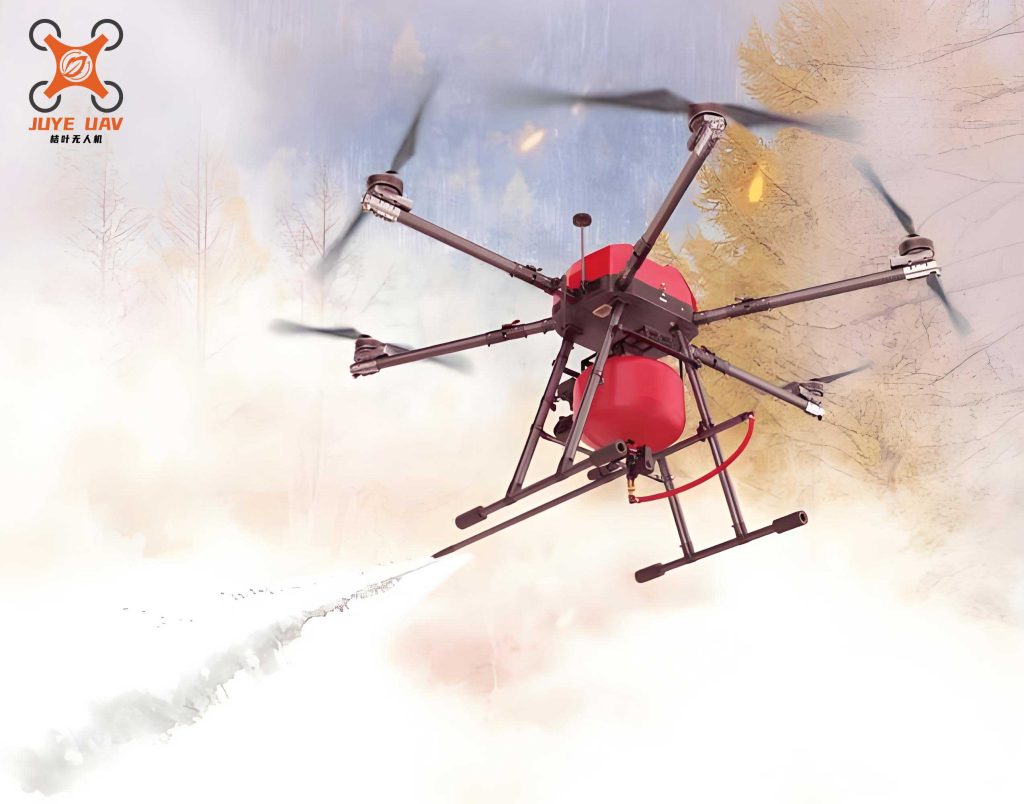
Technological Advancements to Empower Fire UAVs
To overcome these hurdles, a multi-faceted technological push is essential. Enhancing the endurance and payload of fire UAVs is the foremost priority. This involves advances at the component level. The adoption of high-energy-density battery chemistries (e.g., solid-state lithium) is crucial. Concurrently, optimizing the power management system (PMS) can extend usable life. The power draw can be expressed as a function of operational mode:
$$ P_{total}(t) = P_{base} + \alpha \cdot m_{payload} \cdot g \cdot v(t) + \beta \cdot A_{drag} \cdot v(t)^3 + P_{sensors}(t) $$
Where \( \alpha \) and \( \beta \) are efficiency coefficients, \( m_{payload} \) is payload mass, \( g \) is gravity, \( v(t) \) is velocity, and \( A_{drag} \) is frontal area. Reducing \( m_{payload} \) via lightweight composites and minimizing \( A_{drag} \) through aerodynamic design are key. Furthermore, exploring in-flight energy replenishment, such as laser power beaming or tethering options for stationary operations, could revolutionize fire UAV loiter time.
| Improvement Area | Specific Technology | Expected Benefit for Fire UAV |
|---|---|---|
| Energy Storage | Solid-state batteries, Hydrogen fuel cells | Increase flight time by 100-300%. |
| Structural Design | Carbon-fiber composites, Generative design | Reduce empty weight by 20-30%, increasing payload fraction. |
| In-flight Charging | Inductive charging pads on fire trucks, Laser charging | Enable near-continuous operation. |
| Communication | MIMO, Mesh networking, Satellite link backup | Ensure robust control and data link in all conditions. |
Stable signal transmission is the lifeline for any fire UAV operation. To combat interference, we must move beyond single-link systems. Implementing multi-band, multi-path communication protocols with adaptive modulation is vital. The signal-to-noise ratio (SNR) in a fire environment can be modeled:
$$ SNR_{received} = \frac{P_t G_t G_r \lambda^2}{(4\pi R)^2 L_{path} L_{fire}} $$
Here, \( P_t \) is transmit power, \( G_t \) and \( G_r \) are antenna gains, \( \lambda \) is wavelength, \( R \) is range, \( L_{path} \) is path loss, and \( L_{fire} \) is the additional loss due to fire plasma and smoke (a significant factor often >10 dB). Using directional antennas (high \( G \)), lower frequencies (larger \( \lambda \)) for better penetration, and deploying airborne communication relays (reducing \( R \)) can mitigate this. A network of fire UAVs could form an ad-hoc mesh, ensuring one fire UAV always maintains a good link.
Flight control and navigation require equal attention. Advanced sensor fusion is non-negotiable. An Extended Kalman Filter (EKF) can optimally combine data from Inertial Measurement Units (IMUs), LiDAR, and visual odometry to maintain state estimation when GPS is denied indoors:
$$ \hat{x}_{k|k} = \hat{x}_{k|k-1} + K_k (z_k – h(\hat{x}_{k|k-1})) $$
Where \( \hat{x} \) is the estimated state (position, velocity), \( z \) is sensor measurement, \( h \) is the measurement model, and \( K \) is the Kalman gain. Implementing such algorithms allows a fire UAV to map and navigate complex, GPS-denied interiors autonomously. Coupled with real-time path planning algorithms like A* or RRT*, and robust obstacle avoidance using ultrasonics and LiDAR, the fire UAV becomes a resilient scout.
Ultimately, the true power of a fire UAV is realized in synergy. We need a unified C4ISR (Command, Control, Communications, Computers, Intelligence, Surveillance, and Reconnaissance) framework. This platform would ingest data from all fire UAVs, ground robots, and personnel trackers, creating a Common Operational Picture (COP). Standardized data interfaces (e.g., using STANAG 4586 or similar adapted protocols) are necessary for interoperability between different fire UAV brands and other equipment.
Managing Fire UAV Integration in Fire Departments
Technology alone is insufficient. Its effective deployment hinges on sound management practices. First is the cultivation of specialized talent. Operating a fire UAV in a high-stakes, dynamic fireground is vastly different from recreational flying. Training must cover not only piloting skills but also mission planning, data interpretation (thermal imagery, gas detection readings), maintenance, and tactical integration. A structured curriculum should progress from simulations to live drills in representative environments. Table below outlines a proposed training matrix for fire UAV operators.
| Training Phase | Core Competencies | Evaluation Metrics |
|---|---|---|
| Basic Certification | Flight mechanics, Regulations, Basic maintenance | Written exam, Basic flight maneuver test. |
| Tactical Application | Thermal image analysis, Search patterns, Payload deployment (e.g.,灭火弹) | Scenario-based evaluation in simulated smoke. |
| Integrated Operations | Communication with incident command, Coordination with ground teams, Data reporting | Performance in full-scale multi-agency exercises. |
| Advanced/Instructor | Mission planning for complex structures, Troubleshooting in adverse conditions, Training others | Design and execute a complex rescue scenario. |
Optimizing the协同配合机制 is the next pillar. The aforementioned C4ISR platform must be complemented by clear Standard Operating Procedures (SOPs). These SOPs define roles: for instance, a dedicated “Fire UAV Controller” liaises between the aerial asset and the Incident Commander. The SOPs must specify communication protocols (e.g., “UAV-1 to Command, thermal hotspot identified on floor 15, grid Delta-4”), data sharing formats, and safety stand-off distances. Regular joint exercises, where fire UAVs support ladder companies, interior search teams, and hazmat units, are indispensable to build muscle memory and trust.
Finally, standardizing操作流程 is critical for safety and reliability. Every fire UAV mission should follow a strict checklist: pre-flight (battery status, sensor calibration, payload secure), in-flight (adherence to designated flight paths, continuous system health monitoring), and post-flight (data download, maintenance log, battery conditioning). For a fire UAV equipped with a灭火弹, the release sequence must be codified, factoring in altitude, wind drift, and collateral damage. Emergency procedures for link loss, motor failure, or critical battery level must be automated and drilled.
Phased Application of Fire UAVs Throughout a Fire Incident
The utility of a fire UAV evolves with the fire’s stages. In the incipient stage, speed and reconnaissance are paramount. A fire UAV equipped with dual visible-light and thermal cameras can be airborne within minutes of dispatch. Its primary tasks are:
- Rapid Situational Awareness: Providing a live bird’s-eye view to locate the fire floor and assess external spread.
- Precise Source Identification: Using thermal imaging to pinpoint the exact seat of the fire, even inside a room, through windows. The temperature contrast can be quantified: \( \Delta T = T_{source} – T_{ambient} \), guiding the first attack.
- Early Intervention & Communication: If equipped, deploying small灭火弹 or dry chemical agents for very early suppression. Using its loudspeaker to guide occupant evacuation from the outside, reducing panic.
During the growth and fully developed stage, the fire UAV’s role shifts to persistent monitoring and support.
- Fire Spread Tracking: Creating real-time thermal maps to visualize fire movement within the building. This helps predict flashover points and identify structural weaknesses. Heat flux, \( q” \), measured by the fire UAV’s radiometer, can indicate severity: \( q” = \epsilon \sigma (T_{surface}^4 – T_{UAV}^4) \), where \( \epsilon \) is emissivity and \( \sigma \) is Stefan-Boltzmann constant.
- Environmental Monitoring: Deploying gas sensors (for CO, HCN, O2 depletion) to assess toxicity levels for both victims and firefighters, creating a 3D hazard map.
- Resource Guidance: Illuminating access points for ground teams, and precisely directing external water streams from ladder pipes or fire boats by marking targets with laser designators.
In the decay and overhaul stage, the fire UAV ensures safety and aids investigation.
- Post-fire Search: Using sensitive thermal and RGB cameras to scan for residual heat signatures or visual clues of victims in debris.
- Hotspot Detection: Systematically scanning the structure for hidden embers to prevent rekindle. The fire UAV can carry thermal cameras with high sensitivity to small \( \Delta T \).
- Documentation and Assessment: Capturing high-resolution orthomosaic images and 3D LiDAR scans of the damage for forensic analysis and loss estimation. The data can be processed to calculate burned area volume, \( V_{damage} \).
The following table summarizes the multi-role capability of a modern fire UAV across these phases:
| Fire Stage | Primary Fire UAV Tasks | Key Sensors/Payloads | Data Output for Command |
|---|---|---|---|
| Incipient | Rapid ascent, External recon, Source ID, Early comms. | Visible/IR camera, Loudspeaker, Small extinguisher | Live video, Thermal snapshot, Fire floor coordinates. |
| Growth/Developed | Internal/external thermal mapping, Gas sampling, Target designation. | High-res IR camera, Multi-gas sensor, Laser pointer | Heat spread animation, Gas concentration maps, Target coordinates. |
| Decay/Overhaul | Structural inspection, Hotspot scan, Victim search, Damage mapping. | Zoom camera, High-sensitivity IR, LiDAR scanner | Hotspot location list, 3D structural model, Search completion status. |
Conclusion and Future Trajectory
Reflecting on the current state and potential, I am convinced that fire UAVs are not merely auxiliary tools but are becoming central nodes in the high-rise firefighting network. Their ability to provide a safe, elevated, and intelligent perspective fundamentally changes the risk calculus for firefighters. The journey involves tackling the triad of limitations: power, perception, and partnership. By advancing battery and material science, refining sensor fusion and communication algorithms, and fostering an ecosystem of interoperable systems and trained professionals, the fire UAV will mature into an indispensable partner. In future high-rise incidents, I envision swarms of heterogeneous fire UAVs—some for mapping, some for suppression, some for communication relay—working in concert under a unified AI-assisted command system. This integrated approach, constantly fed by data from the fire UAV fleet, will dramatically enhance situational awareness, accelerate response times, and ultimately save more lives and property. The fire UAV, therefore, stands as a testament to how innovation, when carefully managed and integrated, can rise to meet the most daunting vertical challenges.