
As a professional engaged in wildlife protection and resource monitoring, I have witnessed the transformative impact of drone technology, particularly fire UAVs, on forest fire prevention in nature reserves. Forest resources are the lifeblood of these protected areas, and wildfires pose a significant threat, causing immense ecological damage. Traditional fire management methods, relying heavily on manual patrols and ground-based observations, are often costly, inefficient, and pose safety risks to personnel. The integration of fire UAV technology has emerged as a game-changer, offering unprecedented capabilities in monitoring, prevention, and response. In this article, I will delve into the comprehensive application of fire UAV systems, highlighting their advantages, operational methodologies, and the technical synergies that make them indispensable. I will employ detailed analyses, tables, and mathematical models to elucidate how fire UAVs are reshaping forest fire management strategies, ensuring the preservation of our precious natural habitats.
The core of fire UAV technology lies in its ability to autonomously or remotely perform critical tasks in challenging terrains typical of nature reserves. These systems typically comprise multi-rotor or fixed-wing drones equipped with advanced payloads such as high-resolution visible light cameras, thermal infrared sensors, multispectral imagers, and communication relays. When integrated with Remote Sensing (RS), Global Positioning Systems (GPS), Geographic Information Systems (GIS), and robust wireless communication networks, fire UAVs become powerful aerial platforms for real-time data acquisition and transmission. The fundamental equation governing the area coverage capability of a fire UAV during a patrol mission can be expressed as a function of its flight time and sensor footprint:
$$ A_{coverage} = v \cdot t \cdot w \cdot \eta $$
where \( A_{coverage} \) is the total area covered (in km²), \( v \) is the ground speed of the fire UAV (in km/h), \( t \) is the effective flight time (in hours), \( w \) is the swath width of the sensor (in km), and \( \eta \) is the operational efficiency factor accounting for overlap and turning. For instance, a fire UAV with \( v = 50 \) km/h, \( t = 2 \) h, \( w = 0.5 \) km, and \( \eta = 0.8 \) can cover \( A_{coverage} = 50 \times 2 \times 0.5 \times 0.8 = 40 \) km² in a single sortie, far exceeding the capacity of ground teams.
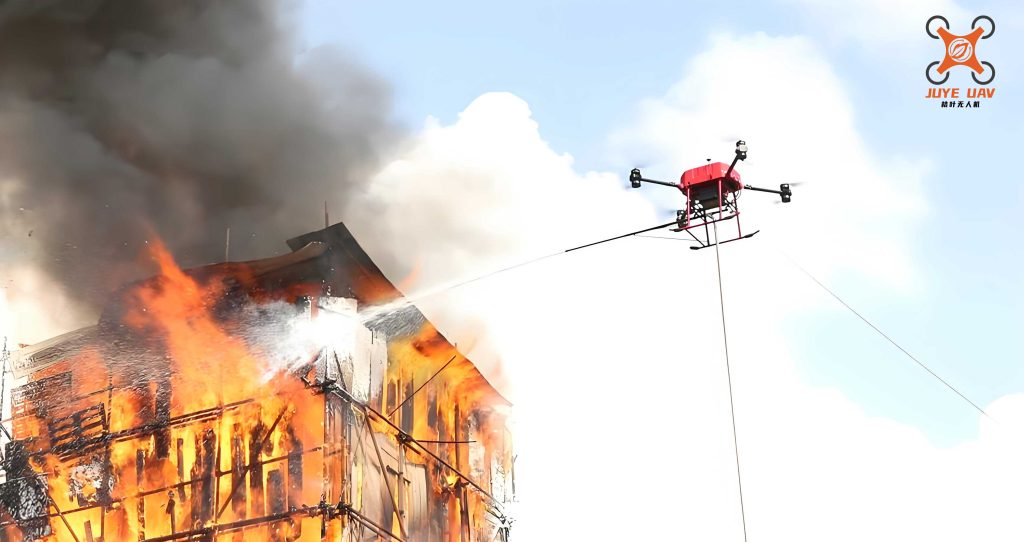
The advantages of deploying fire UAVs in nature reserve forest fire management are multifaceted and profound. Firstly, fire UAVs enable the early detection of fire ignitions. Equipped with thermal cameras, they can identify heat anomalies indicative of smoldering fires or hotspots long before visible smoke or flames are apparent to ground observers. This early warning capability is quantified by the detection probability \( P_d \), which is significantly higher for fire UAVs compared to human patrols, especially in remote or inaccessible areas. Secondly, fire UAVs dramatically improve operational efficiency. By providing real-time aerial imagery, they allow command centers to accurately locate fire perimeters, assess fire intensity, and monitor spread dynamics, facilitating rapid and informed decision-making. Thirdly, fire UAVs enhance personnel safety by reducing the need for firefighters to enter hazardous zones for reconnaissance. They can identify safe routes and alert crews to changing fire behavior, such as sudden flare-ups or wind shifts. Lastly, fire UAVs contribute to timely rescue operations by locating trapped individuals using thermal signatures and dropping emergency supplies. The following table summarizes the key advantages of fire UAVs against traditional methods:
| Aspect | Traditional Methods (Ground Patrols) | Fire UAV Technology |
|---|---|---|
| Detection Time | Slow, dependent on patrol schedules and visibility. | Rapid, continuous monitoring possible with autonomous flights. |
| Coverage Area | Limited by terrain accessibility and human endurance. | Extensive, can cover rugged and vast reserves efficiently. |
| Data Accuracy | Subjective, prone to human error. | High-resolution, georeferenced data with objective thermal analysis. |
| Personnel Risk | High, especially during active fire events. | Minimal, operators remain at a safe distance. |
| Operational Cost | High due to manpower, vehicles, and infrastructure. | Lower long-term cost, scalable with reusable platforms. |
| Response Speed | Delayed by mobilization time. | Immediate deployment from nearby bases. |
In daily operations, fire UAVs are employed for systematic surveillance. Pre-programmed flight paths ensure regular coverage of high-risk zones within the reserve. The integration with GIS allows for the creation of risk maps, where areas are classified based on vegetation type, topography, and historical fire data. A fire UAV can autonomously follow these routes, streaming live video and thermal data to a ground control station. Any anomaly triggers an alert, and the operator can remotely direct the fire UAV for closer inspection. This proactive approach significantly reduces the likelihood of undetected ignitions escalating into major conflagrations. The operational workflow can be modeled as a stochastic process where the fire UAV system continuously samples the environment. The probability of detecting a fire starting at time \( t_0 \) within a given area \( A \) is:
$$ P_{detect}(t) = 1 – e^{-\lambda \cdot \frac{A_{coverage}}{A} \cdot (t – t_0)} $$
Here, \( \lambda \) is the fire occurrence rate per unit area, and \( A_{coverage}/A \) represents the fractional coverage rate of the fire UAV patrol. As \( A_{coverage} \) increases (through longer endurance or higher speed), the detection probability approaches 1 more quickly.
For persistent monitoring, especially during periods of high fire danger (e.g., drought, extreme heat), fire UAVs can be deployed in shifts to maintain a continuous aerial presence. This cyclic monitoring is crucial for rapid response. Modern fire UAVs boast extended flight times, sometimes exceeding several hours, thanks to improved battery technology or hybrid power systems. They can loiter over sensitive areas, providing real-time feeds that are integrated into a common operational picture. When a fire is detected, the fire UAV immediately transmits precise GPS coordinates, estimated fire size, and direction of spread. This information is vital for dispatching ground and aerial assets optimally. The time from detection to initial attack can be minimized using a fire UAV, which is critical given that fire growth often follows an exponential model:
$$ A_{fire}(t) = A_0 \cdot e^{k \cdot t} $$
where \( A_{fire}(t) \) is the fire area at time \( t \), \( A_0 \) is the initial area, and \( k \) is the growth rate coefficient dependent on fuel, weather, and topography. Early detection by a fire UAV keeps \( A_0 \) small, making suppression efforts far more manageable.
During active fire suppression, the role of the fire UAV becomes even more critical. Fire environments are notoriously dangerous, with poor visibility due to smoke, intense heat, and unpredictable winds. A fire UAV equipped with stabilized gimbals and penetrating sensors can fly through or above smoke layers to provide a clear view of the firefront. This real-time intelligence allows incident commanders to assess fire behavior, identify spot fires, and monitor containment lines. Furthermore, specialized fire UAVs can be tasked with direct suppression support. For example, UAVs carrying fire-retardant capsules or water balls can perform precision drops on small ignition points or at the flanks of a fire to slow its spread. The payload capacity of a fire UAV determines its effectiveness in this role. The mass of suppressant \( m \) required to cool a fuel segment can be approximated by:
$$ m = \frac{Q_{fuel}}{\Delta H_{vap} \cdot \epsilon} $$
where \( Q_{fuel} \) is the heat release rate of the burning fuel, \( \Delta H_{vap} \) is the heat of vaporization of the suppressant (e.g., water), and \( \epsilon \) is the application efficiency. While a single fire UAV may carry limited suppressant, a swarm of coordinated fire UAVs can collectively target multiple points, creating a significant tactical advantage, especially in terrain inaccessible to ground crews or manned aircraft.
Post-fire, fire UAVs are invaluable for damage assessment and investigation. They can quickly and safely map the burned area using high-resolution photogrammetry or LiDAR. By processing overlapping images, detailed 3D models and accurate perimeters can be generated. This data is essential for calculating burned area, assessing vegetation loss, and planning rehabilitation. For fire origin determination, a fire UAV can document the scene from multiple angles without disturbing evidence. The use of multispectral sensors can help identify burn severity gradients, which often point toward the ignition source. The process involves analyzing reflectance values in different spectral bands. For instance, the Normalized Burn Ratio (NBR) is calculated from near-infrared (NIR) and shortwave infrared (SWIR) bands:
$$ NBR = \frac{(NIR – SWIR)}{(NIR + SWIR)} $$
A sharp change in NBR values across an area can indicate the fire’s progression path. The following table outlines the applications of fire UAVs across different phases of forest fire management:
| Management Phase | Fire UAV Application | Key Technologies Used | Output/Metric |
|---|---|---|---|
| Prevention & Patrol | Automated routine surveillance, hotspot detection. | Thermal imaging, autonomous flight, GPS/GIS integration. | Early warning alerts, risk maps, patrol logs. |
| Detection & Alarm | Continuous monitoring, immediate fire confirmation. | Real-time video/thermal streaming, cellular/satellite communication. | Precise fire coordinates, size estimate, live feed. |
| Suppression & Response | Firefront monitoring, situational awareness, precision drops. | Stabilized EO/IR cameras, payload release mechanisms, swarm coordination. | Fire behavior analysis, drop accuracy assessment, safety perimeter updates. |
| Post-Fire & Investigation | Burned area mapping, cause investigation, damage assessment. | Photogrammetry, LiDAR, multispectral imaging, data analytics. | 3D terrain models, burn severity maps, area and volume calculations. |
The effectiveness of a fire UAV system is not solely dependent on the aerial platform itself but on its integration into a broader technological ecosystem. Data from the fire UAV’s sensors must be seamlessly fused with other sources, such as satellite imagery, weather stations, and ground sensor networks. Advanced algorithms, including machine learning models, are employed to automatically analyze the incoming data streams. For example, convolutional neural networks can be trained to recognize smoke plumes or fire signatures in visual and thermal imagery, reducing false alarms and accelerating response. The communication link is another critical component; robust, long-range datalinks ensure that command centers receive uninterrupted data even in remote reserves. The overall system reliability can be modeled as a series system where each component (UAV, sensors, comms, processing) must function:
$$ R_{system} = \prod_{i=1}^{n} R_i $$
where \( R_{system} \) is the overall system reliability, \( R_i \) is the reliability of the i-th component, and \( n \) is the number of critical components. Ensuring high \( R_i \) for each, especially for the fire UAV platform and its communication link, is paramount for mission success.
From a practical implementation perspective, the deployment of fire UAVs requires careful planning. Flight operations must comply with aviation regulations, and protocols for beyond-visual-line-of-sight (BVLOS) operations need to be established. Training for operators and analysts is essential to interpret data correctly and make swift decisions. Maintenance schedules for the fire UAV fleet must be rigorous to ensure availability during critical periods. Cost-benefit analyses consistently show that while the initial investment in fire UAV technology can be substantial, the long-term savings from prevented fires, reduced suppression costs, and minimized ecological damage are significant. The return on investment (ROI) can be expressed as:
$$ ROI = \frac{\text{Value of Benefits} – \text{Cost of Investment}}{\text{Cost of Investment}} $$
Benefits include avoided timber loss, protected biodiversity, reduced firefighting expenses, and safeguarded human communities. As fire UAV technology matures and scales, its cost-effectiveness continues to improve.
Looking ahead, the future of fire UAVs in nature reserve forest fire management is incredibly promising. Developments in artificial intelligence will lead to fully autonomous fire UAV swarms capable of collaborative surveillance and suppression. Enhanced sensor technology, such as hyperspectral imaging, will improve the ability to assess vegetation moisture content and predict fire behavior with greater accuracy. Integration with IoT networks will enable fire UAVs to interact with ground-based automated water dispensers or alarm systems. Furthermore, advancements in energy storage, such as hydrogen fuel cells, will extend the endurance of fire UAVs, allowing for days-long monitoring missions. The continuous evolution of fire UAV technology promises to create even more resilient and intelligent systems for protecting our natural heritage from the devastating effects of wildfires.
In conclusion, the adoption of fire UAV technology represents a paradigm shift in how we approach forest fire prevention and management in nature reserves. As someone deeply involved in this field, I have seen firsthand how fire UAVs enhance detection, improve safety, increase efficiency, and provide invaluable data for all phases of fire management. By leveraging the capabilities of fire UAVs—through routine patrols, persistent monitoring, active fire support, and post-fire analysis—we can build a more proactive and effective defense against wildfires. The integration of sophisticated sensors, robust communications, and intelligent analytics makes the modern fire UAV an indispensable tool in the conservationist’s arsenal. It is imperative that more nature reserves invest in and deploy fire UAV systems to safeguard these vital ecosystems for future generations. The journey of the fire UAV from a novel gadget to a cornerstone of forest protection is a testament to the power of innovation in environmental stewardship.