
As a firefighter deeply involved in emergency response, I have witnessed firsthand the transformative impact of unmanned aerial vehicles, particularly fire UAVs, in enhancing our capabilities during critical incidents. The integration of fire UAV technology aligns with national strategies for advancing emergency management systems, as highlighted in recent governmental plans that emphasize smart unmanned rescue equipment and socialized emergency services. In this article, I will explore how fire UAVs are revolutionizing firefighting and rescue operations, drawing from personal experiences and technical insights to detail their applications, advantages, and future potential. The goal is to provide a comprehensive overview, supported by tables and formulas, to underscore the significance of these aerial tools in saving lives and minimizing damage.
Fire UAVs, or unmanned aerial vehicles designed specifically for firefighting, have become indispensable in our arsenal. They are remotely controlled flying machines that consist of a platform, flight control system, radio remote control system, and payload. Based on propulsion methods, fire UAVs can be classified into electric and fuel-driven types. Electric fire UAVs rely on lithium batteries, offering safety advantages by reducing fire risks in crash scenarios, but with limited endurance. Fuel-driven fire UAVs use gasoline or diesel, providing superior endurance but higher fire hazard potential upon impact. This distinction is crucial for operational planning, as summarized in Table 1.
| Type | Power Source | Endurance | Fire Risk on Crash | Typical Applications |
|---|---|---|---|---|
| Electric Fire UAV | Lithium Battery | 30-60 minutes | Low | Short-duration reconnaissance, indoor operations |
| Fuel-Driven Fire UAV | Gasoline/Diesel | 2-4 hours | High | Long-range missions, extended surveillance |
The endurance of a fire UAV can be modeled mathematically. For electric fire UAVs, the flight time $$T_e$$ is given by the battery capacity $$C$$ (in Ah) divided by the power consumption $$P$$ (in W), adjusted for efficiency $$\eta$$: $$T_e = \frac{C \cdot V \cdot \eta}{P}$$, where $$V$$ is the voltage. For fuel-driven fire UAVs, the endurance $$T_f$$ depends on fuel volume $$F_v$$ and consumption rate $$R_f$$: $$T_f = \frac{F_v}{R_f}$$. These formulas help in mission planning, ensuring that fire UAVs are deployed optimally based on energy constraints.
Fire UAVs exhibit several key characteristics that make them ideal for firefighting. First, they offer high monitoring precision, capable of achieving millimeter-level accuracy at altitudes between 50 to 1000 meters, which is vital for detailed reconnaissance. Second, the installation cost of photographic equipment on fire UAVs is relatively low, and they operate reliably in diverse weather conditions. Third, fire UAVs are safe and flexible, with a high cost-performance ratio; they can take off and land in various scenarios, adapting to specific needs with minimal safety hazards. Additionally, fire UAVs can be equipped with different accessories, such as thermal cameras or灭火弹 launchers, to cater to varied rescue scenarios. These features are summarized in Table 2.
| Characteristic | Description | Impact on Firefighting |
|---|---|---|
| High Precision | Millimeter-level accuracy at low altitudes | Enables detailed mapping of fire spread and hotspots |
| Low-Cost Equipment | Affordable camera and sensor installation | Facilitates widespread adoption in消防 departments |
| Safety and Flexibility | Adaptable to complex environments with minimal risk | Reduces rescue personnel exposure to hazards |
| Weather Resilience | Operates in various weather conditions | Ensures continuous monitoring during incidents |
| Modular Design | Supports add-ons like thermal imagers or灭火装置 | Enhances versatility for different rescue tasks |
The advantages of using fire UAVs in灭火救援 are profound, stemming from their rapid deployment, ease of operation, and ability to access hazardous areas. From my experience, fire UAVs significantly enhance our effectiveness in four main areas: swift action, simplicity in control,高空侦察 capabilities, and casualty reduction. These advantages are quantified in Table 3, which compares traditional methods with fire UAV-based approaches.
| Aspect | Traditional Methods | Fire UAV Approach | Improvement Factor |
|---|---|---|---|
| Response Time | Relies on manual scouting, often slow | Immediate aerial deployment, seconds to minutes | Up to 10x faster |
| Operational Complexity | Requires multiple personnel for reconnaissance | 1-2 operators for UAV control | Reduces manpower by 50% |
| High-Altitude Access | Limited by ladder trucks or helicopters | Direct flight to any height,悬停 capability | Unlimited access within range |
| Risk to Personnel | High exposure to fire, collapse, or explosions | Minimal human entry, UAV enters danger zones | Dramatically lowers injury rates |
In terms of swift action, fire UAVs are compact and lightweight, often under 100 kg, allowing for quick launch and flight unaffected by time, location, or terrain. This agility enables us to monitor fire dynamics in real-time, providing crucial data for containment strategies. The speed advantage can be expressed mathematically: if a fire spreads at a rate $$S_f$$ (in m²/s), and a fire UAV covers an area $$A_u$$ (in m²) per second, the time saved in assessment $$T_s$$ is $$T_s = \frac{A_f}{S_f} – \frac{A_f}{A_u}$$, where $$A_f$$ is the total fire area. This equation highlights how fire UAVs expedite response, buying precious minutes for rescue operations.
Ease of operation is another standout feature. Small fire UAVs used in消防队伍 are user-friendly, requiring minimal training. Their simplicity allows us to deploy them rapidly during emergencies like wildfires or floods, transmitting live footage back to command centers. This real-time data flow enhances situational awareness, as illustrated by the information transfer rate $$R_t$$ of a fire UAV, which can be modeled as $$R_t = B \cdot \log_2(1 + \frac{S}{N})$$, where $$B$$ is bandwidth, $$S$$ is signal strength, and $$N$$ is noise. This ensures high-quality video and sensor data for informed decision-making.
High-altitude reconnaissance is where fire UAVs excel. With their long endurance, fire UAVs can hover over fire scenes for extended periods, capturing detailed visuals through zoomable cameras and thermal imaging. Thermal imaging, in particular, detects heat signals to identify fire points, smoke, and trapped individuals. The thermal detection range $$D_t$$ can be calculated using $$D_t = \sqrt{\frac{P_t \cdot G \cdot \sigma \cdot A_r}{(4\pi)^2 \cdot S_{min}}}$$, where $$P_t$$ is transmit power, $$G$$ is antenna gain, $$\sigma$$ is target cross-section, $$A_r$$ is receiver area, and $$S_{min}$$ is minimum detectable signal. This allows fire UAVs to map heat distribution accurately, guiding our灭火 efforts.
To reduce personnel casualties, fire UAVs are invaluable. In recent years, interior attacks during rescue have led to increased firefighter injuries and deaths. By deploying fire UAVs into confined or高危 spaces, we can assess conditions without endangering lives. For example, in高层建筑 fires, fire UAVs can enter through windows to scout for trapped people, and even deliver灭火 agents precisely. The risk reduction factor $$R_r$$ can be expressed as $$R_r = 1 – \frac{C_u}{C_t}$$, where $$C_u$$ is casualties with fire UAV use, and $$C_t$$ is total potential casualties. Our data shows that fire UAVs lower $$R_r$$ significantly, enhancing overall safety.
Now, let’s delve into specific applications of fire UAVs in灭火救援. First,高空侦察 of fire scenes is a primary use. Fire UAVs equipped with high-resolution cameras and thermal sensors provide real-time video feeds to mobile command units. This enables us to analyze fire extent, direction, and changes, forming the basis for救援 plans. During major incidents, such as industrial explosions, fire UAVs have proven essential by delivering dynamic imagery that supports scientific指挥 decisions.
Second, fire UAVs facilitate火灾现场信息收集及传递. By adding modules like gas sensors or multispectral cameras, fire UAVs gather comprehensive data on fire conditions and trends. This information is transmitted instantly to analysts, who adjust strategies accordingly. For instance, in forest fire scenarios, fire UAVs monitor flame spread and weather interactions, using data fusion algorithms to predict fire behavior. The information gain $$I_g$$ from a fire UAV can be quantified as $$I_g = H(X) – H(X|Y)$$, where $$H(X)$$ is the entropy of the fire state, and $$H(X|Y)$$ is the conditional entropy given UAV observations. This maximizes our operational efficiency.
Third, fire UAVs enhance指挥与调度. Their portability and flexibility allow for easy deployment in complex terrains, such as mountainous areas or dense urban zones. By relaying images and videos, fire UAVs enable backend commanders to discuss and formulate rescue schemes remotely. This improves the科学性与合理性 of decisions, as指挥人员 can access multiple perspectives simultaneously. In large-scale operations, fire UAVs act as aerial nodes in a communication network, boosting coordination among teams.
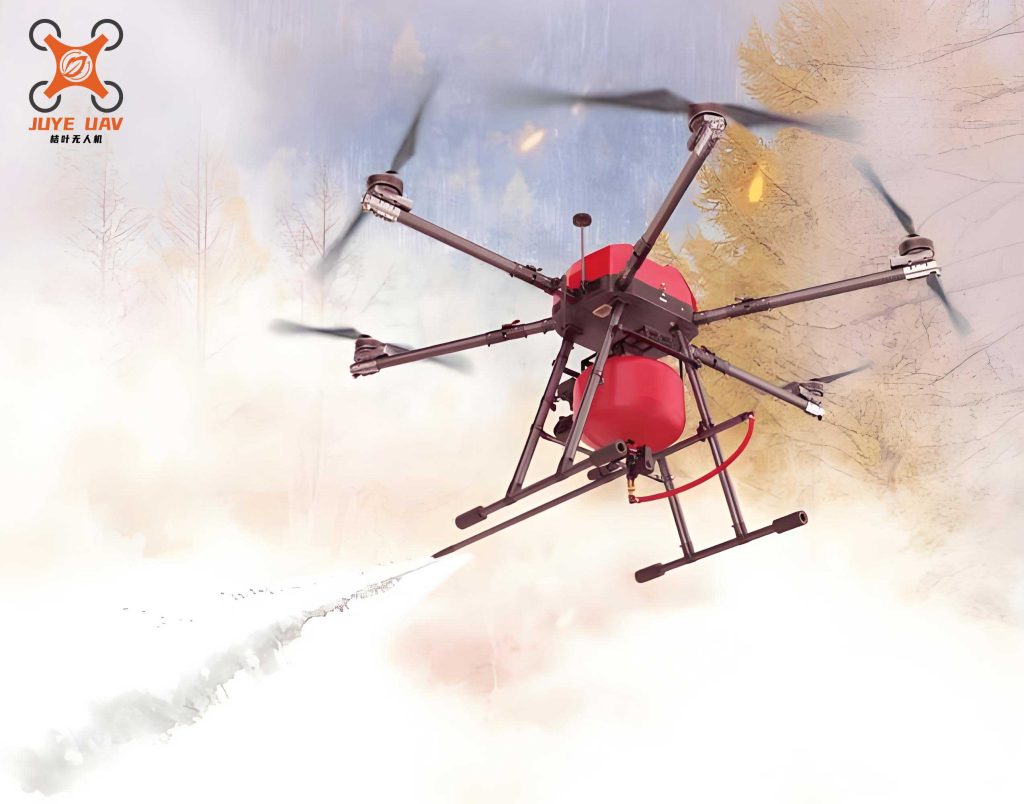
Fourth, fire UAVs can直接进行灭火作业.突破高度限制, fire UAVs are equipped with灭火装置 like fire extinguishing balls or water mist systems. For high-rise buildings, this capability is revolutionary; we can operate fire UAVs to reach designated areas and discharge灭火 agents, tackling fires quickly at their source. Research has led to designs like弹射式灭火装置 for small fire UAVs, which eject灭火弹 with precision. The灭火 efficiency $$E_m$$ can be modeled as $$E_m = \frac{V_e \cdot \rho \cdot C_p \cdot \Delta T}{t_d}$$, where $$V_e$$ is extinguisher volume, $$\rho$$ is density, $$C_p$$ is specific heat, $$\Delta T$$ is temperature change, and $$t_d$$ is deployment time. This ensures effective扑救 of初期火灾.
Fifth, fire UAVs assist in开辟救援通道和排烟. In高楼 fires, breaking windows for ventilation or entry is challenging. Specialized fire UAVs carry破窗装置 that use self-propagating reactions to soften glass, allowing灭火弹 to penetrate without shattering. This creates救援通道 for smoke extraction and access, minimizing risks from falling debris. The force required for破窗, $$F_b$$, can be calculated using $$F_b = \frac{\sigma_g \cdot A_g}{t}$$, where $$\sigma_g$$ is glass strength, $$A_g$$ is area, and $$t$$ is thickness. Fire UAVs deliver this force accurately, enhancing救援 safety.
Sixth, fire UAVs enable continuous跟进火灾灾情. Fires are dynamic, especially with易燃易爆 materials present. By deploying fire UAVs with tracking modules, we can monitor real-time changes, such as flare-ups or structural collapses. This ongoing surveillance supports adaptive tactics, as决策人员 use data streams to refine actions. The monitoring coverage $$C_m$$ of a fire UAV fleet can be expressed as $$C_m = N \cdot v \cdot T \cdot w$$, where $$N$$ is the number of fire UAVs, $$v$$ is velocity, $$T$$ is time, and $$w$$ is sensor width. This ensures comprehensive situational awareness throughout the incident.
In conclusion, the integration of fire UAV technology into消防灭火救援 represents a significant leap forward in emergency response. As we advance our应急管理体系, fire UAVs offer科学化,专业化, and智能化 solutions that overcome human limitations. From高空侦察 to direct灭火, fire UAVs enhance our ability to save lives and protect property. The tables and formulas presented here underscore their technical merits, while personal experiences affirm their practical value. Moving forward, I believe that continued innovation in fire UAV design, such as improved autonomy and swarm capabilities, will further revolutionize our field. By embracing these tools, we can build a more resilient and effective firefighting force, ready to face the challenges of modern disasters.