
As a firefighter with over a decade of experience in emergency response, I have witnessed firsthand the transformative impact of technology on our operations. Among the most groundbreaking advancements in recent years is the integration of Unmanned Aerial Vehicles (UAVs), specifically fire UAVs, into firefighting and rescue missions. The maturity of UAV and aerial photography technologies has enabled these devices to play increasingly vital roles across various domains, including resource exploration, environmental monitoring, disaster relief, and structural assessment. For fire and rescue teams like ours, who often undertake high-risk灭火救援 tasks, having the ability to conduct reconnaissance from multiple perspectives is crucial. Accurate data and clearer situational awareness help us analyze emergencies more effectively, assess the status of trapped individuals, and plan救援 deployments, thereby enhancing efficiency and safeguarding the lives of both firefighters and victims. In this article, I will delve into the application analysis of fire UAVs in抢险救灾 missions, drawing from my own observations and the evolving practices within the field. My aim is to provide a comprehensive overview that underscores the value of fire UAVs and encourages their widespread adoption in firefighting units.
The adoption of fire UAVs is not merely a trend but a necessity in modern firefighting. These devices offer unparalleled advantages that address long-standing challenges in our work, such as limited visibility, hazardous environments, and the need for rapid decision-making. From我的 perspective, the core benefits of fire UAVs can be summarized through their technical superiority, which I will explore in detail below, supported by tables and formulas to quantify their impact.
Technical Advantages of Fire UAVs
In my experience, the technical strengths of fire UAVs are multifaceted, encompassing mobility, ease of operation, and comprehensive视野 capabilities. These attributes make them indispensable tools in high-stakes scenarios.
Mobility and Flexibility
Most small fire UAVs available today weigh only a few kilograms, allowing them to be operated by one or two personnel using flight controls. Their lightweight design and low起飞 requirements enable easy transport to disaster sites. Moreover, fire UAVs can quickly adjust their flight speed within a broad range, with minimal turning radii, resulting in exceptional机动性. This flexibility permits precise control over direction, velocity, spatial positioning, and camera targeting. Due to their compact size and robust power systems, fire UAVs can reach designated areas swiftly, providing first-hand information on terrain and conditions before human responders arrive. This significantly improves our response speed to disasters.
To illustrate the mobility parameters, consider the following table summarizing typical specifications for fire UAVs used in消防 operations:
| Parameter | Value Range | Impact on Firefighting |
|---|---|---|
| Weight | 2-10 kg | Easy portability and deployment |
| Maximum Speed | 50-80 km/h | Rapid scene assessment |
| Flight Time | 20-40 minutes | Sustained reconnaissance missions |
| Turning Radius | 1-5 meters | Maneuverability in confined spaces |
| Wind Resistance | Up to 10-15 m/s | Operation in adverse weather |
The mobility of fire UAVs can be mathematically modeled using flight dynamics. For instance, the time \( t \) to reach a disaster site at a distance \( d \) can be approximated by the formula:
$$ t = \frac{d}{v} + t_{\text{startup}} $$
where \( v \) is the average flight speed and \( t_{\text{startup}} \) represents the deployment time. In practice, fire UAVs often reduce \( t \) by 30-50% compared to ground-based scouts, enhancing our operational efficiency.
Ease of Operation
From a technical standpoint, the remote video transmission and control systems of fire UAVs are typically connected to ground stations via network devices and software interfaces, often utilizing public internet through fiber optics. This design lowers the technical门槛, allowing personnel with minimal training to operate them effectively. Additionally, modern fire UAVs come equipped with辅助设备 like lenses and gimbals; users can view the UAV’s perspective through controllers, smartphones, tablets, or computers by managing the onboard camera. Thus, controlling a fire UAV primarily involves positioning it to capture comprehensive video feeds, simplifying the process. Manufacturers have continually reduced the learning curve to expand their user base, making these devices accessible without extensive专业知识.
A key aspect of ease of operation is the intuitive control interface, which can be summarized in the table below:
| Control Method | Devices Supported | Typical Learning Time |
|---|---|---|
| Remote Controller | Dedicated hardware | 1-2 hours |
| Mobile App | Smartphones, tablets | 30 minutes |
| Ground Station Software | Laptops, computers | 2-3 hours |
The simplicity of operation is further enhanced by automated features, such as waypoint navigation, which can be described by the formula for path planning:
$$ P = \sum_{i=1}^{n} (x_i, y_i, z_i) $$
where \( P \) represents the flight path defined by coordinates \( (x_i, y_i, z_i) \) for \( n \) waypoints. This allows fire UAVs to execute pre-programmed routes with minimal manual intervention, freeing up personnel for other critical tasks.
Comprehensive视野 and Safety Reliability
Due to their strong机动能力 and low起飞 conditions, fire UAVs can perform aerial photography from almost any angle in most environments. By adjusting their空中位置 based on实际需求, they achieve global shots or specific close-ups, providing real-time, holistic information. Furthermore, when operating at low altitudes, fire UAVs capture high-resolution images; if equipped with infrared night vision, they can function in darkness,大幅提升 our ability to handle emergencies. Beyond视野全面性, fire UAVs offer安全可靠的特点. Their flight is largely weather-resistant, enabling operation in extreme conditions like high temperatures or heavy rain. In hazardous scenarios such as chemical leaks, explosive fires, collapsing structures, or inaccessible terrain, fire UAVs can reach the epicenter without risking firefighters’ lives, delivering critical data to inform救援 strategies. This enhances risk应对 efficiency and reduces disaster-related losses.
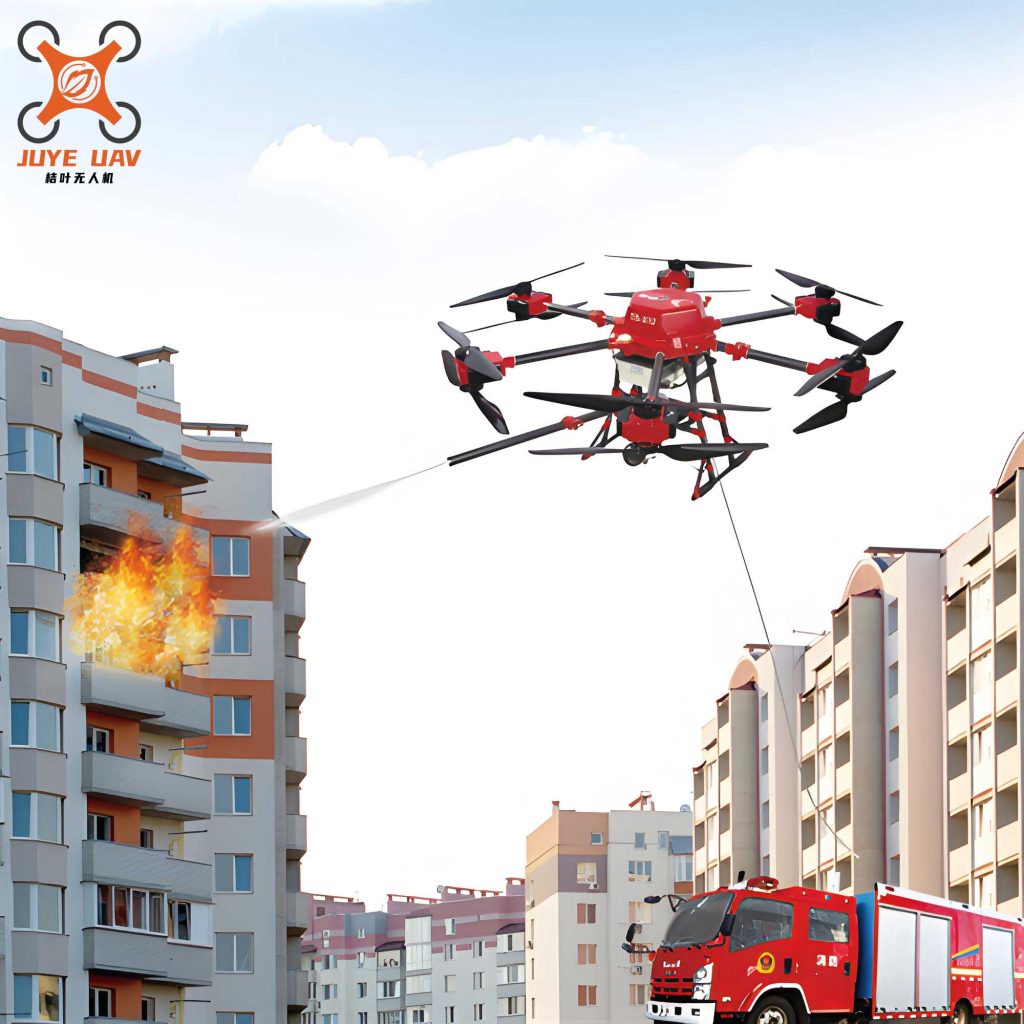
The safety aspect of fire UAVs can be quantified through risk reduction metrics. For example, the probability of firefighter injury \( P_{\text{injury}} \) in a high-risk侦察 mission can be modeled as:
$$ P_{\text{injury}} = 1 – e^{-\lambda t} $$
where \( \lambda \) is the hazard rate and \( t \) is exposure time. By deploying fire UAVs, we effectively set \( t \approx 0 \) for human scouts, thus \( P_{\text{injury}} \to 0 \), showcasing their life-saving potential. Additionally, the侦察 coverage area \( A \) of a fire UAV with a camera field of view \( \theta \) at height \( h \) is given by:
$$ A = \pi (h \cdot \tan(\theta/2))^2 $$
This formula highlights how fire UAVs can survey large areas quickly, providing comprehensive data that would otherwise require multiple ground teams.
Application Prospects of Fire UAVs in Firefighting Teams
Looking ahead, the use of fire UAVs in消防救援工作 is poised to expand significantly. Based on my observations, their applications can be broadly categorized into灾情侦察,监控追踪, and辅助救援, each offering distinct benefits that align with our operational needs.
Disaster Reconnaissance
Fire UAVs excel in灾情侦察 by accessing locations beyond human reach. As machines, they overcome terrain and environmental limitations, especially in high-risk zones where human scouts might face生命威胁. This not only improves工作效率 but also prevents unnecessary casualties. Many firefighter fatalities in灭火抢险 tasks stem from incomplete knowledge of incident sites; fire UAVs mitigate this by enabling thorough assessment without exposing personnel to toxic, harmful, or high-temperature environments. Moreover, when equipped with gas detectors, fire UAVs can identify combustible or toxic gases, enhancing hazard排查 and safeguarding firefighter safety.
The effectiveness of fire UAVs in reconnaissance can be summarized in the following table, which compares traditional methods with UAV-assisted approaches:
| Aspect | Traditional Reconnaissance | Fire UAV Reconnaissance |
|---|---|---|
| Time to Initial Data | 15-30 minutes | 5-10 minutes |
| Personnel at Risk | High | Low to None |
| Area Covered per Hour | 0.5-1 km² | 2-5 km² |
| Data Accuracy | Moderate (subjective) | High (objective, visual) |
| Cost per Mission | $$ 500-1000 (manpower) $$ | $$ 100-300 (UAV operation) $$ |
From a mathematical perspective, the reconnaissance efficiency \( E \) of a fire UAV can be expressed as:
$$ E = \frac{A_{\text{covered}}}{t_{\text{mission}} \cdot C_{\text{risk}}} $$
where \( A_{\text{covered}} \) is the area surveyed, \( t_{\text{mission}} \) is mission duration, and \( C_{\text{risk}} \) is a risk coefficient (lower for UAVs). This formula underscores how fire UAVs optimize resource use while minimizing dangers.
Monitoring and Tracking
Beyond initial侦察, fire UAVs provide real-time monitoring of disaster scenes. In actual灾情处置, conditions are often volatile, with many不确定因素 complicating灭火救援 tasks. Fire UAVs enable continuous surveillance, allowing command personnel to adapt作战方案 based on live feedback. This facilitates accurate决策, reduces casualties, and improves工作效率. Post-disaster, fire UAVs can conduct 24/7 aerial monitoring of prone areas, detecting early signs of incidents like fires or collapses for proactive prevention. Implementing such systems requires integrated information management platforms that link UAV footage with消防指挥 systems, supporting remote access and data storage.
The监控 capabilities of fire UAVs can be enhanced through automated alert systems. For instance, using image processing algorithms, a fire UAV can detect smoke or structural changes and trigger alarms. The probability of early detection \( P_{\text{detect}} \) can be modeled as:
$$ P_{\text{detect}} = 1 – \prod_{i=1}^{n} (1 – p_i) $$
where \( p_i \) is the detection probability per monitoring cycle over \( n \) cycles. By deploying multiple fire UAVs, we can increase \( n \) and thus \( P_{\text{detect}} \), significantly improving disaster preparedness. The table below outlines key monitoring parameters for fire UAVs:
| Monitoring Feature | Specification | Benefit in Firefighting |
|---|---|---|
| Real-time Video Feed | 1080p to 4K resolution | Clear situational awareness |
| Thermal Imaging | Detection range up to 500 m | Spot hotspots through smoke |
| Automated Patrol | Pre-set waypoints | Continuous coverage without manual piloting |
| Data Transmission | Low-latency ( < 200 ms) | Timely decision-making |
| Integration with GIS | Live mapping overlay | Enhanced spatial analysis |
These features make fire UAVs indispensable for dynamic monitoring, ensuring that we stay ahead of evolving emergencies.
Assistance in Rescue Operations
Fire UAVs also serve as运输兵 in救援工作, opening new avenues for aid delivery. They can transport lightweight critical器具, relay指令 in challenging terrains like mountains or high-altitude sites, and assist in抛绳 operations for水域 or山岳 rescues. Furthermore, as integrated通信设备, fire UAVs can act as communication relays during natural disasters like earthquakes, where conventional networks fail, quickly establishing wireless links in extreme conditions.
The辅助救援 role of fire UAVs can be quantified through payload capacity and communication metrics. For example, the maximum payload weight \( W_{\text{payload}} \) for a typical fire UAV is given by:
$$ W_{\text{payload}} = W_{\text{max}} – W_{\text{UAV}} $$
where \( W_{\text{max}} \) is the total lift capacity and \( W_{\text{UAV}} \) is the drone’s weight. In practice, many fire UAVs can carry 2-5 kg of supplies, such as first-aid kits or communication repeaters. Additionally, the communication range \( R \) of a fire UAV acting as a relay can be estimated using the formula:
$$ R = \sqrt{h_t \cdot h_r} \cdot k $$
where \( h_t \) and \( h_r \) are the antenna heights of the UAV and ground station, respectively, and \( k \) is a constant factor. This extends coverage in remote or disrupted areas, vital for coordinated rescues. The table below summarizes rescue applications:
| Rescue Application | Fire UAV Function | Expected Outcome |
|---|---|---|
| Supply Delivery | Transport of medical kits, ropes | Faster aid to trapped victims |
| Communication Relay | 临时转信台 in network outages | Restored command and control |
| Route Establishment | Deploying guide ropes or markers | Safer access for rescue teams |
| Search and Locate | Thermal imaging for victim detection | Reduced search time by up to 70% |
Through these roles, fire UAVs enhance our救援 capabilities, often turning impossible situations into manageable ones.
Future Developments and Integration
As fire UAV technology matures, its integration into消防 workflows will deepen. From my perspective, future advancements should focus on enhancing autonomy, interoperability, and data analytics. For instance, the use of artificial intelligence (AI) can enable fire UAVs to automatically identify hazards or predict fire spread based on real-time imagery. The predictive accuracy \( A_{\text{predict}} \) might be modeled as:
$$ A_{\text{predict}} = \frac{TP + TN}{TP + TN + FP + FN} $$
where \( TP \), \( TN \), \( FP \), and \( FN \) represent true positives, true negatives, false positives, and false negatives in hazard detection. By training AI models on historical data from fire UAVs, we can improve \( A_{\text{predict}} \), leading to more proactive responses.
Moreover, the integration of fire UAVs with other systems, such as Building Information Modeling (BIM) or Internet of Things (IoT) sensors, will create a holistic emergency management ecosystem. Consider the following formula for system efficiency \( S_{\text{eff}} \):
$$ S_{\text{eff}} = \alpha \cdot U_{\text{UAV}} + \beta \cdot I_{\text{sensor}} + \gamma \cdot C_{\text{cloud}} $$
where \( U_{\text{UAV}} \), \( I_{\text{sensor}} \), and \( C_{\text{cloud}} \) represent the contributions of fire UAVs, IoT sensors, and cloud computing, respectively, with weights \( \alpha, \beta, \gamma \) reflecting their importance. Optimizing this equation through technological synergy will maximize our operational impact.
In terms of hardware, we can expect fire UAVs to become more ruggedized and versatile, with longer flight times and enhanced payloads. The evolution of battery technology, for example, might follow the formula for energy density \( E_{\text{density}} \):
$$ E_{\text{density}} = E_0 \cdot e^{k t} $$
where \( E_0 \) is the current energy density, \( k \) is a growth rate, and \( t \) is time. As \( E_{\text{density}} \) increases, fire UAVs will achieve extended missions, covering larger areas without recharging.
Conclusion
Reflecting on my experiences, the adoption of fire UAVs in firefighting and rescue is not just an enhancement but a revolution. These devices address core challenges in our work—safety, efficiency, and situational awareness—by providing机动灵活, operationally simple, and安全可靠 solutions. As technology advances, fire UAVs will play even more critical roles in灾情侦察,监控追踪, and辅助救援, ultimately saving lives and reducing disaster impacts. I urge fire departments worldwide to embrace fire UAVs, invest in training, and develop integrated systems to harness their full potential. Through continued innovation and collaboration, we can build a future where fire UAVs are ubiquitous in消防 operations, making every mission safer and more effective.
In summary, the journey with fire UAVs has taught me that technology, when applied thoughtfully, can transform emergency response. By leveraging their technical advantages and expanding their applications, we not only protect our firefighters but also serve our communities better. Let us move forward with the commitment to integrate fire UAVs into every aspect of our work, ensuring that we are always prepared for the challenges ahead.