
The evolution of urban landscapes, characterized by soaring high-rise structures and complex infrastructure, presents unprecedented challenges for firefighting and rescue services. Traditional methods often force firefighters into perilous, information-scarce environments, increasing operational risk and potentially delaying critical response. In this context, the integration of Unmanned Aerial Vehicles (UAVs), specifically engineered as fire UAV systems, has emerged as a transformative force. From my perspective as a practitioner analyzing technological adoption, the fire UAV is not merely a tool but a pivotal node in a modern, data-driven rescue ecosystem. Its capacity to provide real-time intelligence, extend situational awareness, and perform hazardous tasks remotely fundamentally enhances operational safety, efficiency, and effectiveness. This analysis delves into the systemic design, operational advantages, specific applications, and stringent technical requirements of fire UAV platforms in fire and rescue scenarios.
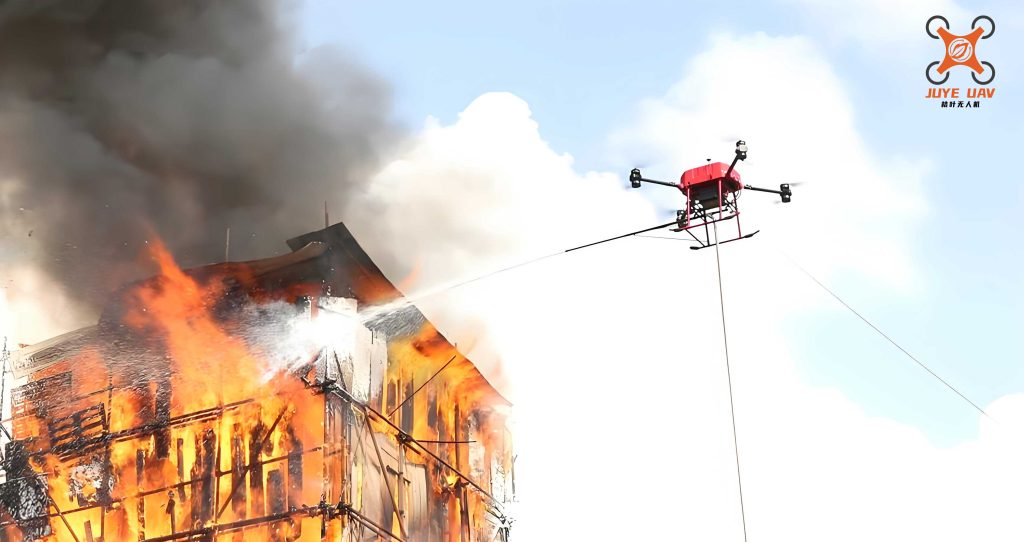
The core value proposition of a fire UAV lies in its ability to serve as an agile, remote sensor platform. Unlike manned aircraft or ground-based observations, a fire UAV can rapidly deploy into environments that are immediately dangerous to life and health (IDLH). The primary advantages are multifaceted. First, their operational flexibility is exceptional. Typically compact and lightweight, a single operator can deploy and pilot a fire UAV, navigating through complex urban canyons, between structures, or close to hazardous materials. Flight trajectories, altitudes, and viewing angles can be adjusted in real-time based on incoming data, allowing for dynamic reconnaissance. Second, the aerial perspective provides an unparalleled, comprehensive field of view. Equipped with high-resolution, stabilized gimbal systems featuring wide-angle and telephoto lenses, a fire UAV can map large-scale incident perimeters and zoom in on critical details like structural integrity or victim location. This visual data is transmitted in real-time to command centers, creating a shared operational picture. Furthermore, by integrating multi-spectral sensors—such as thermal imaging cameras—the fire UAV can peer through smoke, identify heat signatures, and locate trapped individuals or hidden fire spots, day or night.
System Architecture and Design of a Fire UAV
The effective deployment of a fire UAV in high-stakes emergency scenarios necessitates a robust, reliable, and purpose-built system architecture. The design is driven by stringent operational requirements derived from fireground challenges. The system can be architecturally divided into three primary subsystems: the Airborne Payload, the Ground Control Station (GCS), and the Data Link. The design specifications must ensure sustained operation, high-quality data acquisition, and resilient communication.
The operational requirements for a typical fire UAV system include:
- Endurance: Minimum flight time ≥ 60 minutes to cover extended reconnaissance and monitoring tasks.
- Data Link Range: Command and control range ≥ 2100 meters; high-definition video downlink range ≥ 1000 meters.
- Video Quality: Live video feed with a resolution of at least 1920×1080 pixels and a frame rate ≥ 30 fps for clear, actionable intelligence.
- Physical Profile: Compact dimensions (e.g., within 300mm x 200mm x 60mm for certain models) for easy transport and deployment in congested areas.
- Environmental Resilience: Capability to withstand elevated ambient temperatures, variable wind conditions, and mild precipitation.
The interplay between these subsystems is summarized in the following architecture table:
| Subsystem | Key Components | Primary Function | Design Consideration |
|---|---|---|---|
| Airborne Payload | Multi-spectral Camera Gimbal (Visible light, Thermal), Telemetry Sensors (GPS, IMU), Environmental Sensors (Gas, Wind), Onboard Processor, Data Link Transceiver. | Data acquisition, navigation, and uplink transmission. | Lightweight integration, thermal management, sensor stabilization, power efficiency. |
| Data Link | Digital Radio System (often using COFDM or similar protocols for robust video), Frequency Management System. | Bi-directional communication for telemetry/control (uplink) and video/data (downlink). | Low latency, anti-interference, secure & stable connection in urban environments. |
| Ground Control Station (GCS) | Operator Console (RC Transmitter, Tablet, Laptop), Video Monitor/VR Headset, Data Recording & Analysis Software, Power Supply. | Pilot control, data visualization, mission planning, and intelligence dissemination. | Ergonomics, intuitive UI, real-time data overlay (e.g., GPS coordinates, sensor readings on video), portability. |
Control Dynamics and Payload Stabilization
The flight stability and precise positioning of a fire UAV are paramount for obtaining usable imagery. This is governed by the control system, which processes inputs from the Inertial Measurement Unit (IMU) and GPS. A simplified mathematical representation of the attitude control involves Euler angles. The dynamics can be described using Newton-Euler formulations. For a fire UAV, the rotational dynamics about its center of mass are crucial:
$$ \tau = J \cdot \dot{\omega} + \omega \times (J \cdot \omega) $$
Where \( \tau \) is the vector of control torques applied by the motors, \( J \) is the inertia matrix of the fire UAV, \( \omega \) is the angular velocity vector, and \( \dot{\omega} \) is its derivative. The control system aims to generate appropriate torques \( \tau \) to achieve desired orientation angles (roll \( \phi \), pitch \( \theta \), yaw \( \psi \)).
Furthermore, the gimbal stabilization system, essential for clear video, actively counteracts the UAV’s movements. The control objective for the gimbal can be modeled as minimizing the error between the camera’s desired inertial pointing vector and its actual one. If \( \theta_c \) is the camera angle and \( \theta_u \) is the UAV body angle, a proportional-integral-derivative (PID) controller is often employed:
$$ u(t) = K_p e(t) + K_i \int_0^t e(\tau) d\tau + K_d \frac{de(t)}{dt} $$
$$ \text{where } e(t) = \theta_{c_{desired}}(t) – (\theta_c(t) – \theta_u(t)) $$
Here, \( u(t) \) is the control signal to the gimbal motor, and \( K_p, K_i, K_d \) are tuning gains. This ensures the camera remains locked on a target regardless of the fire UAV‘s motion.
Operational Applications in Fire and Rescue
The practical deployment of a fire UAV spans the entire timeline of an incident, from initial response to post-event analysis. Its applications are diverse and impactful.
1. Primary Reconnaissance and Situational Awareness
Upon arrival, the first and most critical application is rapid situational assessment. A fire UAV can be airborne within minutes, providing commanders with a top-down view of the incident. It answers fundamental questions: What is the fire’s origin and current extent? How is it spreading? What are the access points and immediate hazards (e.g., compromised LPG tanks, downed power lines)? For structure fires, especially in high-rises, the fire UAV can safely approach exterior windows to assess internal fire spread, floor-by-floor, and identify potential flashover conditions. The real-time thermal imaging capability is invaluable here, visualizing heat penetration through roofs and walls, which is invisible to the naked eye. This directly informs strategy, whether it’s an offensive interior attack or a defensive exterior operation.
2. Search and Rescue (SAR) and Victim Location
In both structural collapses and wide-area disasters (e.g., wildfires, earthquakes), locating victims quickly is vital. A fire UAV equipped with thermal cameras can detect human body heat signatures through smoke, rubble, or foliage. The efficiency of an aerial search pattern using a fire UAV can be conceptualized in terms of area coverage rate. For a UAV flying at altitude \( h \) with a sensor field-of-view width \( W \), the ground swath width \( S \) is approximately:
$$ S \approx 2h \cdot \tan\left(\frac{FOV}{2}\right) $$
For a systematic search, the required time \( T \) to cover an area \( A \) with a flight speed \( v \) and overlap factor \( \eta \) (e.g., 0.2 for 20% overlap) is:
$$ T \approx \frac{A}{v \cdot S \cdot (1 – \eta)} $$
This demonstrates how a fire UAV can methodically and rapidly scan large, inaccessible areas, relaying precise GPS coordinates of victims to ground teams.
3. Hazardous Environment Monitoring and Gas Detection
Industrial fires and hazardous material (HazMat) incidents present risks of toxic gas release or explosion. Modern fire UAV platforms can be fitted with miniaturized gas sensors (for methane, CO, VOCs, etc.). The UAV can map gas plume dispersion in real-time, creating a dynamic hazard zone model. This allows commanders to adjust evacuation perimeters and ensure responder safety based on actual, not predicted, dispersion patterns. The ability of the fire UAV to sample air at different altitudes provides a three-dimensional understanding of the threat.
4. Operational Support and Logistics
Beyond reconnaissance, the fire UAV can provide direct support. It can illuminate large areas at night using powerful LED arrays, extending operational windows. It can act as a temporary communication relay node in areas with poor radio coverage. In wildfire scenarios, it can be used to monitor firebreak effectiveness and spot new flare-ups. Furthermore, some heavy-lift fire UAV models are being tested for direct intervention, such as delivering emergency supplies to trapped individuals or deploying extinguishing agents in a targeted manner.
| Application Phase | Primary Fire UAV Function | Key Sensor/Payload Used | Outcome/Value |
|---|---|---|---|
| Initial Response | Rapid Situational Assessment | HD Video, Thermal Camera | Informs initial attack strategy, identifies hazards. |
| Active Incident | Fire Spread & Structural Monitoring | Thermal Camera, Zoom Lens | Tracks fire progression, identifies weak structural elements. |
| Search & Rescue | Victim Location | Thermal Camera, Spotlights | Locates casualties in smoke, rubble, or darkness. |
| HazMat Incidents | Environmental Sensing | Gas Detectors, Particulate Sensors | Maps toxic plumes, defines hot/warm/cold zones. |
| Extended Operations | Communication Relay, Illumination | Radio Repeater, LED Arrays | Enhances team coordination and safety during night ops. |
Technical Requirements and Specifications for Fire UAVs
The demanding fireground environment imposes non-negotiable technical requirements on a fire UAV system. These requirements center on reliability, stability, and interoperability.
1. System Reliability and Redundancy: A fire UAV must be mission-ready at all times. This demands rigorous pre-flight checklists, robust mechanical design, and electronic redundancy. Key systems like flight controllers, communication links, and power distribution should have fail-safe mechanisms. The choice of platform (multirotor for hover stability vs. fixed-wing for large-area coverage) must match the typical mission profile. Reliability also extends to data integrity; the telemetry and video link must be secure and resistant to interference from other emergency service radios or public networks.
2. Flight and Payload Stability: As derived in the control dynamics section, precise stability is critical. The Inertial Navigation System (INS) fused with GPS must provide accurate positioning, especially in urban canyons where GPS signals can be degraded. The gimbal stabilization must be capable of compensating for aggressive maneuvers and gusty winds to deliver jitter-free video. The performance criteria can be specified as maximum allowable angular deviation (e.g., \( \pm 0.01 \) radians) under defined wind conditions.
3. Environmental Hardening and Thermal Management: Operating near fires exposes the fire UAV to intense radiant heat. Components must be selected and shielded for higher temperature tolerances. Batteries, in particular, require careful thermal management to prevent performance degradation or safety incidents. The airframe material should be resistant to warping and chemical corrosion.
4. Data Integration and Interoperability: The true power of a fire UAV is realized when its data stream is integrated into the broader incident command system. Video feeds and sensor data should be compatible with common incident management software (e.g., using RTSP or HLS streaming protocols). Geotagging of every video frame and sensor reading allows for direct overlay on GIS maps at the command post, creating a spatially accurate Common Operational Picture (COP).
Future Trajectories and Concluding Perspective
The future development of fire UAV technology points towards greater autonomy, enhanced sensing, and swarming capabilities. Machine learning algorithms will enable automatic fire front detection, structural damage assessment, and victim identification from video feeds. Advances in battery technology and hybrid propulsion will extend mission endurance. Perhaps most transformative will be the coordinated use of multiple, heterogeneous fire UAV swarms—some for mapping, some for sensing, some for communication—all operating under a single human supervisor’s intent.
In conclusion, the fire UAV has unequivocally established itself as a cornerstone of 21st-century firefighting and urban search and rescue. Its value proposition—providing pervasive, persistent, and penetrating situational awareness while keeping personnel out of harm’s way—aligns perfectly with the core tenets of modern emergency response: safety, efficiency, and intelligence-led decision-making. The ongoing refinement of its design, guided by the rigorous technical requirements discussed, and its deeper integration into command structures will continue to amplify its life-saving and property-preserving potential. The fire UAV is more than an eye in the sky; it is a critical force multiplier, redefining the art of the possible in mitigating disaster and safeguarding communities.