
As a firefighter and technology enthusiast, I have witnessed firsthand the transformative impact of unmanned aerial vehicles, commonly known as drones, in our field. Over the years, the integration of drones, specifically fire drones, into firefighting and rescue operations has revolutionized how we approach emergencies. In this article, I will delve into the application strategies of fire drones, exploring their advantages, workflows, functional expansions, and the challenges we face, along with potential improvements. My goal is to provide a comprehensive overview that highlights the critical role of fire drones in enhancing operational efficiency and safety.
The concept of a fire drone refers to an unmanned aircraft equipped with specialized payloads for firefighting and rescue missions. These devices are controlled via remote programming or autonomous systems, allowing them to operate in hazardous environments where human presence is risky. Compared to manned aircraft, fire drones offer cost-effectiveness, ease of maintenance, and adaptability, making them indispensable in tasks ranging from disaster response to industrial inspections. In this context, I will emphasize how fire drones have become a cornerstone in modern firefighting, with applications spanning both civilian and military domains.
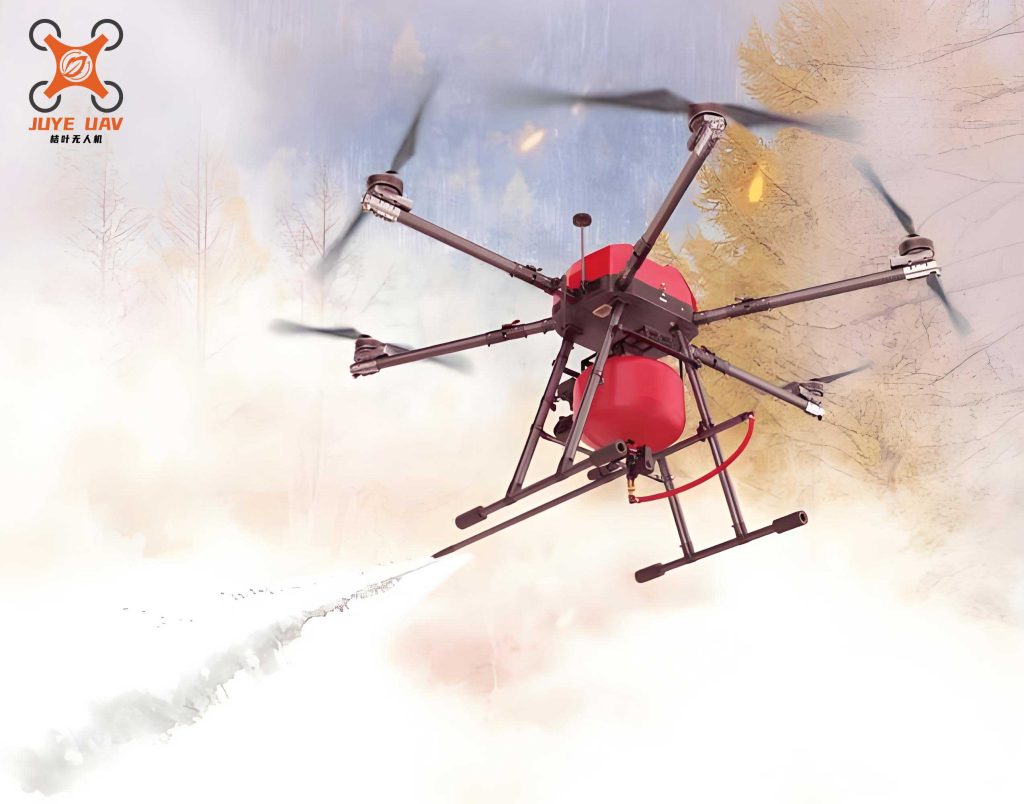
From my experience, the advantages of fire drones in firefighting are manifold. Firstly, fire drones provide real-time aerial surveillance, offering a bird’s-eye view of fire scenes that is otherwise inaccessible. This capability allows us to assess the extent of a fire, identify hotspots, and plan interventions more effectively. Secondly, fire drones enhance situational awareness by transmitting high-resolution imagery and data, which is crucial for decision-making in dynamic environments. To summarize these benefits, I have compiled a table below that outlines the key advantages of fire drones in rescue operations.
| Advantage | Description | Impact on Operations |
|---|---|---|
| Real-Time Aerial Surveillance | Fire drones capture live video and images from above, providing comprehensive scene assessment. | Enables rapid response and accurate resource deployment. |
| Enhanced Safety | By operating in dangerous zones, fire drones reduce risks to firefighters’ lives. | Minimizes human exposure to hazards like heat and toxic gases. |
| Cost-Effectiveness | Fire drones are cheaper to acquire and maintain compared to manned aircraft. | Allows widespread adoption in budget-constrained departments. |
| Versatility in Payloads | Fire drones can carry sensors, cameras, and rescue tools, adapting to various scenarios. | Increases functionality for diverse emergencies, from fires to floods. |
| Rapid Deployment | Fire drones can be launched quickly, reaching sites faster than ground teams. | Speeds up initial assessment and intervention, saving critical time. |
In terms of workflow, I have designed a basic operational process for fire drones, particularly in high-rise building fires. This process begins with ground operators controlling the fire drone to ascend to the affected area. The fire drone is equipped with instruments such as infrared imagers and color cameras, which collect visual and thermal data. This data is transmitted via a wireless system to a command center, where it is analyzed to inform strategic decisions. The workflow can be modeled mathematically to optimize performance; for instance, the flight time of a fire drone can be expressed as: $$ T = \frac{E}{P} $$ where \( T \) is the flight duration, \( E \) is the battery energy capacity, and \( P \) is the power consumption during operation. By adjusting parameters like payload weight or flight speed, we can maximize \( T \) for extended missions.
Furthermore, the data transmission efficiency is crucial. The signal strength \( S \) between the fire drone and the ground station can be described by the Friis transmission equation: $$ S = P_t + G_t + G_r – 20 \log_{10}(d) – 20 \log_{10}(f) – 147.55 $$ where \( P_t \) is the transmitter power, \( G_t \) and \( G_r \) are antenna gains, \( d \) is the distance, and \( f \) is the frequency. This formula helps in planning communication systems for fire drones to ensure reliable data flow during critical operations.
To expand the functionality of fire drones, I have proposed several enhancements based on my field observations. First, the integration of onboard voice interaction systems allows fire drones to broadcast instructions via loudspeakers. This feature enables commanders to direct trapped individuals or coordinate teams, thereby improving evacuation efficiency. Second, aerial monitoring capabilities can be augmented with advanced sensors. For example, a fire drone can be fitted with toxic gas detectors, anemometers, and thermal cameras, providing multi-faceted data. The heat radiation from a fire, which affects drone performance, can be quantified using the Stefan-Boltzmann law: $$ Q = \sigma \epsilon A T^4 $$ where \( Q \) is the radiative heat flux, \( \sigma \) is the Stefan-Boltzmann constant, \( \epsilon \) is the emissivity, \( A \) is the surface area, and \( T \) is the absolute temperature. This helps in assessing environmental hazards for the fire drone.
Third, auxiliary rescue functions, such as deploying ropes or masks via fire drones, offer direct aid to victims in inaccessible locations. Lastly, fire suppression capabilities can be incorporated by mounting extinguishing agents on fire drones. For instance, a fire drone can carry a payload of retardant, with the release mechanism optimized using fluid dynamics equations. The flow rate \( \dot{m} \) of the extinguishing agent can be modeled as: $$ \dot{m} = \rho A v $$ where \( \rho \) is the density, \( A \) is the nozzle area, and \( v \) is the velocity. This allows precise control during aerial firefighting.
I have summarized these functional expansions in the table below, highlighting how each addition enhances the role of fire drones in rescue missions.
| Function | Components | Operational Benefit |
|---|---|---|
| Voice Interaction | High-power speakers, audio transmission systems | Enables real-time communication with victims and teams, guiding evacuations. |
| Aerial Monitoring | Infrared cameras, gas sensors, anemometers, thermal imagers | Provides comprehensive environmental data for hazard assessment and decision-making. |
| Auxiliary Rescue | Deployable ropes, masks, first-aid kits | Delivers essential supplies to trapped individuals, facilitating rescue efforts. |
| Fire Suppression | Extinguishing agent tanks, release mechanisms | Allows targeted firefighting in hard-to-reach areas, reducing spread and damage. |
Despite these advancements, I have encountered several challenges with fire drones in practical scenarios. One major issue is the insufficient heat resistance of fire drones. In intense fire environments, factors like thermal convection, radiation, and chimney effects can compromise drone integrity. The thermal stress on a fire drone can be analyzed using heat transfer equations. For instance, the temperature rise \( \Delta T \) in a drone component due to heat flux can be approximated by: $$ \Delta T = \frac{Q}{\rho c V} $$ where \( Q \) is the absorbed heat, \( \rho \) is the material density, \( c \) is the specific heat capacity, and \( V \) is the volume. To address this, I recommend upgrading fire drone materials with higher proportions of flame-retardant composites or applying advanced thermal coatings. This would extend the operational lifespan of fire drones in extreme conditions.
Another challenge is the portability of fire drones. During disasters like earthquakes or floods, terrain damage often hinders vehicle transport, forcing firefighters to carry equipment on foot. Bulkier fire drones are difficult to transport in such cases, delaying response times. To improve this, I suggest designing modular fire drones with foldable or detachable components. The weight \( W \) of a fire drone can be optimized using structural engineering principles: $$ W = \sum_{i=1}^{n} m_i g $$ where \( m_i \) is the mass of each component, \( g \) is gravitational acceleration, and \( n \) is the number of parts. By reducing \( m_i \) through lightweight materials and enabling easy assembly, we can enhance the deployability of fire drones.
Additionally, I have identified other limitations, such as battery life constraints and signal interference in dense urban areas. The energy management of a fire drone can be modeled with differential equations: $$ \frac{dE}{dt} = -P_{total} + P_{solar} $$ where \( E \) is the energy, \( P_{total} \) is the total power draw, and \( P_{solar} \) represents potential solar charging. Integrating renewable energy sources could mitigate battery issues. For signal reliability, adaptive frequency hopping techniques can be employed, based on algorithms that minimize interference.
To quantify these improvements, I propose a performance index \( PI \) for fire drones, combining factors like heat resistance, portability, and functionality: $$ PI = \alpha \cdot H + \beta \cdot P + \gamma \cdot F $$ where \( H \) is heat resistance score, \( P \) is portability score, \( F \) is functionality score, and \( \alpha, \beta, \gamma \) are weighting coefficients based on operational priorities. By maximizing \( PI \), we can guide the development of next-generation fire drones.
In conclusion, as a firefighter, I believe that fire drones are pivotal in advancing our rescue capabilities. Their agility, versatility, and cost-effectiveness make them invaluable tools for modern firefighting. Through continuous innovation—such as enhancing heat resistance, improving portability, and expanding functions—we can overcome current limitations. The integration of fire drones into standard operating procedures not only boosts efficiency but also safeguards the lives of both responders and victims. Looking ahead, I am confident that with ongoing research and collaboration, fire drones will reach new heights of performance, solidifying their role as essential assets in emergency response worldwide.
To further illustrate the technical specifications of fire drones, I have compiled a table below that compares different models based on key parameters. This can aid fire departments in selecting appropriate fire drones for their needs.
| Model Type | Max Flight Time (minutes) | Payload Capacity (kg) | Heat Resistance Limit (°C) | Key Features |
|---|---|---|---|---|
| Standard Fire Drone | 30 | 2 | 80 | Basic cameras, real-time video transmission |
| Advanced Fire Drone | 45 | 5 | 150 | Infrared sensors, gas detectors, voice systems |
| Heavy-Duty Fire Drone | 60 | 10 | 200 | Extinguishing agent carriers, modular design, high portability |
| Experimental Fire Drone | 90 | 15 | 300 | Solar-assisted charging, AI-based autonomy, enhanced durability |
In my ongoing work, I explore mathematical models to optimize fire drone swarms for large-scale incidents. For example, the coordination of multiple fire drones can be described using graph theory, where each drone is a node, and communication links are edges. The efficiency of such a network can be measured by the connectivity index \( C \): $$ C = \frac{2L}{N(N-1)} $$ where \( L \) is the number of active links, and \( N \) is the number of fire drones. Maximizing \( C \) ensures robust data sharing and collaborative task execution.
Moreover, the use of fire drones in post-disaster assessment involves data analytics. By processing imagery from fire drones, we can estimate damage extent using pixel-based algorithms. The damage score \( D \) for an area can be computed as: $$ D = \frac{\sum_{i=1}^{M} w_i \cdot p_i}{M} $$ where \( w_i \) is the weight for pixel \( i \), \( p_i \) is the damage indicator value, and \( M \) is the total number of pixels. This quantitative approach enhances the accuracy of recovery planning.
Ultimately, the evolution of fire drones hinges on interdisciplinary efforts—from material science to artificial intelligence. As I advocate for their adoption, I emphasize training programs for firefighters to master fire drone operations. Simulations based on virtual reality can replicate fire scenarios, allowing teams to practice without risk. The learning curve can be modeled with a logistic function: $$ P(t) = \frac{K}{1 + e^{-r(t-t_0)}} $$ where \( P(t) \) is proficiency at time \( t \), \( K \) is the maximum proficiency, \( r \) is the learning rate, and \( t_0 \) is the inflection point. This helps in designing effective training schedules.
In summary, fire drones represent a paradigm shift in firefighting and rescue. By leveraging their strengths and addressing weaknesses through innovative strategies, we can build a safer and more responsive emergency management system. The future of fire drones is bright, and I am excited to contribute to their development as they continue to save lives and protect communities.