
In today’s world, fire incidents remain a prevalent and devastating safety hazard, capable of causing immeasurable loss if not promptly addressed. Traditional firefighting methods often fall short in meeting the demands of complex rescue scenarios, such as high-rise building fires, forest blazes, floods, or chemical spills. The advent and refinement of unmanned aerial vehicle (UAV) technology have introduced innovative solutions to these challenges. From my perspective, the integration of fire drones into firefighting and rescue operations represents a transformative leap, enhancing efficiency, safety, and decision-making. This article delves into the multifaceted applications of fire drones, emphasizing key technologies and practical implementations, with a focus on how these aerial tools revolutionize emergency response.
The core of fire drone efficacy lies in several integrated technologies. I will explore these foundational elements, utilizing tables and formulas to summarize their roles and interactions.
Key Technological Frameworks in Fire Drones
Fire drones are not merely flying cameras; they are sophisticated systems combining various technologies. The synergy between communication, monitoring, and image transmission is crucial for their operational success.
Communication Systems
Communication technology forms the backbone of any fire drone system. Typically, a fire drone’s communication module involves integrating a battery, video capture devices, and wireless image transmitters onto the drone’s frame. This setup creates a wireless video transmission system. The fundamental relationship can be expressed in terms of signal integrity and bandwidth. For instance, the maximum effective transmission range \( R \) under ideal conditions can be modeled as:
$$ R = \frac{P_t G_t G_r \lambda^2}{(4\pi)^2 d^2 L} $$
where \( P_t \) is transmitter power, \( G_t \) and \( G_r \) are antenna gains, \( \lambda \) is wavelength, \( d \) is distance, and \( L \) represents system losses. This allows fire drones to perform high-altitude reconnaissance with high-resolution image feeds, essential for real-time situational awareness.
| Component | Function | Typical Specification |
|---|---|---|
| Wireless Transmitter | Transmits video/data to ground station | 5.8 GHz band, 1 W power |
| Video Encoder | Compresses HD video streams | H.264/H.265, bitrate up to 10 Mbps |
| Ground Control Station (GCS) | Receives data and sends control signals | Range: 5-10 km, latency < 200 ms |
| Redundant Link | Ensures communication failsafe | 900 MHz backup frequency |
Monitoring and Sensing Technologies
Monitoring technology, when coupled with autonomous flight control programs, enables fire drones to conduct automated patrols and assessments. For air quality monitoring during fires, drones equipped with sensors can measure pollutant concentrations. The data acquisition rate \( Q \) for such a system can be given by:
$$ Q = n \times s \times f $$
where \( n \) is the number of sensors, \( s \) is the sample size per sensor, and \( f \) is the sampling frequency. This allows for generating real-time pollution distribution maps, which are vital for assessing hazards like toxic fume plumes. The integration of infrared (IR) and visible light cameras further enhances situational analysis, particularly for heat source detection.
Image Transmission Modalities
Reliable image transmission is paramount. Fire drones primarily employ two methods: 4G/5G public network transmission and dedicated microwave links.
4G/5G Transmission: This method leverages cellular networks. The process involves the fire drone capturing video, sending it via a ground terminal to a public base station, which then routes the data to the command center server. The end-to-end latency \( \tau_{4G/5G} \) can be approximated as:
$$ \tau_{4G/5G} = \tau_{prop} + \tau_{proc} + \frac{D}{B} $$
Here, \( \tau_{prop} \) is propagation delay, \( \tau_{proc} \) is processing delay at nodes, \( D \) is data size, and \( B \) is available bandwidth. This method benefits from widespread network coverage but may suffer in remote areas.
Microwave Transmission: This point-to-point method offers a more direct and often more reliable link in complex environments. A portable transmitter on the ground sends the drone’s video via microwave to a communication vehicle, which then relays it to the command center. The signal strength \( S \) at the receiver is critical and follows the Friis transmission equation:
$$ S = P_t + G_t + G_r – 20 \log_{10}\left(\frac{4\pi d}{\lambda}\right) – L_{other} $$
where \( L_{other} \) includes atmospheric and obstacle losses. This enables synchronized viewing between the incident command and the central headquarters.
| Method | Advantages | Limitations | Typical Use Case |
|---|---|---|---|
| 4G/5G Public Network | Wide area coverage, easy setup | Network dependency, potential congestion | Urban fire scenes with good cellular signal |
| Microwave Link | High reliability, low latency, secure | Limited range, line-of-sight required | Complex terrain, large-scale disaster sites |
| Satellite Relay | Global coverage, independent of ground infrastructure | High cost, significant latency | Extremely remote areas like forest fires |
Integration with Command Platforms
The true power of a fire drone is realized when its data stream is integrated into a comprehensive firefighting command platform, often compliant with standards like GB/T 28181. This integration allows for the centralized display of video, flight control data, and geographic information. The platform can perform geospatial analysis, creating 2D orthomosaics or 3D models from drone imagery. The process of generating a 3D model from drone images using structure-from-motion (SfM) can be summarized by the optimization problem:
$$ \min_{R_i, t_i, X_j} \sum_{i,j} \| p_{ij} – \pi(R_i X_j + t_i) \|^2 $$
where \( R_i \) and \( t_i \) are the rotation and translation of camera \( i \), \( X_j \) is a 3D point, \( p_{ij} \) is its observed image coordinate, and \( \pi \) is the projection function. This provides commanders with an immersive, accurate representation of the fireground.
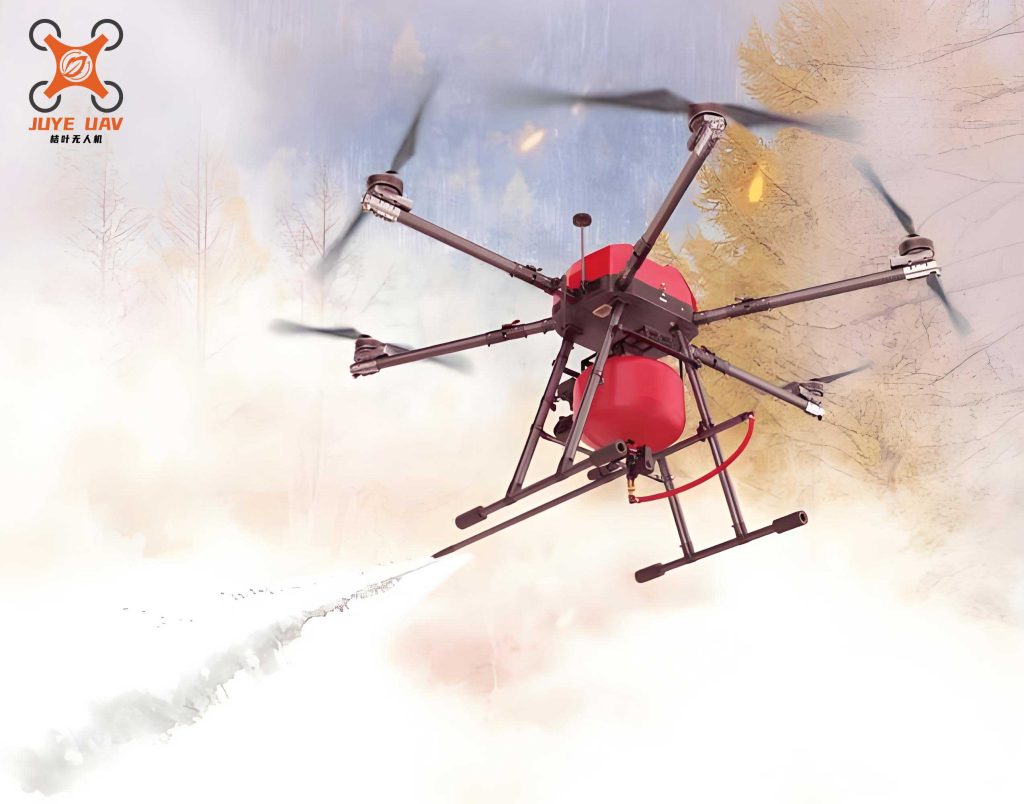
The visual representation above underscores the compact yet potent design of modern fire drones, capable of carrying various payloads essential for firefighting missions.
Comprehensive Application Analysis of Fire Drones in Rescue Operations
From my analysis, the applications of fire drones in实战 are vast and transformative. I will dissect these applications, again employing tables and mathematical concepts to elucidate their impact.
Fire Scene Reconnaissance and Intelligence Gathering
In uncontrolled fire environments, traditional visual assessment by ground crews is limited and risky. A fire drone equipped with visible-light and IR cameras can perform rapid, 360-degree aerial reconnaissance. The effectiveness of such reconnaissance can be quantified by the area coverage rate \( A_{cov} \):
$$ A_{cov} = \frac{v \cdot h \cdot t \cdot \eta}{A_{total}} $$
where \( v \) is drone velocity, \( h \) is sensor swath width, \( t \) is mission time, \( \eta \) is overlap efficiency, and \( A_{total} \) is the total area of interest. This allows for pinpointing ignition sources \( (x_{fire}, y_{fire}) \), calculating fire spread velocity \( \vec{v}_{fire} \), and identifying trapped individuals or hazardous materials. The fusion of GPS, especially Real-Time Kinematic (RTK) positioning providing centimeter-level accuracy, with imaging data drastically improves geolocation precision for targets.
Information Acquisition and 3D Modeling for Tactical Planning
Beyond simple video, fire drones can be outfitted with multispectral sensors, LiDAR, or loudspeaker modules. The data from these payloads is transmitted via 4G/5G or other links to the command center. For tactical mapping, drones can create detailed 2D orthophotos and 3D models. The ground sampling distance (GSD), which determines map resolution, is given by:
$$ GSD = \frac{s \cdot H}{f} $$
Here, \( s \) is sensor pixel size, \( H \) is flight altitude, and \( f \) is lens focal length. A smaller GSD yields higher resolution. These models, often created using photogrammetric techniques, provide an invaluable common operational picture (COP) for assessing structural integrity, planning ingress/egress routes, and allocating resources.
| Payload Module | Primary Function | Key Metric/Formula | Operational Benefit |
|---|---|---|---|
| Dual Visible/IR Gimbal Camera | Fire detection, hotspot identification | Thermal sensitivity < 50 mK | 24/7 reconnaissance, sees through smoke |
| Gas Sensor Array (e.g., CO, CH₄) | Toxic/flammable gas detection | Concentration \( C = k \cdot I_{sensor} \) | Early warning for explosive atmospheres |
| Loudspeaker & Siren | Public address, evacuation guidance | Sound pressure level > 100 dB @ 1m | Directs civilians, calms panic |
| Emergency Payload Dropper | Deploys life-saving supplies | Payload mass \( m \leq \frac{T_{max}}{g} – m_{drone} \) | Resupplies isolated victims |
| Communication Relay Node | Extends radio network coverage | Extended range \( R_{ext} = \sqrt{2hR} \) | Restores comms in dead zones |
| High-Luminosity Spotlight | Illuminates night operations | Luminous flux > 20,000 lumens | Enables safe night-time rescue |
Command, Control, and Real-Time Dispatch
The live feed from a fire drone serves as the eyes for the incident commander. In complex environments, integrating this feed with GIS and resource tracking systems allows for dynamic dispatch. The decision-making process can be modeled as an optimization problem to minimize total response time \( T_{resp} \):
$$ \min T_{resp} = \sum_{i=1}^{n} (t_{dispatch,i} + t_{travel,i} + t_{action,i}) $$
subject to constraints like resource availability \( R_j \leq R_{j,max} \) and evolving fire perimeter constraints \( \partial F(t) \). The fire drone’s real-time data on fire front location \( \vec{x}_{front}(t) \) is a critical input to this model, enabling proactive rather than reactive deployment of firefighting teams and equipment.
Auxiliary Rescue and Support Functions
The modular nature of fire drones allows them to be adapted for direct intervention. I categorize these auxiliary functions below.
Payload Delivery: A fire drone can carry and accurately release emergency supplies like life rafts, respirators, or medical kits to trapped individuals. The release precision depends on the drone’s positioning accuracy and wind conditions. The drop trajectory can be approximated using projectile motion equations, factoring in drone speed \( \vec{v}_d \) and altitude \( h \):
$$ \vec{r}_{payload}(t) = \vec{r}_{drop} + (\vec{v}_d + \vec{v}_{wind})t + \frac{1}{2}\vec{g}t^2 $$
Emergency Communication Bridging: When ground communication infrastructure is damaged, a fire drone can act as a temporary aerial relay station. The coverage area \( A_{cov} \) of such an aerial cell is approximately:
$$ A_{cov} \approx \pi ( \sqrt{2 h R_e} )^2 = 2\pi h R_e $$
for a flat earth model, where \( h \) is drone altitude and \( R_e \) is Earth’s radius, though a more accurate spherical model is often used. This re-establishes vital communication links.
Illumination and Guidance: For night operations, a fire drone-mounted light can illuminate vast areas. The illuminance \( E \) at a point on the ground is given by the inverse-square law adjusted for beam angle \( \theta \):
$$ E = \frac{I_0 \cos(\alpha)}{d^2} $$
where \( I_0 \) is luminous intensity, \( \alpha \) is the angle of incidence, and \( d \) is distance. This guides both rescuers and evacuees.
Direct Fire Suppression: For targeted attacks, especially in inaccessible areas like high-rise facades, fire drones can be fitted with extinguisher ball launchers or liquid agent dispensers. The momentum imparted by a discharged agent must be counteracted by the drone’s control system to maintain stability.
Automated Patrol Systems and Persistent Monitoring
By integrating fire drones into an automated patrol system, continuous monitoring of a fire scene or high-risk area becomes possible. The system can manage flight paths, data collection schedules, and anomaly detection. For a given patrol route of length \( L \), the optimal loiter time \( T_{loiter} \) to detect a change with probability \( P_d \) is related to sensor performance and event rate. Machine learning algorithms can analyze the incoming video stream in real-time to flag areas of increased thermal activity or structural collapse risk.
Air Quality Assessment and Predictive Fire Spread Analysis
A fire drone with environmental sensors performs crucial atmospheric monitoring. Measuring parameters like PM2.5, CO₂, and VOC levels helps assess toxicity risks for responders and downwind populations. Furthermore, by collecting real-time meteorological data (wind speed \( u \), direction \( \phi \), temperature \( T \)) at different altitudes, the fire drone feeds data into fire spread models. A simplified empirical model like Rothermel’s fire spread equation can be informed by this data:
$$ R = \frac{I_R \xi (1+\phi_w)}{\rho_b \epsilon Q_{ig}} $$
where \( R \) is rate of spread, \( I_R \) is reaction intensity, \( \xi \) is propagating flux ratio, \( \phi_w \) is wind factor, \( \rho_b \) is fuel bulk density, \( \epsilon \) is effective heating number, and \( Q_{ig} \) is heat of preignition. This enables predictive analytics for fire behavior, allowing commanders to anticipate breakout zones and deploy resources preemptively.
Synthesis and Forward Perspective
The integration of fire drones into the firefighting ecosystem is a cornerstone of modern “Smart Firefighting.” From my examination, the value proposition is clear: enhanced situational awareness, reduced risk to human life, improved operational efficiency, and data-driven command and control. The fire drone serves as a versatile platform—a scout, a messenger, a sensor node, and even an initial attack vehicle. The convergence of flight control, AI-powered image analysis, robust communication (5G and beyond), and seamless platform integration will only amplify these benefits. Future developments may see swarms of cooperating fire drones autonomously mapping large wildfires, delivering targeted extinguishing agents using AI-identified priority zones, or maintaining persistent communication meshes over disaster areas. The mathematical frameworks and technological modules discussed herein provide the foundation for these advanced capabilities. Ultimately, the strategic deployment of fire drones is not just an enhancement to traditional methods; it is a paradigm shift towards a more agile, informed, and effective fire and rescue service.