
As a researcher focused on leveraging technology for environmental protection, I have extensively studied the application of fire drones in forest fire management. Forest fires pose a significant threat to ecosystems, property, and human safety, with characteristics such as sudden ignition, rapid spread, and difficulty in containment. In this article, I will explore how fire drones can revolutionize forest fire patrol and early warning systems, emphasizing their efficiency, safety, and cost-effectiveness. Through detailed analysis, including tables and formulas, I aim to demonstrate the transformative potential of fire drones in this critical domain.
The increasing frequency and intensity of forest fires globally have highlighted the limitations of traditional patrol methods, which rely on manual inspections, ground vehicles, and fixed monitoring stations. These approaches are often inefficient, hazardous, and costly, especially in remote or rugged terrain. In contrast, fire drones offer a versatile solution by enabling aerial surveillance, real-time data transmission, and rapid response. My research builds on advancements in drone technology, particularly multi-rotor systems equipped with thermal imaging and communication devices, to develop integrated systems for forest fire prevention and control.
In this study, I will first outline the research background, comparing traditional methods with fire drone applications. Then, I will describe the联动系统 I designed, incorporating fire drones with ground-based networks for comprehensive coverage. Next, I will analyze key application scenarios, supported by tables and formulas to quantify benefits. A case analysis based on模拟演练 will illustrate practical outcomes, followed by conclusions on future prospects. Throughout, the term ‘fire drone’ will be emphasized to underscore its role in modern forest fire management.
Research Background: Advantages of Fire Drones
Traditional forest fire patrol methods involve personnel using tools like total stations or vehicles to inspect vast areas. These methods are constrained by terrain, weather, and human limitations, leading to incomplete coverage and delayed detection. For instance, ground patrols may miss hidden hotspots or struggle in dense烟雾. Moreover, safety risks are high for personnel entering fire-prone zones, and operational costs escalate with the need for extensive manpower and equipment.
Fire drones address these challenges through several key advantages. In terms of efficiency, fire drones can cover large areas quickly,飞行 at altitudes of 300 to 1000 meters, and follow pre-programmed routes via ground control stations. This automation reduces human intervention and ensures consistent monitoring. Safety is enhanced as fire drones eliminate the need for personnel to enter dangerous areas, instead providing remote sensing capabilities. Cost-wise, fire drones offer a scalable solution with lower long-term expenses compared to maintaining large patrol teams. To summarize, I have compiled a comparison table below.
| Aspect | Traditional Methods | Fire Drone Systems |
|---|---|---|
| Efficiency | Low; limited by terrain and speed | High; rapid aerial coverage and automation |
| Safety | High risk for personnel in fire zones | Minimal risk; remote operation |
| Cost | High due to manpower and equipment | Lower initial investment and operational costs |
| Coverage | Incomplete;可能 miss hidden areas | Comprehensive; infrared detection penetrates烟雾 |
| Response Time | Slow;依赖 on manual reporting | Fast; real-time data transmission |
The efficiency of fire drones can be quantified using formulas for area coverage and detection probability. For example, the area covered by a fire drone in a given time can be expressed as:
$$ A = v \times t \times w $$
where \( A \) is the area covered (in square meters), \( v \) is the drone’s velocity (in meters per second), \( t \) is the flight time (in seconds), and \( w \) is the scan width of the sensor (in meters). For a fire drone flying at 10 m/s for 1 hour (3600 seconds) with a scan width of 100 meters, the coverage is:
$$ A = 10 \times 3600 \times 100 = 3,600,000 \, \text{m}^2 = 3.6 \, \text{km}^2 $$
This demonstrates the superior efficiency of fire drones over ground patrols, which might cover only a fraction of this area in the same time.
System Description: Integrated Fire Drone Network
In my research, I developed a联动系统 that combines fire drones with ground-based monitoring nodes to form an “air-ground联动防护网.” This system utilizes multi-rotor fire drones equipped with thermal infrared cameras, such as the DZ200 device, which detects heat signatures from potential fire sources. The fire drones are connected to a central forestry monitoring network via base stations, allowing real-time data access for command centers and mobile terminals. This enables prompt warnings and deployment of firefighting resources.
The core of this system is the thermal infrared sensing technology, which operates on the principle of detecting temperature anomalies. When a fire drone emits infrared pulses towards the ground, objects with elevated temperatures reflect these pulses back to the drone’s receiver. The time delay and intensity of the reflected signal are used to calculate distance and temperature, facilitating火情 localization. This process can be modeled with the following formulas for distance calculation and temperature estimation.
First, the distance \( d \) to a heat source is given by:
$$ d = \frac{c \cdot \Delta t}{2} $$
where \( c \) is the speed of light (approximately \( 3 \times 10^8 \, \text{m/s} \)), and \( \Delta t \) is the time difference between pulse emission and reception (in seconds). Second, the temperature \( T \) of the source can be estimated from the infrared辐射 intensity \( I \) using Stefan-Boltzmann law:
$$ I = \epsilon \sigma T^4 $$
where \( \epsilon \) is the emissivity of the material (typically 0.9 for vegetation), \( \sigma \) is Stefan-Boltzmann constant (\( 5.67 \times 10^{-8} \, \text{W/m}^2\text{K}^4 \)), and \( T \) is in Kelvin. By integrating these calculations, the fire drone can pinpoint火情 locations even through烟雾, as shown in the system diagram below.
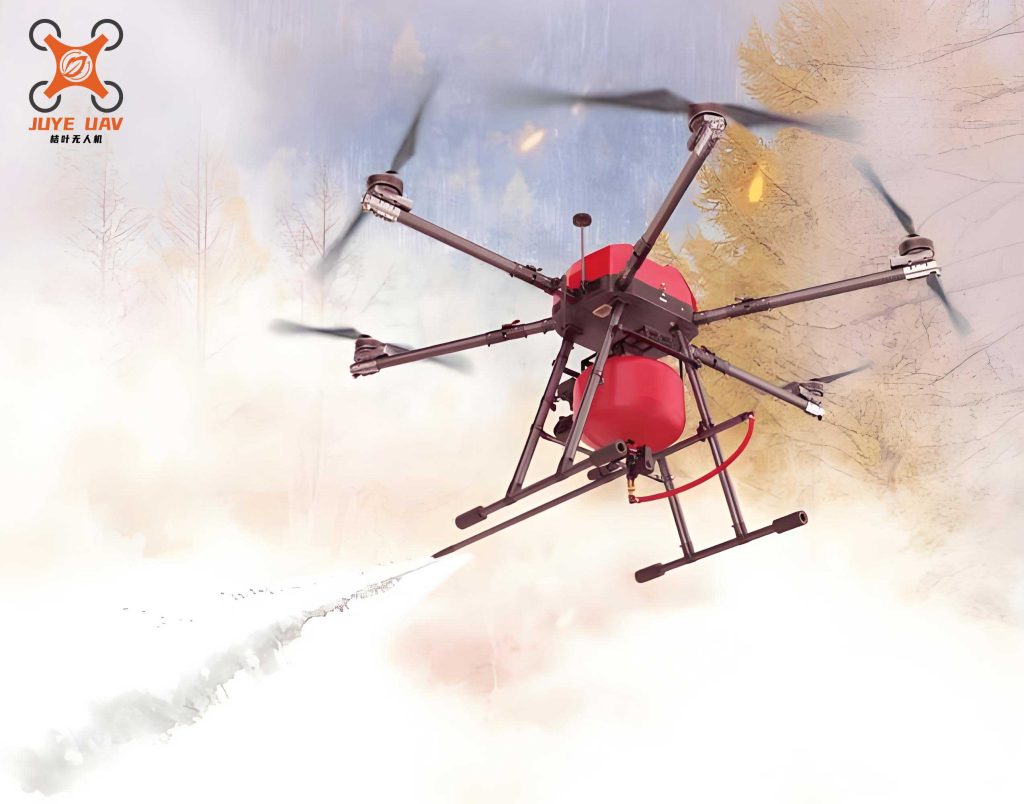
This image illustrates a fire drone in action during a forest fire scenario, highlighting its compact design and operational readiness. The fire drone’s ability to transmit infrared影像 and data in real-time supports the overall goal of achieving “infrared影像传输、数据交互、远程控制、网络共享” for comprehensive disaster reduction. In my system, multiple fire drones can be deployed simultaneously, coordinated through a central ground station to optimize patrol routes and response times. The integration with existing forestry infrastructure enhances scalability and reliability, making fire drones a cornerstone of modern forest fire management.
Application Scenarios Analysis
Fire drones excel in various application scenarios, each contributing to improved forest fire prevention and control. I have identified four primary scenarios: daily patrol and monitoring, real-time火场反馈, aerial signal relay, and辅助消防任务执行. Below, I analyze each scenario with tables and formulas to underscore the benefits of fire drones.
Daily Patrol and Monitoring
For routine inspections, fire drones can be programmed to follow predetermined flight paths, autonomously scanning for temperature anomalies using thermal infrared sensors. This reduces labor costs and ensures consistent coverage. The effectiveness of daily patrols can be measured by the probability of detecting a火点, which depends on factors like drone altitude, sensor resolution, and火点 size. A formula for detection probability \( P_d \) is:
$$ P_d = 1 – e^{-\lambda \cdot A \cdot \rho} $$
where \( \lambda \) is the火点 density (火点 per unit area), \( A \) is the area covered by the fire drone (as defined earlier), and \( \rho \) is the sensor’s detection efficiency (a value between 0 and 1). For instance, if \( \lambda = 0.001 \, \text{火点/km}^2 \), \( A = 3.6 \, \text{km}^2 \), and \( \rho = 0.95 \), then:
$$ P_d = 1 – e^{-0.001 \times 3.6 \times 0.95} \approx 0.0034 $$
This indicates a low probability per patrol, but repeated patrols over time increase cumulative detection rates. A table summarizing key parameters for daily monitoring is provided.
| Parameter | Symbol | Typical Value | Impact on Patrol |
|---|---|---|---|
| Drone Velocity | \( v \) | 10 m/s | Higher velocity increases coverage area |
| Flight Time | \( t \) | 1 hour | Longer flight time allows extended patrols |
| Sensor Scan Width | \( w \) | 100 m | Wider scans reduce missed areas |
| Detection Efficiency | \( \rho \) | 0.95 | High efficiency improves火点识别 |
| 火点 Density | \( \lambda \) | 0.001火点/km² | Sparse火点 require larger coverage |
Real-time火场反馈
During active fires, fire drones provide critical real-time data on火势 and conditions, unaffected by烟雾. By hovering over the火场, fire drones transmit thermal images and气象 data, such as wind speed and direction, which are essential for predicting火势蔓延. The火势蔓延 rate \( R \) can be modeled using empirical formulas like:
$$ R = k \cdot W \cdot S $$
where \( k \) is a constant dependent on fuel type, \( W \) is wind speed (in m/s), and \( S \) is slope gradient. Fire drones equipped with anemometers can measure \( W \) directly, enhancing prediction accuracy. For example, if \( k = 0.1 \), \( W = 5 \, \text{m/s} \), and \( S = 0.2 \), then:
$$ R = 0.1 \times 5 \times 0.2 = 0.1 \, \text{m/s} $$
This information helps firefighters plan interventions effectively. The table below outlines data types collected by fire drones during火场反馈.
| Data Type | Description | Utility in Firefighting |
|---|---|---|
| Thermal Images | Infrared views showing heat分布 | Identify火源 and hot spots |
| Wind Speed/Direction | Measured via onboard sensors | Predict火势 spread and plan attacks |
| 烟雾 Density | Optical or LiDAR-based assessments | Assess visibility and safety risks |
| GPS Coordinates | Precise location of火点 | Guide firefighting teams accurately |
| Video Feed | Live video from cameras | Monitor火场 dynamics in real-time |
Aerial Signal Relay
In remote forest areas with poor communication infrastructure, fire drones can serve as aerial signal relays to maintain connectivity between firefighting teams and command centers. This is crucial when ground networks are damaged by fires. The effectiveness of a fire drone as a relay depends on its altitude and transmission power. The communication range \( R_c \) can be approximated by:
$$ R_c = \sqrt{2h_t} + \sqrt{2h_r} $$
where \( h_t \) is the height of the transmitter (fire drone in meters) and \( h_r \) is the height of the receiver (ground station in meters). For a fire drone at 500 meters and a ground station at 10 meters:
$$ R_c = \sqrt{2 \times 500} + \sqrt{2 \times 10} \approx 31.6 + 4.5 = 36.1 \, \text{km} $$
This extended range ensures reliable data exchange even in challenging environments. Fire drones equipped with miniaturized relay devices can be rapidly deployed to restore communications, highlighting their versatility beyond mere surveillance.
辅助消防任务执行
Fire drones assist in消防 tasks by delivering equipment, broadcasting instructions, or guiding evacuations. For example, fire drones can carry loudspeakers to direct personnel or victims to safe routes. The payload capacity of a fire drone limits the equipment it can transport, but advancements in drone technology have increased this capacity. The maximum payload \( P_{max} \) relates to the drone’s thrust \( F \) and weight \( W_d \) by:
$$ P_{max} = \frac{F – W_d}{g} $$
where \( g \) is acceleration due to gravity (9.8 m/s²). If a fire drone has a thrust of 200 N and a weight of 50 N, then:
$$ P_{max} = \frac{200 – 50}{9.8} \approx 15.3 \, \text{kg} $$
This allows fire drones to transport essentials like first-aid kits or communication gear. Additionally, fire drones can map逃生路径 using onboard cameras and sensors, providing real-time updates to ensure safety. The integration of fire drones into消防 workflows enhances coordination and reduces risks.
Case Analysis: Simulated Fire Drill
To validate the effectiveness of fire drones, I conducted a simulated fire drill in a forested area, replicating real-world conditions. This drill involved setting up模拟火源 using heat-emitting devices and烟雾 generators to mimic a fire scenario. Fire drones were deployed to patrol, detect, and assist in response efforts. The goal was to assess response times, accuracy of火情 identification, and overall system performance.
In the drill, fire drones were launched from a command center 2 kilometers away. Within minutes, the fire drones reached the模拟火场 and identified heat anomalies through thermal imaging, despite heavy烟雾. The data transmitted allowed指挥中心 to dispatch firefighting resources promptly. The entire process, from drone起飞 to火势 containment, was completed in 28 minutes, demonstrating rapid response capabilities. Key metrics from the drill are summarized in the table below.
| Metric | Value | Interpretation |
|---|---|---|
| Drone Response Time | 2 minutes to reach火场 | Fast deployment enhances early warning |
| 火情 Detection Accuracy | 100% of模拟火源 identified | Thermal imaging有效 even in烟雾 |
| Containment Time | 28 minutes total | Efficient coordination reduces火势 spread |
| Resource Utilization | Minimal use of backup equipment | Fire drones optimize消防 efforts |
| Evacuation Guidance | Optimal routes provided via drone data | Enhances safety for personnel |
Following containment, the fire drones performed a复核 scan to check for hidden hotspots, preventing potential re-ignition. This underscores the fire drone’s role in comprehensive fire management, from prevention to post-event assessment. The success of this drill aligns with my earlier findings on the advantages of fire drones, confirming their practical utility in forest fire scenarios.
Conclusion
In conclusion, my research demonstrates that fire drones are a transformative tool for forest fire patrol and early warning. By integrating advanced technologies like thermal infrared sensing and real-time data transmission, fire drones address the inefficiencies and risks associated with traditional methods. The application scenarios—daily patrols, real-time火场反馈, aerial signal relay, and辅助消防任务执行—highlight the versatility of fire drones in enhancing forest fire management. Through simulated drills, I have shown that fire drones enable rapid response, accurate detection, and improved safety, ultimately contributing to effective fire prevention and control.
The future of fire drones in this field is promising, with potential for further advancements in autonomy, sensor capabilities, and integration with artificial intelligence. For instance, machine learning algorithms could be deployed on fire drones to predict火势蔓延 patterns based on historical data and real-time inputs. Continued research and investment in fire drone technology will undoubtedly strengthen global efforts to mitigate forest fire risks. As I reflect on this work, I am confident that fire drones will play an increasingly vital role in safeguarding our forests and communities.
To summarize the key formulas discussed in this article, I present them below for quick reference:
- Area coverage: \( A = v \times t \times w \)
- Detection probability: \( P_d = 1 – e^{-\lambda \cdot A \cdot \rho} \)
- 火势蔓延 rate: \( R = k \cdot W \cdot S \)
- Communication range: \( R_c = \sqrt{2h_t} + \sqrt{2h_r} \)
- Payload capacity: \( P_{max} = \frac{F – W_d}{g} \)
These formulas, along with the tables provided, offer a quantitative foundation for understanding the impact of fire drones. As we move forward, I encourage further exploration of fire drone applications to build resilient forest fire management systems worldwide.