
In my years of experience in firefighting and emergency response, I have witnessed a dramatic evolution in technology that has reshaped how we approach灭火救援. The traditional methods of assessing fire scenes, often reliant on ground-based observations or limited aerial views from satellites, have proven inadequate in the face of complex urban fires, wildland blazes, and hazardous material incidents. The need for real-time, high-precision data is paramount, and this is where the fire drone has emerged as a game-changing tool. A fire drone, essentially an unmanned aerial vehicle (UAV) tailored for fire service applications, offers unparalleled flexibility, safety, and efficiency. This article, drawn from my firsthand observations and analysis, delves into the intricate world of fire drones, exploring their technical foundations, diverse classifications, inherent advantages, and transformative applications within消防灭火救援. I will structure this discussion to provide a comprehensive understanding, utilizing tables and mathematical models to encapsulate key concepts, all while emphasizing the critical role of the fire drone in modern emergency response.
The advent of fire drones represents a significant leap forward. Historically,消防通信建设 relied on tools like海事卫星平板 for image transmission, which were constrained by fixed angles, obstructed views due to terrain or building structures, and delayed data relay. These limitations often hampered strategic decision-making during critical, time-sensitive operations. The integration of fire drone technology has fundamentally altered this landscape. By providing immediate aerial reconnaissance, multi-angle imaging, and real-time video feeds, fire drones empower incident commanders with a god’s-eye view of the disaster, facilitating more effective and safer消防工作. The following sections will unpack the mechanics, varieties, and operational prowess of these remarkable machines, consistently highlighting the term ‘fire drone’ to underscore its centrality to this discourse.
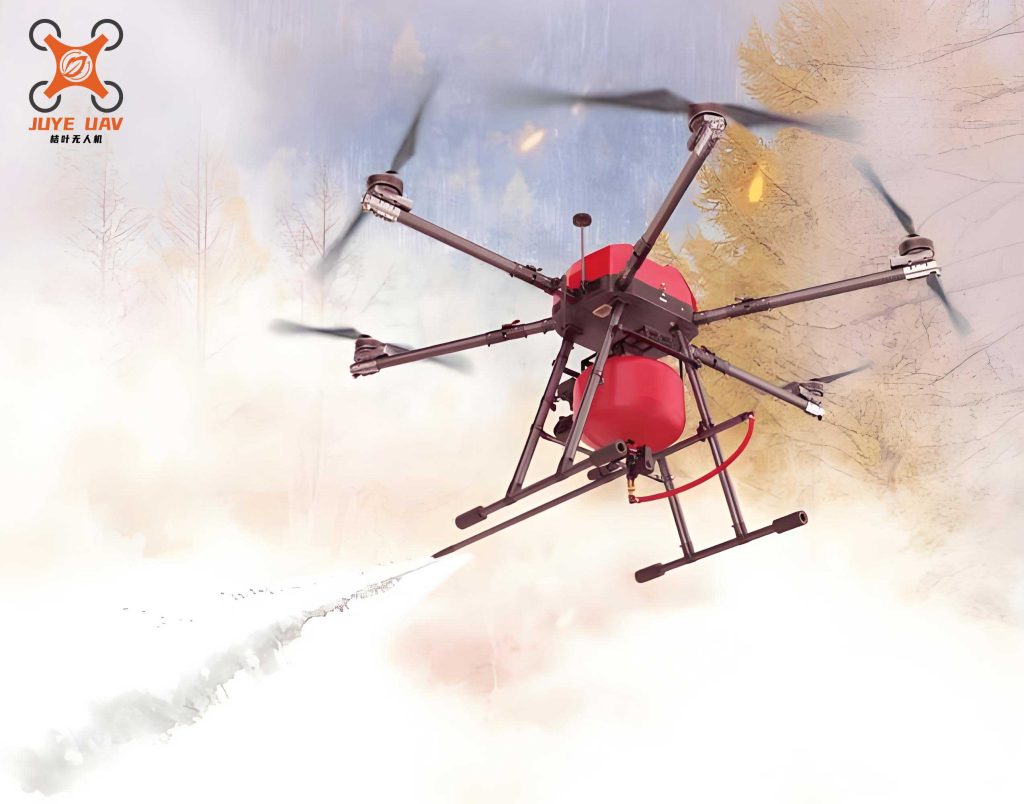
To appreciate the application, one must first understand the instrument. A fire drone is a sophisticated system comprising several integrated subsystems. From an engineering perspective, its operation can be broken down into core components and governing principles.
1. The Anatomy and Mechanics of a Fire Drone
1.1 Core Working Principle
The fundamental operation of a fire drone hinges on the synergy between its airframe, propulsion, and, most importantly, its flight control system (FCS). The FCS is the brain of the fire drone. It processes data from onboard sensors (gyroscopes, accelerometers, GPS, barometers) and executes control algorithms to maintain stable flight, navigate waypoints, and execute commands. The dynamics can be conceptually modeled. For a multi-rotor fire drone, the thrust $T$ generated by each rotor is a function of its rotational speed $\omega$:
$$T = k_T \cdot \omega^2$$
where $k_T$ is the thrust coefficient. The total thrust vector must counteract the weight $mg$ of the fire drone and provide the necessary acceleration for movement. The flight control algorithm continuously solves for the required $\omega_i$ for each motor (i=1,2,…,n) to achieve desired pitch, roll, yaw, and lift. This is often governed by a set of equations derived from Newton-Euler mechanics. For a simplified quadcopter model, the net torque $\tau$ and force $F$ in the body frame are:
$$
\begin{aligned}
\tau_\phi &= l \cdot k_T (\omega_4^2 – \omega_2^2) \\
\tau_\theta &= l \cdot k_T (\omega_3^2 – \omega_1^2) \\
\tau_\psi &= k_Q (\omega_1^2 – \omega_2^2 + \omega_3^2 – \omega_4^2) \\
F_z &= k_T (\omega_1^2 + \omega_2^2 + \omega_3^2 + \omega_4^2)
\end{aligned}
$$
where $l$ is the arm length, $k_Q$ is the drag coefficient, and $\phi, \theta, \psi$ represent roll, pitch, and yaw angles respectively. The FCS uses Proportional-Integral-Derivative (PID) controllers or more advanced algorithms to manipulate these torques and forces. Alongside the FCS, the data link system ensures robust, low-latency communication between the fire drone and the ground control station (GCS), transmitting telemetry and video while receiving commands. The launch and recovery system, though simpler for multi-rotors, ensures safe deployment and retrieval of the fire drone, completing the operational loop.
1.2 Classification of Fire Drones
Fire drones are not monolithic; they come in various configurations suited to different mission profiles. Based on my operational needs, I categorize them primarily by propulsion and airframe design. The table below summarizes this classification:
| Classification Basis | Type | Key Characteristics | Typical Use in Firefighting |
|---|---|---|---|
| Propulsion | Fuel-powered (Gasoline/Diesel) | High endurance (often 1-2+ hours), higher payload capacity, but carries risk of fuel ignition upon crash and requires more maintenance. | Long-duration perimeter monitoring of large forest fires. |
| Electric (Battery/LiPo) | Lower noise, immediate readiness, safer in crash scenarios, but limited flight time (typically 20-45 mins). Easy to deploy. | Rapid response for urban structure fire assessment, hazardous gas detection. | |
| Airframe Design | Multi-rotor (Multi-copter) | Vertical Take-off and Landing (VTOL), excellent hover stability, high maneuverability in confined spaces. Simple mechanics. | The most common fire drone. Ideal for close-quarters inspection, vertical scans of building facades, and indoor reconnaissance (if specially designed). |
| Fixed-Wing | Long range and endurance, efficient forward flight, but requires runway or catapult for launch, cannot hover. | Mapping large wildfire perimeters, assessing damage over wide areas post-disaster. | |
| Hybrid VTOL (Vertical Take-Off and Landing Fixed-Wing) | Combines hover capability with efficient forward flight. Complex and costly. | Emerging application for missions requiring both detailed inspection of a point and rapid coverage of a large zone. |
For most tactical消防灭火救援 scenarios, the electric multi-rotor fire drone is the workhorse due to its deployability, safety, and maneuverability—key attributes I prioritize on the fireground.
1.3 Salient Characteristics and Advantages
The operational superiority of a fire drone stems from a confluence of characteristics. Let me quantify some of these advantages through a comparative lens.
1. High Monitoring Precision: Operating at low altitudes (50m to 1000m), a fire drone conducts what is essentially近景测量. The ground sampling distance (GSD), a measure of resolution, can be sub-meter, even down to centimeter level. The precision $P$ of a photogrammetric model derived from fire drone imagery can be related to the GSD and overlap between images. For a measurement taken from a 3D model, the error $\sigma$ can be approximated as:
$$ \sigma \approx k \cdot \text{GSD} $$
where $k$ is a factor typically between 1 and 3, depending on processing algorithms and flight parameters. This allows the fire drone to detect subtle thermal anomalies, structural cracks, or chemical plumes invisible from the ground.
2. Cost-Effectiveness and Operational Efficiency: The total cost of ownership (TCO) for a fire drone system is favorable. We can model a simplified cost-benefit analysis. Let $C_{\text{acq}}$ be acquisition cost, $C_{\text{ops}}$ be annual operational cost (training, maintenance), and $B_{\text{risk}}$ be the monetized benefit from reduced risk to firefighters and improved outcomes. Over $n$ years, the net value $V$ of deploying a fire drone is:
$$ V_n = \sum_{t=1}^{n} \frac{B_{\text{risk},t} – C_{\text{ops},t}}{(1+r)^t} – C_{\text{acq}} $$
where $r$ is a discount rate. The high benefit often justifies the cost. Furthermore, the fire drone’s quick deployment saves critical time, a non-monetary but vital efficiency gain.
3. Flexibility and Safety: This is the paramount advantage. The fire drone imposes minimal requirements on launch/landing sites. Its operational readiness time $T_{\text{ready}}$ is short, often under 5 minutes. Most importantly, it acts as a force multiplier that reduces the exposure of personnel to extreme hazards. The risk mitigation factor $R_{mf}$ can be conceptualized as:
$$ R_{mf} = 1 – \frac{P_{\text{injury, drone-aided}}}{P_{\text{injury, traditional}}}} $$
where $P_{\text{injury}}$ is the probability of firefighter injury for a given task. By sending the fire drone into toxic, collapsing, or thermally intense environments, $R_{mf}$ approaches 1. Its ability to capture vertical, oblique, and nadir imagery solves the problem of visual obstructions, providing a comprehensive view of the incident.
2. Applied Research: The Fire Drone on the Fireground
The theoretical capabilities of the fire drone translate into concrete, life-saving applications. Based on my experience and ongoing research, the integration of fire drones follows several key functional pathways.
2.1 Initial Scene Assessment and Data Acquisition
The first minutes of an incident are crucial. A compact fire drone, weighing less than 25 kg, can be transported by a small team and airborne within moments of arrival. Its primary role is to act as a rapid aerial sensor platform. The data acquisition process can be systematized. The fire drone follows a pre-planned or manually piloted flight path, collecting a multi-dimensional dataset $D$:
$$ D = \{I_v, I_t, S_g, M_w, T_a\} $$
where:
- $I_v$: Visual spectrum imagery/video (RGB).
- $I_t$: Thermal imagery from an onboard infrared (IR) camera. This detects heat signatures, identifying fire seats, hotspots, and victims through smoke. The temperature measurement $T_{\text{surface}}$ from a thermal pixel is derived from emitted radiation.
- $S_g$: Gas sensor readings (e.g., for CO, CH₄, VOCs). Concentration $C$ can be mapped in 2D/3D.
- $M_w$: Meteorological data (wind speed $v_w$, direction $\theta_w$, ambient temperature).
- $T_a$: Telemetry data (drone position, altitude, attitude).
This dataset is streamed in real-time via secure data links (e.g., 4G/5G, dedicated RF) to the command post. Using photogrammetry software, overlapping visual images $I_v$ are processed to generate orthomosaics and 3D models of the structure or terrain. The spatial resolution of these models is directly tied to the flight altitude $h$ and camera focal length $f$, following the relationship for GSD mentioned earlier. This immediate intelligence allows for accurate size-up, identification of exposures, and planning of ingress/egress routes before firefighters commit to interior operations. The fire drone is indispensable for this initial reconnaissance phase.
2.2 Enhancing Command, Control, and Coordination
The fire drone evolves from a scout to a persistent eye in the sky, directly feeding the incident command system (ICS). The real-time video feed $I_v(t)$ and thermal overlay $I_t(t)$ create a common operational picture (COP). This shared situational awareness is critical for coordinating complex operations involving multiple companies and agencies. The benefit can be modeled in terms of decision-making quality. Let the quality of a tactical decision $Q_d$ be a function of information completeness $C_i$, timeliness $T_i$, and accuracy $A_i$:
$$ Q_d = f(C_i, T_i, A_i) $$
The fire drone directly optimizes all three variables. $C_i$ increases through multi-spectral data; $T_i$ is maximized by live streaming; $A_i$ is enhanced by high-resolution, georeferenced data. This leads to superior resource allocation. Commanders can monitor fire spread $\frac{dA_f}{dt}$ in real-time, where $A_f$ is the fire area, and dynamically reposition assets. Furthermore, the fire drone’s feed can be bridged to remote experts or agency heads via video conferencing, effectively expanding the “brain trust” available to the incident commander without them being physically on the hazardous scene. The fire drone thus becomes a central node in the消防指挥调度 network.
2.3 Expanded and Specialized Applications
The versatility of the fire drone platform allows for mission-specific adaptations, continually expanding its utility. The following table catalogs some advanced and emerging applications:
| Application Domain | Fire Drone Configuration | Technical Modifications / Payloads | Operational Impact |
|---|---|---|---|
| Night Operations & Low-Visibility | Standard multi-rotor or fixed-wing. | High-gain thermal cameras ($I_t$), infrared illuminators, low-light RGB cameras. | Enables 24/7 monitoring capability. The fire drone can track hotspots and structural integrity through darkness and dense smoke, maintaining situational awareness. |
| Hazardous Material (HazMat) Response | Multi-rotor with sealed components. | Multi-gas detectors ($S_g$), radiation sensors, sampling arms (for airborne particulates). | Provides stand-off detection and mapping of contaminant plumes. The fire drone can identify the chemical threat and its dispersion pattern $\nabla C(x,y,z,t)$ without exposing personnel. |
| Search and Rescue (SAR) | Agile multi-rotor with loudspeaker/spotlight. | High-resolution zoom cameras, thermal cameras for victim detection, AI-based object detection software. | Accelerates victim location in collapsed structures or wildland areas. The fire drone can cover large areas systematically, increasing probability of detection $P_{det}$. |
| Active Intervention | Heavy-lift multi-rotor. | Payload release mechanisms for dropping fire retardants, emergency supplies, or life jackets. Experimental models with water/foam projection lines. | Extends reach for initial attack on wildland fires or delivering aid to inaccessible victims. The payload mass $m_p$ is limited by thrust $T_{\text{total}}$: $m_p \cdot g < T_{\text{total}} – m_{\text{drone}} \cdot g$. |
| Post-Incident Analysis & Forensics | High-precision mapping multi-rotor. | Survey-grade GPS (RTK/PPK), high-megapixel cameras. | Creates detailed, accurate 3D models for fire cause investigation, damage assessment, and training. The model serves as a permanent, measurable record. |
Each of these applications leverages the core strengths of the fire drone: accessibility, sensor agility, and safety. The development of lightweight, powerful payloads continues to push the boundaries of what a single fire drone can accomplish on a single mission.
3. Mathematical Modeling for Fire Drone Deployment Optimization
To fully integrate the fire drone into standard operating procedures, we can apply operational research models. For instance, optimizing the flight path for area coverage or sensor deployment. One common challenge is designing a flight path for thermal mapping of a fire. This can be framed as a variant of the Coverage Path Planning (CPP) problem. The objective is to cover area $A$ with a sensor footprint of width $w$ (which depends on altitude $h$ and sensor field-of-view $\alpha$: $w = 2h \cdot \tan(\alpha/2)$), minimizing total flight time $T_{\text{flight}}$ or energy consumption $E$.
A simplified energy consumption model for an electric multi-rotor fire drone during hover-dominated mapping is:
$$ E \approx P_{\text{hover}} \cdot T_{\text{flight}} = (m \cdot g \cdot \sqrt{\frac{1}{2 \rho A_{\text{disk}}}}) \cdot T_{\text{flight}} $$
where $P_{\text{hover}}$ is the hover power, $m$ is total mass, $g$ is gravity, $\rho$ is air density, and $A_{\text{disk}}$ is the total rotor disk area. The flight time $T_{\text{flight}}$ needed to cover area $A$ with a given overlap ratio $O$ is:
$$ T_{\text{flight}} \approx \frac{A}{w \cdot v \cdot (1-O)} $$
where $v$ is the cruising speed. Optimizing these parameters ($h$, $v$, $O$) for a given fire drone specification and mission goal is key to efficient data collection. Furthermore, for multiple fire drone deployments, swarm algorithms can be explored where $n$ fire drones cooperate to cover an area more quickly, with total coverage time scaling roughly as $\sim 1/n$ under ideal conditions. The fire drone is not just a tool but a node in a potentially intelligent network.
4. Challenges and Future Trajectory
Despite its promise, the operationalization of the fire drone faces hurdles. Regulatory airspace integration, pilot training and certification, data security/encryption for sensitive feeds, and limited endurance for electric models are ongoing concerns. Technological advancements are addressing these. The energy density of batteries is improving, modeled by the trend in specific energy $E_{sp}$ (Wh/kg). Future fire drones may employ hydrogen fuel cells or hybrid systems, dramatically extending flight time $T_{\text{flight}}$.
The most exciting frontier is the integration of Artificial Intelligence (AI) and Machine Learning (ML). An AI-powered fire drone could autonomously identify specific hazards (e.g., flashover conditions, structural failure patterns) in real-time from its sensor stream $D(t)$. This involves training a model $M$ such that:
$$ \text{Hazard Prediction} = M(I_v(t), I_t(t), S_g(t), …) $$
with a high confidence score. Automated flight in GPS-denied environments (e.g., inside buildings) using simultaneous localization and mapping (SLAM) is another critical research area. The future fire drone will likely be more autonomous, collaborative, and intelligent, acting as a true partner to the firefighter on the ground.
In conclusion, my analysis and experience affirm that the fire drone is a transformative technological force in消防灭火救援. From its foundational principles governed by aerodynamic and control equations to its diverse classifications and expansive applications summarized in tabular formats, the fire drone has proven its worth as a versatile, precise, and life-saving asset. It enhances situational awareness, protects firefighter lives, and improves operational outcomes. The continued research and development into fire drone capabilities—from longer endurance and smarter AI to specialized intervention payloads—will undoubtedly deepen its integration into fire service protocols. The ultimate goal is a seamless fusion of human expertise and robotic capability, where the fire drone serves as an indispensable extension of the firefighter’s senses and reach, ensuring that消防事业 evolves to meet the challenges of an increasingly complex world. The journey of the fire drone, from a novel gadget to a core component of the incident command toolkit, is a testament to the power of innovation in the service of public safety.