
In the context of the digital era, technological empowerment is driving quality improvements across all sectors. As a crucial force safeguarding public life and property, fire and rescue services must similarly leverage scientific and technological advancements to enhance operational effectiveness. The strategic application of novel technologies, particularly in improving the quality of firefighting communication support, is paramount for elevating overall rescue capabilities. This analysis explores the application of fire drone technology in emergency firefighting communications. By examining its role from multiple dimensions—including disaster reconnaissance, information relay, and functioning as a communications hub—we can understand how fire drone technology fundamentally enhances the reliability, efficiency, and scope of emergency communications during critical incidents.
1. The Role of Fire Drones in Fire and Rescue Operations
Unmanned Aerial Vehicles (UAVs), or drones, are aircraft operated via remote control through radio technology and programmed software to execute various flight missions. In firefighting, these specialized tools are best termed fire drones. Their integration has revolutionized tactical approaches, offering unparalleled situational awareness and operational support.
1.1 Common Types of Fire Drones
The selection of an appropriate fire drone type depends heavily on the specific demands of the incident scene, including scale, terrain complexity, and required mission duration. The primary categories are summarized below.
| Drone Type | Principle of Operation | Key Advantages | Primary Limitations | Ideal Use Case in Firefighting |
|---|---|---|---|---|
| Multi-Rotor Fire Drone | Lift and control generated by varying the speed of multiple fixed-pitch rotors. | Vertical Take-Off and Landing (VTOL), precise hovering, compact size, easy operation, low requirement for launch/landing area. | Limited flight endurance and range. | Close-range inspection, indoor/confined space operations, precise payload delivery over a point. |
| Fixed-Wing Fire Drone | Lift generated by aerodynamic wings as it moves forward through the air. | Long endurance, high cruising speed, large area coverage. | Requires runway or launcher for take-off; cannot hover. | Large-scale area assessment for wildfires, post-disaster damage mapping over wide regions. |
| Hybrid VTOL Fire Drone | Combines multi-rotor systems for VTOL with fixed-wing design for efficient forward flight. | Vertical take-off/hover capability coupled with extended range and endurance. | More complex mechanically and electronically, higher cost. | Missions requiring both access to confined spaces and long-duration, wide-area surveillance. |
The optimal deployment often involves a combination of fire drone types to leverage their complementary strengths. For instance, a multi-rotor fire drone can provide immediate close-in assessment of a structural fire, while a fixed-wing or hybrid fire drone concurrently maps the broader incident perimeter and monitors for fire spread.
1.2 Application Scenarios for Fire Drones
Modern fire drone systems have evolved into indispensable tools across the emergency response timeline. Their applications extend far beyond simple aerial photography.
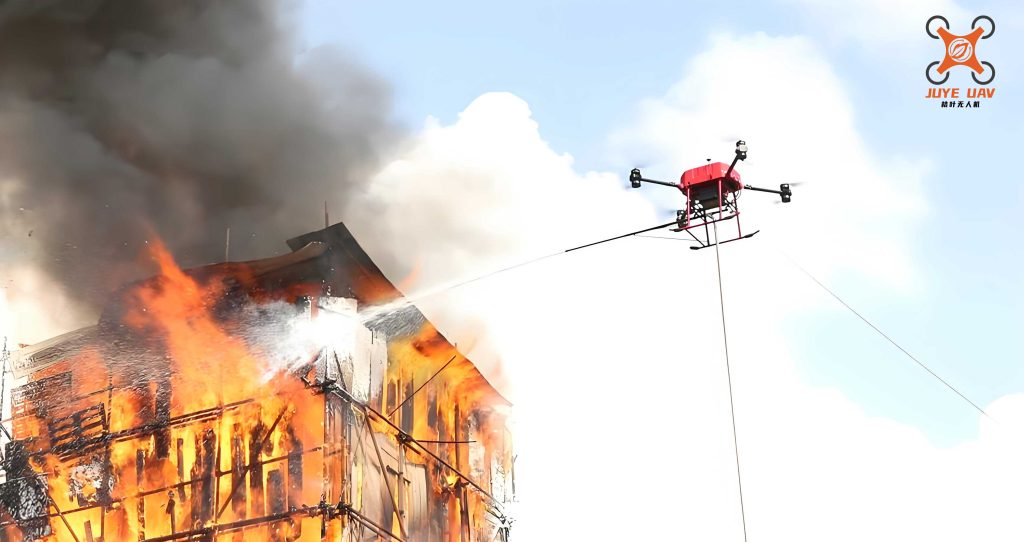
The image above illustrates the multifaceted role of a fire drone, showcasing its capability for aerial monitoring, a core function that supports numerous downstream applications. The primary scenarios include:
- Disaster Reconnaissance & Assessment: Acting as a rapid aerial scout, a fire drone can quickly survey an incident, using HD cameras and thermal imaging sensors to locate the fire seat, identify development directions, and pinpoint trapped individuals. For complex disasters, they can create 3D terrain models to aid in route planning and damage estimation.
- Operational Support: Fire drones can carry specialized payloads such as fire-retardant capsules, life-saving equipment (e.g., life jackets, respirators), or even cutting charges for targeted delivery to otherwise inaccessible areas, reducing risk to personnel.
- Public Interaction & Scene Management: Equipped with loudspeakers and powerful LED lights, fire drones assist in crowd management, guiding evacuations, providing instructions to survivors, and illuminating nighttime operations.
2. Advantages of Fire Drone Technology in Emergency Communications
The integration of fire drone technology specifically for communications addresses critical vulnerabilities in traditional systems. Its core advantages can be quantified and modeled, forming the basis for its strategic value.
2.1 High Mobility and Rapid Deployment
A fire drone‘s ability to be deployed within minutes and navigate directly to a target location overcomes ground-based obstacles. This drastically reduces the time to establish an initial communications link or visual overview. The time advantage can be expressed relative to ground crew deployment:
$$T_{advantage} = T_{ground} – T_{drone}$$
where $T_{ground}$ is the time for ground units to reach the vantage point and $T_{drone}$ is the time for the fire drone to achieve the same. In complex terrain, $T_{advantage}$ can be substantial, directly translating to faster decision-making.
2.2 Real-Time Monitoring and Data Transmission
Fire drones provide a continuous, real-time data feed from the incident heart. The data stream $D(t)$ can include video $V(t)$, thermal imagery $I_{thermal}(t)$, and telemetry $M(t)$:
$$D(t) = \{ V(t), I_{thermal}(t), M(t) \}$$
This real-time stream is transmitted via secure digital links (e.g., COFDM, 4G/5G) to command centers, creating a shared situational awareness platform that is critical for coordinated action and adaptive strategy formulation.
2.3 Extended Signal Coverage Range
By elevating a communication payload, a fire drone acts as an aerial cell tower or radio repeater, dramatically extending the effective communication range. The line-of-sight (LoS) coverage radius $R$ from an altitude $h$ can be approximated, ignoring sophisticated terrain diffraction models, as:
$$R \approx \sqrt{(2k \cdot R_e \cdot h)}$$
where $R_e$ is the Earth’s radius and $k$ is an adjustment factor for atmospheric refraction (typically ~4/3). More practically for tactical planning, the coverage area $C$ from a given altitude with a signal beamwidth $\theta$ is:
$$C = \pi \times (h \times \tan(\theta))^2$$
This demonstrates how even a modest altitude significantly increases the area served by the fire drone‘s relay, connecting isolated front-line teams with command.
3. Application Strategies for Fire Drones in Emergency Communication Assurance
3.1 Communication Assurance in Complex Environments
Rescue operations in urban canyons, dense forests, tunnels, or during catastrophic infrastructure failure present unique challenges where traditional signals are blocked or non-existent. Fire drones offer tailored solutions.
| Environment Type | Communication Challenge | Fire Drone Strategy | Key Enabling Payload |
|---|---|---|---|
| Above-ground Complex (Mountains, Forests, Urban) | Signal blockage, limited LoS for ground units. | Aerial signal relay via hovering or orbiting fire drone; multi-drone relay chain for extended range. | Signal amplifier, directional antenna, multi-band repeater. |
| Building Interior | No GPS, rapid signal attenuation through walls/floors. | Penetration by agile multi-rotor fire drone to act as a mobile signal node inside, bridging to exterior network. | Miniaturized mesh radio node, Wi-Fi hotspot. |
| Subterranean/Surface Denied (Collapsed structures, Tunnels) | Complete isolation from surface communication networks. | Fire drone deploys a tethered or autonomous communication cable/ node to establish a link through shafts or breaches. | Fiber-optic dispenser, resilient mesh node. |
| Public Network Restoration | Damaged cellular infrastructure leads to public comms blackout. | Fire drone deploys a temporary Cellular-on-the-Go (COTG) or LTE/5G portable base station. | Compact COTG system, satellite backhaul link. |
3.2 Frontline-to-Command Information Nexus
The fire drone effectively moves the command post’s “eyes and ears” deep into the hazard zone, enabling a seamless information nexus.
- Forward Information Acquisition: Upon alarm, a pre-programmed fire drone is launched on an optimal path $P_{opt}$ to the coordinates, minimizing $T_{drone}$. It captures and streams the multi-sensor data $D(t)$ back to command. Thermal data is crucial for identifying heat sources $H_{source}(x,y)$ through smoke:
$$I_{thermal}(x,y,t) \rightarrow H_{source}(x,y)$$
This allows for dynamic resource allocation based on live threat assessment. - Aerial Voice Broadcast: A fire drone equipped with a powerful loudspeaker can project clear audio instructions $A_{msg}$ to specific zones $Z_i$ that are inaccessible or hazardous for rescue personnel:
$$Broadcast(Drone, A_{msg}, Z_i)$$
This is vital for crowd guidance and communicating with trapped individuals.
3.3 Rapid Deployment of Temporary Aerial Communication Relays
When ground infrastructure is destroyed, a fire drone can be rapidly configured as an aerial relay station. The effectiveness of this Aerial Temporary Relay Node (ATRN) depends on optimal positioning and robust operations.
Optimization of Drone Positioning: The goal is to maximize coverage $C$ over the operational area $A_{op}$ while maintaining a stable flight position. This involves solving for altitude $h$ and horizontal coordinates $(x_d, y_d)$ to satisfy constraints like signal-to-noise ratio $SNR_{min}$ and LoS to ground users $U_i$. A simplified utility function $U_{pos}$ for placement could be:
$$U_{pos}(h, x_d, y_d) = \alpha \cdot \frac{C \cap A_{op}}{A_{op}} – \beta \cdot P_{interference} – \gamma \cdot E_{consumption}(h)$$
where $\alpha, \beta, \gamma$ are weighting factors, $P_{interference}$ is signal interference, and $E_{consumption}$ is energy use at altitude $h$.
Sustained Operations: For prolonged missions, energy and link stability are critical. This requires redundant systems:
- Power: Use of high-capacity batteries with swap systems, or tethering to a ground power source.
- Data Links: Implementation of redundant communication channels (e.g., dual-band 2.4GHz and 5.8GHz, satellite back-up). The system automatically switches upon degradation of the primary link $L_1$ to the secondary $L_2$:
$$ActiveLink = \begin{cases} L_1 & \text{if } QoS(L_1) > threshold \\ L_2 & \text{otherwise} \end{cases}$$
3.4 Multi-Drone Swarm for Optimized Communication Mesh Networks
To overcome the limitations of a single fire drone and create resilient, wide-area coverage, coordinated multi-drone “swarm” or “hive” strategies are employed.
This approach forms a dynamic, self-adjusting aerial mesh network. Each fire drone $D_i$ acts as a node with a position $p_i(t)$ and a communication radius $r_i$. The collective coverage $C_{swarm}(t)$ is the union of individual coverages:
$$C_{swarm}(t) = \bigcup_{i=1}^{n} C(D_i, r_i, p_i(t))$$
Adaptive algorithms, often based on flocking or artificial potential fields, adjust $p_i(t)$ in real-time to fill coverage gaps, avoid collisions, and maintain network connectivity $G(t)$, which must remain above a minimum threshold (e.g., a connected graph).
$$Maintain(Connectivity(G(t)) > K_{min})$$
Swarm Relay and Handover: For persistent coverage, a hive system manages a pool of fire drones. When the battery level $B_j$ of an active drone $D_j$ falls below a threshold $B_{low}$, a reinforcement learning-informed scheduler triggers the launch and seamless handover to a fresh drone $D_k$. The handover process $H(D_j \rightarrow D_k)$ is designed to minimize service disruption $T_{disruption}$:
$$\min(T_{disruption}) \text{ subject to } p_k(t_{handover}) \approx p_j(t_{handover})$$
This ensures the communication link $L_{swarm}$ remains stable over extended durations, ideal for prolonged rescue operations.
4. Conclusion
In summary, the integration of fire drone technology into emergency firefighting communications represents a paradigm shift. Its intrinsic advantages—high mobility, real-time data capability, and significant signal extension—provide direct solutions to historically intractable communication problems. The strategic application of fire drone systems, from single-unit deployments for reconnaissance and voice broadcast to complex, multi-drone swarm networks forming resilient aerial meshes, enables firefighting forces to establish reliable communication links in the most demanding environments. By adopting and refining these strategies, fire and rescue agencies can develop a highly flexible, robust, and effective fire drone-enabled emergency communication support system. This technological empowerment directly translates to enhanced command and control, improved responder safety, more efficient resource deployment, and ultimately, greater success in safeguarding lives and property during catastrophic events. The future of emergency response communication is inherently aerial, and the fire drone is its cornerstone.