
In recent years, I have observed that firefighting forces worldwide face increasingly severe challenges, particularly with the rapid urbanization leading to more high-rise buildings. These structures complicate fire suppression efforts, as traditional methods like ladder trucks and water hoses often fall short due to physical limitations. As a researcher in this field, I believe that unmanned aerial vehicles, or drones, offer a promising solution. While some economically advanced regions have adopted fire drones for reconnaissance and manual remote-controlled firefighting, these systems lack automation, intelligent on-site capabilities, and inter-drone communication, resulting in low efficiency. To address these gaps, I propose a fire drone swarm system that leverages swarm intelligence and sub-group design to enhance autonomy, reduce operational complexity, and maximize effectiveness in firefighting missions.
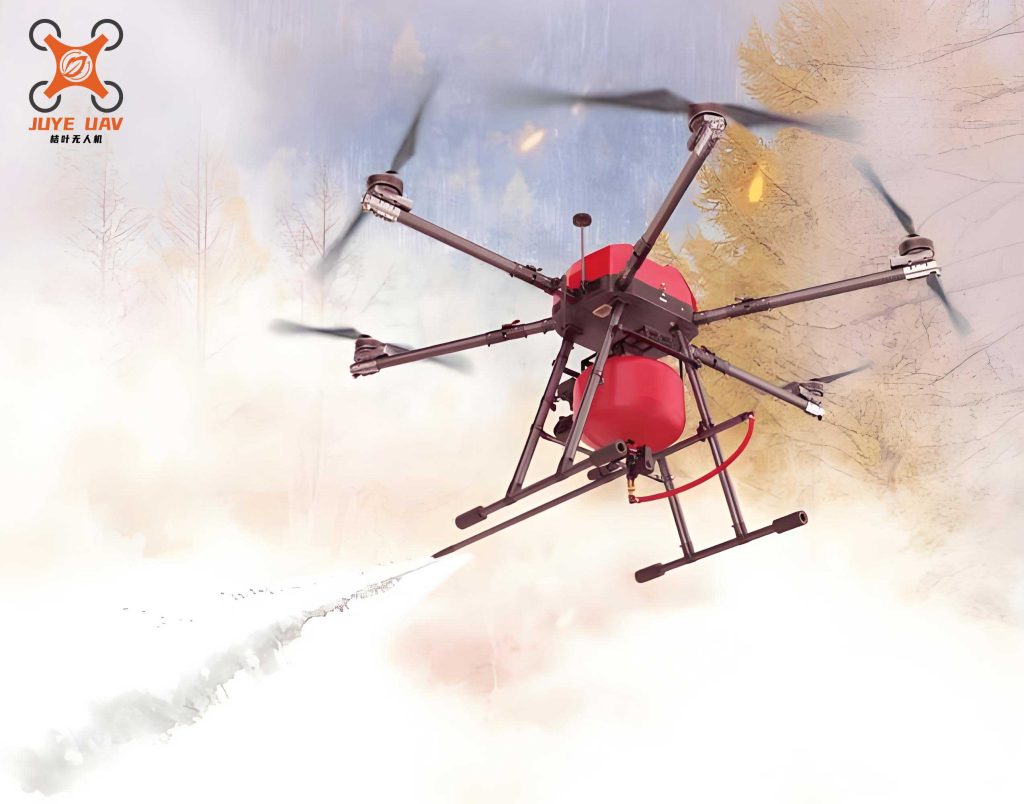
Fire drones, essentially unmanned aircraft, have evolved from military applications to civil uses, especially in disaster response. Their advantages include rapid mobility, low cost, and minimal risk, as they can quickly reach hazardous areas without endangering human lives. A typical fire drone comprises an airframe, flight control system, data link, power supply, and propulsion system. However, single fire drone platforms suffer from limited functionality and high manual operation costs. Inspired by biological clusters—such as fish schools or bird flocks that exhibit collective intelligence through simple interactions—I advocate for fire drone swarms. These swarms “emerge” with enhanced capabilities, overcoming individual limitations through coordinated behavior.
In my design, the fire drone swarm system is divided into sub-groups to simplify individual platforms and boost overall intelligence. The primary sub-groups include reconnaissance fire drones, fire suppression fire drones, and special rescue fire drones. This division allows for specialized roles, reducing complexity and cost while enabling functional emergence. The overall architecture consists of multi-rotor drone platforms, a ground control station, power supply systems, mission payloads, and a cloud-based firefighting system. The ground station acts as the command center, handling task planning, flight monitoring, and payload control. Mission payloads for fire drones include fire-extinguishing bombs, targeting devices, deployment mechanisms, and various sensors. The cloud system facilitates data processing and rule extraction, fostering continuous system evolution toward greater intelligence.
| Aspect | Traditional Methods | Fire Drone Swarm |
|---|---|---|
| Response Time | Limited by physical access | Rapid deployment via air |
| Cost | High for equipment and manpower | Lower operational costs |
| Risk to Personnel | High in dangerous zones | Minimal, as drones operate remotely |
| Automation Level | Low, mostly manual | High, with autonomous协同 mechanisms |
| Scalability | Fixed resources | Flexible swarm size adjustment |
A key innovation in my fire drone swarm system is the autonomous协同 decision-making mechanisms. These enable fire drones to operate intelligently without constant human intervention. First, the self-organizing collision avoidance mechanism uses a repulsive force algorithm, similar to charged particles. Each fire drone continuously monitors its surroundings via a local network. If a collision risk is detected, a repulsive force is applied, calculated as:
$$F_{rep} = k \frac{1}{r^2}$$
where \( F_{rep} \) is the repulsive force, \( k \) is a constant, and \( r \) is the distance between two fire drones. This ensures safe navigation even in dense swarms.
For fire source detection, I employ a cooperative search strategy. Upon receiving a fire alarm with approximate location data, the reconnaissance fire drone sub-group initiates a全覆盖 search. The area is divided into sectors, and each fire drone is assigned a path to cover the entire region efficiently. The required number of fire drones \( n \) is determined by:
$$n = \lceil \frac{A_{total}}{A_{drone}} \rceil$$
where \( A_{total} \) is the total search area and \( A_{drone} \) is the area coverage per fire drone. This strategy ensures rapid and accurate火源 localization, critical for后续 fire suppression.
Once a火源 is detected,协同 positioning is performed using the Angle-of-Arrival (AOA) method. This technique leverages signal direction measurements between fire drones to triangulate the exact火源 position. Consider two reconnaissance fire drones at coordinates \((x_1, y_1)\) and \((x_2, y_2)\), measuring angles \(\theta_1\) and \(\theta_2\) relative to the火源. The火源 coordinates \((x_f, y_f)\) can be derived from:
$$\tan(\theta_1) = \frac{y_f – y_1}{x_f – x_1}, \quad \tan(\theta_2) = \frac{y_f – y_2}{x_f – x_2}$$
Solving these equations yields precise positioning, enhancing targeting accuracy for灭火 fire drones. This协同 approach reduces errors compared to single-fire drone methods.
| Sub-Group | Primary Role | Key Payloads |
|---|---|---|
| Reconnaissance Fire Drones | 火源 detection, imaging, and real-time monitoring | Thermal cameras, sensors, communication modules |
| Fire Suppression Fire Drones | Deploying extinguishing agents | Fire bombs,投掷 devices, targeting systems |
| Special Rescue Fire Drones | Assisting in complex救援 scenarios | Life-saving tools, advanced sensors |
For fire suppression, the协同 bomb-dropping mechanism coordinates灭火 fire drones based on火势 assessment. After reconnaissance, the fire drone sub-group leader decides the number of灭火 fire drones needed. Each is assigned a specific altitude layer to avoid mid-air collisions. The dropping sequence follows a height-based order, from lowest to highest, ensuring systematic coverage. The required extinguishing agent volume \( V_{ext} \) can be estimated using:
$$V_{ext} = \alpha \cdot A_{fire} \cdot I_{fire}$$
where \( \alpha \) is a coefficient, \( A_{fire} \) is the fire area, and \( I_{fire} \) is the fire intensity. This allows the fire drone swarm to allocate resources efficiently, with depleted fire drones automatically returning for reloading.
The operational workflow of the fire drone swarm illustrates its practicality. In a typical urban fire scenario, such as a vehicle fire in a residential area, fire stations—designed to respond within 5 minutes—can deploy the swarm en route. First, 1-3 reconnaissance fire drones are launched and directed to the site. These fire drones transmit real-time imagery and precise定位 data to the ground station. Using infrared analysis, the火势 is evaluated, and the appropriate number of灭火 fire drones is dispatched. Throughout, the fire drones maintain network communication, with reconnaissance units guiding suppression efforts and monitoring extinguishing agent levels. After明火 is extinguished, reconnaissance fire drones remain to assess the area, ensuring complete mitigation before all fire drones return.
| Mechanism | Purpose | Key Formula/Algorithm |
|---|---|---|
| Self-Organizing Collision Avoidance | Prevent mid-air crashes in dense swarms | Repulsive force: \( F_{rep} = k/r^2 \) |
| Cooperative火源 Search | Efficiently locate fires in large areas | Area coverage: \( n = \lceil A_{total}/A_{drone} \rceil \) |
| 协同 Positioning (AOA) | Accurately triangulate fire locations | Trigonometric equations based on angle measurements |
| Cooperative Bomb-Dropping | Systematic fire suppression with altitude layers | Extinguishing volume: \( V_{ext} = \alpha \cdot A_{fire} \cdot I_{fire} \) |
In conclusion, I assert that fire drone swarms represent a transformative advancement in firefighting, offering self-organization, functional emergence, and enhanced autonomy. By integrating these fire drone systems, we can better assess disaster scenes, support decision-making, and improve operational safety. However, fire drone technology is still nascent, requiring further innovation in areas like battery life, payload capacity, and adaptive algorithms. I encourage collaborative efforts between developers and firefighting agencies to refine these fire drone swarms, ensuring they meet real-world demands and deliver maximum benefits. As we continue to explore swarm intelligence, the potential for fire drones to revolutionize emergency response grows exponentially, paving the way for smarter, more resilient cities.
To quantify the efficiency gains, consider a performance metric \( E_{swarm} \) for the fire drone swarm versus single fire drones:
$$E_{swarm} = \frac{T_{single}}{T_{swarm}} \cdot \frac{C_{single}}{C_{swarm}}$$
where \( T_{single} \) and \( T_{swarm} \) are task completion times, and \( C_{single} \) and \( C_{swarm} \) are operational costs. Typically, \( E_{swarm} > 1 \), indicating superior performance of fire drone swarms. This underscores the value of协同 approaches in modern firefighting, where every second counts and resources must be optimized. Through continuous research and deployment, I am confident that fire drone swarms will become a cornerstone of future消防 strategies, saving lives and property with unprecedented efficiency.