
In my experience as a researcher and practitioner in the field of emergency response, I have witnessed the rapid evolution of technology transforming traditional firefighting and rescue methods. The increasing complexity of rescue environments, characterized by urban high-rises, dense forests, and hazardous material incidents, has exposed the limitations of conventional monitoring and救护手段. The advent and refinement of unmanned aerial vehicles, particularly specialized fire drones, have opened new avenues for enhancing消防灭火救援 efficiency and safety. Through extensive study and field applications, I have delved into the fundamental performance metrics of these modern fire drones, revealing their immense potential for widespread adoption in firefighting units. This article aims to articulate the core functionalities, distinctive features, and technical advantages of fire drones, with a focused analysis on their operational implementation, functional expansions, and contributions to战勤安全保障 in消防灭火救援 scenarios. By systematizing and standardizing the use of fire drones, I hope to provide a robust theoretical foundation for消防救援队伍 to integrate these tools effectively, ultimately fostering better推广和应用 of this technology in灭火救援相关工作.
The proliferation of drone technology marks a significant shift in various sectors, and消防灭火救援 is no exception. From my perspective, the integration of fire drones into emergency response protocols is not merely an enhancement but a necessary evolution. As societal infrastructure grows more intricate and消防救援队伍 face expanding operational mandates, the risks during灭火救援行动 have escalated dramatically. Investigating the practical deployment of fire drones in such contexts holds profound implications for saving lives and minimizing property damage. This narrative will explore these aspects in depth, emphasizing the transformative role of fire drones.
Technical Overview of Fire Drones
In my analysis, a fire drone is essentially an unmanned aerial vehicle designed specifically for firefighting and rescue operations. Often referred to as a flying robot, it represents a sophisticated remote-controlled system. Internally, a fire drone incorporates a suite of sensors and a core flight control system, utilizing positioning software to autonomously navigate and stabilize its orientation. During operation, a fire drone typically requires a remote pilot and可能 support personnel for oversight, though advanced models can execute pre-programmed flight paths. This capability ensures real-time video capture and data transmission, which is crucial in emergency settings. Originally prominent in military applications, fire drones have gained民用 traction due to technological advancements and economic growth. The primary components of a typical fire drone include the airframe, flight management system, propulsion unit, data link, and recovery mechanisms. Key operational features involve radio遥控 and automated functions, with notable characteristics being compact size, user-friendly operation, and cost-effectiveness. In火灾现场以及事故救援现场, the fire drone’s ability to provide aerial intelligence has revolutionized situational awareness, offering消防指战员 enhanced safety and efficiency.
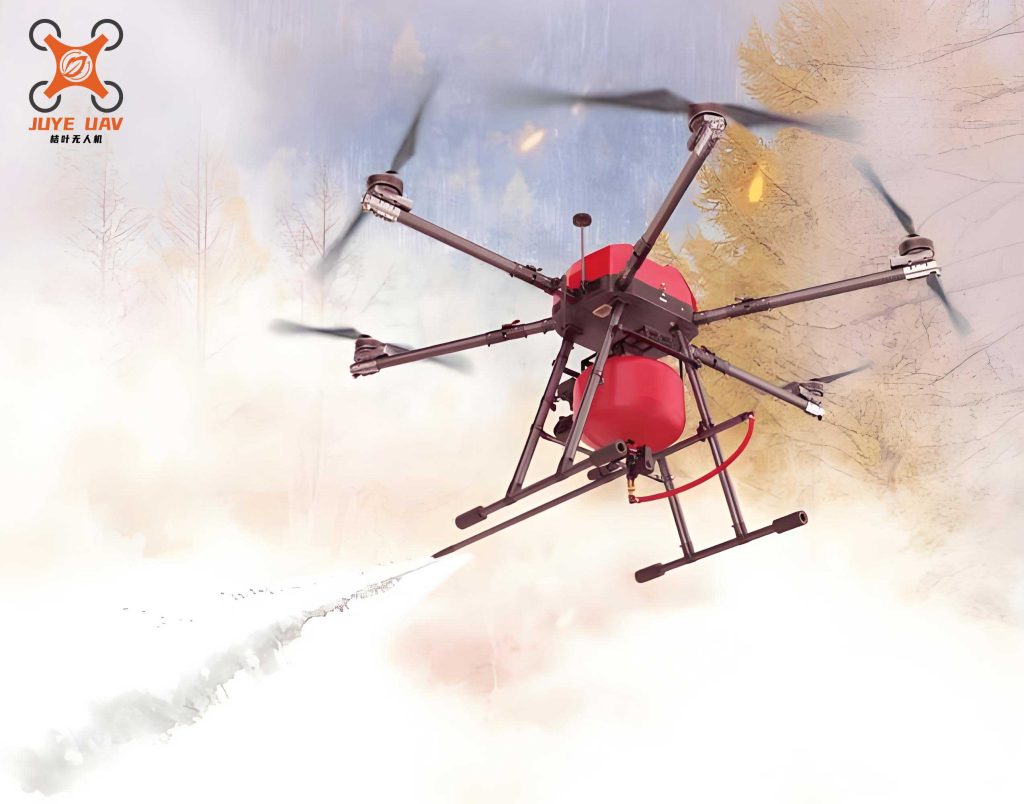
Characteristics and Advantages of Fire Drone Technology
From my firsthand observations, fire drones exhibit several compelling attributes that make them indispensable in消防灭火救援. Below is a table summarizing these key characteristics:
| Characteristic | Description | Impact on Firefighting |
|---|---|---|
| Portability | Compact and lightweight, easy to transport and deploy in confined spaces. | Enables rapid response and机动能力 in diverse terrains. |
| Operational Safety | Remote-controlled operation minimizes human exposure to hazardous environments. | Reduces casualty risks among救援人员, especially in toxic or坍塌 scenarios. |
| Technical Efficacy | Capable of recording 4K video and high-resolution photos; batteries are easily replaceable. | Facilitates quick training and reliable data capture for决策支持. |
| Expanded Field of View | Equipped with广角 cameras and 360° rotating lenses, often with multiple sensors. | Provides comprehensive,无死角侦察, even in low-light conditions with红外 options. |
| Reliability | Operates in extreme conditions (e.g., toxic gases,爆炸 risks,恶劣天气). | Ensures continuous monitoring (24/7) without compromising personnel safety. |
| Operational Intelligence | Integrates AI features like obstacle sensing,智能跟随, and指点飞行. | Enables autonomous navigation in GPS-denied areas, enhancing adaptability. |
Mathematically, the effectiveness of a fire drone in侦察 can be modeled using a coverage area formula. For instance, the area \(A\) surveilled by a fire drone with a camera field of view angle \(\theta\) at altitude \(h\) is approximately:
$$ A = \pi \left( h \cdot \tan\left(\frac{\theta}{2}\right) \right)^2 $$
where \(\theta\) is in radians. This highlights how fire drones can optimize surveillance范围.
In灭火救援行动, the advantages of fire drones are particularly pronounced. First, they significantly enhance火场侦察. By deploying a fire drone, I can obtain real-time高清图像 of the entire incident, allowing for accurate damage assessment. The fire drone transmits data via wireless links to a command center, providing insights into火势发展,烟雾蔓延, and地理坐标. When equipped with infrared thermography, a fire drone can measure surface temperatures through smoke, yielding a thermal distribution map. This aids in formulating dynamic strategies, such as adjusting resource deployment. For example, the heat flux \(Q\) detected by a fire drone’s红外 sensor can be expressed as:
$$ Q = \epsilon \sigma T^4 $$
where \(\epsilon\) is emissivity, \(\sigma\) is the Stefan-Boltzmann constant, and \(T\) is absolute temperature—critical for identifying hotspots.
Second, fire drones boost救援效率. They enable宏观对比 of disaster zones, improving灾情分析能力. From an aerial vantage, a fire drone captures wide-area imagery, facilitating strategic planning and evacuation coordination. This data can also populate预警信息数据库, enhancing future防灾减灾 efforts. Moreover, fire drones allow continuous monitoring of evolving火灾现场, feeding实时信息 to commanders. The information flow rate \(R\) from a fire drone to指挥中心 can be modeled as:
$$ R = B \log_2\left(1 + \frac{S}{N}\right) $$
where \(B\) is bandwidth and \(S/N\) is signal-to-noise ratio, underscoring the need for robust communication in fire drone operations.
Third, fire drones enhance指战员作战安全. By providing preliminary reconnaissance, they help verify现场的真实情况 before personnel entry. During operations, fire drones monitor for二次灾害, enabling精确指挥. Compared to ground robots, fire drones reduce exposure in危险品救援行动, minimizing the need for protective gear. In scenarios like危化品事故, a fire drone’s ability to conduct细致性的掌控 without human entry is invaluable. The risk reduction factor \(F\) can be quantified as:
$$ F = 1 – \frac{P_d}{P_h} $$
where \(P_d\) is the probability of harm with fire drone use, and \(P_h\) is without—ideally, \(F\) approaches 1 for optimal safety.
Fourth, fire drones aid in辅助救援. Their flexibility in carrying payloads allows for diverse applications. Beyond cameras, a fire drone can deploy扩音设备 for communication, drop救生衣 or泡沫弹, and even establish空中索道 for access. With红外设备, they operate in low-visibility environments. After地形数据搜集, a fire drone helps identify optimal救援和逃生通道. The payload capacity \(W\) of a fire drone relates to its lift force \(L\), given by:
$$ L = \frac{1}{2} \rho v^2 S C_L $$
where \(\rho\) is air density, \(v\) is velocity, \(S\) is wing area, and \(C_L\) is lift coefficient—key for designing fire drones to carry救援物资.
Applications of Fire Drone Technology in消防灭火救援行动
In my practice, I have deployed fire drones across various scenarios, each highlighting their versatility. Below is a table outlining primary applications:
| Application Scenario | Fire Drone Role | Key Technologies Involved |
|---|---|---|
| High-Altitude Fire and Rescue | Conducts高空现场侦查 in高层建筑 or山地森林 fires; assists举高消防车 with video feeds. | GPS定位, life detection sensors, thermal imaging. |
| Information Collection and Transmission | Gathers data via附加设备 like风速仪 and气体探测仪; streams live video to command. | Wireless data transmission, multi-angle cameras,编程控制. |
| Command and Dispatch | Supports现场灭火救援的应急指挥部 with real-time terrain assessment and战术监督. | Real-time video analytics, communication relays. |
| Direct Fire Suppression | Carries灭火剂 (e.g., foam, dry粉) for初期火灾扑救 in inaccessible areas like超高层建筑. | Precision payload delivery, stabilisation systems. |
| Special Environment Rescue | Delivers救援物资 in山沟,水域, or孤岛 settings; uses红外热成像 for夜间搜救. | Payload deployment mechanisms, infrared cameras,基站功能. |
For instance, in高空侦查, a fire drone’s ability to hover and capture细节 is governed by its悬停时间 \(T_h\), which depends on battery energy \(E_b\) and power consumption \(P_c\):
$$ T_h = \frac{E_b}{P_c} $$
Optimizing this is crucial for prolonged missions. In直接灭火应用, the灭火剂 dispersion from a fire drone can be modeled using fluid dynamics. The coverage area \(A_m\) for a fire drone releasing foam at rate \(Q_f\) over time \(t\) is:
$$ A_m = k \cdot Q_f \cdot t $$
where \(k\) is a dispersion constant—vital for calculating effectiveness.
Challenges and Improvement Measures for Fire Drones in消防灭火救援工作
Despite their promise, fire drones face several hurdles in实战 applications. Based on my evaluations, I have identified key issues and propose solutions, summarized in the table below:
| Challenge | Description | Proposed Improvement Measures |
|---|---|---|
| Insufficient Heat and Fire Resistance | Fire drones are vulnerable to热对流,热辐射,烟尘, and water in火灾现场, limiting operational proximity. | Maintain safe distances; enhance camera像素 with变焦 lenses; upgrade阻燃材料 and防火隔热剂 coatings to extend operational duration \(T_o\). |
| Lack of Rainproofing in Small Drones | Small fire drones require散热, preventing密封 for防水; larger models sacrifice机动性 for weatherproofing. | Select drone types based on现场情况; collaborate with manufacturers to develop advanced密封材料 balancing散热与防水. The effectiveness \(E_r\) can be expressed as \(E_r = \alpha \cdot R + \beta \cdot D\), where \(R\) is rain resistance and \(D\) is散热 capability. |
| Signal Interference from Buildings and Other Sources | Obstacles and干扰设备 reduce fire drone connectivity, often limiting range to ~100 meters in urban or山林 areas. | Deploy signal增强器 or utilize移动基站 for辅助连接; optimize transmission protocols to maintain视频实时传输. The signal strength \(S_s\) can be boosted using: $$ S_s = S_0 \cdot e^{-\gamma d} + G $$ where \(S_0\) is initial strength, \(\gamma\) is attenuation, \(d\) is distance, and \(G\) is gain from boosters. |
| Need for Modular Design | Fire drones often lack标准化 interfaces for easy integration of various devices across industries. | Implement模块化设计 with standardized接口结构,尺寸, and参数 to ensure互换性 and通用性, allowing flexible attachment of不同型号设备. |
| Limited Endurance and Power Supply | Heavy payloads (e.g.,救援用品) increase耗电量, shortening续航能力 during prolonged missions. | Adopt新型电池 (e.g., lithium-sulfur),混合动力 systems, and无线充电技术 to enhance续航时间 \(T_e\). The energy equation is: $$ T_e = \frac{C_b + E_a}{P_t} $$ where \(C_b\) is battery capacity, \(E_a\) is auxiliary energy, and \(P_t\) is total power draw. |
| Requirement for Strong Lighting | Fire drones need照明设备 for悬停 in弱光 or夜间条件 to aid both拍摄 and救援人员照明. | Integrate高流明 LED lights with adjustable intensity; ensure power efficiency to avoid draining batteries. The illumination intensity \(I\) at distance \(r\) is: $$ I = \frac{P_l}{4\pi r^2} $$ where \(P_l\) is light power. |
| Insufficient Compatibility | Fire drones may not seamlessly connect with多种不用型号的设备, hindering集成 and处理能力. | Develop兼容技术 to enhance设备兼容性; optimize software interfaces for minimal辅助系统干扰, improving overall系统集成 accuracy. Compatibility score \(C_s\) can be modeled as: $$ C_s = \sum_{i=1}^n w_i \cdot I_i $$ where \(w_i\) are weights and \(I_i\) are interface metrics. |
| Demands on Payload Capacity | Future applications require fire drones to carry heavier灭火剂 and救援器材 for direct intervention. | Increase载物能力 through structural redesign and advanced materials; optimize lift-to-weight ratios. The maximum payload \(W_{max}\) relates to thrust \(T\) and weight \(W_d\): $$ W_{max} = T – W_d $$ aiming to maximize \(W_{max}\) for broader utility. |
From my perspective, addressing these challenges requires iterative innovation. For example, improving抗高温耐火性 involves material science advancements. The thermal resistance \(R_t\) of a fire drone coating can be expressed as:
$$ R_t = \frac{\delta}{\lambda} $$
where \(\delta\) is thickness and \(\lambda\) is thermal conductivity—reducing \(\lambda\) enhances performance. Similarly, for持续供电续航技术, energy density \(\rho_e\) of batteries is critical:
$$ \rho_e = \frac{E}{m} $$
where \(E\) is energy and \(m\) is mass; higher \(\rho_e\) permits longer flights.
Conclusion
In my assessment, the integration of fire drones into消防救援队伍 represents a paradigm shift in emergency response. Currently,通信设备配备 is advancing, and fire drones have demonstrated tangible benefits in diverse灭火救援现场. They empower救援人员 with accurate, timely situational awareness, aiding指挥部 in making科学合理的决策. This capability is not only a pressing need for improving应急处置能力 but also an inevitable trend towards快速侦察 in消防灭火救援. While existing fire drone technologies exhibit某些缺陷, such as heat sensitivity and signal limitations, I am confident that through sustained research and development—focusing on优化改进创新—these hurdles can be overcome. The future promises fire drones with enhanced实战需求 adaptability, leveraging AI, better materials, and robust designs. As we continue to refine these systems, the fire drone will undoubtedly become a cornerstone of modern firefighting, saving more lives and protecting communities with greater efficiency. The journey ahead involves collaborative efforts among technologists, firefighters, and policymakers to fully realize the potential of fire drones in safeguarding our world.