
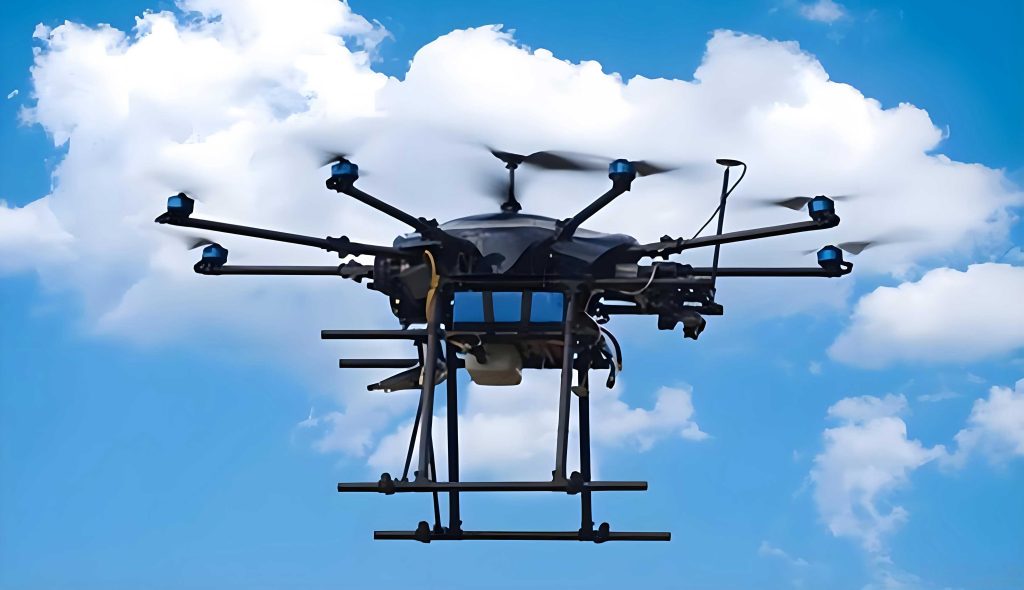
Unmanned aerial vehicles (UAVs), commonly known as drones, have been extensively deployed in military reconnaissance, emergency communication, environmental monitoring, agriculture, logistics, and disaster response. Despite their versatility, the inherent characteristics of UAV networks—high mobility, dynamic topology, and limited energy—pose severe challenges to cybersecurity. Traditional centralized intrusion detection systems (IDS) are ill-suited for flying ad-hoc networks (FANETs) because they require uplinking all traffic data to a central server, causing privacy leakage, high communication overhead, and single-point failures. Federated learning (FL) emerges as a privacy-preserving distributed learning paradigm that enables multiple UAVs to collaboratively train a shared model without exchanging raw data. However, in high-speed UAV communication, the Doppler effect caused by fast movement destroys subcarrier orthogonality in orthogonal frequency division multiplexing (OFDM) systems, leading to severe inter-carrier interference (ICI). As a result, model parameters transmitted over unreliable wireless channels may be corrupted or lost, degrading the convergence and accuracy of FL. Moreover, the data collected by different UAVs are typically non-independent and identically distributed (non-IID), and in multi-task emergency scenarios, communication resources become even scarcer. This paper addresses these challenges by proposing communication-aware FL frameworks for intrusion detection in high-speed UAV networks. We first analyze the impact of Doppler shift on MIMO-OFDM-based UAV communications and derive closed-form expressions for signal-to-interference-plus-noise ratio (SINR) and packet loss rate. Then, we propose a personalized FL scheme to mitigate non-IID data effects, followed by a joint optimization algorithm, PVBO, that jointly optimizes transmit power, UAV velocity, and resource block allocation. For multi-task scenarios, we extend the framework to a two-layer multi-task personalized FL architecture and develop the TLO algorithm for speed–communication–FL co-optimization. Extensive simulations on CICIDS2017, FMNIST, and FLAME datasets demonstrate that our methods markedly improve intrusion detection accuracy and convergence speed compared with baselines.
The rest of this paper is organized as follows. Section 2 introduces the system model, including the MIMO-OFDM communication model and the Doppler effect. Section 3 presents the personalized FL-based intrusion detection framework and the PVBO joint optimization algorithm. Section 4 describes the two-layer multi-task FL framework and the TLO algorithm. Section 5 concludes the paper.
1. Communication Model for High-Speed UAV Networks
We consider a ground base station (BS) communicating with multiple UAVs via MIMO-OFDM links. The BS is equipped with \(N_t\) transmit antennas, and each UAV is equipped with \(N_r\) receive antennas. OFDM divides the total bandwidth into \(N\) orthogonal subcarriers. In high-mobility environments, the relative motion between a UAV and the BS induces a Doppler frequency shift \(f_d\), which can be expressed as
\[
f_d = \frac{V_s}{\lambda_c} = \frac{V_s f_c}{c}
\]
where \(V_s\) is the UAV speed, \(\lambda_c\) is the carrier wavelength, \(f_c\) is the carrier frequency, and \(c\) is the speed of light. The Doppler shift destroys the orthogonality among subcarriers, causing ICI. In an OFDM system, the received signal on the \(k\)-th subcarrier after beamforming can be written as
\[
Y(k)=\mathbf{Z}_R^H(k)\mathbf{H}(k)\mathbf{Z}_s^H(k)\sqrt{P_i}X(k)+I(k)+n(k)
\]
where \(X(k)\) is the transmitted symbol, \(\mathbf{H}(k)\) is the channel frequency response matrix, \(\mathbf{Z}_s(k)\) and \(\mathbf{Z}_R(k)\) are the transmitter and receiver beamforming matrices, \(P_i\) is the transmit power, \(I(k)\) denotes the ICI term, and \(n(k)\) is additive white Gaussian noise with variance \(N_0\). The channel matrix for the \(p\)-th path is
\[
[\mathbf{H}_p(k)]_{i,j}=\frac{1}{N}\sum_{n=0}^{N-1} h_{i,j}(p,n) e^{-j\frac{2\pi kn}{N}}
\]
where \(h_{i,j}(p,n)\) is the time-domain channel gain. The time correlation of the channel is characterized by
\[
\rho_m = \mathbb{E}[h_{i,j}(p,n)h_{i,j}^*(p,n+m)] = \sigma_p^2 J_0(2\pi m f_d T_s)
\]
where \(J_0(\cdot)\) is the zero-order Bessel function of the first kind, \(T_s\) is the symbol period, and \(\sigma_p^2\) is the power of the \(p\)-th path. The ICI variance can be derived as
\[
\mathbb{E}[|I_i(0)|^2] = N_T E_0 \sum_{p=0}^{L-1}\sum_{l=1}^{N-1} \frac{\|\mathbf{Z}_R^H\|^2 \sigma_p^2}{N^2} \|\mathbf{Z}_s^H\|^2 \left\{ N + 2\sum_{m=1}^{N-1}(N-m) J_0(2\pi m f_d T_s)\cos\left(\frac{2\pi lm}{N}\right)\right\}
\]
In a Rician fading channel, the channel matrix is composed of a deterministic line-of-sight (LoS) component and a random scattered component:
\[
\mathbf{H}(k) = \sqrt{\frac{K}{K+1}}\mathbf{H}_u(k) + \sqrt{\frac{1}{K+1}}\mathbf{H}_f(k)
\]
where \(K\) is the Rician factor, \(\mathbf{H}_u(k)\) is the LoS component, and \(\mathbf{H}_f(k)\) is the zero-mean unit-variance Gaussian scattering component. Considering channel estimation errors, the actual scattering component is \(\mathbf{H}_f(k)=\hat{\mathbf{H}}_f(k)+e\boldsymbol{\Omega}\), where \(\boldsymbol{\Omega}\) is a standard Gaussian matrix and \(e\) measures the estimation error. After singular value decomposition and detection, the SINR on subcarrier \(k\) for user \(i\) can be expressed as
\[
\gamma_i(k) = \frac{E_0 \lambda_i}{\frac{e^2 P_i N_T E_0}{K+1} + N_T E_0 \beta + N_0}
\]
where \(E_0\) is the average transmit symbol energy, \(\lambda_i\) is the \(i\)-th eigenvalue of the channel, and \(\beta\) is the ICI coefficient. For brevity, the average SINR over all subcarriers is
\[
\gamma = \left(\frac{1}{N_R}\sum_{j=1}^{N_R}\lambda_j\right) \frac{E_0}{\frac{e^2 P_i N_T E_0}{K+1} + N_T E_0 \beta + N_0}
\]
In a Rician fading channel, the probability density function (PDF) of the SINR is
\[
p(\gamma) = \frac{K+1}{\bar{\gamma}} \exp\left(-K – \frac{(K+1)\gamma}{\bar{\gamma}}\right) I_0\left(2\sqrt{\frac{K(K+1)\gamma}{\bar{\gamma}}}\right)
\]
where \(\bar{\gamma}\) is the average SINR. The average packet loss rate (PLR) is obtained by integrating the bit error rate (BER) function \(f(\gamma)\) over this PDF:
\[
P_{ave}(\gamma) = \int_0^\infty f(\gamma) p(\gamma) d\gamma
\]
A tractable approximation is given by
\[
P_{ave}(\gamma) \approx \frac{w_0}{\gamma(K+1)}
\]
where \(w_0 = \int_0^\infty f(\gamma)d\gamma\) is a constant determined by the modulation scheme. Thus, the PLR for UAV \(i\) is \(q_i = P_{ave}(\gamma_i)\). The BS uses cyclic redundancy check to verify the received local model; if an error is detected, the packet is discarded without retransmission, and the corresponding local model is excluded from global aggregation.
Each UAV consumes energy for local training, transmission, and flight. The total energy consumption per UAV is modeled as
\[
e_i(r_i,P_i)=\varsigma w_i f^2 Z(w_i) + P_i l_i^U(r_i,P_i) + \frac{1}{2} C_D \rho A v^3
\]
where \(\varsigma\) is the effective switched capacitance, \(w_i\) is the number of CPU cycles per bit, \(f\) is the CPU frequency, \(Z(w_i)\) is the training workload, \(P_i\) is the transmit power, \(l_i^U\) is the uplink transmission time, \(C_D\) is the drag coefficient, \(\rho\) is air density, \(A\) is the frontal area, and \(v\) is the UAV speed.
2. Personalized Federated Learning for Intrusion Detection
We adopt personalized FL to address the non-IID data distribution across UAVs. Each UAV \(i\) maintains three models: a local copy of the global model \(w_i^{(t)}\), its own local model \(v_i^{(t)}\), and a personalized mixed model \(\tilde{v}_i^{(t)}\). The local update equations are
\[
w_i^{(t)} = w_i^{(t-1)} – \eta_t \nabla f_i(w_i^{(t-1)};\xi_i^t)
\]
\[
v_i^{(t)} = v_i^{(t-1)} – \eta_t \nabla f_i(v_i^{(t-1)};\xi_i^t)
\]
\[
\tilde{v}_i^{(t)} = \alpha_i v_i^{(t)} + (1-\alpha_i)w_i^{(t)}
\]
where \(\alpha_i\) is a personalized coefficient balancing local and global knowledge. After \(\tau\) local updates, selected UAVs upload their local global models to the BS, which performs the global aggregation:
\[
w^{(t+1)} = \frac{1}{|U_t|}\sum_{j=1}^{U_t} w_j^{(t)}
\]
However, due to packet loss, only correctly received models are aggregated. The effective global model becomes
\[
w(P,V,B) = \frac{\sum_{i=1}^U K_i \xi_i b_i S(w_i) w_i}{\sum_{i=1}^U K_i \xi_i b_i S(w_i)}
\]
where \(b_i\in\{0,1\}\) indicates whether UAV \(i\) is selected, and \(S(w_i)\in\{0,1\}\) is the indicator of successful transmission. The divergence between the ideal and actually received global updates can be characterized by
\[
\varsigma = \nabla F(w^t) – \frac{\sum_{i=1}^U b_i \sum_{k_j} \nabla f(w;\xi_i^{k_j}) S(w_i)}{\sum_{i=1}^U K_i \xi_i S(w_i)b_i}
\]
To understand the effect of PLR on convergence, we derive the expected convergence rate under non-convex conditions. We make the following standard assumptions:
- Assumption 1 (Lipschitz continuous gradient): \(\|\nabla f_i(w^{(t+1)})-\nabla f_i(w^{(t)})\|\le L\|w^{(t+1)}-w^{(t)}\|\).
- Assumption 2 (Second-order Taylor expansion applies).
- Assumption 3 (Bounded gradient): \(\|\nabla F(w^t)\|^2 \le G^2\).
Using these assumptions, we can bound the expected loss difference between iteration \(t+1\) and the global optimum \(w^*\):
\[
\mathbb{E}(F(w^{t+1})-F(w^*)) \le A^t \mathbb{E}(F(w^0)-F(w^*)) + \zeta_1 \left[\frac{G^2\eta^2+2K\eta-2KG^2\eta^2}{2KG^2\eta^2}\right] \frac{1}{1+\frac{2}{G^2\eta^2}\sum_{i=1}^U k_i\xi_i(1-b_i+b_iq_i) – \left(\frac{1}{2K}+1-\frac{1}{G^2\eta}\right)\zeta_2}
\]
where
\[
A = \left(\frac{G^2\eta^2L}{K}-2\eta L+2LG^2\eta^2\right)\zeta_2\sum_{i=1}^U k_i\xi_i(1-b_i+b_iq_i)-G^2\eta^2L
\]
This bound reveals that a larger PLR \(q_i\) increases the divergence gap and slows convergence. Therefore, minimizing the PLR is crucial for improving FL performance.
3. PVBO: Joint Power, Velocity, and Resource Block Optimization
We formulate a joint optimization problem to minimize the FL loss function under channel and energy constraints. The problem is stated as:
\[
\min_{P,V,B} \sum_{i=1}^U k_i\xi_i \left(1-\sum_{m=1}^M b_i^m(1-q_i)\right)
\]
subject to
\[
v_{\min}\le v\le v_{\max}, \quad e_i(q_i,P^*,v^*)\le \xi_E, \quad T\le T_{\max}, \quad \sum_{k=1}^N \|\mathbf{Z}_s(k)\|^2 \le P_{\max}, \quad b_i^m\in\{0,1\}
\]
Since this is a mixed-integer nonlinear program, we decompose it into three subproblems and solve iteratively. The resulting PVBO algorithm is summarized as follows:
Algorithm 1: PVBO (Power, Velocity and Resource block Joint Optimization)
1. Initialize \(P=\text{random}(P_{\min},P_{\max})\), \(V=\frac{v_{\min}+v_{\max}}{2}\), \(B=\text{random}(M,U)\).
2. For \(t=0\) to \(T\):
3. BS receives \(w_i^{(t)}\) from UAV \(i\) over fading channels.
4. Aggregate: \(w^{(t+1)}=\frac{1}{|U_t|}\sum_{i=1}^{U_t}w_i^{(t)}\).
5. Solve the resource block allocation: \(B^*=\arg\min_B \sum_{i=1}^U \sum_{m=1}^M cost_{i,m}b_i^m\).
6. Broadcast updated \(w^{(t+1)}\) to selected UAVs.
7. Each UAV computes optimal transmit power: \(P_i^*=\min\{P_i,\xi_E,P_{\max}\}\).
8. Each UAV computes optimal velocity: \(v^*=\arg\min_v J(v)\), where \(J(v)=\alpha(E_{train}+E_{trans}+\frac{1}{2}C_D\rho A v^3)+\beta q_i+\gamma T\).
9. Update local models using equations above.
10. End for.
11. Return \(B^*,P^*,V^*\).
The transmit power is obtained by minimizing the uplink energy consumption. Since the energy function is monotonically increasing with respect to \(P_i\), the optimal power is simply the minimum of the available power budget and the maximum allowed power:
\[
P_i^* = \min\left\{P_i,\xi_E,\frac{N_T E_0}{\sum_{i=1}^{N_T}\|\mathbf{Z}_s^{(i)}\|^2}\right\}
\]
The velocity optimization minimizes a weighted sum of energy consumption, PLR, and task completion time. A gradient descent approach is used with the constraint \(v\le v_{\max}\).
4. Simulation Results
We evaluated the proposed PVBO algorithm using the CICIDS2017 intrusion detection dataset. The dataset contains approximately 3 million network traffic samples, including seven attack types. We partitioned the data into training and test sets using stratified sampling with a 7:3 ratio. The simulation parameters are summarized in Table 1.
Table 1: Simulation Parameters
| Parameter | Value |
|---|---|
| Number of UAVs \(U\) | 10 |
| Number of resource blocks \(RB\) | 5 |
| UAV speed range \(v\) | 19–50 m/s |
| Transmit power \(P\) | 0–10 W |
| Learning rate \(\eta\) | 0.01 |
| Carrier frequency \(f_c\) | 2–5.8 GHz |
| Number of subcarriers \(N\) | 128 |
| Rician factor \(K\) | 6 dB |
| Antennas \(N_t, N_r\) | 4, 4 |
We compared PVBO with a random allocation strategy (Random) and an ideal baseline without communication errors. Figure 1 (would be inserted) shows the intrusion detection accuracy versus training rounds. The baseline achieves 94.24% accuracy, whereas Random drops to 83.09% due to packet loss. With PVBO, the accuracy recovers to 90.91%, which is close to the ideal. The average accuracy over the last 150 rounds is 92.09% for Baseline, 85.26% for Random, and 89.79% for PVBO. These results confirm that PVBO effectively mitigates the adverse impact of Doppler-induced packet loss.
We also analyzed the convergence speed in terms of the number of iterations required to reach the target loss. Table 2 shows the convergence iterations for different numbers of UAVs with 4 resource blocks and a mini-batch size of 16.
Table 2: Convergence Iterations vs. Number of UAVs
| Number of UAVs | Random | PVBO |
|---|---|---|
| 10 | 520 | 410 |
| 15 | 625 | 470 |
| 20 | 710 | 510 |
| 25 | 790 | 545 |
| 30 | 860 | 575 |
The results demonstrate that PVBO reduces the convergence iterations by approximately 20.15%–46.50% compared with the random strategy, and the advantage becomes more prominent as the number of UAVs increases.
Figure 2 (not shown) would depict the number of successfully received packets per UAV at a given round. PVBO consistently yields a higher number of received packets than Random, and the variance is smaller, indicating improved reliability and stability.
We further studied the effect of mini-batch size on convergence. As shown in Table 3, when the mini-batch size increases, the number of iterations to convergence decreases. In all cases, PVBO converges faster than Random.
Table 3: Mini-batch Size and Convergence Iterations
| Mini-batch size | 10 | 20 | 30 | 40 | 50 |
|---|---|---|---|---|---|
| Random | 980 | 720 | 560 | 450 | 380 |
| PVBO | 710 | 530 | 420 | 340 | 300 |
Finally, we examined the robustness to data heterogeneity by varying a parameter that controls the degree of non-IID distribution. Under strong non-IID (parameter = 0.01), PVBO still achieves higher accuracy and faster convergence than Random, confirming its effectiveness in heterogeneous environments.
5. Multi-Task Federated Learning for High-Speed UAV Networks
In post-disaster emergency scenarios, a swarm of UAVs must simultaneously perform heterogeneous tasks, such as emergency assessment (e.g., fire detection, object recognition) and security tasks (e.g., intrusion detection). To handle this, we propose a two-layer multi-task personalized FL framework. The first layer deals with strongly heterogeneous tasks (emergency vs. security) by dynamically adjusting a weight coefficient \(\beta_i\). The second layer handles multiple sub-tasks within the emergency task that share similar feature representations. The overall objective is
\[
\min_{w_i^{Emer},w_i^{Sec}} \sum_{i=1}^U \frac{D_i}{D}\left[\beta_i f_i^{Sec}(w_i^{Sec}) + (1-\beta_i)f_i^{Emer}(w_i^{Emer})\right]
\]
where \(f_i^{Emer}(w_i^{Emer}) = \frac{1}{M}\sum_{m=1}^M f_m(w_t^{s,Emer}, w_{m,t}^{u,Emer})\).
The emergency branch consists of a shared feature extractor \(w^{s,Emer}\) and task-specific heads \(\{w_m^{u,Emer}\}_{m=1}^M\). Each UAV \(n\) updates the shared feature extractor and its assigned task head using:
\[
w_{m,n,t}^{s,Emer} = w_{m,n,t-1}^{s,Emer} – \eta_t \nabla F_s(w_{m,n,t-1}^{s,Emer}; w_{m,n,t-1}^{u,Emer})
\]
\[
w_{m,n,t}^{u,Emer} = w_{m,n,t-1}^{u,Emer} – \eta_t \nabla F_u(w_{m,n,t-1}^{s,Emer}; w_{m,n,t-1}^{u,Emer})
\]
After local training, each UAV uploads the gradients. The BS aggregates the task-specific heads separately and the shared feature extractors are aggregated across tasks using a similarity-aware mechanism. The task affinity between tasks \(i\) and \(j\) at round \(t\) is
\[
\Phi_{i\to j}^{t}=1-\frac{L_j(w_{j,t}^{s,Emer},G_{j,t}^{Emer},G_{i,t}^{Emer})}{L_j(w_{j,t}^{s,Emer},G_{j,t}^{Emer})}
\]
where \(L_j\) is the loss on the test set of task \(j\). If the affinity exceeds a threshold, the two tasks share their feature extractors in the next aggregation round, reducing the communication overhead.
To balance emergency and security tasks, we introduce a dynamic weight coefficient updated as
\[
\beta_i(t) = \text{clip}\left(\beta_i(t-1) + \eta_1\frac{\Delta f_i^{Sec}(t)}{f_i^{Sec}(t-1)} + \eta_2 q_i, \beta_{\min}, \beta_{\max}\right)
\]
This mechanism ensures that the security task receives higher priority when communication quality degrades or when the security loss increases.
6. TLO: Three-Layer Joint Optimization Algorithm
Because the multi-task FL framework uploads more parameters, the communication burden becomes heavier. We develop the TLO algorithm to jointly optimize UAV velocity, communication resource allocation, and task scheduling. The algorithm operates in three layers:
- Task-similarity merging: Compute the affinity between each pair of emergency sub-tasks; if \(\Phi_{i\to j}^{t}>\delta_\Phi\), merge them into a cluster for upload sharing.
- Speed optimization: Solve \(\min_v F(v)=\alpha_1\sum_{i=1}^N D_i b_i(1-r_i+r_iq_i)+\alpha_2 q_i+\alpha_3 T(v)\) using gradient descent, where \(T(v)=d/v+t_i^{tr}+s/R(v)\cdot(1-q_i)\).
- Resource allocation: Given the estimated spectral efficiency \(\rho_k\), allocate bandwidth \(b_k\) and time slots \(\tau_k\) to each cluster to maximize the number of successfully aggregated tasks, subject to total bandwidth and time constraints. The optimization is
\[
\max_{v^*,R,b} \sum_{k=1}^{K_t} y_k Q_k^t
\]
\[
\text{s.t.} \sum_k b_k \le B_{\max}, \quad \sum_k \tau_k \le T_{up}
\]
where \(Q_k^t\) is the training progress weight for cluster \(k\), based on recent performance improvement. The greedy algorithm proceeds by computing the resource area \(a_k = s_k/\rho_k\) and selecting tasks in descending order of benefit density \(\pi_k = Q_k^t/a_k\) until the budget is exhausted.
7. Experimental Results for Multi-Task FL
We conducted experiments on three datasets: CICIDS2017 for intrusion detection, FMNIST for emergency tasks (number color recognition, rotation angle recognition, and clothing classification), and FLAME for fire detection. We considered two scenarios: (1) two emergency tasks plus intrusion detection, and (2) three emergency tasks plus intrusion detection. The compared algorithms are Baseline (ideal communication), TLO, PFL (personalized FL separately for each task), MTFL (multi-task FL), and FedAvg.
Table 4: Intrusion Detection Accuracy in Multi-Task Scenarios
| Algorithm | 2 tasks + IDS | 3 tasks + IDS |
|---|---|---|
| Baseline | 94.03% | 94.03% |
| TLO | 92.26% | 91.89% |
| PFL | 88.71% | 87.01% |
| MTFL | 86.43% | 80.15% |
| FedAvg | 76.81% | 75.28% |
TLO achieves an intrusion detection accuracy of 92.26% and 91.89% in the two scenarios, outperforming PFL by about 3.5% and MTFL by about 11.7% in the three-task case. The results confirm that the proposed joint optimization effectively mitigates the negative impact of Doppler-related packet loss.
We also measured the number of iterations required for convergence as the number of UAVs increased from 10 to 30. Table 5 lists the convergence iterations for each algorithm with 5 resource blocks.
Table 5: Convergence Iterations under Varying UAV Counts
| UAV count | TLO | PFL | MTFL | FedAvg |
|---|---|---|---|---|
| 10 | 350 | 390 | 420 | 470 |
| 15 | 380 | 430 | 440 | 580 |
| 20 | 405 | 460 | 435 | 570 |
| 25 | 430 | 510 | 440 | 590 |
| 30 | 450 | 520 | 445 | 600 |
TLO consistently requires the fewest iterations, and its growth with UAV count is the slowest, indicating superior scalability and robustness.
For the FMNIST tasks, the accuracies of all methods under the three-task scenario are summarized in Table 6.
Table 6: Accuracy on FMNIST Three-Task Scenario
| Task | Color Recognition | Rotation Angel | Digit Recognition | Intrusion Detection |
|---|---|---|---|---|
| Baseline | 92.6% | 93.4% | 95.5% | 94.3% |
| TLO | 89.4% | 90.2% | 91.2% | 90.3% |
| MTFL | 83.4% | 82.3% | 84.6% | 80.1% |
| FedAvg | 77.5% | 78.6% | 79.3% | 75.2% |
TLO improves intrusion detection accuracy by 15.1% over FedAvg and by 10.2% over MTFL. The improvement is significant especially when the number of tasks increases, validating the effectiveness of task-similarity merging and dynamic resource allocation.
We also evaluated the robustness to data heterogeneity by generating non-IID distributions using a Dirichlet distribution. Across all heterogeneity levels, TLO consistently outperforms PFL, MTFL, and FedAvg in terms of accuracy and stability. In high-heterogeneity settings, the accuracy of FedAvg degrades significantly and exhibits high variance, while TLO maintains smoother convergence and higher final accuracy, demonstrating its strong resistance to non-IID data.
Finally, we tested the FLAME fire detection dataset combined with CICIDS2017 to emulate a real post-disaster scenario. The results show that TLO effectively balances the fire detection task and the intrusion detection task, achieving high accuracy on both without significant negative transfer. The dynamic weight coefficient adjusts the resource allocation according to the current communication quality, ensuring timely and secure task completion.
Conclusion
In this paper, we investigated the problem of intrusion detection in high-speed unmanned aerial vehicle (UAV) networks using federated learning. We first established a MIMO-OFDM communication model with Doppler shift and derived the packet loss rate. We then proposed a personalized FL framework to handle non-IID data and derived the expected convergence bound under non-convex conditions. Based on this analysis, we designed the PVBO algorithm to jointly optimize transmit power, UAV velocity, and resource block allocation, effectively improving intrusion detection accuracy and convergence speed. For multi-task emergency scenarios, we extended the framework to a two-layer multi-task personalized FL architecture and developed the TLO algorithm that jointly optimizes UAV speed, communication, and learning. Experimental results on CICIDS2017, FMNIST, and FLAME datasets demonstrated that the proposed methods significantly outperform existing baselines, achieving high intrusion detection accuracy while maintaining robust performance under severe communication impairments and data heterogeneity. These contributions provide a solid foundation for secure and efficient collaborative learning in future high-speed UAV networks.