
In modern agriculture, the management of pests and diseases in high-value fruit crops, such as plum trees, poses significant challenges due to labor intensity, safety concerns, and inefficiencies in traditional application methods. As a researcher focused on innovative agricultural technologies, I have explored the potential of agricultural UAVs (unmanned aerial vehicles) to address these issues. This article presents a comprehensive feasibility analysis based on a comparative study between agricultural UAV application and conventional manual spraying for pest and disease control in plum orchards. The goal is to evaluate whether agricultural UAVs can offer a viable alternative by improving efficiency, safety, and efficacy while minimizing environmental and health risks.
The traditional approach to spraying in tall fruit trees, like plum trees reaching 4–5 meters in height, often involves backpack or stretcher-type sprayers. These methods are not only labor-intensive but also hazardous, as operators are exposed to pesticide drift, leading to potential eye, nose, and mouth irritation. Moreover, the uneven distribution of spray droplets, especially at the tree canopy, can reduce control efficacy. In contrast, agricultural UAVs have gained traction in various crops, including wheat, corn, and rice, for their precision, speed, and reduced human exposure. However, their application in high-value fruit orchards, such as plum trees, remains underexplored due to high trial costs and limited research. In this study, we aimed to bridge this gap by assessing the spray droplet deposition, control effectiveness, safety, and pesticide residue dynamics when using an agricultural UAV compared to manual spraying.
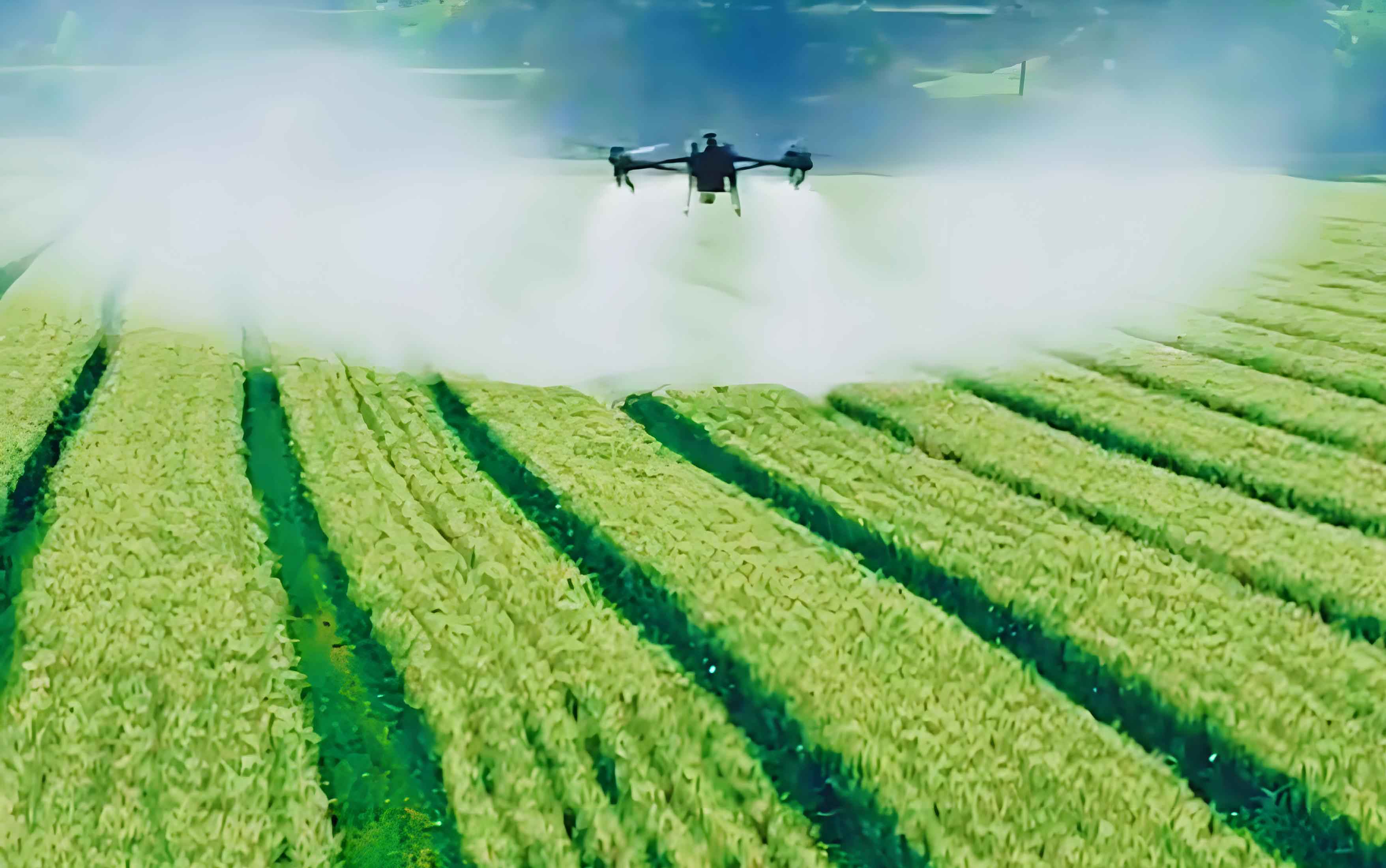
Our investigation was conducted in a plum orchard with trees approximately 20 years old, focusing on the fruit expansion stage—a critical period for pest and disease management to prevent premature fruit drop. We employed a T16 agricultural UAV for the treatment area, while a conventional stretcher sprayer was used for the manual control. The pesticides applied included common formulations: 20% emamectin benzoate–chlorantraniliprole suspension, 50% thiophanate-methyl suspension, and 1.8% abamectin emulsion, following local recommended rates. To quantify spray performance, we used water-sensitive papers placed near fruits at the tree canopy to capture droplet characteristics, including droplet size, coverage, number, and volume. Additionally, we monitored fruit drop as an indicator of pest and disease damage and analyzed pesticide residues in harvested fruits to assess safety and metabolic patterns.
The core of our analysis revolves around droplet deposition, which is crucial for effective pesticide delivery. We measured key parameters using image analysis of water-sensitive papers, and the data were summarized in Table 1. The agricultural UAV produced significantly finer droplets compared to manual spraying, leading to distinct differences in deposition patterns. This can be explained by the aerodynamic effects and nozzle configurations of the agricultural UAV, which generate smaller droplet spectra for better canopy penetration. To model this, we considered the droplet distribution using a log-normal function: $$ D(d) = \frac{1}{\sqrt{2\pi \ln \sigma_g}} \exp\left(-\frac{(\ln d – \ln d_{50})^2}{2 (\ln \sigma_g)^2}\right) $$ where \( D(d) \) is the droplet density, \( d \) is the droplet diameter, \( d_{50} \) is the median diameter, and \( \sigma_g \) is the geometric standard deviation. For the agricultural UAV, the finer droplets result in a higher \( \sigma_g \) value, indicating a broader distribution that enhances coverage on complex surfaces like leaves.
| Parameter | Agricultural UAV | Manual Spraying | Significance (p-value) |
|---|---|---|---|
| Average Droplet Area (μm²) | 37,008.73 | >400,000 (estimated) | <0.01 |
| Average Coverage (%) | 1.56 | 5.32 | <0.01 |
| Average Droplet Number (drops/cm²) | 40.03 | 9.5 (estimated) | <0.01 |
| Average Droplet Volume (μL/cm²) | 0.07 | 0.7 (estimated) | <0.01 |
The data in Table 1 highlight the advantages of using an agricultural UAV: the droplet area was less than one-tenth of that from manual spraying, coverage was significantly lower but with a higher droplet count, and the droplet volume was drastically reduced. These findings suggest that the agricultural UAV achieves a more uniform and fine droplet distribution, which can improve pesticide adhesion and reduce runoff. The coverage percentage, though lower, is compensated by the increased number of droplets, enhancing the probability of hitting target pests. We can express the effective coverage \( C_e \) as: $$ C_e = N \times A_d \times \eta $$ where \( N \) is the droplet number per unit area, \( A_d \) is the average droplet area, and \( \eta \) is the deposition efficiency factor. For the agricultural UAV, \( N \) is higher, leading to comparable or better biological efficacy despite lower \( A_d \).
Regarding operational safety and efficiency, the agricultural UAV demonstrated clear benefits. During application, the downward airflow generated by the agricultural UAV did not cause fruit drop in the plum trees at the fruit expansion stage, addressing concerns about mechanical damage. This is critical for high-value crops where yield loss must be minimized. The application time for the agricultural UAV was only 7 minutes and 54 seconds for a 267 m² area, whereas manual spraying took 7 hours for a 1700 m² area. This translates to a dramatic increase in efficiency, with the agricultural UAV covering area at a rate approximately 20 times faster. Such efficiency not only reduces labor costs but also allows for timely interventions during critical pest windows. The safety aspect is further underscored by the reduced operator exposure; with the agricultural UAV, spray is directed downward from above, minimizing drift and inhalation risks.
In terms of pest and disease control efficacy, we assessed fruit drop as a proxy for damage. At maturity, the number of dropped fruits due to pests and diseases was similar between the agricultural UAV and manual spraying areas, indicating equivalent control effectiveness. This is summarized in Table 2, where we used a t-test to confirm no significant difference (p>0.05). The consistency in control suggests that the fine droplets from the agricultural UAV can adequately reach and protect the fruit surfaces, despite the lower spray volume (10 kg/667 m² for UAV vs. 100 kg/667 m² for manual). This aligns with principles of low-volume spraying, where droplet size and distribution are more important than volume alone.
| Treatment | Average Fruit Drop Count (per circular plot) | Standard Error | p-value |
|---|---|---|---|
| Agricultural UAV | 15.3 | 2.1 | 0.42 |
| Manual Spraying | 16.8 | 1.9 | — |
Pesticide residue analysis revealed important insights into food safety and environmental impact. Samples from both treatments were tested for residues of the applied pesticides. Except for thiophanate-methyl and its metabolite carbendazim, no other residues (e.g., abamectin) were detected, and all levels were below the maximum residue limits (MRLs) set by national standards. However, a notable difference emerged in the metabolic pattern of thiophanate-methyl. In fruits from the agricultural UAV area, thiophanate-methyl content was higher than carbendazim, whereas in manual spraying samples, the two were equal, indicating complete metabolism. This suggests slower degradation in the agricultural UAV treatment, possibly due to differences in droplet deposition and microenvironment on fruit surfaces. The residue dynamics can be modeled using a first-order decay equation: $$ C(t) = C_0 e^{-kt} $$ where \( C(t) \) is the concentration at time \( t \), \( C_0 \) is the initial deposit, and \( k \) is the degradation rate constant. For the agricultural UAV, \( k \) might be lower due to finer droplets forming a more persistent film, as shown in Table 3.
| Pesticide | Agricultural UAV | Manual Spraying | MRL (mg/kg) |
|---|---|---|---|
| Thiophanate-methyl | 0.12 | 0.05 | 0.5 |
| Carbendazim | 0.08 | 0.05 | 0.5 |
| Abamectin | Not detected | Not detected | 0.01 |
The slower metabolism in the agricultural UAV treatment warrants further investigation, as it could influence pre-harvest intervals and residue management. Nonetheless, all samples met safety standards, confirming that agricultural UAV application does not compromise food safety. This aspect is crucial for consumer acceptance and regulatory compliance, especially for high-value fruits like plums that are often consumed fresh.
Expanding on the feasibility, we must consider the economic and environmental dimensions. The agricultural UAV reduces pesticide use per unit area due to precise targeting, aligning with integrated pest management (IPM) goals. The reduction in spray volume from 100 kg/667 m² to 10 kg/667 m² represents a 90% decrease in water usage, which is significant in water-scarce regions. Additionally, the energy consumption of the agricultural UAV can be optimized. We can estimate the operational cost using: $$ Cost_{UAV} = C_{depreciation} + C_{energy} + C_{labor} $$ where \( C_{depreciation} \) is the UAV amortization, \( C_{energy} \) is battery cost, and \( C_{labor} \) is operator time. Compared to manual spraying, the agricultural UAV offers lower long-term costs despite higher initial investment, thanks to scalability and efficiency.
However, challenges remain for widespread adoption of agricultural UAVs in orchard settings. The flight parameters, such as altitude and speed, need optimization for different tree architectures and growth stages. In our study, the agricultural UAV was flown 1.5 m above the canopy to avoid fruit drop, but this may vary with tree density and fruit load. Future research should explore the effects of agricultural UAV downwash on flowering and fruit set during “on” and “off” years (i.e., years with high and low fruit production). Moreover, the selection of pesticides and adjuvants compatible with agricultural UAV nozzles is critical to enhance droplet retention and efficacy. We propose a framework for optimizing agricultural UAV applications using a response surface methodology: $$ Y = \beta_0 + \beta_1 X_1 + \beta_2 X_2 + \beta_{12} X_1 X_2 + \epsilon $$ where \( Y \) is a response variable (e.g., coverage or control efficacy), \( X_1 \) is flight altitude, \( X_2 \) is spray volume, and \( \beta \) are coefficients.
In conclusion, our study demonstrates the strong feasibility of agricultural UAVs for pest and disease control in plum orchards. The agricultural UAV achieved comparable efficacy to manual spraying, with superior droplet distribution, enhanced safety, and high efficiency. While pesticide residue metabolism was slower, it remained within safe limits, indicating no major food safety concerns. The agricultural UAV technology aligns with sustainable agriculture by reducing chemical and water use, minimizing operator exposure, and enabling timely interventions. As agricultural UAVs continue to evolve, their integration into orchard management systems holds promise for improving productivity and sustainability. We recommend further trials to refine protocols and explore economic benefits, ensuring that agricultural UAVs become a cornerstone of modern fruit production.
To summarize key equations and models used in this analysis:
- Droplet distribution model: $$ D(d) = \frac{1}{\sqrt{2\pi \ln \sigma_g}} \exp\left(-\frac{(\ln d – \ln d_{50})^2}{2 (\ln \sigma_g)^2}\right) $$
- Effective coverage: $$ C_e = N \times A_d \times \eta $$
- Pesticide decay: $$ C(t) = C_0 e^{-kt} $$
- Operational cost: $$ Cost_{UAV} = C_{depreciation} + C_{energy} + C_{labor} $$
- Optimization framework: $$ Y = \beta_0 + \beta_1 X_1 + \beta_2 X_2 + \beta_{12} X_1 X_2 + \epsilon $$
These mathematical tools help quantify the performance of agricultural UAVs and guide future improvements. As we advance, the role of agricultural UAVs in precision agriculture will only grow, driven by data-driven insights and technological innovations.