
In modern aviation technology, quadrotor unmanned aerial vehicles (UAVs) have gained widespread use in both civilian and military applications due to their unique structure and agile flight capabilities. From aerial photography and logistics to emergency response and surveying, quadrotor UAVs demonstrate significant potential. However, their flight operations heavily rely on various sensors, such as gyroscopes, accelerometers, and magnetometers, which provide critical state information for precise trajectory tracking. In real-world environments, sensors are susceptible to faults caused by factors like harsh weather or electromagnetic interference, leading to deviations, drifts, or complete failures. These faults can severely impact tracking accuracy and stability, potentially resulting in mission failure or accidents. Existing control methods often simplify the quadrotor dynamics and struggle with parameter uncertainties and coupled sensor faults, limiting their robustness. This paper addresses these challenges by developing a fault-tolerant control strategy based on adaptive fuzzy control for quadrotor UAVs under multi-sensor fault conditions, enhancing trajectory tracking precision and reliability.
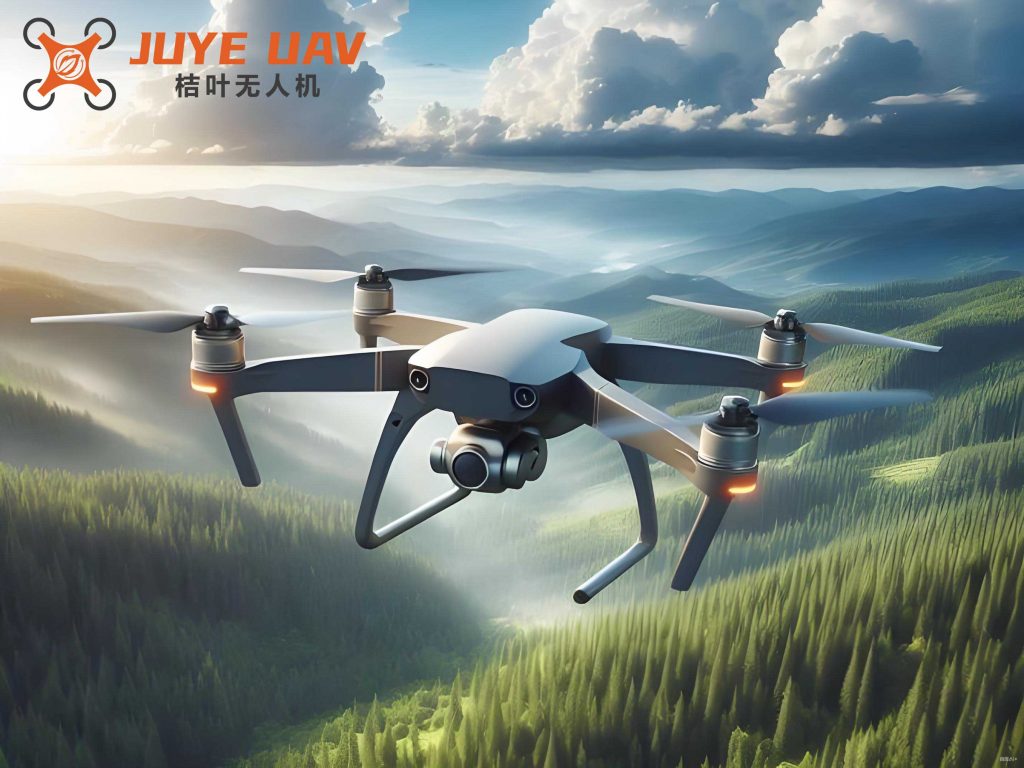
The structure of a quadrotor UAV consists of a flight control system, four carbon fiber arms, DC motors, rotors, electronic speed controllers, and a battery. The four rotors are symmetrically arranged in a horizontal plane, with each motor positioned at the end of an arm and the flight computer at the center. By adjusting the rotational speeds of the motors, the quadrotor achieves attitude and position control. The dynamic model of the quadrotor is derived from Newton-Euler equations, accounting for forces and moments. The translational dynamics in the inertial frame are given by:
$$ \ddot{x} = \frac{u_1 (C_\phi S_\theta C_\psi + S_\phi S_\psi)}{m} – \frac{Q_1 \dot{x}}{m} + \Delta k_1 + d_1 $$
$$ \ddot{y} = \frac{u_1 (C_\phi S_\theta S_\psi – S_\phi C_\psi)}{m} – \frac{Q_2 \dot{y}}{m} + \Delta k_2 + d_2 $$
$$ \ddot{z} = \frac{u_1 (C_\phi C_\theta)}{m} – g – \frac{Q_3 \dot{z}}{m} + \Delta k_3 + d_3 $$
where $m$ is the mass, $Q_i$ ($i=1,2,3$) are air resistance coefficients, $\Delta k_i$ represent model uncertainties, $d_i$ are external disturbances, and $C_{(\cdot)}$ and $S_{(\cdot)}$ denote cosine and sine functions, respectively. The rotational dynamics are described as:
$$ \ddot{\phi} = \frac{l u_2}{U_{xx}} + \frac{(U_{yy} – U_{zz})}{U_{xx}} \dot{\theta} \dot{\psi} + \frac{U}{U_{xx}} \dot{\theta} \Omega_r + \frac{l Q_4 \dot{\phi}}{U_{xx}} + \Delta k_4 + d_4 $$
$$ \ddot{\theta} = \frac{l u_3}{U_{yy}} + \frac{(U_{zz} – U_{xx})}{U_{yy}} \dot{\phi} \dot{\psi} – \frac{U}{U_{yy}} \dot{\phi} \alpha_r + \frac{l Q_5 \dot{\theta}}{U_{yy}} + \Delta k_5 + d_5 $$
$$ \ddot{\psi} = \frac{l u_4}{U_{zz}} + \frac{(U_{xx} – U_{yy})}{U_{zz}} \dot{\phi} \dot{\theta}_r + \frac{l Q_6 \dot{\psi}}{U_{zz}} + \Delta k_6 + d_6 $$
Here, $U_{xx}$, $U_{yy}$, $U_{zz}$ are moments of inertia, $l$ is the arm length, and $u_i$ are control inputs. The quadrotor structure is illustrated below, highlighting key components such as motors and the flight control computer.
Sensor faults in quadrotor UAVs can be categorized into three types: bias, drift, and failure faults. For angular velocity sensors, these faults are modeled as follows. Let $\Omega_h = [\Omega_{hx}, \Omega_{hy}, \Omega_{hz}]^T$ represent the measured angular velocities, and $\beta = [\beta_x, \beta_y, \beta_z]^T$ denote the actual angular velocities. The bias fault is characterized by a constant offset: $\Omega_h = \beta + d_h(t)$, where $d_h(t) = [d_{ha}(t), d_{hb}(t), d_{hc}(t)]^T$ and $d_{hi}(t) \equiv 0$ for no fault, but $d_{hi}(t) \neq 0$ during fault. The drift fault involves a linearly increasing error: $\Omega_h = \beta + d_h(t)$, with $|d_{hi}(t)| = \lambda t$ for $0 < \lambda \leq 1$. The failure fault results in scaled measurements: $\Omega_h = K_h(t) \beta$, where $K_h(t) = \text{diag}(k_{ha}(t), k_{hb}(t), k_{hc}(t))$ is a time-varying matrix. Combining these, the overall fault model for angular velocity sensors is:
$$ \Omega_h = \beta + h(t) $$
$$ h(t) = (K_h(t) – I) \beta + d_h(t) $$
This leads to the quadrotor sensor fault model:
$$ \dot{\eta} = E (\Omega_h – h(t)) $$
$$ \dot{\Omega_h} = h_h + g_f \Gamma_h + \Delta_h $$
where $\eta = [\phi, \theta, \psi]^T$ is the attitude angle vector, $E$ is a transformation matrix, $\Gamma_h$ is the control torque input, $h_h$ and $g_f$ are system matrices, and $\Delta_h$ encapsulates unknown terms due to faults. The matrix $E$ is defined as:
$$ E = \begin{bmatrix}
1 & \sin\phi \tan\theta & \cos\phi \tan\theta \\
0 & \cos\phi & -\sin\phi \\
0 & \sin\phi / \cos\theta & \cos\phi / \cos\theta
\end{bmatrix} $$
To address sensor faults, an adaptive fuzzy fault-tolerant control law is designed. The control system comprises an attitude angle loop and an angular velocity loop. For the attitude angle loop, define the tracking error as $\tilde{\eta} = \eta – \eta_d$, where $\eta_d$ is the desired attitude. The derivative is $\dot{\tilde{\eta}} = E(\Omega_h – h(t)) – \dot{\eta_d}$. Using a fuzzy system to approximate the unknown term $E h(t)$, we have $E h(t) = W_1^T \xi_1 + \epsilon_1$, where $W_1$ is the optimal weight vector, $\xi_1$ is the fuzzy basis function vector, and $\epsilon_1$ is the approximation error. The virtual control input $\Omega_{h}^a$ is designed as:
$$ \Omega_{h}^a = E^{-1} (-D_1 \tilde{\eta} + \hat{W}_1^T \xi_1 + \dot{\eta_d}) $$
where $D_1$ is a positive definite matrix, and $\hat{W}_1$ is the estimated weight. The adaptation law for $\hat{W}_1$ is:
$$ \dot{\hat{W}}_1 = N_1 (-\xi_1 \tilde{\eta}^T – C_1 \hat{W}_1) $$
with $N_1$ and $C_1$ as positive constants. A filter is introduced to handle differentiation issues: $\tau_1 \dot{\bar{\Omega}}_h^a + \bar{\Omega}_h^a = \Omega_h^a$, where $\bar{\Omega}_h^a$ is the filtered output, and the filter error is $e_1 = \bar{\Omega}_h^a – \Omega_h^a$. A Lyapunov function $V_1(t) = \frac{1}{2} \tilde{\eta}^T \tilde{\eta} + e_1^T e_1 + \tilde{W}_1^T N_1^{-1} \tilde{W}_1$ (with $\tilde{W}_1 = W_1 – \hat{W}_1$) ensures stability, leading to bounded errors and convergence.
For the angular velocity loop, define the error $\tilde{\Omega} = \Omega_h – \bar{\Omega}_h^a$. The derivative is $\dot{\tilde{\Omega}} = h_h + g_f \Gamma_h + \Delta_h – \dot{\bar{\Omega}}_h^a$. A sliding surface is designed as $S = a \tilde{\eta} + \tilde{\Omega}$, where $a$ is a positive matrix. The derivative of $S$ is:
$$ \dot{S} = a(-D_1 \tilde{\eta} + \hat{W}_1^T \xi_1 + E \tilde{\Omega} + E e_1) + h_h + g_f \Gamma_h – \dot{\bar{\Omega}}_h^a + \Delta_h – a E h(t) $$
The uncertain term $\Delta_h – a E h(t)$ is approximated by another fuzzy system: $\Delta_h – a E h(t) = W_2^T \xi_2 + \epsilon_2$. The control law $\Gamma_h$ is derived as:
$$ \Gamma_h = g_f^{-1} \left[ -a(-D_1 \tilde{\eta} + \hat{W}_1^T \xi_1 + E \tilde{\Omega} + E e_1) – h_h – D_1 S – D_2 \text{sign}(S) – \hat{W}_2^T \xi_2 + \dot{\bar{\Omega}}_h^a \right] $$
where $D_2$ is a positive definite matrix, and $\hat{W}_2$ is adapted via $\dot{\hat{W}}_2 = N_2 \xi_2 S^T$. The Lyapunov function $V_2(t) = \frac{1}{2} (S^T S + \tilde{W}_2^T N_2^{-1} \tilde{W}_2)$ guarantees stability, ensuring that the quadrotor tracks desired trajectories despite sensor faults.
Simulation experiments were conducted in MATLAB/Simulink to validate the proposed adaptive fuzzy control method for quadrotor UAVs. The desired trajectory was a circular path in the xy-plane: $x_d = 2 \sin(0.5t + 4)$, $y_d = 2 \cos(0.5t + 4)$, with initial conditions $x(0) = 4$, $y(0) = 6$, over a 20-second duration. Angular velocity sensor faults were modeled with $d_h(t) = [0.5, 0.5, 0.5]^T$, representing coupled bias faults. The proposed method was compared against a traditional Kalman filter-based approach. The results demonstrate that the adaptive fuzzy control achieves significantly higher trajectory tracking accuracy, with a 42% improvement in precision compared to the Kalman filter. The table below summarizes key parameters and performance metrics from the simulations.
| Parameter | Value | Description |
|---|---|---|
| Mass ($m$) | 1.2 kg | Quadrotor mass |
| Inertia ($U_{xx}$, $U_{yy}$, $U_{zz}$) | 0.01, 0.01, 0.02 kg·m² | Moments of inertia |
| Fault magnitude ($d_h$) | [0.5, 0.5, 0.5] rad/s | Angular velocity bias faults |
| Control gain ($D_1$, $D_2$) | Diag([5, 5, 5]) | Positive definite matrices |
| Adaptation rate ($N_1$, $N_2$) | Diag([0.1, 0.1, 0.1]) | Learning parameters |
| Tracking error (Kalman filter) | 0.85 m | Average position error |
| Tracking error (Adaptive fuzzy) | 0.49 m | Average position error |
| Improvement | 42% | Precision enhancement |
The stability analysis based on Lyapunov theory confirms that both the attitude angle and angular velocity loops remain bounded under the proposed control laws. The fuzzy systems effectively compensate for uncertainties and faults, enabling robust trajectory tracking. This approach enhances the reliability of quadrotor UAVs in practical applications where sensor faults are common.
In conclusion, this paper presents a comprehensive fault-tolerant control strategy for quadrotor UAVs subject to sensor faults. By modeling angular velocity sensor faults and designing adaptive fuzzy control laws, the method achieves precise trajectory tracking with improved robustness. Simulations validate the superiority over traditional methods, highlighting its potential for real-world deployment. Future work could explore extension to more complex fault scenarios and integration with machine learning techniques for enhanced adaptability.