
As a leading institution in unmanned systems within China’s aerospace sector, we have witnessed the rapid evolution of drone technology and its critical role in modern military operations. The development of military drones dates back to the early 20th century, but progress was initially slow due to limitations in propulsion, control, communication, and navigation technologies, coupled with a lack of systematic understanding of drone applications. However, with advancements in communication, artificial intelligence, materials science, and the emergence of manned-unmanned teaming concepts, drones have gained unprecedented vitality, entering a period of迅猛发展. Yet, drones differ from traditional航空 products in terms of装备特性 and usage patterns. Traditional航空 integrated support systems are not fully applicable to drone systems, especially medium to large drones, which require agile deployment, rapid mobility, and strong battlefield survivability. Conventional support models can no longer meet today’s high-intensity operational demands. Thus, alongside drone technological advancements, we must explore and实践 new integrated support modes to adapt to evolving作战 needs.
In this article, we share our insights and experiences in developing a comprehensive drone integrated support模式, emphasizing the importance of drone training throughout. We will discuss global trends, our institutional framework, operational mechanisms, and future plans, incorporating tables and formulas to summarize key points.
Global Trends in Drone Integrated Support
Currently, drone usage is trending toward迅捷化 and通用化, with a focus on efficiently mobilizing resources in minimal time to ensure mission completion. Internationally, the United States military represents a key参考点. Their support trends primarily manifest in two areas: integration of support spatial layouts, extending capabilities from large air bases to civilian airports,备用机场, or forward临时基地; and flattening of support systems,强化主承包商责任制. Domestically, China emphasizes军民一体化保障 and agile作战 deployment support.
| Aspect | United States | China |
|---|---|---|
| Support Philosophy | Agile Combat Deployment (ACE), Performance-Based Logistics (PBL) | Civil-Military Integration, Rapid Deployment |
| Key Initiatives | Contractor-led support, automated landing, hot refueling, highway operations | Leveraging enterprise力量, “边生产、边改进、边提升” strategy |
| Efficiency Metrics | Mission availability, maintenance cycle time, cost reduction (e.g., ~20% lower维护成本) | Response time,保障力量精简, equipment小型化 |
| Training Emphasis | Integrated contractor training,模拟演习 | 军地联合培训,专业化人才培养, with a focus on drone training |
The U.S. approach, as seen in MQ-9 and RQ-4 drone programs, involves主承包商责任制 to reduce steps and enhance efficiency. For instance, in 2021, only five personnel achieved three rapid refuelings in an average of 20 minutes, far below the standard three hours. Exercises in 2022-2023 validated automated takeoff/landing, hot refueling, quick rearming, and operations from highways, significantly reducing personnel and equipment投入. The PBL model ties contracts to metrics like mission availability and维修周期, driving承包商 to optimize maintenance. Domestically, China’s strategy involves absorbing enterprise力量 into a军民协同保障体系, but challenges remain, such as disparities in人才, technical资料, and数字化水平, as well as communication gaps between enterprises and部队. Addressing these issues is crucial for deepening军民一体化道路.
Our Institute’s Exploration of Drone Integrated Support Mode
As the overall unit for unmanned equipment within China Aerospace Science and Technology Corporation, we focus on装备体系化正向设计 and innovation in unmanned systems. We have integrated modern drone保障特点 with national conditions, optimized institutional systems, and consolidated军地保障资源. Our exploration has led to the development of a “本部 + 区域靠前保障中心 + 服务站” (Headquarters + Regional Forward Support Centers + Service Stations) integrated support模式, ensuring rapid response and efficient resolution of装备使用 and售后问题 for frontline部队. We have established various joint保障模式, such as “军企联合组训” (military-enterprise joint training), “军厂联合维修” (military-factory joint maintenance), and “军地联合培训” (military-local joint training), achieving localized保障能力提升 and effective发挥 of drone装备作战效能.
Overall Framework
We have built a three-tier hierarchical organizational架构体系 centered on “T+4S” principles: Timeliness, Standardization, Smart, Swift, and Sustainable. This framework aims for efficient resource allocation, quick demand response, and enhanced service coverage. The overall structure is visualized below, with Beijing as the command hub, coordinating five regional forward support centers (East, West, South, North, Central) that bridge headquarters and service stations. Service stations directly engage users, providing immediate support and escalating unresolved issues. This system reduces本部 pressure, minimizes personnel waste, accelerates problem-solving, and allows designers to focus on product optimization, fostering a良性循环 of维修验证优化设计. The support efficiency can be modeled as:
$$ \text{Support Efficiency} = \frac{\text{Number of Issues Resolved}}{\text{Total Response Time}} \times \text{User Satisfaction Index} $$
where User Satisfaction Index is derived from feedback scores, often exceeding 99% in our case.
| Level | Role | Key Functions | Impact on Drone Training |
|---|---|---|---|
| Headquarters (本部) | Strategic command | Planning, resource allocation, standard-setting, data analysis, system optimization | Overseas overall training curricula and innovation in drone training methods |
| Regional Forward Support Centers | Coordination bridge | Emergency response, technical support, inter-station coordination, regional adaptation | Implements localized drone training programs and skill assessments |
| Service Stations | Frontline interface | Immediate problem-solving, user feedback, light维修工具 deployment | Provides hands-on drone training and on-site maintenance guidance |
Supporting Mechanisms
We have pioneered three joint modes that synergize military and enterprise resources:
- Military-Enterprise Joint组训: Evolved from project-based to常态化 “基地化” training, sharing airports, ranges, test equipment, and experts. This includes technical validation组训,需求导向型组训, and emergency救援演练, driving technology iteration through实战化演习. The integration enhances战斗力 and科技融合, with drone training as a core component.
- Military-Factory Joint Maintenance: Enterprises embed into基层部队, shifting from “事后维修” to predictive health management. We promote即损即修 and预制维修模块, emphasizing平战结合. This involves编制维修规程,工艺标准, and教材手册,常态化开展维修人才培训, shortening response times and boosting部队维修能力. The maintenance cost model can be expressed as:
$$ C_{\text{maintenance}} = C_{\text{labor}} \times T_{\text{repair}} + C_{\text{parts}} \times N_{\text{replacements}} $$
where \( T_{\text{repair}} \) decreases with enhanced drone training and predictive analytics.
- Military-Local Joint Training: Emphasizes knowledge fusion and equipment sharing, employing a “双导师制度” with军事 and technical experts. Training spans three stages:理论教学,外场飞行训练, and实战演练, covering drone操控,维修维护,指挥控制, and情报分析. This cultivates dual-competency talents proficient in both operations and technology. The training effectiveness metric is:
$$ E_{\text{training}} = \alpha \cdot \text{Theory Score} + \beta \cdot \text{Practical Score} + \gamma \cdot \text{Field Exercise Score} $$
with \( \alpha, \beta, \gamma \) as weighting factors adjusted based on drone training objectives.
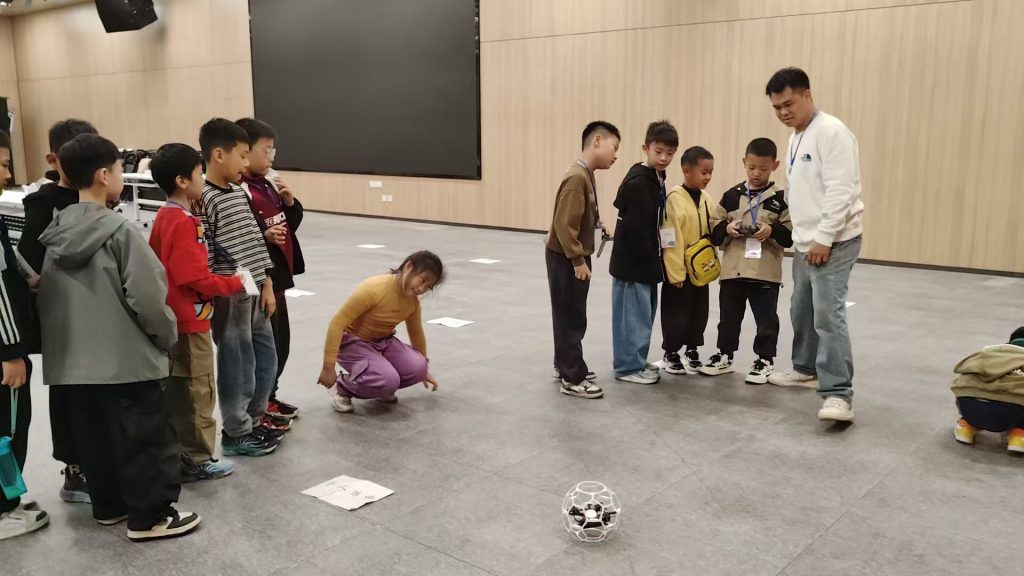
This image illustrates a practical drone training session, highlighting the hands-on approach we advocate in our joint programs. It underscores the importance of immersive learning in developing operational proficiency.
Institutional System
We have established management systems for武器装备综合保障工作,在役装备问题处置,巡检巡修管理, and实战化模拟在役考核试验控制程序, clarifying responsibilities between院本级 and厂所. Annually, we release院级综合保障工作要点 and integrate型号实战化改制,整修 plans into科研生产考核计划. We conduct regular training to disseminate requirements and enhance保障能力. Key institutional features include:
- Specialized售后保障机构: A dedicated保障队伍 with talent库建设,规范工作流程, and data analytics for易损件预测. We have developed systems like “售后保障能力建设系统,” “远程专家诊断系统,” and “电子交互手册” to improve信息准确性.
- Information Collection: A售后信息服务平台 enables数字化 collection of装备情况,用户信息,产品质量,投诉建议, and任务需求, facilitating分类管理和精准保障. This supports continuous improvement in drone training feedback loops.
Operational Mode
Our system operates through a dynamic workflow: when a drone issue arises, service stations provide紧前保障 while logging it on the综合保障信息平台. They attempt repair using轻量化工具 and快速修理包. If resolved, solutions are fed back to regional centers and the platform. If not, regional centers offer technical and resource support, coordinating adjacent centers if needed. Unresolved issues escalate to headquarters, which mobilizes institute resources. Post-resolution, analyses optimize the system and create digital models. The协作模式 follows “相邻协作,相互补充” principles among regional centers. The response time reduction is quantified as:
$$ \Delta T = T_{\text{traditional}} – T_{\text{new}} \approx 37\% \cdot T_{\text{traditional}} $$
based on our 2024 data, where \( T_{\text{new}} \) benefits from efficient drone training and resource coordination.
| Step | Action | Agent | Outcome |
|---|---|---|---|
| 1 | Issue detection and initial response | Service Station | Immediate repair attempt; issue logged |
| 2 | Escalation if unresolved | Regional Center | Technical support; inter-center coordination |
| 3 | Final escalation and resolution | Headquarters | Institute-wide resource mobilization; system optimization |
| 4 | Feedback and modeling | All levels | Digital model更新; drone training material enhancement |
Achievements
In 2024, we served users over 140 times, achieving >99% satisfaction. Problem resolution time shortened by >37% on average. By building易损件数据模型 and optimizing supply chains, we reduced备件供应时间 and implemented前置零配件供应保障. We also developed an unmanned equipment综合保障车 for mobile support, featuring automated inventory management to minimize personnel dependency. These outcomes validate our mode’s effectiveness in enhancing装备作战效能 through integrated drone training and maintenance.
Future Development Plans for Support Work
Drone integrated support is a庞大系统工程, and军民协同 is a long-term task. We will continuously iterate our system, focusing on four areas:
1. Conducting Support System Planning
We will refine both product and institutional保障体系. For product体系, we analyze装备场景用途 to develop通用化,系列化,模块化设备, forming保障性指标体系 and验证评估标准. Our internal maturity assessments show most units at level 4 or above, with some reaching level 5 in综合保障管理. We will promote智能化,无人化装备,远程培训,模拟训练,虚拟装配, and健康管理 to reduce lifecycle costs. For institutional体系, we clarify职责界限, prioritize annual work,健全奖惩办法, and conduct专项评审. We extend evaluations to “科研数字化” and “成本控制管理” to drive management penetration, leveraging drone training as a cross-cutting enabler.
2. Deepening Support Equipment Research and Development
Advanced保障装备 is core to support efficacy. We will:
- Hardware: Collaborate with research institutions to apply emerging智能技术,推动系列化及通用化保障设备, and explore低成本保障 options. The innovation rate can be modeled as:
$$ I_{\text{hardware}} = \frac{\text{Number of New Patents}}{\text{R&D Investment}} \times \text{Integration Coefficient} $$
- Software: Leverage big data and cloud computing to build a综合保障信息库 for lifecycle prediction and备件精准预估. We will advance故障预测与健康管理技术 through online monitoring, enabling状态评估,故障诊断, and辅助决策. This shift from被动保障 to超前规划 is encapsulated in:
$$ P_{\text{proactive}} = 1 – \frac{\text{Reactive Incidents}}{\text{Total Incidents}} $$
where \( P_{\text{proactive}} \) increases with improved drone training and data analytics.
3. Continuously Strengthening Training and Maintenance Work
Training and maintenance are pivotal. We will introduce智能模拟训练平台 and虚拟装配维修平台 for复杂环境 simulation and virtual equipment repair. By allocating technical骨干 to部队培训, we tailor courses to岗位需求, balancing theory and实飞课 with VR/AR-based virtual训练 as supplements. This enhances部队自主组织训练能力, directly tying to drone training outcomes. Maintenance will benefit from system数字化 and智能化, reducing technician burden and fostering a良性循环 of design improvement. With AI advances in 2025, we will explore AI-drone support integration, developing offline-deployable modules for rapid manual retrieval and case analysis, boosting智能化水平 while adhering to保密要求.
4. Promoting Regionalized Forward Support Center Construction
We will expand forward support centers in consultation with users, leveraging institute and兄弟单位资源 to覆盖五大地区. New centers will be nurtured through “以老带新” mentorship, while existing ones undergo能力建设 via本部-driven optimization. We plan to:
- Select示范靠前保障中心 annually based on user feedback, summarizing best practices for应急抢修模式 innovation.
- Enhance备品备件库建设 with易损件数据模型 to streamline supply chains.
- Deepen integration with部队 through日常训练 participation and战略合作协议, aiming for基地级装备综合保障能力. This includes靠前储存,联合培养, and售后服务保障, all reinforced by ongoing drone training initiatives.
Conclusion
Effective equipment integrated support is key to realizing operational capabilities. As an industrial department, we must align with user任务需求,健全保障体系, and enhance全流程保障能力 for “随时可用、有效能用、持续能用.” Facing new形势新任务, we adhere to以国为重、用户至上 principles, actively innovating support modes to提升保障效能和响应速度. Our commitment to supporting部队战斗力生成 contributes to航天强国建设, with drone training serving as a cornerstone for sustainable excellence. Through continued exploration and实践, we aim to set benchmarks in drone integrated support, ensuring readiness and resilience in an ever-evolving landscape.