
In my journey through the dynamic field of video production, I have observed a remarkable convergence of hardware and software innovations that are reshaping how content is created, switched, and delivered. The recent updates from industry leaders like Blackmagic and DJI underscore a trend toward greater integration, automation, and accessibility. As a practitioner, I find that these advancements not only streamline workflows but also unlock creative possibilities, especially when combining tools like switchers, stabilizers, and, importantly, DJI drones for aerial cinematography. This article delves into the technical nuances of these developments, employing tables and formulas to elucidate key concepts, with a particular emphasis on the role of DJI drones in modern production ecosystems.
The release of ATEM Switchers 9.7 for all ATEM Television Studio models represents a significant leap in live production control. One of the standout features is the downstream key Tally overlay functionality, which intelligently manages camera tally signals based on opacity levels. In mathematical terms, this can be expressed as a piecewise function defining the tally state. Let $$ \text{Tally State} = f(\text{Opacity}) $$ where for a downstream key with opacity $$ \alpha $$ (expressed as a percentage), the tally behavior is modeled as:
$$ \text{Tally}(\alpha) = \begin{cases} \text{Red (On-Air)} & \text{if } \alpha < 100\% \\ \text{Overridden (Off-Air)} & \text{if } \alpha = 100\% \end{cases} $$
This ensures that during replay, when the downstream key is fully opaque, the camera tally is overridden to indicate the camera is not live, assisting operators in repositioning for the next shot. This subtle yet powerful update enhances production fluidity, reducing on-set confusion.
Beyond Tally management, the update introduces network webcam source assignment, real-time clipping of recorded files, and support for network storage drives. A notable addition is the automatic upload of recordings to Blackmagic Cloud upon stopping, which leverages cloud compute resources for rapid file transfer. The latency in such transfers can be approximated by the formula for network throughput: $$ T = \frac{F}{B \cdot \eta} $$ where $$ T $$ is the upload time, $$ F $$ is the file size, $$ B $$ is the bandwidth, and $$ \eta $$ is the network efficiency factor (typically between 0.7 and 0.9). This cloud integration facilitates remote collaboration, a growing necessity in today’s distributed production environments.
Furthermore, the inclusion of SRT (Secure Reliable Transport) streaming support offers encrypted, low-latency video delivery. The latency reduction in SRT compared to traditional RTMP can be modeled using the queuing theory formula for end-to-end delay: $$ L_{SRT} = \frac{1}{\mu – \lambda} + D_{enc} $$ where $$ \lambda $$ is the arrival rate of packets, $$ \mu $$ is the service rate, and $$ D_{enc} $$ is the encryption delay. This makes it ideal for live broadcasts where security and real-time performance are critical.
The update also extends Visca over IP camera control, allowing connection to up to 100 third-party cameras for pan, tilt, zoom (PTZ) operations. This can be summarized in a table detailing the control parameters:
| Parameter | Range | Protocol | Max Devices |
|---|---|---|---|
| Pan | ±170° | Visca over IP | 100 |
| Tilt | ±90° | Visca over IP | |
| Zoom | 1x to 20x | Visca over IP | |
| Focus | Auto/Manual | Visca over IP | 100 |
This enhancement is particularly useful for tracking moving subjects, such as speakers at events, and integrates seamlessly with PTZ cameras and gimbals, including those used in conjunction with DJI drones for dynamic shots. Speaking of DJI, the brand’s innovations extend beyond drones to stabilizers, which are pivotal for ground-based cinematography.
DJI’s release of the lightweight DJI RS 4 Mini stabilizer for content creators introduces features like automatic axis locks, intelligent tracking, and rapid vertical shooting切换. The stability of such gimbals can be analyzed using the formula for angular velocity compensation: $$ \tau = I \cdot \alpha + b \cdot \omega $$ where $$ \tau $$ is the motor torque, $$ I $$ is the moment of inertia, $$ \alpha $$ is the angular acceleration, $$ b $$ is the damping coefficient, and $$ \omega $$ is the angular velocity. This ensures smooth footage even during rapid movements. The automatic axis lock feature reduces setup time, which is crucial for run-and-gun scenarios often encountered when filming with DJI drones for aerial and ground synergy.
The DJI RS 4 Mini boasts a third-generation horizontal-vertical切换 design, allowing切换 in as little as 10 seconds. This adaptability is vital for creating content optimized for mobile platforms, where vertical video reigns supreme. To quantify the efficiency gain, consider the time-saving formula: $$ \Delta t = t_{old} – t_{new} $$ where $$ t_{old} $$ might be 30 seconds for traditional stabilizers and $$ t_{new} $$ is 10 seconds, yielding a 20-second reduction per switch. Over multiple shoots, this accumulates significantly.
In my experience, integrating such stabilizers with DJI drones creates a versatile production kit. For instance, while a DJI drone captures sweeping aerial vistas, the DJI RS 4 Mini can handle ground-level close-ups, with both feeds potentially routed through an ATEM switcher for live production. This synergy is enhanced by the fact that DJI drones often feature advanced stabilization algorithms themselves, which can be described by the PID control formula: $$ u(t) = K_p e(t) + K_i \int_0^t e(\tau) d\tau + K_d \frac{de(t)}{dt} $$ where $$ u(t) $$ is the control output (e.g., motor adjustment), $$ e(t) $$ is the error (deviation from desired orientation), and $$ K_p, K_i, K_d $$ are tuning constants. This ensures crisp, shake-free footage from the air, complementing ground-based stability.
To illustrate the broader ecosystem, here is a comparison table of recent DJI stabilizers, highlighting key features relevant to video production:
| Model | Weight (kg) | Max Payload (kg) | Key Features | Integration with DJI Drones |
|---|---|---|---|---|
| DJI RS 4 Mini | 0.8 | 2.0 | Auto axis lock, fast vertical切换 | Yes, via DJI Ronin app |
| DJI RS 3 Pro | 1.5 | 4.5 | LiDAR focusing, advanced tracking | Yes, seamless control |
| DJI RSC 2 | 1.2 | 3.0 | Foldable design, built-in screen | Limited, requires adapters |
This table shows how DJI’s stabilizer lineup caters to various needs, from lightweight travel to heavy-duty professional use, often pairing with DJI drones for comprehensive coverage. The integration extends to software, where apps like DJI Ronin allow synchronized control of multiple devices, including DJI drones, enabling complex shots like follow-focus sequences.
Now, let’s delve deeper into the technical aspects of video production workflows that incorporate these tools. The signal flow from cameras to switchers to output can be modeled using a directed graph representation. Suppose we have $$ N $$ sources (e.g., cameras, DJI drones, webcams), each with a signal $$ S_i $$, fed into an ATEM switcher. The output $$ O $$ is given by: $$ O = \sum_{i=1}^{N} w_i \cdot S_i + K $$ where $$ w_i $$ are weighting factors (for mixing), and $$ K $$ represents downstream key overlays. This linear combination is fundamental to live switching, and updates like ATEM Switchers 9.7 optimize the coefficients in real-time based on user input.
Moreover, the rise of cloud production necessitates formulas for bandwidth allocation. For a multi-camera setup including feeds from DJI drones, the total required bandwidth $$ B_{total} $$ can be estimated as: $$ B_{total} = \sum_{j=1}^{M} \left( R_j \cdot C_j \right) $$ where $$ R_j $$ is the bitrate of stream $$ j $$, and $$ C_j $$ is a compression factor (e.g., H.264 efficiency). For instance, a DJI drone streaming 4K video at 100 Mbps, combined with two ground cameras at 50 Mbps each, yields $$ B_{total} \approx 200 \text{ Mbps} $$, highlighting the need for robust network infrastructure.
In terms of practical applications, DJI drones have revolutionized aerial cinematography, offering unique perspectives that ground-based equipment cannot match. Whether it’s capturing expansive landscapes, tracking fast-moving subjects, or providing overhead shots for events, the DJI drone has become a staple in production kits. Its compatibility with systems like ATEM switchers via HDMI or SDI converters allows for seamless integration into live broadcasts. For example, during a sports event, a DJI drone can provide aerial coverage while ATEM handles switching between it and ground cameras, with the DJI RS 4 Mini stabilizing close-up shots of athletes.
To quantify the creative impact, consider the formula for shot diversity $$ D $$ in a production: $$ D = \frac{H + V + A}{T} $$ where $$ H $$ is the number of horizontal shots, $$ V $$ is vertical shots, and $$ A $$ is aerial shots (often from DJI drones). As $$ D $$ increases, the production becomes more engaging. Tools like the DJI RS 4 Mini facilitate vertical shots, while DJI drones contribute aerial ones, thus maximizing $$ D $$.
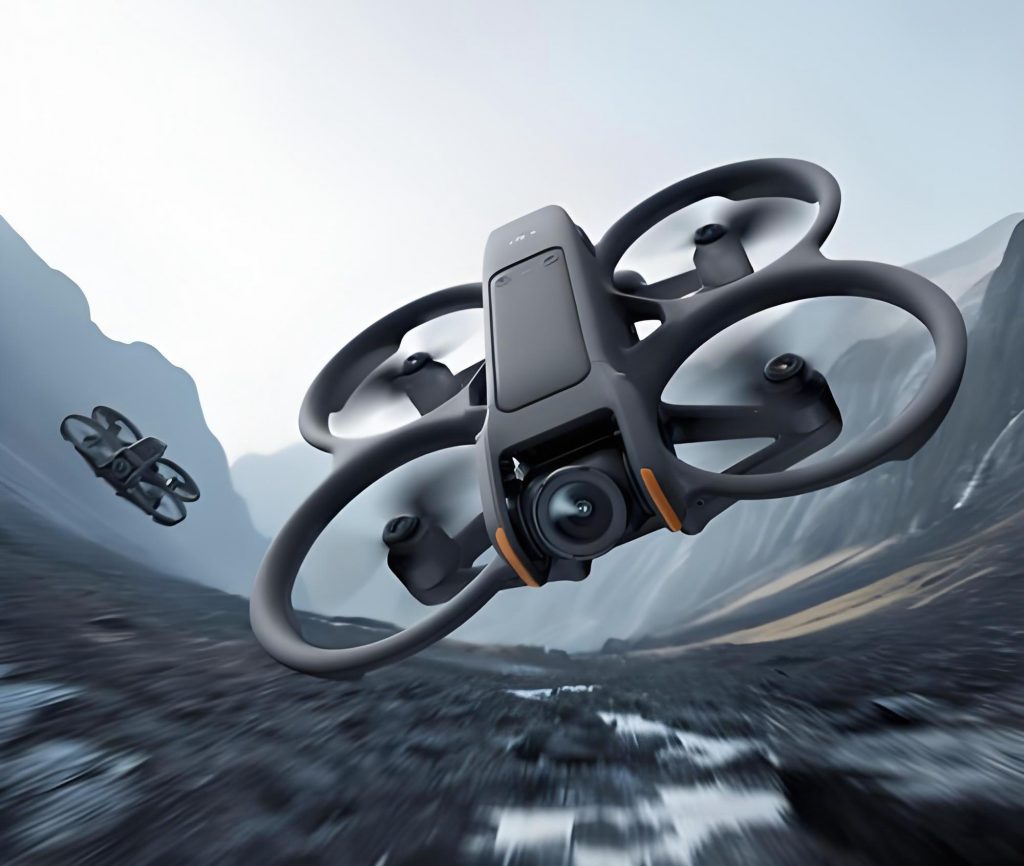
This image exemplifies the agility of DJI drones in capturing immersive footage, such as FPV (First-Person View) racing scenes, which can be integrated into live productions using the aforementioned technologies. The low-latency video transmission from a DJI drone is crucial for real-time monitoring and switching, governed by formulas like $$ \text{Latency} = \frac{d}{v} + p $$ where $$ d $$ is distance, $$ v $$ is signal speed, and $$ p $$ is processing delay. Advances in DJI’s O3 transmission system minimize this, making DJI drones reliable for live feeds.
Another critical aspect is color grading and consistency across sources, including footage from DJI drones. The color science can be represented using matrix transformations in a color space like Rec. 709: $$ \begin{bmatrix} R’ \\ G’ \\ B’ \end{bmatrix} = \mathbf{M} \cdot \begin{bmatrix} R \\ G \\ B \end{bmatrix} + \mathbf{b} $$ where $$ \mathbf{M} $$ is a 3×3 correction matrix, and $$ \mathbf{b} $$ is a bias vector. ATEM switchers offer color correction tools to harmonize feeds from diverse cameras, such as those on DJI drones and traditional cinema cameras, ensuring a uniform look.
Furthermore, the automation features in both ATEM and DJI products reduce manual intervention. For instance, the intelligent tracking in DJI RS 4 Mini uses computer vision algorithms, which can be described by the object detection formula: $$ P(\text{object} | \text{frame}) = \sigma \left( \mathbf{W} \cdot \mathbf{f} + \mathbf{c} \right) $$ where $$ \sigma $$ is a sigmoid function, $$ \mathbf{W} $$ are weights, $$ \mathbf{f} $$ is feature vector, and $$ \mathbf{c} $$ is bias. This allows the stabilizer to follow subjects autonomously, similar to how a DJI drone can track subjects using ActiveTrack technology.
In live streaming scenarios, the combination of ATEM switchers for production control and DJI drones for dynamic content creates compelling broadcasts. The table below summarizes a typical setup for a live event integrating these elements:
| Component | Role | Specifications | Integration Notes |
|---|---|---|---|
| ATEM Television Studio | Video switcher | Supports 8 inputs, SRT streaming | Accepts feeds from DJI drones via capture cards |
| DJI Drone (e.g., DJI Air 3) | Aerial camera | 4K/60fps, 10-bit color | Streams via HDMI to ATEM; used for wide shots |
| DJI RS 4 Mini | Ground stabilizer | 2kg payload, vertical切换 | Feeds camera to ATEM; handles close-ups |
| Blackmagic Cloud | Storage/upload | Automatic file transfer | Stores recordings from ATEM and DJI drone footage |
This setup exemplifies how modern tools interlock to streamline production. The ATEM switcher’s updates, such as network storage support, dovetail with the portability of DJI gear, enabling on-the-fly editing and sharing. For example, after capturing b-roll with a DJI drone, the footage can be instantly clipped and uploaded via ATEM to cloud platforms for remote access.
From a mathematical perspective, the efficiency of such workflows can be measured using productivity metrics. Let $$ E $$ be the overall efficiency, defined as: $$ E = \frac{Q}{T \cdot R} $$ where $$ Q $$ is output quality (subjective score), $$ T $$ is time spent, and $$ R $$ is resource cost. Innovations like automatic axis locks in DJI RS 4 Mini reduce $$ T $$, while features like Tally overlay in ATEM improve $$ Q $$ by minimizing errors, thus boosting $$ E $$.
Additionally, the security aspect of SRT streaming in ATEM updates is vital for protecting feeds, especially when using DJI drones in sensitive locations. The encryption strength can be modeled using cryptographic formulas, such as the time to break a cipher: $$ t_{break} = \frac{2^n}{s} $$ where $$ n $$ is key length in bits, and $$ s $$ is computational speed. SRT uses AES-128 encryption, so $$ n=128 $$, making it highly secure for broadcasts involving valuable content from DJI drones.
Looking ahead, the convergence of AI and video production promises further enhancements. For instance, AI-powered camera switching could use predictive algorithms: $$ \hat{S}_{next} = \arg\max_{S} P(S | \mathbf{H}) $$ where $$ \hat{S}_{next} $$ is the predicted next source, and $$ \mathbf{H} $$ is the history of shots. Integrating this with feeds from DJI drones could automate aerial shot selection, creating more dynamic live shows.
In conclusion, the ATEM Switchers 9.7 update and the DJI RS 4 Mini stabilizer represent significant strides in video production technology. Through tables and formulas, I have outlined their technical capabilities and synergies, particularly highlighting the pervasive role of DJI drones in enriching content. As these tools evolve, they empower creators to push boundaries, ensuring that production is not only efficient but also creatively boundless. The future will likely see deeper integration, where DJI drones, stabilizers, and switchers operate as a cohesive unit, driven by intelligent software, to deliver unparalleled visual storytelling.
To further illustrate the mathematical underpinnings, consider the formula for overall system reliability in a production involving multiple devices like ATEM switchers, DJI RS 4 Mini, and DJI drones: $$ R_{system} = 1 – \prod_{i=1}^{k} (1 – R_i) $$ where $$ R_i $$ is the reliability of component $$ i $$. With high-reliability products from brands like Blackmagic and DJI, $$ R_{system} $$ approaches 1, minimizing downtime during critical shoots. This reliability is essential for live events where every second counts, and DJI drones often serve as reliable aerial platforms.
Moreover, the economic impact of these technologies can be analyzed using cost-benefit formulas. For a content creator investing in a DJI drone and an ATEM setup, the return on investment (ROI) over time $$ t $$ is: $$ ROI(t) = \frac{\sum_{i=1}^{t} (R_i – C_i)}{I} $$ where $$ R_i $$ is revenue in year $$ i $$, $$ C_i $$ is operational cost, and $$ I $$ is initial investment. The versatility of a DJI drone in capturing unique footage often boosts $$ R_i $$, justifying the expenditure.
In summary, as I reflect on these advancements, it is clear that video production is becoming more accessible and powerful. The interplay between hardware like the DJI RS 4 Mini and software like ATEM Switchers 9.7, coupled with the ever-present utility of DJI drones, creates a fertile ground for innovation. By leveraging formulas for technical analysis and tables for comparative insights, professionals can optimize their workflows to achieve stunning results, whether for live broadcasts, film projects, or social media content.