
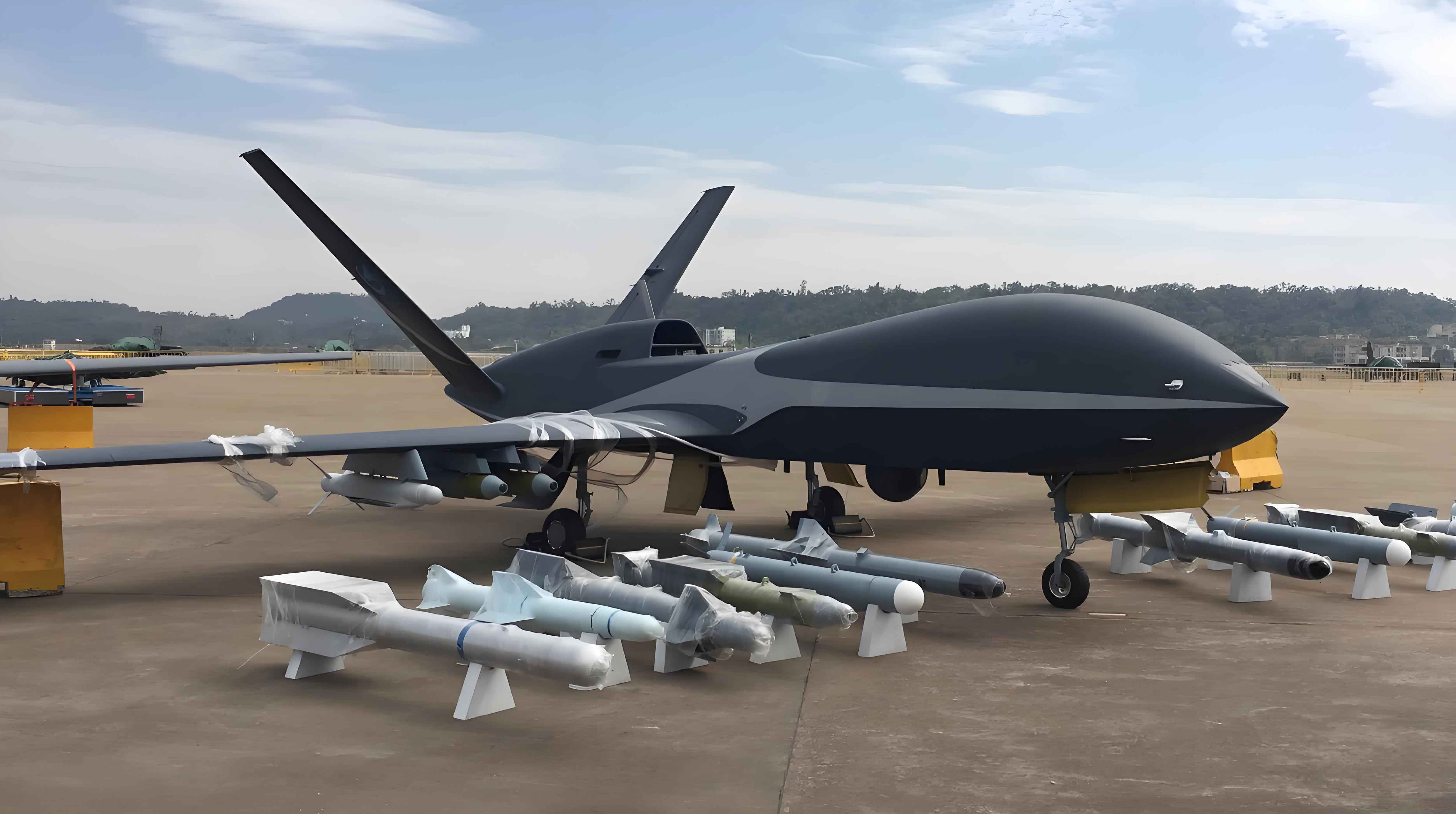
The development of U.S. military drone technology represents a critical nexus of technological innovation and strategic adaptation. As an asymmetric force multiplier, military UAV systems have transitioned from niche surveillance platforms to cornerstone assets in America’s defense architecture. This transformation mirrors shifting geopolitical priorities—from counterterrorism operations to great power competition—with each strategic pivot fundamentally reshaping military UAV capabilities and deployment patterns.
Counterterrorism Genesis (2001-2014)
Post-9/11 security imperatives catalyzed the operational deployment of military drones. The MQ-1 Predator’s maiden armed strike in Afghanistan (2001) established a new paradigm for counterterrorism. Military UAV effectiveness in this asymmetric context is quantified by the strike efficiency equation:
$$E_s = \frac{T_d}{T_a} \times P_k \times (1 – C_c)$$
Where \(E_s\) = Strike efficiency, \(T_d\) = Time from detection to decision (minutes), \(T_a\) = Time from authorization to impact (minutes), \(P_k\) = Probability of kill, \(C_c\) = Collateral casualty rate.
Signature strikes exemplified this era’s technical-strategic fusion, leveraging pattern recognition algorithms to identify targets based on behavioral metadata rather than positive ID. The exponential growth in military drone operations is evidenced by deployment statistics:
| Year | Combat Hours (000s) | Strikes Conducted | Platforms Deployed |
|---|---|---|---|
| 2001 | 2.5 | 3 | 2 types |
| 2005 | 56 | 48 | 4 types |
| 2010 | 297 | 117 | 7 types |
| 2014 | 592 | 237 | 11 types |
Pivot to Asia-Pacific (2014-2017)
The strategic reorientation toward Asia fundamentally transformed military UAV deployment patterns. RQ-4 Global Hawks forward-deployed to Guam (2010) initiated a reconnaissance architecture designed for maritime domain awareness. The ISR effectiveness metric for theater surveillance demonstrates this capability enhancement:
$$I_{eff} = \frac{A_c \times R_r \times T_o}{P_d \times C_h}$$
Where \(I_{eff}\) = ISR effectiveness, \(A_c\) = Area coverage (km²/hr), \(R_r\) = Resolution (cm/px), \(T_o\) = On-station time (hours), \(P_d\) = Probability of detection, \(C_h\) = Cost per flight hour.
Third Offset Strategy investments prioritized autonomy and interoperability, yielding platforms like the MQ-4C Triton with enhanced electronic warfare resilience. Military drone deployments created layered surveillance networks:
| Location | Platforms | Primary Mission | Coverage Radius |
|---|---|---|---|
| Guam | RQ-4/MQ-4C | Broad-area maritime surveillance | 2,000 nm |
| Japan | MQ-1C | Sea lane monitoring | 500 nm |
| Philippines | ScanEagle | Littoral ISR | 100 nm |
Great Power Competition Era (2017-Present)
Strategic competition refocused military UAV development toward peer-conflict capabilities. The 2020 MQ-9B Sea Guardian deployment to India exemplified the integrated deterrence framework, with drone exports becoming geostrategic instruments. Modern military UAVs now incorporate multi-domain command architectures:
$$C2_{mdc} = \frac{\sum_{i=1}^{n} S_i \times L_i}{\Delta t_c + \Delta t_p}$$
Where \(C2_{mdc}\) = Multi-domain command effectiveness, \(S_i\) = Sensor input quality (0-1), \(L_i\) = Data link reliability (0-1), \(\Delta t_c\) = Cognitive processing delay (sec), \(\Delta t_p\) = Physical response delay (sec).
DoD’s 2021 Counter-Small UAS Strategy institutionalized layered defense against adversarial military drones, while OFFensive Swarm-Enabled Tactics (OFFSET) advanced swarm capabilities:
| Program | Objective | Platforms | AI Integration |
|---|---|---|---|
| Loyal Wingman | Manned-unmanned teaming | UTAP-22 Mako | Level 4 autonomy |
| Skyborg | AI-enabled mission control | Multiple | Deep reinforcement learning |
| LOCUST | Swarm saturation attacks | Coyote UAV | Swarm intelligence algorithms |
Future Trajectories
Military UAV development vectors now prioritize three dimensions:
- Autonomy Enhancement: Achieving OODA loop superiority through AI-driven decision cycles
$$t_{OODA} = k \cdot \ln\left(\frac{C_d}{I}\right) + t_{min}$$
Where \(t_{OODA}\) = Decision cycle time, \(C_d\) = Data complexity, \(I\) = AI processing capability, \(k\) = System constant - Cost-Density Optimization: Balancing capability with attritability
$$C_e = \frac{K \cdot V_s}{P_a \cdot M_c}$$
Where \(C_e\) = Cost-effectiveness, \(K\) = Kinetic payload, \(V_s\) = Survivability, \(P_a\) = Platform cost, \(M_c\) = Mission capability - Cross-Domain Integration: Enabling Joint All-Domain Command and Control (JADC2)
$$J_{int} = 1 – \prod_{i=1}^{n} (1 – C_i)$$
Where \(J_{int}\) = Integration probability, \(C_i\) = Compatibility coefficient per domain
Military drone swarms represent the emergent capability frontier. The swarm effectiveness parameter:
$$S_e = N^{0.85} \cdot C_c^{1.2} \cdot \frac{B_w}{\Delta L} \cdot e^{-0.02t_d}$$
Where \(S_e\) = Swarm effectiveness, \(N\) = Number of drones, \(C_c\) = Coordination coefficient, \(B_w\) = Bandwidth (Mbps), \(\Delta L\) = Latency (ms), \(t_d\) = Decision time (sec).
Strategic Implications
Military UAV systems have transitioned from tactical tools to strategic instruments that shape theater calculus. Their evolution demonstrates how threat perception drives defense technology prioritization:
$$\frac{dT}{dt} = \alpha \cdot \Delta S \cdot R_b + \beta \cdot \frac{dT_h}{dt}$$
Where \(T\) = Technology investment, \(\Delta S\) = Strategic shift magnitude, \(R_b\) = Resource availability, \(T_h\) = Threat horizon assessment.
Current development aligns with high-end warfare requirements against peer adversaries. The 2022 NDAA funding distribution reveals these priorities:
| Technology Area | Funding ($M) | Growth (%) | Key Programs |
|---|---|---|---|
| Autonomous Systems | 1,840 | 17.3 | Skyborg, NOMARS |
| Swarm Technologies | 680 | 42.5 | OFFSET, LOCUST |
| Counter-UAS | 1,120 | 38.6 | Mjolnir, DE M-SHORAD |
| AI Processing | 924 | 29.7 | Project Maven, JAIC |
Military UAV systems continue to evolve as indispensable components of power projection architecture. Their trajectory confirms that weapons platforms develop not through technological determinism, but as functions of strategic necessity—a principle that will guide next-generation autonomous warfare systems.