
The miniaturization of electro-optical/infrared (EO/IR) payloads has transformed military UAV capabilities, enabling compact platforms to transition from reconnaissance assets to multi-role combat systems. This technological evolution allows small military drones to conduct complex missions historically reserved for larger platforms, fundamentally altering tactical paradigms in contested environments.
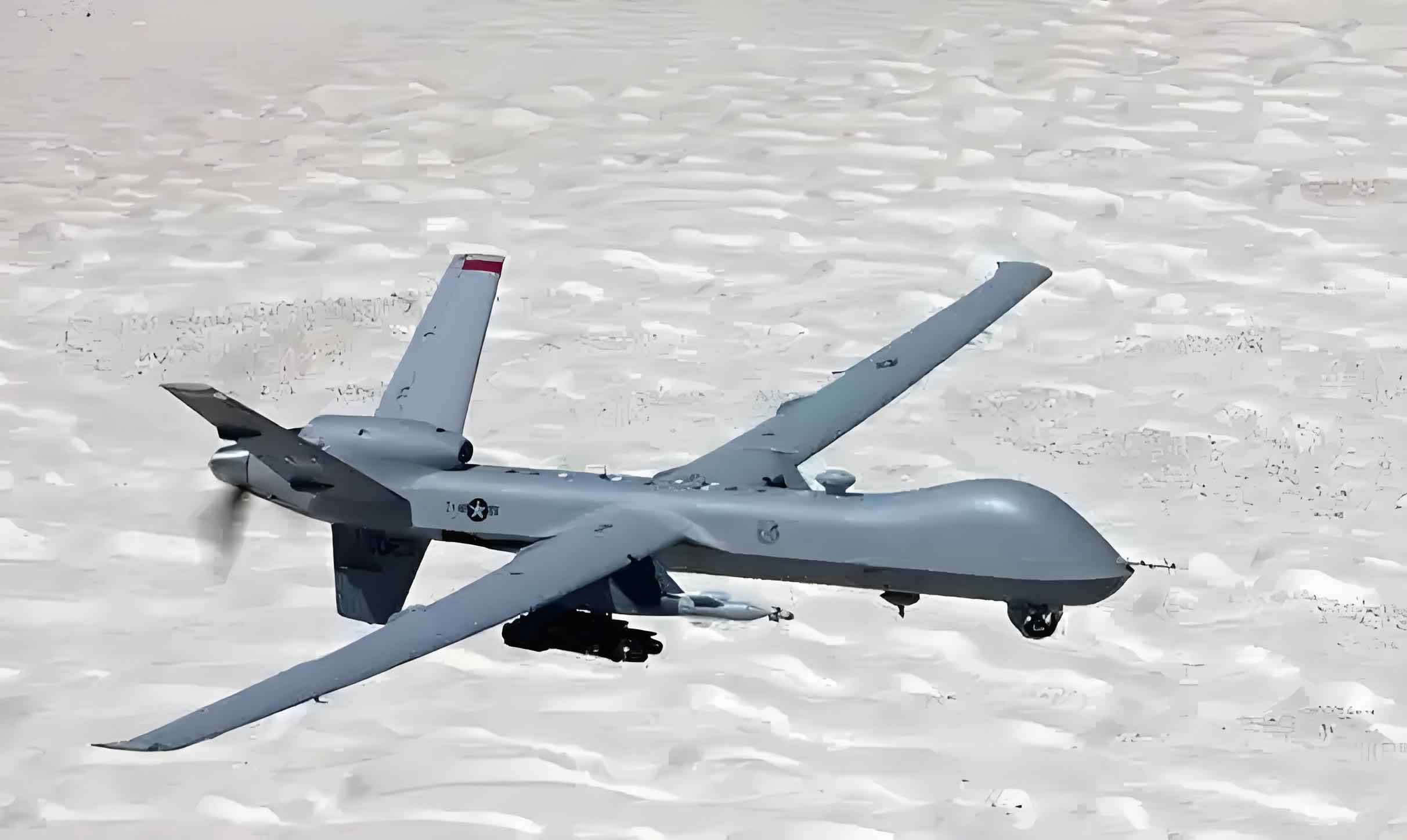
Modern compact EO/IR pods integrate multi-spectral sensors within stringent SWaP constraints: $$\text{SWaP} = k \cdot \left( \frac{\text{Sensor Resolution} \times \text{FOV Range}}{\text{Weight} \times \text{Power Consumption}} \right)$$ where $k$ represents integration efficiency. These systems typically incorporate:
| Capability | Military UAV Class I-II | Class III+ Platforms |
|---|---|---|
| Max Weight | 1.2-3.7 kg | 5-8 kg |
| Sensor Suites | Dual-band IR + VIS | Tri-band + Laser Designator |
| Targeting Accuracy | <5 m CEP | <1 m CEP |
| Endurance Impact | 15-25% reduction | 30-40% reduction |
Advanced military UAV pods like StormCaster-DX (1,250g) achieve NATO STANAG 3733-compliant laser designation previously exclusive to larger platforms. The target acquisition probability follows: $$P_d = 1 – e^{-\lambda \cdot \text{NIIRS} \cdot \text{IFOV}^{-1}}$$ where $\lambda$ represents atmospheric transmission and NIIRS the imagery interpretability scale.
Operational Integration Matrix
| Mission Profile | Sensor Requirements | Military UAV Impact |
|---|---|---|
| Over-the-Hill Recon | 30x EO zoom, LWIR | 90% reduction in forward observer exposure |
| Laser Designation | 1064nm laser, <400μrad divergence | Enables micro-munitions deployment (e.g., Switchblade 300) |
| BDA | Multi-spectral comparison | 70% faster re-attack decisions |
| ELINT | Laser warning receivers | Triples counter-targeting capability |
During target geolocation, military drones combine IMU/GPS data with sensor metrics: $$\text{Target Coordinates} = \begin{bmatrix} x \\ y \\ z \end{bmatrix} + \begin{bmatrix} R \cdot \cos\theta \cdot \sin\phi \\ R \cdot \sin\theta \\ R \cdot \cos\theta \cdot \cos\phi \end{bmatrix}$$ where $R$ is laser range, $\theta$ elevation, and $\phi$ azimuth. This enables artillery correction with <10m error at 5km standoff.
Modern combat employment follows three primary models:
1. Sensor-to-Shooter Integration: Class I military UAVs (e.g., Puma AE) identify targets, transmitting coordinates to loitering munitions. This reduces the sensor-to-shooter cycle from minutes to seconds while keeping operators outside threat envelopes.
2. Laser Designation Chains: Light military UAVs with StormCaster-DX pods designate for heavy platforms. The designation effectiveness follows: $$E_{des} = \frac{P_t \cdot G_t \cdot \sigma \cdot A_r}{(4\pi R^2)^2 \cdot L_a}$$ where $P_t$ is laser power, $G_t$ transmitter gain, $\sigma$ target cross-section, $A_r$ receiver area, and $L_a$ atmospheric loss.
3. Swarmed BDA: Multiple military drones perform post-strike assessment through sensor fusion, with confidence scoring: $$C_{BDA} = 1 – \prod_{i=1}^{n} (1 – A_i \cdot \text{NIIRS}_i)$$ where $A_i$ is platform altitude factor and NIIRS the image quality metric.
Technical Disparities in Military UAV Payloads
| Parameter | Western Systems | Current Alternatives | Gap |
|---|---|---|---|
| Max Range Resolution | 0.05 mrad @ 10km | 0.15 mrad @ 5km | 3× angular resolution |
| Laser Designation | STANAG 3733 compliant | Laser illumination only | Weapon integration |
| Multi-sensor Fusion | 4-layer AI processing | 2-layer processing | Real-time tracking |
| SWaP Efficiency | 1W/g/axis stabilization | 2.3W/g/axis | Endurance impact |
Closing these gaps requires fundamental advances in military UAV payload architecture: $$\text{Performance Density} = \frac{\sum \text{Capabilities}}{\text{Weight} \times \text{Power} \times \text{Cost}} \times \text{MTBF}$$ Future military drone pods must achieve >200:1 performance density increases through quantum dot IR sensors, integrated photonic circuits, and neuromorphic processing.
The next evolution involves military UAV cooperative pods forming distributed aperture systems, where $N$ platforms create synthetic sensors: $$\text{Effective Aperture} = \sqrt{ \sum_{i=1}^{N} d_i^2 \cdot \text{Coherence}_i }$$ enabling over-the-horizon targeting without satellite dependence. This capability will cement military drones as indispensable assets in multi-domain operations against peer adversaries.