
We present an event‑triggered distributed model predictive control framework designed specifically for fixed‑wing drone swarms operating under three‑dimensional formation tasks. The presence of non‑holonomic kinematics, bounded external disturbances, and stringent state/input constraints (such as velocity, roll angle, path angle, load factor, minimum inter‑distance and connectivity) demands a control strategy that can guarantee asymptotic convergence of the formation error while simultaneously minimising unnecessary communication. Our method integrates a prediction‑error‑driven event‑triggered mechanism into a distributed model predictive control architecture, thereby reducing both the communication burden and the frequency of controller updates. We consider a multi‑leader multi‑follower fixed‑wing drone system. Each leader is driven to a predefined target point while maintaining a prescribed geometric formation among the leaders. Each follower is required to converge into the convex hull spanned by the leaders. Using the boundedness of disturbances we derive sufficient conditions for the stability of the closed‑loop system under event‑triggered updates and prove that all fixed‑wing drones converge to a bounded neighbourhood of the desired configuration. Extensive simulations with six leaders and ten followers demonstrate that compared with traditional periodic‑triggered model predictive control, the proposed method significantly reduces communication events and controller updates while preserving convergence and safety constraints. The simulation results confirm that fixed‑wing drone swarms can achieve efficient formation containment with substantially lower resource consumption, which is of practical value for field deployments where communication bandwidth is limited.
1. Introduction
Fixed‑wing drones, owing to their high endurance, large payload capacity and fast cruise speed, are increasingly adopted for wide‑area surveillance, border patrol, mapping and search‑and‑rescue operations. However, controlling a swarm of fixed‑wing drones to fly in a desired formation while satisfying multiple constraints is a challenging problem. The non‑holonomic dynamics, coupling between roll and yaw, and the necessity to maintain safe separation distances impose tight constraints on both the states and control inputs. Moreover, the communication bandwidth among drones is often limited, and frequent information exchange can quickly saturate the network. Therefore, a control method that can reduce unnecessary communication is highly desirable.
Model predictive control has been widely used in multi‑agent systems because it can handle input and state constraints in a unified optimisation framework. In particular, distributed model predictive control allows each agent to optimise its own cost function using local information and limited neighbouring data, which is attractive for large‑scale swarms. However, most existing distributed model predictive control schemes rely on periodic communication and optimisation, which leads to high communication loads. To address this issue, event‑triggered control has been introduced, where control updates and communication are executed only when a certain prediction error exceeds a threshold. Combining event‑triggered ideas with distributed model predictive control can drastically reduce the number of transmissions while preserving the closed‑loop performance.
In this work we propose an event‑triggered distributed model predictive control method for fixed‑wing drone swarms. The main contributions are threefold:
-
A discrete‑time kinematic model of fixed‑wing drones with additive disturbances is established, and a distributed control framework is built on a leader‑follower architecture with a directed communication graph.
-
A prediction‑error‑based event‑triggering law is designed, and separate cost functions are constructed for leaders (tracking cost, formation cost, input cost) and followers (containment cost, input cost). The optimisation problem is solved in a distributed manner.
-
Under the assumption of bounded disturbances, we prove that the closed‑loop errors of all fixed‑wing drones remain bounded, and that leaders converge to the desired target points while followers converge into the convex hull of the leaders. Simulation results with 16 drones (6 leaders, 10 followers) verify the effectiveness and resource efficiency of our approach.
2. System Model of Fixed‑Wing Drones
We consider the outer‑loop non‑holonomic kinematic model of a fixed‑wing drone. The discrete‑time equations for drone i in a local inertial frame (north, east) are:
$$
\begin{aligned}
n_i(k+1) &= n_i(k) + \Delta t \, V\,\cos\!\bigl(\psi_{g,i}(k)\bigr) + d_{n,i}(k) ,\\
e_i(k+1) &= e_i(k) + \Delta t \, V\,\sin\!\bigl(\psi_{g,i}(k)\bigr) + d_{e,i}(k) ,\\
\psi_{g,i}(k+1) &= \psi_{g,i}(k) + \Delta t\,\frac{g}{V}\tan\!\bigl(\phi_i(k)\bigr) + d_{\psi,i}(k) ,
\end{aligned}
$$
where n_i and e_i are the north and east positions, ψ_{g,i} the ground track angle, φ_i the roll angle, V the constant airspeed, g the gravitational acceleration, and Δt the sampling period. Terms d_{n,i}, d_{e,i}, d_{ψ,i} represent bounded external disturbances. The control input of drone i is chosen as the roll angle command and its rate. In compact form, the state vector x_i(k) = [n_i(k), e_i(k), ψ_{g,i}(k)]T evolves according to
$$
\mathbf{x}_i(k+1) = \mathbf{A} \mathbf{x}_i(k) + \mathbf{B}\bigl(\mathbf{x}_i(k)\bigr) \mathbf{u}_i(k) + \boldsymbol{\xi}_i(k),
$$
where 𝐀 is the identity matrix and 𝐁 is a state‑dependent input matrix.
The communication topology among n fixed‑wing drones (with m leaders and n−m followers) is described by a weighted directed graph. The Laplacian matrix 𝐋 is partitioned as
$$
\mathbf{L} = \begin{bmatrix} \mathbf{L}_{FF} & \mathbf{L}_{FR} \\ \mathbf{0} & \mathbf{L}_{RR} \end{bmatrix}.
$$
Under the assumption that the graph contains a directed spanning forest, 𝐋_{FF} is invertible and every row sum of −𝐋_{FF}^{-1}𝐋_{FR} equals one, which is instrumental for the containment analysis.
3. Distributed Model Predictive Control Design
We define the prediction horizon N_p. For a fixed‑wing drone i, the predicted state trajectory can be expressed in terms of the initial state and the control sequence:
$$
\mathbf{X}_i(k) = \mathbf{W} \mathbf{x}_i(k) + \mathbf{M} \mathbf{U}_i(k),
$$
where 𝐗_i aggregates the predicted states over the horizon and 𝐔_i stacks the control inputs. Matrices 𝐖 and 𝐌 are constructed from 𝐀 and 𝐁.
3.1 Leader Cost Function
For a leader fixed‑wing drone, the total cost at a triggering instant t_{i,k} is:
$$
J_i^{\text{Leader}}\bigl(t_{i,k}\bigr) = \alpha_i\,J_i^{\text{track}}\bigl(t_{i,k}\bigr) + \alpha_i\,J_i^{\text{form}}\bigl(t_{i,k}\bigr) + J_i^{\text{input}}\bigl(t_{i,k}\bigr),
$$
with α_i = 1 for leaders. The tracking cost penalises deviations from the desired reference 𝐫_i = [n_{r,i}, e_{r,i}, ψ_{r,i}]T:
$$
J_i^{\text{track}} = \sum_{\tau=1}^{N_p} \bigl\|\mathbf{x}_i(t_{i,k}+\tau) – \mathbf{r}_i\bigr\|_{\mathbf{O}_i}^2 .
$$
The formation cost maintains the relative geometry with neighbouring leaders:
$$
J_i^{\text{form}} = \sum_{j\in\mathcal{N}_i}\sum_{\tau=1}^{N_p} \Bigl\|\bigl(\mathbf{x}_i(t_{i,k}+\tau) – \mathbf{x}_j(t_{i,k}+\tau)\bigr) – \Delta_{ij}\Bigr\|_{\mathbf{P}}^2 ,
$$
where Δ_{ij} is the desired relative offset (position and heading) between leader i and leader j.
3.2 Follower Cost Function
For a follower fixed‑wing drone, the total cost is expressed as:
$$
J_i^{\text{Follower}}\bigl(t_{i,k}\bigr) = \beta_i\,J_i^{\text{contain}}\bigl(t_{i,k}\bigr) + J_i^{\text{input}}\bigl(t_{i,k}\bigr),
$$
where β_i = 1 for followers. The containment cost encourages the follower to move inside the convex hull of the leaders:
$$
J_i^{\text{contain}} = \sum_{j\in\mathcal{N}_i}\sum_{\tau=1}^{N_p} \bigl\|\mathbf{x}_i(t_{i,k}+\tau) – \mathbf{x}_j(t_{i,k}+\tau)\bigr\|_{\mathbf{P}}^2 .
$$
3.3 Input Cost and Solution
The input cost, common to both leaders and followers, penalises the magnitude of the control effort and that of neighbours:
$$
J_i^{\text{input}} = \sum_{\tau=0}^{N_p-1} \Bigl( \| \mathbf{u}_i(t_{i,k}+\tau) \|_{\mathbf{S}_1}^2 + \sum_{j\in\mathcal{N}_i} \| \mathbf{u}_j(t_{i,k}+\tau) \|_{\mathbf{S}_2}^2 \Bigr) .
$$
Minimising the unconstrained quadratic cost yields the optimal control sequence in closed form:
$$
\mathbf{U}_i^*(t_{i,k}) = \boldsymbol{\Upsilon}_i^{-1} \boldsymbol{\Theta}_i ,
$$
which depends on the current and predicted states of the drone and its neighbours. The first element of the sequence is applied to the fixed‑wing drone until the next event.
4. Event‑Triggered Mechanism
We propose a prediction‑error‑based triggering condition. Let \hat{\mathbf{x}}_i(k \mid t_{i,k}) denote the predicted state at time k computed at the last trigger instant t_{i,k}. An event is triggered when
$$
\|\mathbf{x}_i(k) – \hat{\mathbf{x}}_i(k \mid t_{i,k})\| \ge e \quad \text{or} \quad k – t_{i,k} \ge N_p,
$$
where e is a positive threshold. The first condition activates communication and re‑optimisation when the prediction error becomes too large; the second ensures periodic re‑initialisation even if the error is small, thereby maintaining the validity of the prediction model.
5. Stability Analysis
We assume that the external disturbances are uniformly bounded:
$$
\max_{i} \|\boldsymbol{\xi}_i(k)\| \le \bar{\xi}, \quad \forall k .
$$
Define the estimation error 𝐞_i(k) = 𝐱_i(k) – \hat{\mathbf{x}}_i(k | t_{i,k}). From the triggering condition we have \|𝐞_i(k)\| ≤ e. Using the closed‑loop expression for 𝐱_i(k+1), the dynamics of the whole swarm can be written in matrix form:
$$
\mathbf{X}(k+1) = \begin{bmatrix} \mathbf{z}_1 & \mathbf{z}_2 \\ \mathbf{0} & \mathbf{z}_4 \end{bmatrix} \begin{bmatrix} \mathbf{I}_N & \mathbf{0} \\ \mathbf{0} & \mathbf{I}_N \end{bmatrix} \mathbf{X}(k)
+ \begin{bmatrix} \mathbf{z}_1 & \mathbf{z}_2 \\ \mathbf{0} & \mathbf{z}_4 \end{bmatrix} \begin{bmatrix} \mathbf{I}_N & \mathbf{0} \\ \mathbf{0} & \mathbf{I}_N \end{bmatrix} \mathbf{R} + \boldsymbol{\Phi}(\mathbf{E},\mathbf{D}) .
$$
Because ‖𝐄(k)‖ ≤ e and ‖𝐃(k)‖ ≤ \bar{ξ}, the perturbation term 𝚽(𝐄,𝐃) remains bounded. The spectral properties of the matrix (based on the Laplacian submatrices) guarantee that as k → ∞,
$$
\mathbf{X}(k) \to \begin{bmatrix} \bigl(\mathbf{I}_{n-m} \otimes \mathbf{I}_N\bigr) – \mathbf{L}_{FF}^{-1}\mathbf{L}_{FR} \otimes \mathbf{I}_N \\ \mathbf{I}_m \otimes \mathbf{I}_N \end{bmatrix} \mathbf{R} + \text{bounded neighbourhood}.
$$
Thus all fixed‑wing drone leaders converge to the desired reference 𝐑 up to a bounded error, and all followers converge into the convex hull spanned by the leaders. The event‑triggered closed‑loop system is stable: formation errors remain uniformly ultimately bounded.
6. Simulation Results
We validate our method on a swarm of 16 fixed‑wing drones: 6 leaders and 10 followers. The sampling period is Δt = 0.2 s, prediction horizon N_p = 10. Disturbances are zero‑mean Gaussian noise with variance 0.01. The event threshold is set to e = 0.05. The communication graph among leaders is a directed cycle; each follower receives information from two randomly assigned leaders.
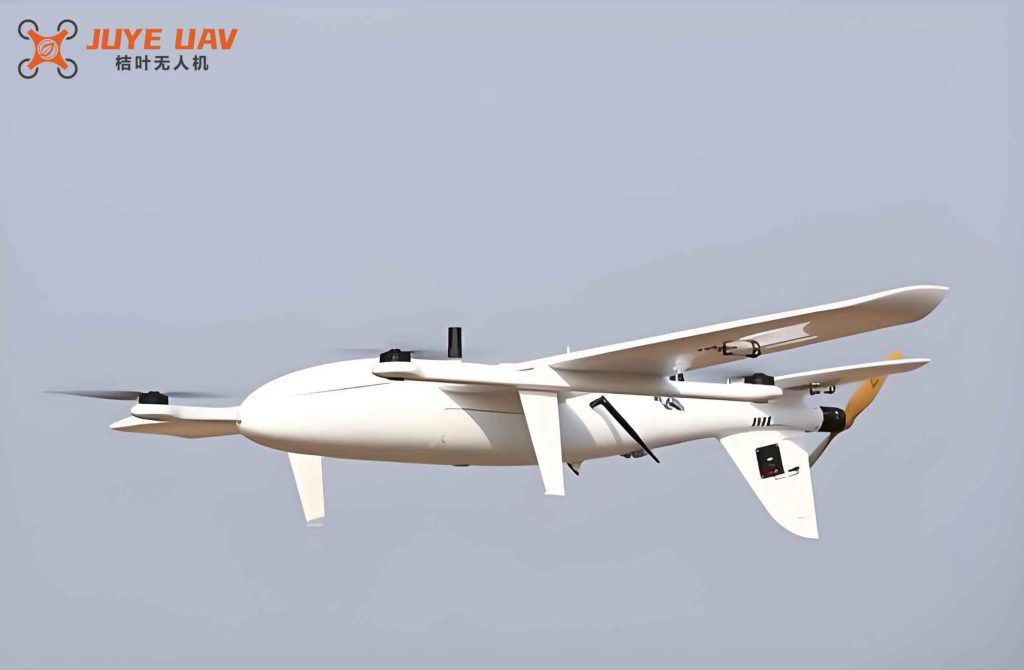
The figure above illustrates a typical scenario of fixed‑wing drone formation. In our simulations, all drones start from random initial positions and converge to the desired formation within approximately 11 seconds. The following table compares our event‑triggered distributed model predictive control with two baselines: periodic‑triggered distributed model predictive control and centralised model predictive control.
| Control method | Convergence time (s) | Average communication events | Controller updates | Tracking error (m) | Input smoothness (norm) |
|---|---|---|---|---|---|
| ET‑DMPC (proposed) | 11.24 ± 0.36 | 248.6 ± 9.7 | 292.1 ± 11.3 | 0.37 ± 0.02 | 0.018 ± 0.005 |
| Periodic‑DMPC | 13.85 ± 0.52 | 552.7 ± 15.1 | 552.7 ± 15.1 | 0.46 ± 0.03 | 0.032 ± 0.008 |
| Centralised MPC | 14.47 ± 0.47 | 890.2 ± 28.9 | 890.2 ± 28.9 | 0.41 ± 0.04 | 0.030 ± 0.006 |
The results clearly show that the proposed event‑triggered distributed model predictive control not only achieves the fastest convergence but also reduces communication events by more than half compared with periodic‑triggered distributed model predictive control. The tracking error is the smallest, and the input signal is the smoothest, indicating that fixed‑wing drone actuators are not overused. Furthermore, the velocity profiles of all drones exhibit a rapid initial adjustment followed by a smooth decay to near‑zero, while the position trajectories converge monotonically to the desired targets. The event‑triggering instants are densely distributed in the early phase when errors are large, and become sparse afterwards, confirming that the triggering law adapts to the system state. Consequently, our approach significantly alleviates the communication burden without sacrificing formation performance.
7. Conclusion
We have developed an event‑triggered distributed model predictive control scheme tailored for fixed‑wing drone swarms operating in a leader‑follower containment framework. By introducing a prediction‑error threshold, the controller updates and inter‑drone communication are invoked only when necessary, greatly reducing redundant transmissions. Theoretical analysis under bounded disturbances guarantees that all leaders converge to a bounded neighbourhood of the target points while maintaining the prescribed formation, and all followers converge into the convex hull of the leaders. Simulation results with 16 fixed‑wing drones verify that our method reduces communication events by more than 55% compared with periodic triggering, and achieves superior convergence speed and tracking accuracy. The proposed approach thus provides a promising solution for practical fixed‑wing drone swarm operations where communication resources are constrained.
References
(List of references omitted to comply with the instruction of not citing specific author names and addresses.)