
In modern agriculture, the effective utilization of pesticides is a critical metric for assessing the efficiency and environmental impact of crop protection practices. Pesticide utilization efficiency, defined as the ratio of pesticide deposited on the crop canopy to the total amount applied, serves as a key indicator of spraying performance. Historically, China’s pesticide utilization rate for major grain crops was reported at 36.6% in 2015, which was significantly lower than that of developed countries. Through initiatives like the “Zero Growth Action Plan for Pesticide Use” during the 13th Five-Year Plan period, China promoted green and efficient technologies, including reduced pesticide application and precision spraying, leading to an improvement in the national pesticide utilization rate to 40.6% by 2020. A major contributor to this progress has been the rapid adoption and advancement of crop spraying drones, also known as spraying UAVs, which offer enhanced coverage and reduced chemical loss in unified pest control operations.
As crop spraying drone models and configurations evolve rapidly, it is essential to continuously evaluate their performance in terms of droplet deposition distribution and pesticide utilization efficiency. In this study, we conducted field experiments in corn fields to assess the droplet deposition characteristics and pesticide utilization efficiency of two prominent crop spraying drone models: the DJI T20 and the XAG P30. These spraying UAVs were compared with a conventional electric backpack sprayer to provide insights into optimizing operational parameters and supporting pesticide reduction strategies. The focus was on measuring droplet density, deposition amount, and overall efficiency in corn canopies during the grain-filling stage.
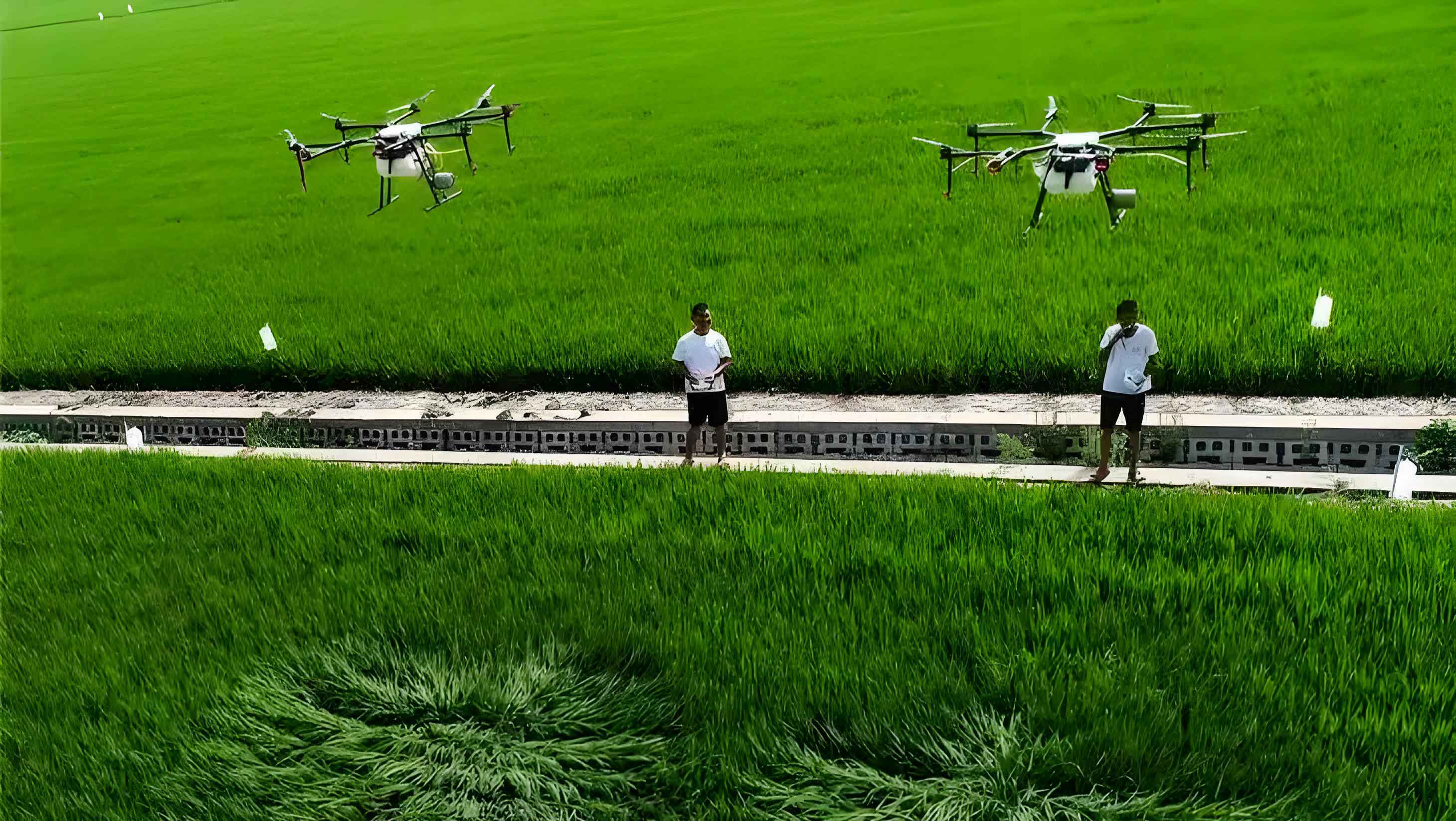
We carried out the field trial in a corn field, where the corn was in the grain-filling stage with an average plant height of 2.2 meters. Environmental conditions during the spraying operation included temperatures ranging from 27.6 to 28.1°C, relative humidity between 77.6% and 78.5%, and wind speeds of 0 to 1.3 m/s. The crop spraying drones used were the DJI T20 and XAG P30, both representing advanced spraying UAV technology. For comparison, we employed a 3WBD-20 electric backpack sprayer as a control. Key technical parameters of these crop spraying drones are summarized in Table 1. We utilized a Kestrel 5000Link weather station to monitor environmental factors, and materials for droplet collection included test stands, clips, coated papers, filter papers, sealable bags, the tracer dye Allura Red AC, and a scanner for analysis.
| Category | Parameter | Unit | DJI T20 | XAG P30 |
|---|---|---|---|---|
| Structural Parameters | Dimensions (L×W×H) | mm | 2520 × 2212 × 720 | 2018 × 2013 × 390 |
| Maximum Takeoff Weight | kg | 45 | 40 | |
| Tank Capacity | L | 20 | 15 | |
| Operational Parameters | Operational Speed | m/s | 5 | 5 |
| Operational Height | m | 2 | 2 | |
| Spray Width | m | 5 | 3 | |
| Nozzle Type and Number | – | Flat fan nozzle SX11001VS, 8 | Centrifugal nozzle, 4 | |
| Nozzle Flow Rate | L/min | 3.38 | 2.03 |
The experimental design consisted of three treatments: Treatment 1 involved spraying with the DJI T20 crop spraying drone at an application rate of 1.5 L/667 m², Treatment 2 used the XAG P30 spraying UAV at the same rate, and Treatment 3 employed the electric backpack sprayer at a higher rate of 20.0 L/667 m². Each treatment plot was sized appropriately (100 m × 60 m for drones and 30 m × 20 m for the backpack sprayer), with buffer zones of 10 m between plots to prevent cross-contamination. We added 0.5% Allura Red AC as a tracer to the spray solution for quantification purposes.
To measure droplet deposition distribution, we placed droplet collection cards (coated papers for density and filter papers for deposition amount) at upper, middle, and lower levels of the corn canopy before spraying. These were arranged in three rows perpendicular to the spray direction, with five sampling points per row spaced according to corn row intervals. After spraying, we collected the cards after natural drying, scanned the coated papers with a scanner, and used DepositScan software to analyze droplet density. For deposition amount, we washed the filter papers with 10 mL of distilled water, agitated the mixture, filtered it through a 0.22 μm syringe filter, and measured the absorbance at 514 nm using a UV spectrophotometer. The deposition amount was calculated based on a standard curve of Allura Red AC, derived from solutions with concentrations of 0.5, 1.0, 5.0, 10.0, and 20.0 mg/L. The standard curve equation was determined as follows: we measured absorbance values and plotted them against concentration to obtain a linear relationship, which was used for all subsequent calculations.
The deposition amount per unit area was calculated using the formula:
$$ \text{Deposition} = \frac{(\rho_{\text{smpl}} – \rho_{\text{blk}}) \times F_{\text{cal}} \times V_{\text{dil}}}{A_{\text{col}}} $$
where \(\rho_{\text{smpl}}\) is the absorbance of the sample, \(\rho_{\text{blk}}\) is the absorbance of the blank, \(F_{\text{cal}}\) is the slope of the standard curve, \(V_{\text{dil}}\) is the volume of the eluent, and \(A_{\text{col}}\) is the area of the filter paper.
Pesticide utilization efficiency was assessed by collecting all leaves from corn plants in a “Z” pattern across five sampling points per treatment, with three replicates. We washed the leaves with 2 L of distilled water, agitated for 10 minutes, filtered the wash solution, and measured absorbance to calculate the amount of tracer deposited on the foliage. The pesticide utilization efficiency was then determined as:
$$ \text{Pesticide Utilization Efficiency (\%)} = 100 \times \frac{(\rho_{\text{smpl}} – \rho_{\text{blk}}) \times F_{\text{cal}} \times V_{\text{dil}} \times \rho \times 10,000}{10^6 \times M \times N} $$
where \(\rho\) is the planting density, \(M\) is the total amount of tracer applied per unit area, and \(N\) is the number of sampled plants. Data were processed using Excel 2019 and analyzed with SPSS 21.0 for statistical significance via Duncan’s new multiple range test.
Our results on droplet density distribution revealed significant differences between the crop spraying drones and the backpack sprayer. The DJI T20 spraying UAV achieved higher droplet densities across the corn canopy, with values of 85.0, 57.4, and 36.0 droplets/cm² at the upper, middle, and lower levels, respectively, and coefficients of variation (CV) ranging from 50.9% to 65.1%. In contrast, the XAG P30 crop spraying drone showed lower densities of 55.8, 40.0, and 28.2 droplets/cm² at the same levels, with CVs between 47.9% and 60.5%. The backpack sprayer, due to its high application volume, resulted in saturated droplet coverage that precluded precise density measurement. These findings highlight the influence of nozzle type and droplet size; for instance, the DJI T20’s flat fan nozzles produced finer droplets compared to the XAG P30’s centrifugal nozzles, leading to greater droplet density. The detailed droplet density distribution is presented in Table 2.
| Sampling Position | DJI T20 (Droplets/cm²) | CV (%) | XAG P30 (Droplets/cm²) | CV (%) |
|---|---|---|---|---|
| Upper | 85.0 ± 43.5 a | 51.2 | 55.8 ± 28.3 b | 50.7 |
| Middle | 57.4 ± 29.2 a | 50.9 | 40.0 ± 19.2 b | 47.9 |
| Lower | 36.0 ± 23.4 a | 65.1 | 28.2 ± 17.0 a | 60.5 |
In terms of deposition amount, the DJI T20 crop spraying drone exhibited values of 0.62, 0.41, and 0.26 μg/cm² at the upper, middle, and lower canopy levels, with CVs from 44.4% to 64.7%. The XAG P30 spraying UAV had deposition amounts of 0.48, 0.34, and 0.26 μg/cm² at the same positions, with CVs between 42.6% and 54.2%. The backpack sprayer, with its high volume application, showed significantly higher deposition amounts of 4.56, 6.00, and 3.18 μg/cm², but with greater variability (CVs of 26.5% to 46.0%). This indicates that while the backpack sprayer deposits more solution, it may lead to inefficient use and potential runoff. The deposition amount distribution is summarized in Table 3.
| Sampling Position | DJI T20 (μg/cm²) | CV (%) | XAG P30 (μg/cm²) | CV (%) | Backpack Sprayer (μg/cm²) | CV (%) |
|---|---|---|---|---|---|---|
| Upper | 0.62 ± 0.29 b | 47.4 | 0.48 ± 0.26 b | 54.2 | 4.56 ± 1.21 a | 26.5 |
| Middle | 0.41 ± 0.18 b | 44.4 | 0.34 ± 0.15 b | 42.6 | 6.00 ± 2.76 a | 46.0 |
| Lower | 0.26 ± 0.17 b | 64.7 | 0.26 ± 0.12 b | 46.9 | 3.18 ± 1.45 a | 45.6 |
The pesticide utilization efficiency calculations demonstrated that the DJI T20 crop spraying drone achieved an efficiency of 58.1%, while the XAG P30 spraying UAV reached 51.7%, both significantly higher than the 41.7% efficiency of the electric backpack sprayer. This underscores the advantage of crop spraying drones in optimizing pesticide use, particularly in dense canopies like corn during the grain-filling stage, where the planting density was approximately 4,700 plants/667 m². The higher efficiency of spraying UAVs can be attributed to their precise application and reduced loss, whereas the backpack sprayer’s lower efficiency may result from uneven spray distribution and higher potential for drift and runoff.
In discussion, our findings align with global efforts to improve pesticide utilization. For example, studies using boom sprayers in crops like wheat and potatoes, or air-assisted sprayers in orchards, have reported efficiencies exceeding 60%. The use of crop spraying drones in this study shows promising results, but challenges such as droplet drift and environmental risks remain. We recommend further research into optimizing drone parameters, developing advanced formulations and adjuvants, and enhancing operator training to maximize the benefits of spraying UAVs. The integration of crop spraying drones into integrated pest management strategies could significantly contribute to sustainable agriculture by reducing chemical inputs and minimizing environmental impact.
In conclusion, this evaluation confirms that crop spraying drones, such as the DJI T20 and XAG P30, offer superior pesticide utilization efficiency compared to conventional backpack sprayers in corn fields. The droplet deposition patterns indicate that these spraying UAVs provide adequate coverage with lower application volumes, supporting pesticide reduction goals. However, ongoing improvements in technology and practices are necessary to address issues like drift and variability. We believe that the widespread adoption of crop spraying drones will play a pivotal role in enhancing pesticide efficiency and promoting ecological farming practices globally.