
As a researcher in the field of precision agriculture, I have witnessed the growing importance of managing crop diseases efficiently and sustainably. Wheat fusarium head blight (FHB), caused primarily by Fusarium graminearum, is a devastating disease that not only reduces yield but also contaminates grains with mycotoxins, such as deoxynivalenol, posing serious food safety risks. In recent years, the adoption of agricultural UAVs (unmanned aerial vehicles), commonly known as drones, has surged due to their ability to perform precise, rapid, and low-volume spray applications. This article aims to provide a comprehensive evaluation of the efficacy of various fungicides applied via agricultural UAVs for FHB control, based on field trials conducted in 2021. I will delve into the methodologies, results, and implications, emphasizing the role of agricultural UAVs in modern crop protection strategies.
The integration of agricultural UAVs into pest management programs represents a paradigm shift in farming practices. These devices offer advantages such as reduced labor costs, minimal soil compaction, and the ability to operate in challenging terrains. However, their effectiveness depends on factors like spray parameters, environmental conditions, and the properties of the applied chemicals. In this study, I focused on comparing multiple fungicide formulations delivered by an agricultural UAV to assess their control efficacy against FHB and their impact on wheat yield. The trials were designed to mimic real-world conditions, ensuring practical relevance for farmers and agronomists.
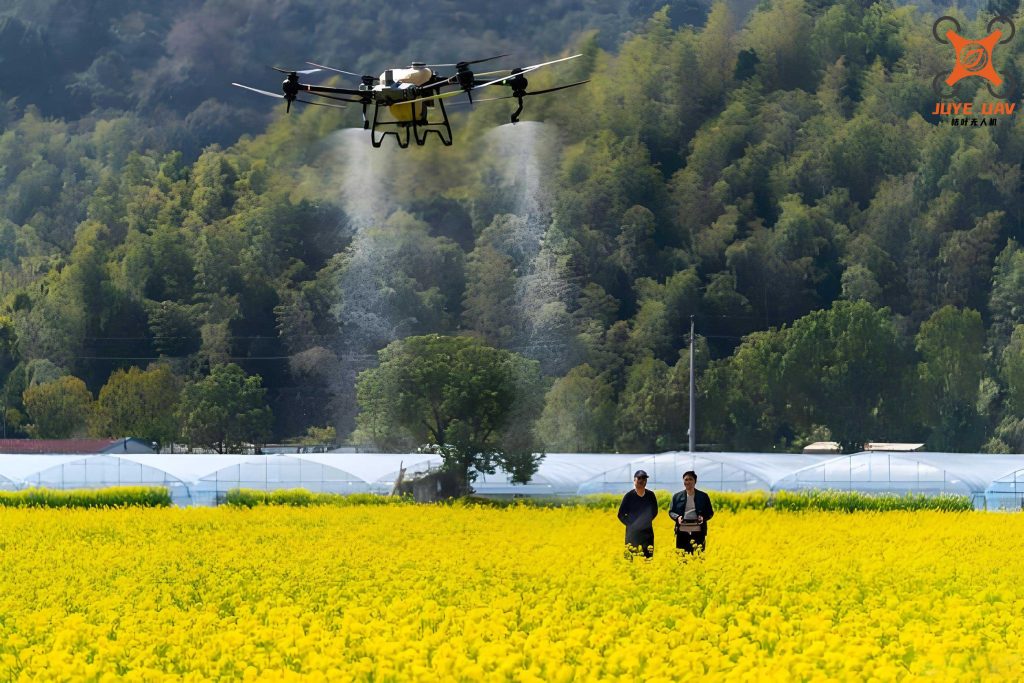
In the following sections, I will detail the materials and methods used, present results through tables and formulas, discuss the findings in the context of existing literature, and conclude with recommendations for optimizing agricultural UAV applications. Throughout this article, I will consistently highlight the term “agricultural UAV” to underscore its centrality in contemporary agriculture. The goal is to contribute to the body of knowledge that supports the sustainable intensification of crop production through technological innovation.
Materials and Methods
The field trials were conducted in a winter wheat field during the 2021 growing season. The wheat variety used was ‘Cunmai 16’, a common cultivar in the region. The experimental site was characterized by uniform fertility and management practices, with a previous crop of maize. Sowing was done mechanically on November 4, 2020, at a seeding rate of 160 kg/ha. The soil type was classified as alkaline clay, with a pH of 8.34 and organic matter content of 16.0 g/kg, representing medium to low fertility conditions.
The core of this study involved the use of an agricultural UAV for spray applications. The UAV model was a Jifei 3WWDZ-20A spraying system, equipped with features typical of modern agricultural UAVs: a droplet size range of 85–550 μm, a maximum single-pump flow rate of 1.8 L/min, an average spray width of 5 m, and an average operating speed of 6 m/s. This agricultural UAV was operated in fully automatic mode to ensure consistency across treatments. The spray volume was set at 15 L/ha, which is lower than conventional ground sprayers, aligning with the water-saving benefits of agricultural UAVs.
Seven treatments were evaluated, including six fungicide formulations and a blank control. Each treatment was applied to a plot of 0.3 hectares, except for the control plot of 0.1 hectares, without replication due to field size constraints. The fungicides were selected based on their common use in FHB management and included pre-mixed formulations, combinations with adjuvants, and single-active ingredients. To simulate integrated pest management, all treatments except the control were supplemented with an insecticide (5% acetamiprid) and a biostimulant (Xianzhengda Guanwushuang natural-source bio-activator). The application timing was at the early flowering stage (April 26, 2021), which is critical for FHB control. Weather conditions during application were recorded as cloudy, with an average temperature of 14°C, west wind at 0.4 m/s. Post-application, cumulative rainfall reached 101 mm by the end of the trial, which influenced disease progression.
The efficacy assessment followed standard protocols from the “Pesticide Field Efficacy Trial Guidelines.” Disease severity was evaluated 28 days after application (May 24, 2021) by examining 1000 randomly selected wheat ears per plot. The disease index (DI) was calculated based on a 0–9 scale, where 0 indicates no symptoms and 9 represents severe infection with mycotoxin production. Control efficacy was computed using the formula:
$$ \text{Efficacy} (\%) = \left(1 – \frac{\text{DI}_{\text{treated}}}{\text{DI}_{\text{control}}}\right) \times 100\% $$
Yield components were measured 39 days after application (June 4, 2021) by assessing the number of ears per hectare, grains per ear, and thousand-grain weight. Theoretical yield was derived from:
$$ \text{Yield} \, (\text{kg/ha}) = \text{Ears per Hectare} \times \text{Grains per Ear} \times \text{Thousand Grain Weight} \times 10^{-5} $$
Safety observations were made at 1, 7, 28, and 39 days after application to detect any phytotoxic effects. All data were analyzed descriptively, with a focus on comparing performance across treatments.
| Treatment | Fungicide Formulation | Dosage per Hectare | Additional Components |
|---|---|---|---|
| 1 | 275 g/L Pre-mixed Formulation A | 1200 mL | Insecticide + Biostimulant |
| 2 | 200 g/L Formulation B + Adjuvant | 900 mL + 600 mL | Insecticide + Biostimulant |
| 3 | 30% Prothioconazole | 675 mL | Insecticide + Biostimulant |
| 4 | 480 g/L Cyproconazole + Tebuconazole | 750 mL | Insecticide + Biostimulant |
| 5 | 40% Tebuconazole + Imazalil | 450 g | Insecticide + Biostimulant |
| 6 | 45% Tebuconazole + Imazalil | 375 mL | Insecticide + Biostimulant |
| 7 | Blank Control | 0 | None |
The selection of these fungicides was informed by their mode of action and solubility, as agricultural UAV applications require formulations that enhance droplet adhesion and systemic movement within the plant. The adjuvants were included to improve spray coverage and reduce drift, which is a common challenge with agricultural UAVs. Throughout the trial, I monitored operational parameters such as flight altitude and speed to maintain consistency, underscoring the precision offered by agricultural UAV technology.
Results and Analysis
The field trials revealed significant differences in FHB control among the treatments, all applied via the agricultural UAV. No phytotoxicity was observed in any treatment, indicating that the fungicides were safe for wheat under the given conditions. This aligns with the general safety profile of modern fungicides when used at recommended rates, especially with the precise delivery enabled by agricultural UAVs.
Disease severity data, collected 28 days after application, showed that Treatments 1, 2, and 3 provided the highest control efficacy, all exceeding 80%. Treatment 4 approached 80% efficacy, while Treatments 5 and 6 yielded lower efficacies around 65%. The blank control exhibited the highest disease index, with severe symptoms including mycotoxin-producing stages. These results are summarized in Table 2, which details the disease parameters and efficacy calculations. The formula for disease index (DI) is based on the weighted sum of severity grades:
$$ \text{DI} = \frac{\sum (\text{Number of Ears in Grade} \times \text{Grade Value})}{\text{Total Number of Ears} \times \text{Maximum Grade Value}} \times 100 $$
In this trial, the maximum grade value was 9, corresponding to the most severe infection.
| Treatment | Total Ears Sampled | Diseased Ears | Disease Incidence (%) | Disease Index (DI) | Control Efficacy (%) |
|---|---|---|---|---|---|
| 1 | 1000 | 6 | 0.6 | 0.09 | 88.9 |
| 2 | 1000 | 9 | 0.9 | 0.13 | 83.3 |
| 3 | 1000 | 10 | 1.0 | 0.14 | 81.4 |
| 4 | 1000 | 12 | 1.2 | 0.17 | 77.7 |
| 5 | 1000 | 11 | 1.1 | 0.24 | 68.5 |
| 6 | 1000 | 13 | 1.3 | 0.27 | 64.7 |
| 7 (Control) | 1000 | 37 | 3.7 | 0.77 | 0.0 |
Beyond disease control, yield performance is a critical metric for evaluating fungicide efficacy. The theoretical yield calculations, based on ear density, grain number, and grain weight, demonstrated substantial yield increases in treated plots compared to the control. Treatments 1, 2, and 3 resulted in yield gains of 34–45%, while Treatments 4, 5, and 6 showed increases of 18–27%. These findings are presented in Table 3, along with the yield components. The yield formula used here incorporates agronomic parameters that are influenced by FHB infection:
$$ \text{Yield Increase} (\%) = \left( \frac{\text{Yield}_{\text{treated}} – \text{Yield}_{\text{control}}}{\text{Yield}_{\text{control}}} \right) \times 100\% $$
| Treatment | Ears per Hectare (×10⁴) | Grains per Ear | Thousand Grain Weight (g) | Theoretical Yield (kg/ha) | Yield Increase (%) |
|---|---|---|---|---|---|
| 1 | 531 | 33.8 | 42.04 | 7545.3 | 38.1 |
| 2 | 549 | 35.0 | 41.17 | 7910.9 | 44.8 |
| 3 | 543 | 33.6 | 40.40 | 7370.9 | 34.9 |
| 4 | 561 | 31.3 | 39.41 | 6920.1 | 26.7 |
| 5 | 555 | 32.7 | 38.10 | 6914.6 | 26.6 |
| 6 | 522 | 31.5 | 39.39 | 6476.9 | 18.6 |
| 7 (Control) | 541.5 | 32.0 | 31.53 | 5463.5 | 0.0 |
Field observations at 39 days after application corroborated the quantitative data. Treatments with higher efficacy exhibited better plant health, including sturdy stems, plump grains, and minimal disease symptoms. In contrast, the control plot showed widespread FHB infection, along with secondary diseases like powdery mildew and take-all, leading to poor canopy appearance and some lodging. The use of the agricultural UAV ensured that spray droplets reached the ear zone effectively, which is crucial for FHB control, as the pathogen primarily infects floral tissues.
Discussion
The results of this trial highlight the potential of agricultural UAVs as a tool for precise fungicide delivery in wheat production. The high efficacies achieved by Treatments 1, 2, and 3 (all above 80%) suggest that pre-mixed formulations and certain single-active ingredients like prothioconazole are well-suited for aerial application. This may be attributed to their systemic properties and compatibility with the low-volume sprays typical of agricultural UAVs. In contrast, the lower efficacies of Treatments 5 and 6 (around 65%) could indicate reduced sensitivity of the FHB pathogen to tebuconazole and imazalil, possibly due to resistance development from prior overuse. This underscores the need for fungicide rotation and resistance management when integrating agricultural UAVs into pest control programs.
The yield increases observed in this study are closely linked to disease control efficacy. Treatments with higher FHB suppression resulted in greater yield gains, emphasizing the economic benefits of effective disease management. The yield formula used here provides a reliable estimate, though actual harvest yields may vary due to environmental factors. Notably, the agricultural UAV application contributed to water savings (15 L/ha compared to hundreds of liters in ground spraying), reducing resource use and environmental impact. However, challenges remain, such as ensuring adequate coverage in dense canopies. In this trial, powdery mildew was observed in lower leaves, particularly in plots with lower fungicide efficacy, indicating that agricultural UAV sprays may have limitations in penetrating thick foliage. This can be addressed by optimizing flight patterns, droplet sizes, and formulation properties.
Comparisons with existing literature reveal that agricultural UAVs often match or exceed the performance of conventional sprayers in FHB control. For instance, studies have shown that adding adjuvants can enhance efficacy by improving droplet retention and spreading. In this trial, the inclusion of adjuvants in Treatment 2 likely contributed to its high performance. The formula for efficacy calculation is standard, but its application in agricultural UAV contexts requires attention to spatial variability. Future research could explore dynamic modeling of spray deposition using:
$$ \text{Deposition Efficiency} = \frac{\text{Mass of Pesticide on Target}}{\text{Mass of Pesticide Released}} \times 100\% $$
This would help refine operational parameters for agricultural UAVs.
Moreover, the integration of agricultural UAVs with other technologies, such as remote sensing and artificial intelligence, could enable real-time disease detection and targeted spraying. For example, multispectral imaging from agricultural UAVs can identify early FHB symptoms, allowing for timely intervention. The scalability of agricultural UAV operations makes them suitable for large-scale farming, but cost-benefit analyses are necessary to promote adoption. In this trial, the agricultural UAV demonstrated efficiency in terms of time and labor, aligning with the trends toward automation in agriculture.
Conclusion
Based on the field trials conducted in 2021, I conclude that agricultural UAVs are effective platforms for applying fungicides to control wheat fusarium head blight. The highest efficacies and yield increases were achieved with pre-mixed formulations and prothioconazole, making them recommended choices for aerial spraying via agricultural UAVs. The lower performance of tebuconazole-based mixtures suggests potential resistance issues, warranting caution in their use. Overall, the agricultural UAV technology proved safe, efficient, and capable of delivering significant agronomic benefits.
To optimize agricultural UAV applications, future work should focus on formulation development, spray parameter calibration, and integration with decision-support systems. The formula for yield prediction can be enhanced by incorporating disease pressure indices derived from UAV-based sensors. As agricultural UAVs continue to evolve, their role in sustainable crop protection will expand, offering solutions to challenges like labor shortages and environmental concerns. I encourage further trials across diverse regions to validate these findings and develop best practices for agricultural UAV deployment in wheat disease management.
In summary, this evaluation underscores the transformative potential of agricultural UAVs in modern agriculture. By enabling precise, low-volume fungicide applications, agricultural UAVs contribute to improved disease control, higher yields, and reduced environmental footprint. As a researcher, I am optimistic about the future of agricultural UAVs and their integration into holistic farm management strategies.