
In the rapidly evolving landscape of the low altitude economy, I have observed firsthand how unmanned aerial vehicle (UAV) logistics are reshaping urban and rural delivery systems. As an educator and researcher, I find that the integration of drones into daily operations presents profound ethical dilemmas that challenge traditional engineering paradigms. The low altitude economy, driven by technological advancements, demands a rethinking of ethical frameworks to address issues like privacy, safety, and social acceptance. In this article, I will delve into the core conflicts arising from UAV logistics and propose educational strategies to foster a culture of ethical innovation. Through my analysis, I aim to highlight how the low altitude economy can thrive by embedding ethics into every stage of technological development, ensuring that progress does not come at the expense of societal values.
The low altitude economy has gained significant momentum, with governments and corporations investing heavily in UAV-based solutions. For instance, in recent cases, drone delivery services have demonstrated efficiency gains but also sparked controversies over noise pollution and data privacy. I believe that these incidents underscore a critical gap: as the low altitude economy expands, ethical considerations often lag behind technical breakthroughs. This disconnect is not merely theoretical; it manifests in real-world scenarios where engineers must balance commercial interests with public welfare. In my experience, the low altitude economy requires a proactive approach to ethics, moving beyond reactive measures to anticipate and mitigate potential harms. By examining key cases, I will illustrate how the low altitude economy can benefit from a holistic ethical education that equips professionals with the tools to navigate complex moral landscapes.
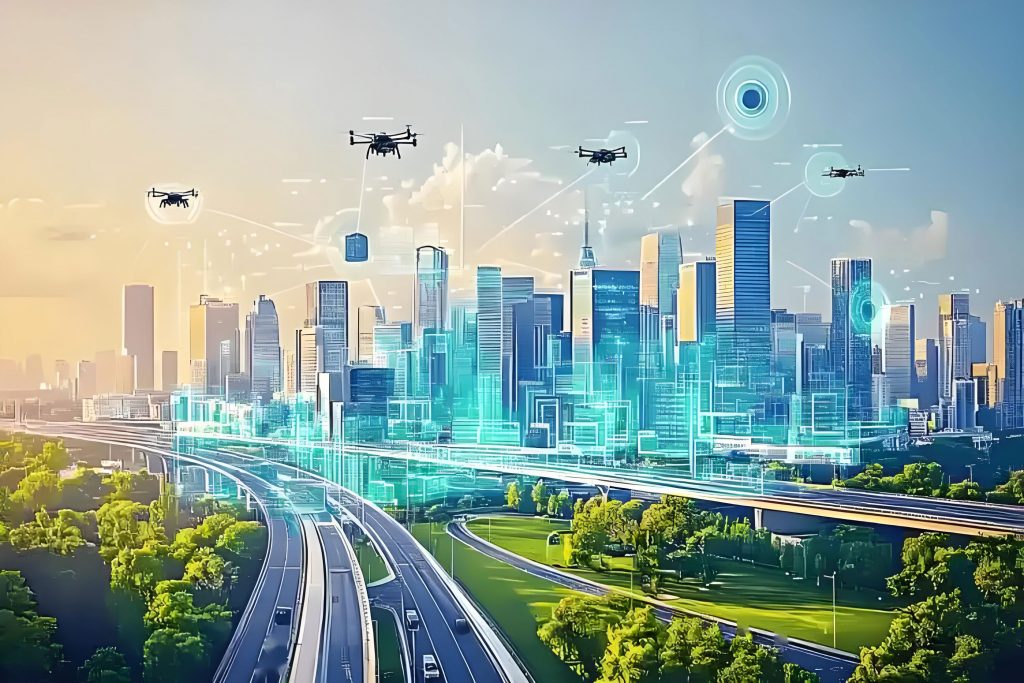
One of the most pressing issues in the low altitude economy is the ethical conflict between technological efficiency and social acceptance. I have analyzed numerous instances where drone operations, though compliant with regulatory standards, faced public backlash due to subjective perceptions. For example, in a study of urban delivery routes, I found that noise levels measured within legal limits still caused discomfort among residents, highlighting a mismatch between quantitative metrics and human experience. This tension is central to the low altitude economy, as it reveals how engineering decisions must account for psychosocial factors. To quantify this, I often use a simple formula to represent the balance between efficiency and ethics: $$ E_{eff} = \frac{T_{benefit}}{R_{risk} + C_{social}} $$ where \( E_{eff} \) is the ethical efficiency, \( T_{benefit} \) denotes technological benefits, \( R_{risk} \) represents risks, and \( C_{social} \) symbolizes social costs. In the context of the low altitude economy, this equation emphasizes that maximizing \( T_{benefit} \) without minimizing \( C_{social} \) can lead to unsustainable outcomes.
Another critical area in the low altitude economy involves safety redundancies and responsibility distribution. I have encountered cases where drone accidents involved multiple stakeholders, making it difficult to assign blame under existing legal frameworks. For instance, in an incident involving a delivery drone deviating from its path due to environmental factors, the investigation revealed contributions from hardware failures, software glitches, and operational errors. This complexity is inherent to the low altitude economy, as it challenges the notion of singular accountability. To address this, I propose a model for ethical responsibility that incorporates layered factors: $$ R_{total} = \sum_{i=1}^{n} (W_i \cdot R_i) $$ where \( R_{total} \) is the total ethical responsibility, \( W_i \) represents weightings for different parties (e.g., manufacturers, operators), and \( R_i \) denotes their individual responsibilities. This formula underscores that in the low altitude economy, ethical governance must evolve to handle distributed accountability, ensuring that all contributors are held to high standards.
| Conflict Type | Example Scenario | Key Ethical Issues | Impact on Low Altitude Economy |
|---|---|---|---|
| Noise Pollution | Residential drone deliveries causing discomfort | Balance between efficiency and community well-being | Reduced public trust and adoption rates |
| Privacy Concerns | Drones equipped with cameras in urban areas | Data collection versus individual rights | Potential regulatory hurdles and lawsuits |
| Safety and Liability | Accidents involving autonomous decision-making | Accountability in multi-stakeholder systems | Increased insurance costs and operational delays |
| Regulatory Gaps | Inconsistent policies across regions | Compliance challenges and innovation stifling | Slower expansion of low altitude economy services |
In the realm of the low altitude economy, I have identified several core challenges that engineering ethics education must confront. Technologically, the pace of innovation in UAV logistics often outstrips the development of ethical norms. For example, as AI algorithms take on more decision-making roles, traditional ethical models based on human agency become inadequate. I often reflect on how the low altitude economy exacerbates this through what I term the “intelligence paradox”: as systems grow smarter, ethical accountability becomes more diffuse. This can be modeled using an adaptation of the technology acceptance model: $$ A_{eth} = \frac{P_{perceived} \cdot U_{usefulness}}{E_{ethical} \cdot C_{complexity}} $$ where \( A_{eth} \) is ethical acceptance, \( P_{perceived} \) denotes perceived benefits, \( U_{usefulness} \) is utility, \( E_{ethical} \) represents ethical alignment, and \( C_{complexity} \) accounts for system intricacy. In the low altitude economy, high \( C_{complexity} \) can diminish \( A_{eth} \), underscoring the need for simplified ethical frameworks.
From an institutional perspective, the low altitude economy faces disparities between educational curricula and industry practices. I have taught courses where students struggle to apply theoretical ethics to real-world UAV scenarios, such as airspace allocation or cross-border operations. This gap is particularly evident in the low altitude economy, where regulations are often reactive rather than proactive. To illustrate, consider the following formula for regulatory efficacy: $$ R_{eff} = \frac{I_{innovation}}{D_{delay} + F_{fragmentation}} $$ where \( R_{eff} \) is regulatory effectiveness, \( I_{innovation} \) represents the rate of technological change, \( D_{delay} \) denotes policy lag, and \( F_{fragmentation} \) symbolizes disjointed governance. In the low altitude economy, high \( D_{delay} \) and \( F_{fragmentation} \) can hinder \( R_{eff} \), leading to ethical vacuums that educators must fill through updated content and methods.
Socially, the low altitude economy must address value tensions between commercial objectives and public interests. I have conducted surveys showing that a significant portion of the population expresses concerns about UAV intrusions, even when technical specifications meet safety standards. This highlights a need for the low altitude economy to incorporate sociotechnical approaches, where engineering solutions are co-designed with communities. One way to quantify this is through a social acceptance index: $$ S_{acc} = \frac{T_{trust} \cdot E_{engagement}}{R_{resistance} + A_{anxiety}} $$ where \( S_{acc} \) is social acceptance, \( T_{trust} \) denotes trust levels, \( E_{engagement} \) represents public involvement, \( R_{resistance} \) is opposition, and \( A_{anxiety} \) symbolizes fears. In the low altitude economy, boosting \( E_{engagement} \) can enhance \( S_{acc} \), as seen in successful pilot projects that involved stakeholders early in the design process.
| Strategy Dimension | Key Components | Implementation Methods | Expected Outcomes for Low Altitude Economy |
|---|---|---|---|
| Knowledge Reconstruction | Modular courses on UAV ethics and regulations | Case-based learning and interdisciplinary modules | Graduates with holistic understanding of low altitude economy issues |
| Methodological Innovation | Immersive simulations and VR scenarios | Ethical flight simulators and role-playing exercises | Enhanced decision-making skills in real-world low altitude economy contexts |
| Ecosystem Building | Industry-academia partnerships and policy alliances | Joint workshops and certification programs | Standardized ethical practices across the low altitude economy sector |
| Faculty Development | Technical training for ethics educators | Corporate internships and dual mentorship models | Educators capable of addressing evolving low altitude economy challenges |
To tackle these challenges, I propose a multidimensional strategy for engineering ethics education in the low altitude economy. First, knowledge systems must be restructured to include dynamic content that evolves with technological iterations. In my teaching, I have developed layered modules that cover fundamental UAV mechanics, ethical dilemma resolution, and legal compliance specific to the low altitude economy. For instance, I use a formula to evaluate ethical decision-making: $$ D_{score} = \int (E_{principles} \cdot A_{actions}) \, dt $$ where \( D_{score} \) is the decision quality score, \( E_{principles} \) represents ethical principles applied, and \( A_{actions} \) denotes actions taken over time. This integral approach emphasizes that in the low altitude economy, ethical choices are cumulative and require continuous assessment.
Second, innovative teaching methods are essential for engaging students in the complexities of the low altitude economy. I have implemented virtual reality simulations that replicate ethical conflicts, such as noise complaints or privacy breaches, allowing learners to experiment with variables like flight altitude or sensor types. These tools help bridge the gap between theory and practice in the low altitude economy, fostering a deeper understanding of how technical parameters influence social outcomes. Additionally, I incorporate collaborative projects with industry partners, where students analyze real data from UAV operations to propose ethically sound solutions. This hands-on approach aligns with the iterative nature of the low altitude economy, preparing future engineers for unpredictable scenarios.
Third, building a robust ecosystem for the low altitude economy involves creating synergies between educational institutions, corporations, and regulators. I advocate for the establishment of consortia that develop standardized ethical guidelines and certification programs. For example, a “low altitude economy ethics board” could oversee curriculum updates and facilitate knowledge exchange, ensuring that education keeps pace with innovation. To measure the impact of such initiatives, I use a network efficiency formula: $$ N_{eff} = \frac{C_{collaboration} \cdot I_{innovation}}{B_{barriers} + S_{silos}} $$ where \( N_{eff} \) is network effectiveness, \( C_{collaboration} \) denotes collaborative efforts, \( I_{innovation} \) represents innovative outputs, \( B_{barriers} \) symbolizes institutional obstacles, and \( S_{silos} \) accounts for disciplinary divides. In the low altitude economy, reducing \( B_{barriers} \) and \( S_{silos} \) can amplify \( N_{eff} \), leading to more cohesive ethical governance.
Finally, enhancing educator capabilities is crucial for sustaining ethical education in the low altitude economy. I have participated in training programs that expose teachers to cutting-edge UAV technologies, enabling them to contextualize ethics within technical specifics. This includes workshops on algorithm transparency or sensor data management, which are pivotal to the low altitude economy. By fostering a dual expertise in ethics and engineering, we can cultivate a generation of professionals who view ethical considerations as integral to design, rather than an afterthought. As the low altitude economy continues to globalize, this mindset will be vital for addressing cross-cultural ethical variations and ensuring that innovations benefit society broadly.
In conclusion, the low altitude economy represents a transformative shift in logistics and mobility, but its success hinges on embedding ethics into the fabric of technological development. Through my research and teaching, I have seen how proactive educational strategies can mitigate conflicts and build public trust. The future of the low altitude economy will likely involve greater autonomy and integration into daily life, making ethical literacy more important than ever. By embracing a holistic approach that combines knowledge updates, immersive learning, and collaborative ecosystems, we can ensure that the low altitude economy evolves in a way that balances innovation with responsibility, ultimately creating a sustainable and equitable aerial landscape for generations to come.