
The proliferation of Unmanned Aerial Vehicle (UAV) drone technology has revolutionized numerous sectors, including aerial photography, precision agriculture, logistics, and emergency response. The operational safety, efficiency, and mission success of any UAV drone are fundamentally dependent on the health and reliability of its core subsystem: the Flight Control System (FCS). The FCS acts as the central nervous system of the UAV drone, integrating sensors, processors, and actuators to maintain stable flight attitudes, execute navigation commands, and manage onboard payloads. Given the complexity of its components and the often harsh operational environments, even minor faults within the FCS can escalate into catastrophic failures, leading to loss of the UAV drone and potential safety hazards. Therefore, the development of accurate, timely, and automated fault detection methodologies is paramount for ensuring the operational integrity of UAV drones.
Traditional fault detection approaches and even some contemporary intelligent methods face significant challenges when dealing with the nonlinear, coupled, and dynamic nature of UAV drone FCS faults. Issues such as difficulty in feature extraction, susceptibility to local optima in model training, and poor generalization under varying flight conditions often limit their effectiveness. This research addresses these challenges by proposing a novel, automated fault detection framework for UAV drone flight control systems. The core innovation lies in the synergistic integration of multi-dimensional signal analysis with a metaheuristic-optimized artificial intelligence model. Specifically, the method involves acquiring multi-dimensional state signals to overcome information insufficiency from single sources, extracting robust time and frequency-domain features, and employing the Cuckoo Search (CS) algorithm to optimize an Artificial Neural Network (ANN), thereby constructing a highly accurate and robust fault detection model for UAV drone systems.
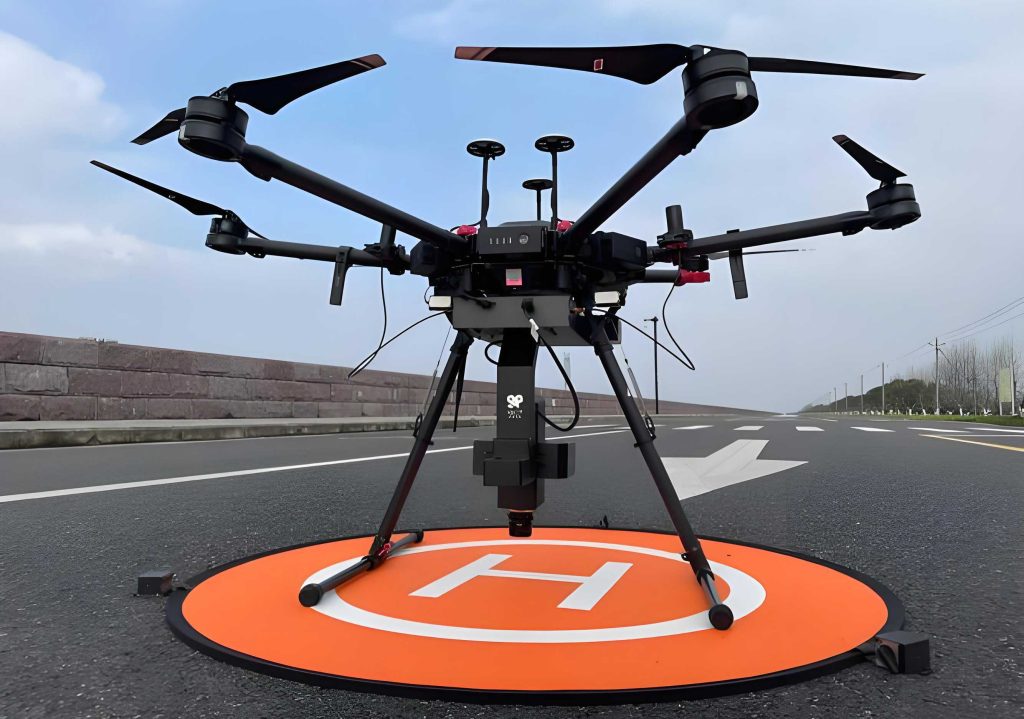
1. Methodology for UAV Drone FCS Fault Detection
The proposed framework is designed to automatically and accurately identify faults in a UAV drone’s flight control system. It follows a structured pipeline: data acquisition from multiple physical dimensions, sophisticated feature extraction to characterize system state, and the construction of an optimized diagnostic model. This comprehensive approach ensures that subtle fault signatures are captured and correctly classified, enhancing the overall safety profile of the UAV drone.
1.1 Acquisition of Multi-Dimensional State Signals
Relying on a single signal type can lead to missed detections, as some faults may manifest predominantly in one physical domain but not another. To build a resilient detection system for the UAV drone, we concurrently monitor two critical, complementary dimensions of the FCS operation: output current and structural vibration. The output current signal directly reflects the electrical load and power delivery status of the FCS actuators and controllers. Abnormalities such as excessive current draw (indicating a stuck or overloaded actuator) or unexpected current drops (suggesting a disconnect or driver fault) provide direct electrical evidence of malfunction. Concurrently, the vibration signal captures the mechanical response of the UAV drone airframe. A healthy UAV drone under stable FCS control exhibits predictable, low-magnitude vibrations. Faults like actuator jitter, imbalance, or structural loosening induced by control errors manifest as anomalous changes in the vibration spectrum and amplitude.
These signals are captured using a Hall effect sensor for current and an accelerometer or displacement sensor for vibration. The raw, multi-dimensional signal vector A(t) at time t is represented as:
$$A(t) = \{ \alpha(t), \beta(t) \}, \quad t = 1, 2, \ldots, T$$
where \( \alpha(t) \) is the output current signal, \( \beta(t) \) is the flight vibration signal, and \( T \) is the total signal length. To ensure signal quality for the subsequent UAV drone fault analysis, the raw signals are conditioned through a filter to remove high-frequency noise and interference. A simplified representation of this filtering process for a signal component is:
$$Q(t) = \frac{1}{1 + j \omega R C} A(t)$$
where \( Q(t) \) is the filtered state signal, \( R \) and \( C \) are filter parameters, \( j \) is the imaginary unit, and \( \omega \) is the angular frequency. This multi-dimensional data acquisition strategy for the UAV drone provides a richer, more reliable information base than any single signal could offer.
1.2 Extraction of Model Input Features
The filtered signals \( Q(t) \) contain the essential information but in a high-dimensional, raw form. To enable efficient and accurate learning by the detection model, we extract a concise set of statistical and spectral features that characterize both the time-domain dynamics and frequency-domain content of each signal. These features form the input vector for the UAV drone fault classifier.
Time-Domain Features: These features describe the signal’s amplitude distribution and shape over time.
- Peak-to-Peak Value (\(s_1\)): Measures the total signal swing, sensitive to large impulses or shifts common in certain UAV drone faults.
$$s_1 = \max(Q(t)) – \min(Q(t))$$ - Skewness (\(s_2\)): Quantifies the asymmetry of the signal distribution around its mean. Changes in skewness can indicate the development of a biased or intermittent fault in the UAV drone system.
$$s_2 = \frac{\sum_{t=1}^{T} [Q(t) – \bar{Q}]^3}{(T-1) \cdot q^3}$$
where \( \bar{Q} \) is the signal mean and \( q \) is its standard deviation.
Frequency-Domain Features: These features are derived from the signal’s frequency spectrum, obtained via the Fourier Transform, revealing periodicities and resonant behaviors linked to specific UAV drone component faults.
$$Q(f) = \int_{-\infty}^{\infty} Q(t) e^{-j 2 \pi f t} dt$$
- Spectral Energy (\(s_3\)): Represents the total power within a specific frequency band. Faults often cause energy to shift or concentrate in particular bands of the UAV drone’s vibration or current spectrum.
$$s_3 = |Q(f)|^2 \Delta f$$ - Spectral Variance (\(s_4\)): Measures the dispersion of spectral power around its centroid frequency. An increase in spectral variance can signify the emergence of multiple or broadband frequency components due to a fault in the UAV drone’s rotating or actuating parts.
$$s_4 = \frac{\sum_{f=1}^{F} (Q(f) – B)^2 \cdot s_3}{\sum_{f=1}^{F} s_3}$$
where \( B \) is the centroid frequency and \( F \) is the number of frequency components.
For each data sample from the UAV drone, we extract these four features from both the current signal (\( \alpha \)) and the vibration signal (\( \beta \)), resulting in an 8-dimensional feature vector \( S \):
$$S = \{ s_{\alpha 1}, s_{\alpha 2}, s_{\alpha 3}, s_{\alpha 4}, s_{\beta 1}, s_{\beta 2}, s_{\beta 3}, s_{\beta 4} \}$$
This comprehensive feature set \( S \) serves as the primary input to the fault detection model, encapsulating the multi-faceted state of the UAV drone’s FCS.
1.3 CS-Optimized ANN for Fault Detection
The final and most critical stage is the construction of the fault classifier. We employ an Artificial Neural Network (ANN) due to its proven capability to model complex, nonlinear relationships—ideal for the intricate fault patterns in a UAV drone FCS. However, the performance of a standard ANN heavily depends on the initial choice of its connection weights (\(w\)) and thresholds (\(I\)), and its training via backpropagation can be prone to convergence issues like local minima. To overcome this, we integrate the Cuckoo Search (CS) algorithm, a robust metaheuristic optimizer, to globally and efficiently find the optimal network parameters before fine-tuning.
1.3.1 Cuckoo Search (CS) Algorithm Overview
The CS algorithm is inspired by the brood parasitism of some cuckoo species and leverages Lévy flight for exploration. It operates on three idealized rules:
- Each cuckoo lays one egg (a solution) in a randomly chosen nest.
- The best nests (solutions) carry over to the next generation.
- The number of available host nests is fixed, and an egg laid by a cuckoo can be discovered by the host bird with a probability \( P_a \in [0,1] \).
The algorithm’s strength in exploring the search space for the UAV drone model parameters comes from the Lévy flight-based update rule for a nest’s position \( x_i \) (representing a set of ANN weights/thresholds):
$$x_i^{(t+1)} = x_i^{(t)} + \alpha \oplus L(\lambda)$$
where \( \alpha \) is a step size scaling factor, \( \oplus \) denotes entry-wise multiplication, and \( L(\lambda) \) is a step drawn from a Lévy distribution. This allows for both localized fine-tuning and large, exploratory jumps in the parameter space, making it highly effective for optimizing the UAV drone’s diagnostic ANN.
1.3.2 ANN Architecture and CS-based Optimization
The base ANN is a multilayer perceptron. The output \( y_k \) of a neuron is given by:
$$y_k = \varphi \left( \sum_{j=1}^{n} \omega_{jk} x_j + b_k \right)$$
where \( x_j \) are inputs, \( \omega_{jk} \) are weights, \( b_k \) is the bias, and \( \varphi \) is the activation function (e.g., sigmoid: \( \varphi(z) = 1/(1+e^{-z}) \)). The network’s final output for fault classification is:
$$U_l = H \left( \sum_{k=1}^{L} w_{kl} \cdot H \left( \sum_{i=1}^{n} w_{ij} S_i + I_j \right) + I_l \right)$$
where \( H(\cdot) \) is the activation function, \( w_{ij}, w_{kl} \) are weights, \( I_j, I_l \) are thresholds, and \( S_i \) is the input feature vector from the UAV drone data.
The CS algorithm is used to pre-optimize the weights \( w \) and thresholds \( I \). Each nest in the CS population represents a candidate set of these ANN parameters. The fitness of a nest (i.e., the performance of that ANN configuration) is evaluated using the Mean Squared Error (MSE) on a training dataset:
$$\text{Fit}(w, I) = \frac{1}{L} \sum_{l=1}^{L} (U_l – \hat{U}_l)^2$$
where \( L \) is the number of training samples, \( U_l \) is the network output, and \( \hat{U}_l \) is the actual fault label. The CS algorithm iteratively generates new nests via Lévy flights, replaces poor solutions, and converges towards the nest with the minimum fitness value (MSE). This process yields an optimally initialized set of parameters \( (w’, I’) \). This CS-optimized ANN is then subjected to final, light training via backpropagation to create the ultimate fault detection model for the UAV drone FCS. This hybrid approach combines the global search prowess of CS with the learning capability of ANN, resulting in a model that is both accurate and robust against convergence to poor local minima.
2. Experimental Analysis and Results
To validate the proposed framework for UAV drone FCS fault detection, a comprehensive experimental study was conducted using a commercial quadcopter UAV drone platform.
2.1 Data Collection and Sample Preparation
Sensors were integrated with the UAV drone’s FCS: a Hall-effect sensor for motor drive current and an accelerometer for body vibrations. Data was transmitted wirelessly to a ground station for recording. To build a representative dataset, several common FCS-related fault modes were artificially induced during controlled flight tests, alongside normal operation flights. The collected dataset is summarized below.
| Fault Type | Flight Runs | Fault Duration (min) | Training Samples | Testing Samples |
|---|---|---|---|---|
| Constant Bias | 3 | 10 | 100 | 20 |
| Actuator Stuck | 3 | 15 | 120 | 25 |
| Gradual Drift | 4 | 8 | 90 | 18 |
| Dead Zone | 3 | 20 | 150 | 30 |
| No Fault (Normal) | 5 | 5 | 80 | 15 |
Features were extracted from each sample as described in Section 1.2, resulting in an 8-dimensional input vector for the UAV drone fault detection model.
2.2 Performance of the CS-Optimized ANN Model
The core contribution of the CS optimization is evident in the training phase. The following table shows a comparison of key parameters for the ANN before and after CS optimization.
| Parameter | Before CS Optimization | After CS Optimization |
|---|---|---|
| Input-Hidden Weight (example) | 0.56 | 0.41 |
| Hidden-Output Weight (example) | 0.23 | 0.18 |
| Hidden Layer Threshold (example) | 0.63 | 0.77 |
| Output Layer Threshold (example) | 1.22 | 1.47 |
The impact of this optimization is most clearly seen in the training convergence. The CS-optimized ANN demonstrated a significantly faster reduction in Mean Squared Error (MSE) and converged to a lower final error level compared to the standard ANN trained solely with backpropagation. This indicates that the CS algorithm successfully navigated the parameter space to find a superior starting point, enabling the UAV drone fault model to learn more effectively and accurately.
2.3 Comparative Fault Detection Results
The proposed CS-ANN method was tested on the hold-out test dataset and compared against three other contemporary fault diagnosis methods referenced in literature: a Particle Swarm Optimized Wavelet Neural Network (PSO-WNN), a Knowledge Graph-based method, and a Broad Learning System (BLS) model. The fault detection accuracy was evaluated using standard metrics: Recall (true positive rate) and Cohen’s Kappa coefficient (which accounts for class imbalance).
| Method | Recall (%) | Kappa Coefficient |
|---|---|---|
| Proposed CS-ANN Method | 98.15 | 0.963 |
| BLS-based Method | 94.44 | 0.908 |
| Knowledge Graph-based Method | 88.89 | 0.823 |
| PSO-WNN Method | 91.67 | 0.876 |
The results are decisive. The proposed CS-ANN method achieved the highest recall rate of 98.15% and the highest Kappa coefficient of 0.963, indicating near-perfect agreement with the actual fault types and superior performance over the other methods. This demonstrates the effectiveness of the multi-dimensional feature extraction combined with the CS-based optimization of the neural network for the specific task of UAV drone FCS fault diagnosis. The model’s low error rate and high confidence in predictions make it a reliable tool for automated health monitoring of UAV drones.
3. Conclusion
This research successfully developed and validated an automated fault detection framework for UAV drone Flight Control Systems. The method addresses key limitations of prior approaches by integrating a multi-perspective data strategy with advanced computational intelligence. The acquisition of both current and vibration signals provides a comprehensive view of the UAV drone’s operational state, ensuring that fault signatures are not missed. The extraction of complementary time and frequency-domain features creates a robust input representation for the diagnostic model. Most significantly, the innovative use of the Cuckoo Search algorithm to optimize the initial parameters of an Artificial Neural Network overcomes the convergence pitfalls of traditional training, resulting in a model with exceptional accuracy and generalization capability.
Experimental validation on a real UAV drone platform under various induced fault conditions confirmed the framework’s superiority. The CS-optimized ANN model significantly outperformed other state-of-the-art methods in terms of detection accuracy and reliability, as measured by recall and Kappa coefficient. This work provides a powerful, practical solution for enhancing the safety and operational readiness of UAV drones. By enabling early and accurate fault detection, this framework can help prevent in-flight failures, reduce maintenance costs, and increase mission assurance for UAV drone applications across all sectors. The principles of multi-modal sensing and metaheuristic-optimized modeling are also broadly applicable to fault diagnosis in other complex cyber-physical systems.