
In modern agriculture, the use of agricultural UAVs, or unmanned aerial vehicles, has revolutionized crop protection strategies. These aerial platforms offer significant advantages, including high operational efficiency, adaptability to various terrains, and reduced water and labor requirements. However, challenges such as spray drift and droplet evaporation persist, particularly in low-volume spray applications typical of agricultural UAV operations. To address these issues, spray adjuvants are often employed to modify the physicochemical properties of pesticide solutions, thereby improving droplet deposition and reducing losses. In this study, I investigated the effects of a vegetable oil adjuvant, Aero-mate 320, on the spray performance of agricultural UAVs in rice fields. My focus was on understanding how this adjuvant enhances pesticide deposition utilization through changes in droplet behavior, evaporation resistance, and distribution within the crop canopy.
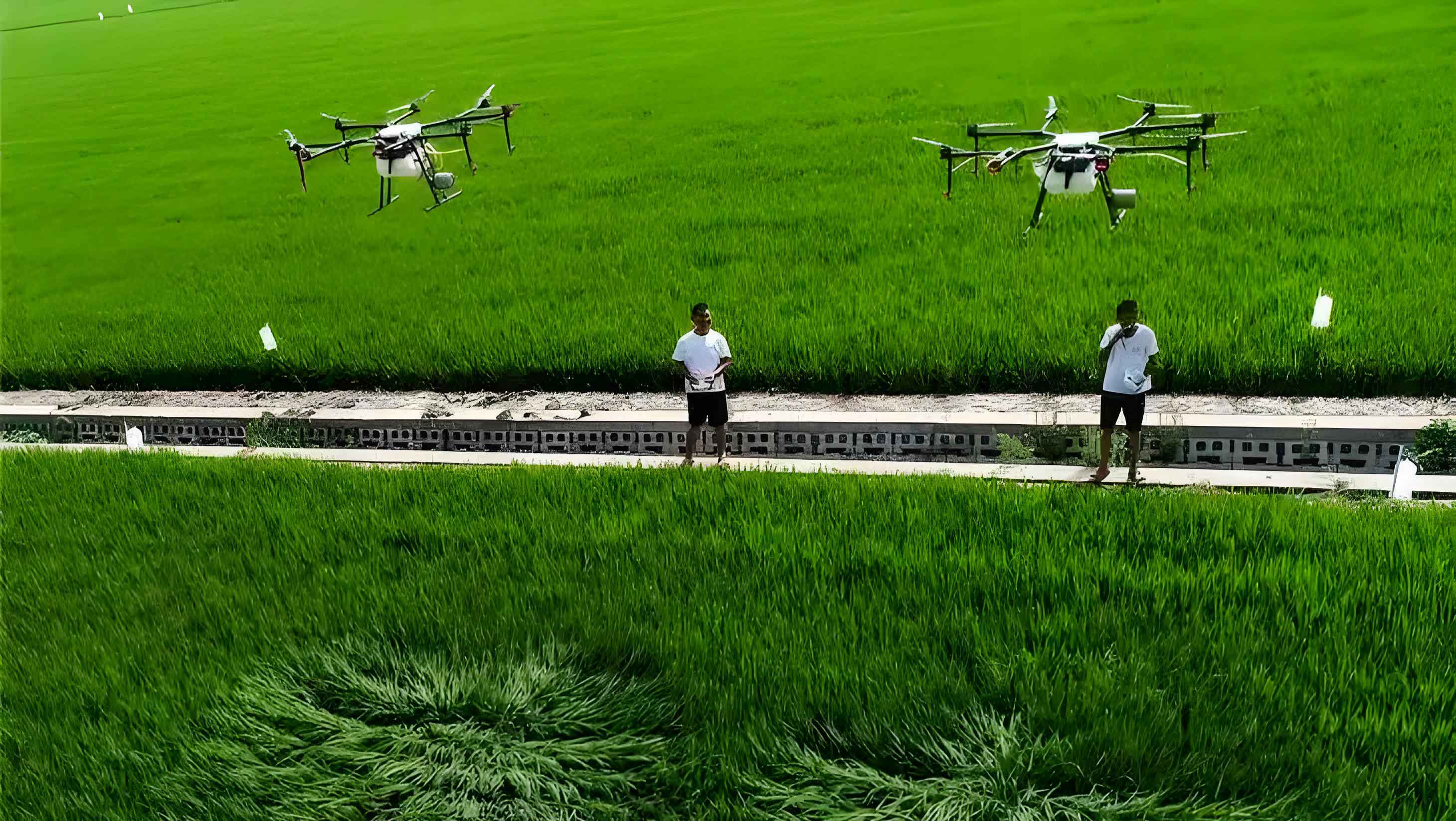
The integration of agricultural UAVs into pest management systems has grown rapidly, driven by their ability to cover large areas quickly and apply pesticides with precision. Despite these benefits, the low-volume sprays used by agricultural UAVs are prone to drift and evaporation, which can lead to inefficient pesticide use and environmental contamination. Spray adjuvants, such as vegetable oil-based products, are known to alter solution properties like surface tension and viscosity, potentially mitigating these issues. In my research, I aimed to evaluate whether Aero-mate 320 could serve as a viable adjuvant for agricultural UAV applications, specifically by examining its impact on droplet deposition, uniformity, and overall pesticide utilization in rice fields. This work contributes to optimizing agricultural UAV spray technologies for sustainable crop protection.
To conduct this study, I formulated pesticide solutions using common agrochemicals: a 15% emamectin·indoxacarb suspension concentrate and a 325 g/L difenoconazole·azoxystrobin suspension concentrate. These were mixed with water to achieve concentrations of 25 mL/L and 20 mL/L, respectively. The vegetable oil adjuvant Aero-mate 320 was added at varying volume fractions: 0%, 0.3%, 0.6%, and 1.0%. I then measured key physicochemical properties, including surface tension ($\gamma$), contact angle on rice leaves ($\theta$), adhesion tension ($\beta$), and adhesion work ($W_a$). The equations used for these calculations are fundamental in understanding wetting behavior:
$$ \beta = \gamma \cos \theta $$
$$ W_a = \gamma (\cos \theta + 1) $$
These parameters help assess how well the solution spreads and adheres to leaf surfaces, which is critical for effective pesticide delivery in agricultural UAV sprays. Additionally, I evaluated the anti-evaporation properties by monitoring droplet volume changes over time under controlled conditions. The evaporation inhibition rate ($R$) was calculated as:
$$ R = \frac{V_0 – V_i}{V_0} \times 100\% $$
where $V_0$ is the volume change of the control droplet and $V_i$ is that of the adjuvant-treated droplet. This metric indicates the adjuvant’s ability to reduce evaporation, a key factor in maintaining droplet integrity during aerial application with agricultural UAVs.
Droplet size distribution was analyzed using a laser diffraction system, with metrics such as the volume median diameter ($D_{V0.5}$), relative span ($RS$), and the proportion of droplets smaller than 100 µm. The relative span is given by:
$$ RS = \frac{D_{V0.9} – D_{V0.1}}{D_{V0.5}} $$
A lower $RS$ value suggests a more uniform droplet distribution, which is desirable for minimizing drift in agricultural UAV operations. Field trials were conducted in rice paddies at the booting stage, using a multi-rotor agricultural UAV equipped with centrifugal nozzles. The spray parameters included an application rate of 30 L/ha, a flight height of 2.0 m above the canopy, and a speed of 4.5 m/s. Deposition was assessed using water-sensitive papers and filter papers placed at upper, middle, and lower canopy layers, with tracer dye analysis to quantify deposition amounts and calculate pesticide deposition utilization rate.
The results revealed that adding Aero-mate 320 significantly altered the spray solution’s properties. As shown in Table 1, surface tension decreased with adjuvant addition, enhancing the solution’s ability to wet rice leaves. The contact angle reduction indicated improved spreadability, crucial for agricultural UAV sprays aiming to maximize coverage.
| Adjuvant Concentration (%) | Surface Tension (mN/m) | Contact Angle (°) | Adhesion Tension (mN/m) | Adhesion Work (mN/m) |
|---|---|---|---|---|
| 0.0 | 36.84 | 105.3 | -9.7 | 27.1 |
| 0.3 | 31.90 | 81.0 | 5.0 | 36.9 |
| 0.6 | 31.93 | 73.4 | 9.1 | 41.0 |
| 1.0 | 31.80 | 92.9 | -1.6 | 30.2 |
Table 1: Effects of Aero-mate 320 on physicochemical properties of the pesticide solution. Data represent mean values from triplicate measurements. The optimal concentration of 0.6% showed the lowest contact angle and highest adhesion work, promoting better leaf wetting for agricultural UAV applications.
Droplet size analysis demonstrated that the adjuvant increased droplet diameters and reduced the proportion of fine droplets, as summarized in Table 2. This is beneficial for agricultural UAV sprays, as larger droplets are less prone to drift, enhancing on-target deposition.
| Adjuvant Concentration (%) | $D_{V0.1}$ (µm) | $D_{V0.5}$ (µm) | $D_{V0.9}$ (µm) | Relative Span | Droplets < 100 µm (%) |
|---|---|---|---|---|---|
| 0.0 | 48.3 | 125.0 | 221.9 | 1.39 | 35.8 |
| 0.3 | 60.0 | 138.4 | 222.2 | 1.17 | 27.3 |
| 0.6 | 63.9 | 147.0 | 230.4 | 1.13 | 22.8 |
Table 2: Droplet size distribution parameters with different adjuvant concentrations. The 0.6% treatment yielded the largest median diameter and most uniform distribution, key for optimizing agricultural UAV spray efficiency.
Evaporation tests showed that Aero-mate 320 effectively reduced droplet evaporation rates. The evaporation inhibition rate reached 25.0% at the 0.6% concentration, meaning droplets retained more volume during flight, a critical advantage for agricultural UAV operations in warm, dry conditions. This can be modeled by the evaporation equation:
$$ \frac{dV}{dt} = -k \cdot A $$
where $dV/dt$ is the volume change rate, $k$ is the evaporation constant, and $A$ is the droplet surface area. The adjuvant likely forms a protective layer, reducing $k$ and thus slowing evaporation. In field trials, deposition density and coverage increased significantly with adjuvant addition. For instance, at the 0.6% concentration, deposition density in the upper canopy rose from 53.1 to 65.9 droplets/cm², and coverage increased from 6.2% to 7.9%. Similar improvements were observed in middle and lower layers, though deposition decreased with canopy depth, highlighting the need for effective canopy penetration in agricultural UAV sprays.
Pesticide deposition utilization rate, a key metric for assessing agricultural UAV spray efficiency, was calculated based on tracer dye recovery. Without adjuvant, the utilization rate was 45.3%, but with 0.6% Aero-mate 320, it increased to 66.8%. This represents a 21.5% improvement, demonstrating the adjuvant’s role in enhancing pesticide use efficiency. The deposition amount ($D$) per unit area was derived using:
$$ D = \frac{Q \cdot V}{S} $$
where $Q$ is the tracer concentration, $V$ is the wash volume, and $S$ is the collection area. Higher $D$ values with adjuvant treatment confirm better retention on rice leaves. These findings underscore the importance of adjuvant selection for maximizing the performance of agricultural UAVs in integrated pest management.
The mechanisms behind these improvements are multifaceted. First, the reduction in surface tension lowers the energy required for droplet spread, as described by the Young-Dupré equation:
$$ W_a = \gamma_{lv} (1 + \cos \theta) $$
where $\gamma_{lv}$ is the liquid-vapor surface tension. With Aero-mate 320, $\gamma_{lv}$ decreases, and $\theta$ becomes smaller, leading to higher $W_a$ and better adhesion. This is crucial for agricultural UAV sprays, where droplets must quickly wet leaves upon impact. Second, the increase in droplet size reduces drift potential, as larger droplets have higher momentum and are less affected by wind. The drift reduction can be approximated by:
$$ \text{Drift} \propto \frac{1}{D_{V0.5}^n} $$
with $n$ depending on environmental conditions. By boosting $D_{V0.5}$, the adjuvant helps keep more spray on target. Third, the anti-evaporation effect preserves droplet volume, ensuring that active ingredients reach the canopy intact. This is particularly vital for agricultural UAVs operating at low volumes, where evaporation losses can be substantial. The adjuvant likely achieves this by forming a hydrophobic film or altering the solution’s vapor pressure, though further study is needed to elucidate the exact chemistry.
In discussing the implications, I note that vegetable oil adjuvants like Aero-mate 320 offer an eco-friendly option for enhancing agricultural UAV sprays. They are biodegradable and derived from renewable resources, aligning with sustainable agriculture goals. However, optimal concentration is key; excessive amounts may increase viscosity or cause phytotoxicity, as hinted by the slight rise in contact angle at 1.0% concentration. Future research should explore synergies with other adjuvant types and their effects on different crop species. Additionally, integrating these adjuvants into real-time agricultural UAV control systems could allow for dynamic adjustment based on weather conditions, further optimizing deposition.
From a practical standpoint, farmers using agricultural UAVs can benefit from adjuvants by achieving better pest control with reduced pesticide inputs. This not only cuts costs but also minimizes environmental impact. For example, in rice fields prone to leaf roller and sheath blight, improved deposition can enhance efficacy of insecticides and fungicides. The data from this study support including adjuvant recommendations in agricultural UAV spray protocols. Moreover, regulatory bodies might consider adjuvant performance standards for aerial applications to ensure safety and efficiency.
To conclude, my investigation demonstrates that the vegetable oil adjuvant Aero-mate 320 significantly improves the deposition utilization rate of pesticides applied via agricultural UAVs in rice fields. By modifying physicochemical properties, increasing droplet size, reducing evaporation, and enhancing leaf wetting, this adjuvant addresses key challenges in low-volume aerial spraying. The optimal concentration of 0.6% yielded the best results, raising pesticide deposition utilization to 66.8%. These findings highlight the potential of adjuvants to optimize agricultural UAV technologies, contributing to more precise and sustainable crop protection. As agricultural UAVs continue to evolve, adjuvant development will play a crucial role in maximizing their efficacy and minimizing ecological footprints.